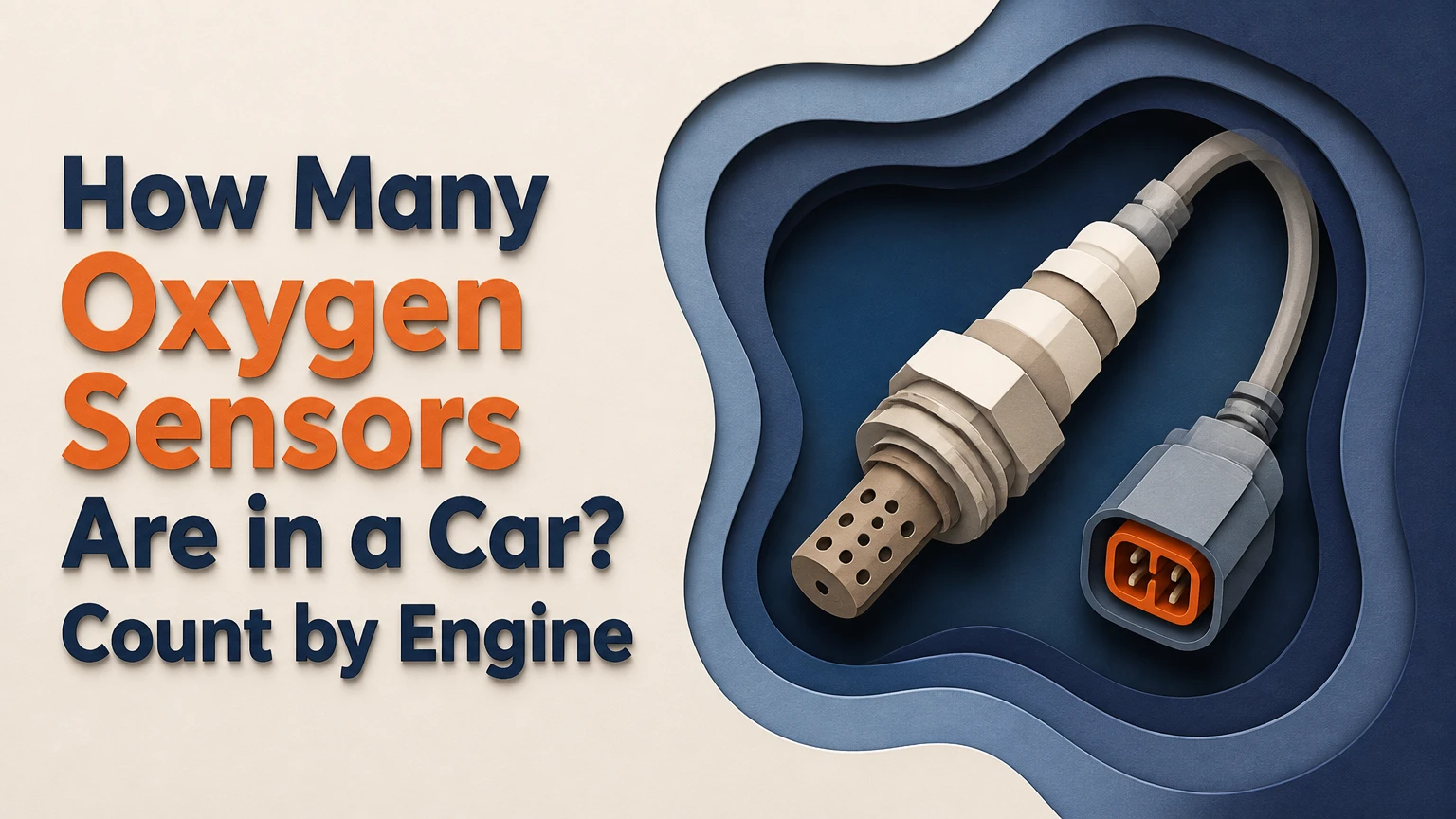
Most cars have 2-4 oxygen sensors, although some vehicles use only 1 and others use 5, 6, or more. The exact number depends on the engine’s cylinder banks, catalytic-converter layout, emissions system, and whether the vehicle uses separate air-fuel-ratio or oxygen sensors before and after each catalyst.
Key Facts at a Glance
- A typical inline-four gasoline engine has one upstream and one downstream sensor, for 2 total.
- A typical V6 or V8 with two monitored banks has 4 sensors, with one upstream and one downstream sensor per bank.
- Bank 1 contains cylinder number one; Bank 2 is the opposite cylinder bank.
- Sensor 1 is upstream of the main catalytic converter, while Sensor 2 is downstream.
- A wideband air-fuel-ratio sensor may be cataloged as an O2 sensor even though it uses a different control and measurement method.
- The vehicle’s VIN-specific parts catalog and exhaust diagram provide the reliable sensor count.
How Many Oxygen Sensors Are in a Car?
The most useful general answer is two sensors for a common inline engine and four for a common V-engine, but engine shape alone does not determine the count. The exhaust system may include a close-coupled catalyst, a secondary catalyst, a pre-catalyst sensor, or separate monitoring for each bank.
A standard inline-four with one catalytic converter usually has one sensor before the converter and one after it. A V6 with two exhaust banks generally has four, because each bank receives an upstream control sensor and a downstream catalyst-monitoring sensor.
Some older vehicles have one sensor before the catalytic converter. Some modern turbocharged, performance, hybrid, diesel, and large-engine vehicles use more than four. The accurate count belongs to the specific year, make, model, engine code, market, and emissions package.
Sensor Count by Engine and Exhaust Layout
| Vehicle configuration | Common sensor count | Typical arrangement | Important qualification |
|---|---|---|---|
| Older inline-four | 1-2 | One upstream, sometimes no downstream sensor | OBD-II-era vehicles usually add catalyst monitoring |
| Modern inline-three or inline-four | 2-4 | One or two sensors around one or more catalysts | Multiple catalysts can raise the count |
| Inline-six | 2-4 | One bank, with sensors before and after catalyst sections | Exhaust routing determines the final number |
| V6 or V8 | 4 | Upstream and downstream sensor on each bank | Typical when both banks are monitored separately |
| V6 or V8 with extra catalyst stages | 4-8 | Several sensors per bank | Common on complex, high-output emissions systems |
| Flat-four or flat-six | 2-4 | One or two sensors per exhaust bank | Boxer cylinder grouping varies by manufacturer |
| Diesel passenger vehicle | 2-6 or more | Oxygen sensors plus NOx, temperature, and particulate sensors | Not every exhaust sensor is an oxygen sensor |
| Hybrid gasoline vehicle | 2-4 | Similar bank and catalyst logic to gasoline cars | Engine-off operation changes data patterns |
The table gives typical ranges rather than a parts-ordering rule. For example, a four-cylinder engine can have two oxygen sensors, but a turbocharged four-cylinder may use separate sensors around a close-coupled catalyst and a second underfloor catalyst.
Why Do Cars Have Upstream and Downstream Sensors?
Upstream oxygen sensors control combustion, while downstream oxygen sensors evaluate catalytic-converter performance. The upstream sensor sits in the exhaust stream before the relevant catalyst, and the downstream sensor sits after it.
The engine control module uses the upstream signal to adjust fuel delivery. The downstream signal should generally change more slowly because a functioning catalyst stores and releases oxygen while converting hydrocarbons, carbon monoxide, and nitrogen oxides.
What Do Sensor 1 and Sensor 2 Mean?
Sensor 1 means the sensor is before the catalytic converter being referenced. Sensor 2 means the sensor is after that converter. The terms do not mean the first and second sensors installed on the whole vehicle.
| Label | Physical position | Primary job | Common fault-code range |
|---|---|---|---|
| Bank 1 Sensor 1 | Before Bank 1 catalyst | Fuel-control feedback | P0130-P0135, P2195, P2196 |
| Bank 1 Sensor 2 | After Bank 1 catalyst | Catalyst-efficiency monitoring | P0136-P0141, P0420 |
| Bank 2 Sensor 1 | Before Bank 2 catalyst | Fuel-control feedback | P0150-P0155, P2197, P2198 |
| Bank 2 Sensor 2 | After Bank 2 catalyst | Catalyst-efficiency monitoring | P0156-P0161, P0430 |
A manufacturer may label a sensor relative to a specific catalyst rather than the entire exhaust system. That matters on vehicles with pre-catalysts, close-coupled converters, or multiple catalyst bricks.
Where Is Bank 1 Sensor 1?
Bank 1 Sensor 1 is the upstream sensor on the cylinder bank containing cylinder number one. On an inline engine, the entire engine is Bank 1, so Bank 1 Sensor 1 is usually the first sensor before the catalytic converter.
The cylinder-one position is not always the front cylinder nearest the radiator. Transverse engines, rear-wheel-drive engines, and manufacturer-specific numbering can place cylinder one in different physical locations. Use the service manual, under-hood diagram, or VIN-specific repair information before disconnecting a sensor.
How Does an Oxygen Sensor Measure Exhaust Oxygen?
A conventional zirconia oxygen sensor generates a changing voltage from the difference in oxygen concentration between exhaust gas and reference air. A wideband sensor uses a sensing cell and a pump cell, with the engine computer controlling current to determine the mixture over a broader range.
How Narrowband Zirconia Sensors Work
A heated zirconia sensor contains a ceramic element that needs several hundred degrees Celsius to operate. The heater reduces cold-start delay, while the sensing element compares oxygen in the exhaust with reference oxygen at the sensor side or through its construction.
A rich gasoline mixture leaves little oxygen in the exhaust, so a narrowband zirconia sensor typically produces a higher signal, often near 0.8-0.9 volts. A lean mixture leaves more oxygen, so the signal typically falls near 0.1-0.2 volts. The exact voltage depends on sensor design, temperature, exhaust conditions, and scan-tool scaling.
The sensor does not directly report a precise air-fuel ratio. It mainly indicates whether the mixture is richer or leaner than the narrow switching point.
How Wideband Sensors Differ
A wideband air-fuel-ratio sensor can estimate mixture across a substantially wider range than a narrowband sensor. The engine computer controls a pump-current circuit to maintain a sensing condition, then interprets the required current as an air-fuel measurement.
Wideband sensors are common upstream on turbocharged, direct-injected, and late-model gasoline engines. Parts catalogs may call them AFR sensors, lambda sensors, A/F sensors, or wide-range oxygen sensors. The names overlap, but the replacement part and diagnostic procedure are not interchangeable.
| Sensor technology | Typical location | Signal behavior | Main advantage | Main limitation |
|---|---|---|---|---|
| Narrowband zirconia | Upstream or downstream | Switches around rich/lean threshold | Low replacement cost, simple feedback | Poor mixture accuracy away from stoichiometry |
| Planar zirconia | Upstream or downstream | Similar voltage principle, faster packaging | Compact heated construction | Contamination and heater faults remain possible |
| Wideband zirconia | Usually upstream | Pump-current or lambda-based signal | Measures mixture over a broad range | Requires specialized control circuitry |
| Titania | Mostly older vehicles | Resistance changes with oxygen level | Does not use the same voltage principle | Less common and vehicle-specific |
| Exhaust gas oxygen sensor | Older fuel systems | Rich/lean switching signal | Simple closed-loop feedback | Limited diagnostic resolution |
A scan tool may display a wideband sensor as equivalence ratio, lambda, current, or a manufacturer-specific value rather than a simple 0.1-0.9-volt graph.
Does Every Car Have Four Oxygen Sensors?
No. Four sensors are common on two-bank engines, but a vehicle may have one, two, three, four, or more depending on its catalyst configuration. A car with an inline engine does not automatically have four sensors, and a V-engine does not automatically use exactly four.
The simplest modern arrangement has one upstream and one downstream sensor. A two-bank arrangement doubles that pattern. Additional sensors appear when an emissions system separately monitors a close-coupled catalyst, a secondary catalyst, or another exhaust branch.
Why Can the Count Be Higher Than Four?
A vehicle can exceed four oxygen sensors when each cylinder bank has multiple catalyst stages. A high-output V6, V8, or V10 may use a pre-catalyst close to each exhaust manifold and a larger underfloor catalyst farther downstream, with sensors positioned to control and monitor both stages.
Some vehicles also use sensors that resemble oxygen sensors but measure different exhaust properties. NOx sensors, exhaust-gas-temperature sensors, differential-pressure sensors, and particulate-matter sensors should not be counted as oxygen sensors, even when they share the same exhaust system.
What About Turbocharged Engines?
Turbocharged engines may place the upstream sensor near the exhaust manifold or turbine inlet, then use one or more sensors after close-coupled and underfloor catalysts. Turbocharger position changes access, heat exposure, and sensor wiring, but turbocharging alone does not guarantee a specific count.
A turbocharged inline-four commonly still has two oxygen or air-fuel sensors. A more complex emissions package can add another sensor after a second catalyst. The exhaust diagram is more reliable than the engine’s cylinder count.
Which Sensor Type Does a Car Use?
Most gasoline vehicles use a narrowband downstream oxygen sensor and either a narrowband or wideband upstream sensor, depending on the engine-management system. A vehicle’s electrical connector, calibration, and service documentation determine the correct technology.
Oxygen Sensor Versus Air-Fuel-Ratio Sensor
An oxygen sensor usually refers to a narrowband device that switches around a target mixture. An air-fuel-ratio sensor, commonly called an AFR or wideband sensor, estimates mixture over a broader operating range and uses different electronics.
The distinction matters during replacement. Installing a universal narrowband sensor where a vehicle requires a wideband AFR sensor can produce incorrect readings, poor fueling, and new fault codes. A connector that physically fits does not prove electrical compatibility.
What Does the 14.7:1 Ratio Mean?
The 14.7:1 figure describes the approximate stoichiometric air-to-fuel mass ratio for conventional gasoline under reference conditions. It does not apply unchanged to diesel fuel, ethanol blends, every operating condition, or every fuel-control strategy.
Gasoline engines intentionally run richer during cold starts, high load, and some catalyst-heating events. Modern engines may also use ethanol content, exhaust-gas recirculation, and modeled fuel control, so a sensor reading should be interpreted with fuel trims and operating conditions.
How Much Does an Oxygen Sensor Replacement Cost?
A typical oxygen-sensor replacement costs approximately $150-$500 per sensor installed in the United States, although wideband parts, seized exhaust threads, restricted access, and dealer labor can push the total above $600.
| Replacement situation | Typical part cost | Typical labor time | Typical installed total |
|---|---|---|---|
| Downstream narrowband sensor | $40-$150 | 0.5-1.5 hours | $150-$400 |
| Upstream narrowband sensor | $50-$180 | 0.5-2 hours | $175-$450 |
| Wideband AFR sensor | $150-$400 | 0.5-2 hours | $275-$650 |
| Seized or damaged sensor bung | $50-$200 extra parts | 1-3 additional hours | $400-$900 |
| Multiple-bank replacement | $100-$800 in parts | 1-4 hours | $300-$1,200 |
These are typical planning ranges, not a quote. Repair shops commonly charge about $80-$200 per labor hour, while a vehicle with a rusted exhaust system may require thread repair or exhaust-component removal.
Should You Replace All Oxygen Sensors Together?
Usually, no. Replace the sensor identified by a confirmed fault, unless inspection shows that several sensors have similar age-related degradation or contamination. Replacing every sensor because one code appeared can waste money and leave the actual fuel, ignition, vacuum, or exhaust problem unresolved.
A vehicle with one failed upstream sensor may still drive, but the engine computer can enrich the mixture, reduce fuel economy, increase emissions, and damage the catalytic converter. A downstream sensor failure often affects emissions monitoring more than basic drivability.
How Do You Diagnose a Bad Oxygen Sensor?
Diagnose the circuit, sensor signal, fuel system, ignition system, and exhaust for leaks before replacing the part. An oxygen-sensor trouble code identifies a monitored circuit or condition, not necessarily a defective sensor.
A Practical Diagnostic Sequence
- Record all diagnostic trouble codes and freeze-frame data. Note engine temperature, fuel trims, engine speed, and load when the fault occurred.
- Inspect the wiring and connector. Look for melted insulation, pulled wires, corrosion, oil saturation, and contact with the exhaust.
- Check for exhaust leaks upstream of the sensor. Outside air entering a crack can create a false lean signal.
- Check intake and fuel delivery. Vacuum leaks, low fuel pressure, injector faults, and mass-airflow errors can cause genuine lean or rich readings.
- Evaluate live data at operating temperature. Compare the sensor response with short-term and long-term fuel trims.
- Test the heater circuit. Confirm power, ground, fuse integrity, and resistance against the manufacturer’s specification.
- Compare upstream and downstream behavior. A downstream signal that closely mirrors the upstream signal can support a catalyst-efficiency fault, but it does not prove the oxygen sensor itself is bad.
A narrowband upstream sensor often switches repeatedly between lean and rich once the engine reaches closed-loop operation. A downstream sensor should generally be more stable, but a fixed value near 0.45 volts is not a universal pass condition, especially on wideband systems.
What Do Common O2 Codes Mean?
Codes in the P0130-P0167 family can indicate sensor circuits, heater circuits, slow response, low or high voltage, or mixture-related performance. P0420 and P0430 primarily indicate catalyst-efficiency performance below the expected threshold, not an automatic oxygen-sensor failure.
| Code example | Usual monitored issue | Sensor replacement guaranteed? | Other checks |
|---|---|---|---|
| P0135 | Bank 1 Sensor 1 heater | No | Fuse, wiring, power, heater resistance |
| P0133 | Bank 1 Sensor 1 slow response | No | Exhaust leak, fuel trims, contamination |
| P0136 | Bank 1 Sensor 2 circuit | No | Connector, wiring, sensor, catalyst |
| P0171 | Bank 1 system too lean | No | Vacuum leak, fuel pressure, airflow |
| P0420 | Bank 1 catalyst efficiency | No | Exhaust leaks, catalyst, sensor data |
| P2195 | Bank 1 Sensor 1 stuck lean | No | Intake leak, fuel delivery, sensor signal |
Which Live-Data Values Matter?
No single oxygen-sensor voltage proves that a sensor works. The diagnostic value comes from response speed, heater operation, fuel-trim correction, commanded mixture, engine temperature, and comparison with other sensors.
A technician should avoid condemning a sensor from a cold-start graph. The sensor may not yet be hot, and open-loop enrichment can make the data appear abnormal. Manufacturer service information takes priority over generic voltage rules.
What Mistakes Cause Incorrect Sensor Replacement?
The most expensive mistakes are confusing bank and sensor numbering, replacing a sensor before checking for an exhaust leak, and treating a catalyst code as proof of sensor failure. Sensor contamination from coolant, oil ash, silicone, or fuel additives can also damage a replacement unless the source is repaired.
Expert Rules That Prevent Repeat Repairs
- Bank 1 is defined by cylinder number one, not by the driver’s side. The driver-side rule works on some vehicles and fails on others.
- A lean code can result from an exhaust leak. A crack before the sensor draws oxygen into the exhaust and falsely suggests insufficient fuel.
- Do not apply anti-seize automatically. Use only the compound and application specified by the sensor manufacturer; many replacement sensors already have treated threads, and contamination of the sensing tip can cause failure.
- Never pull on sensor wires to remove a connector. Wire damage can create an intermittent heater or signal fault that looks like a bad sensor.
- Do not clean a contaminated sensor as a repair strategy. Solvents, compressed air, and water can damage the sensing element, while the underlying oil, coolant, or rich-running problem remains.
How Can You Confirm the Exact Sensor Count?
Confirm the exact count with the vehicle identification number, engine code, emissions label, and an illustrated parts catalog. A generic online listing can combine multiple engine options and incorrectly show a sensor that your vehicle does not use.
Use this verification order:
- Read the under-hood emissions label for engine and emissions-family information.
- Decode the VIN and confirm the engine code.
- Search the manufacturer parts catalog for oxygen and air-fuel-ratio sensors.
- Compare the exhaust diagram with the physical vehicle.
- Match each connector, wire length, mounting position, and sensor technology.
- Use the diagnostic code to identify the monitored bank and sensor position.
- Confirm the part number with a dealer or reputable aftermarket catalog before purchase.
The most reliable answer is vehicle-specific. Year, make, model, engine size, drivetrain, transmission, and emissions market can all change the sensor count.
Can a Car Run With a Failed Oxygen Sensor?
A car can often run with a failed oxygen sensor, but continued driving can increase fuel consumption, emissions, and catalytic-converter damage. The risk depends on whether the failed sensor controls fuel mixture, monitors a catalyst, or has created a separate engine problem.
An upstream sensor failure can force substitute fueling, sometimes producing rough operation, poor acceleration, hard starting, or black exhaust. A downstream sensor failure may leave drivability nearly normal while illuminating the check-engine light and disabling emissions-test readiness.
Stop driving and investigate promptly if the vehicle has severe misfires, flashing check-engine light, strong fuel odor, overheating, or loss of power. Unburned fuel can overheat and melt the catalytic converter.
What Is an Oxygen Sensor Not Good For?
An oxygen sensor is not a direct fuel-pressure gauge, mass-airflow meter, misfire detector, or universal air-fuel-ratio meter. The sensor reports oxygen conditions at one exhaust location, so the engine computer and technician must interpret that signal alongside other data.
A normal sensor cannot rule out every fuel or ignition fault. Likewise, a sensor code cannot prove that the sensor is the root cause. A vacuum leak, injector imbalance, exhaust leak, damaged wiring, or weak fuel pump can create the same apparent mixture condition.
Frequently Asked Questions
Do diesel cars have oxygen sensors?
Many modern diesel cars use oxygen sensors, but diesel exhaust systems also rely heavily on NOx sensors, exhaust-temperature sensors, particulate sensors, and differential-pressure sensors. A diesel may therefore have several exhaust sensors without having the same upstream and downstream oxygen-sensor arrangement as a gasoline car.
Are oxygen sensors and lambda sensors the same thing?
Oxygen sensor and lambda sensor usually describe the same general component. Lambda expresses the mixture relative to stoichiometric combustion, while oxygen sensor describes the hardware that detects exhaust oxygen. A catalog may use lambda sensor for both narrowband and wideband designs.
How long do oxygen sensors last?
A modern heated sensor commonly lasts about 60,000-100,000 miles, or roughly 100,000-160,000 kilometers, when the engine is correctly tuned and the exhaust is uncontaminated. Oil consumption, coolant leaks, silicone contamination, rich operation, and road damage can shorten that interval substantially.
Can a bad oxygen sensor damage the catalytic converter?
A bad upstream oxygen sensor can contribute to catalytic-converter damage if it causes excessive fuel enrichment. Persistent misfires and leaking injectors are often even more destructive because they send unburned fuel into the catalyst. A downstream sensor usually monitors catalyst performance rather than controlling the primary mixture.
Should oxygen sensors be replaced on a schedule?
Most manufacturers do not require routine replacement at one universal mileage. Some maintenance schedules provide inspection or replacement guidance, but diagnosis, mileage, fuel-trim behavior, sensor response, and emissions-test requirements should determine the decision.
Can I replace an oxygen sensor myself?
A competent DIYer can often replace an accessible sensor using a sensor socket, penetrating oil, safe jack stands, and the correct direct-fit part. Hot exhaust components cause burns, and seized threads can damage the exhaust bung, so difficult access or rusted hardware may justify professional service.
The Bottom Line
The answer to how many oxygen sensors are in a car is usually 2-4, but the exact number belongs to the vehicle’s engine-bank and catalytic-converter design. Inline engines commonly use two, V6 and V8 engines commonly use four, and complex turbocharged, hybrid, diesel, or multi-catalyst systems can use different counts.
Identify each part by bank, sensor position, technology, and VIN-specific fitment. Diagnose the complete circuit and exhaust system before buying a replacement, because a code or symptom can originate from wiring, fuel delivery, vacuum leaks, exhaust leaks, contamination, or the catalytic converter rather than the sensor itself.