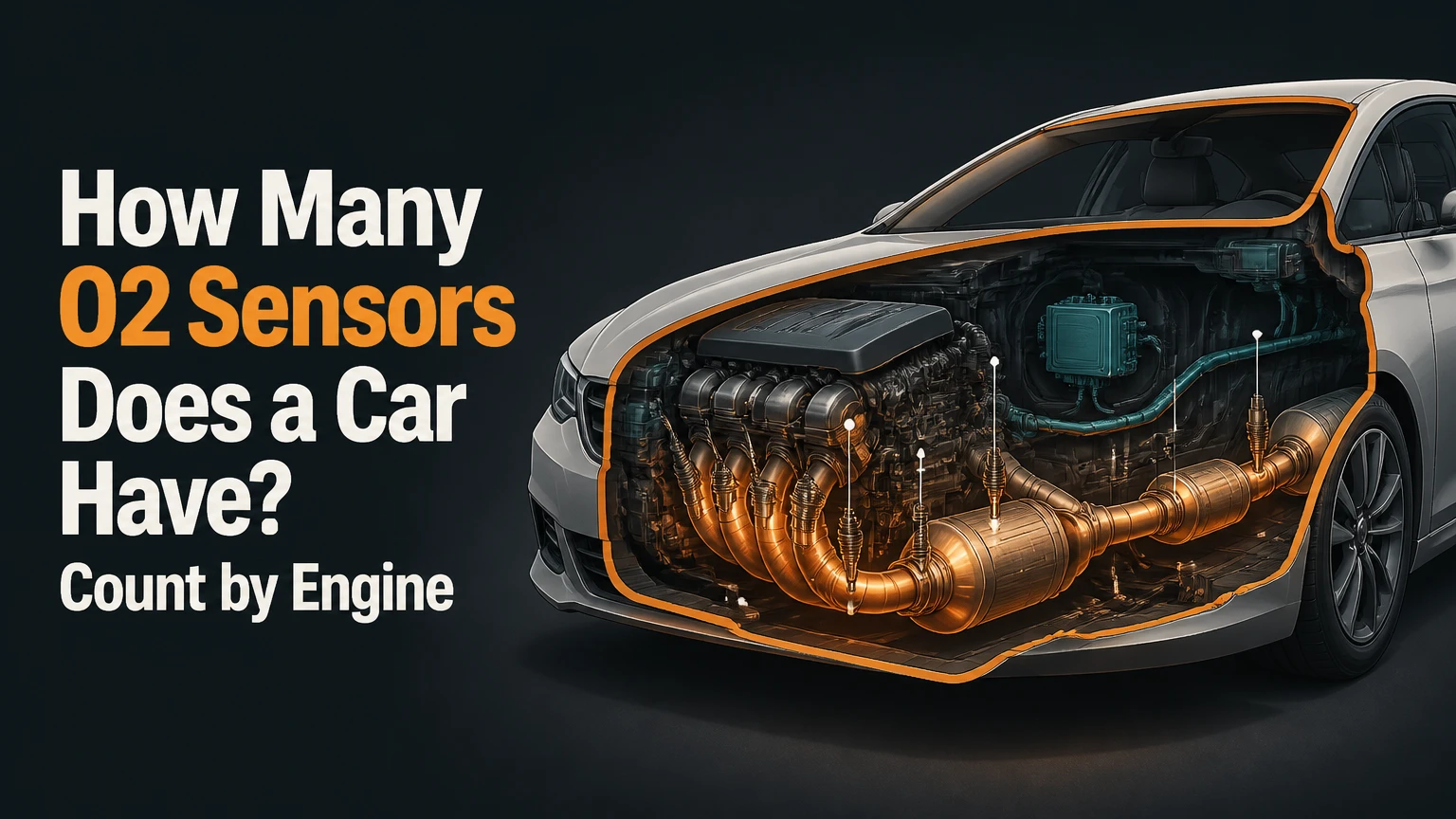
A car typically has two to four oxygen sensors, although some V6, V8, turbocharged, or dual-bank vehicles use six. An inline-four commonly has one upstream and one downstream sensor, while a V6 or V8 normally has one upstream sensor per cylinder bank and at least one downstream sensor for each monitored catalytic converter.
Key Facts at a Glance
- A modern inline-four gasoline engine most commonly has two oxygen sensors.
- A V6 or V8 commonly has four oxygen sensors, with one upstream and one downstream sensor on each bank.
- A vehicle’s sensor count follows its cylinder banks and catalytic converters, not simply its number of exhaust outlets.
- Sensor 1 is upstream of the catalytic converter; Sensor 2 is downstream.
- Pre-1996 vehicles may have one oxygen sensor, while many post-1996 OBD-II vehicles have multiple sensors.
- A diagnostic trouble code identifies a circuit or operating fault, but it does not automatically prove that the sensor itself needs replacement.
How Many 02 Sensors Does a Car Have?
Most modern gasoline cars have two, three, or four oxygen sensors, and the exact number depends on engine layout, emissions equipment, model year, and catalytic-converter arrangement. A four-cylinder car usually has two, whereas a V-engine generally needs one upstream sensor for each cylinder bank.
The most reliable counting method is to identify the number of monitored exhaust banks and converters. Count the sensors before the converters, then count the sensors after them. Some vehicles use one rear sensor to monitor two exhaust paths, while others use a separate downstream sensor for each converter.
| Vehicle configuration | Typical upstream sensors | Typical downstream sensors | Common total |
|---|---|---|---|
| Inline-four, single converter | 1 | 1 | 2 |
| Inline-six, single converter | 1 | 1 | 2 |
| V6, two monitored banks | 2 | 2 | 4 |
| V8, two monitored banks | 2 | 2 | 4 |
| V6 or V8 with extra monitored converters | 2 | 3-4 | 5-6 |
These figures are typical, not a universal parts catalog. A 2012 four-cylinder sedan and a 2012 four-cylinder SUV can use different exhaust layouts, so the vehicle identification number, factory service information, or an exact parts lookup remains the final authority.
What Do Upstream and Downstream Sensors Mean?
An upstream oxygen sensor sits before the catalytic converter and helps the engine control module adjust fueling. A downstream oxygen sensor sits after the converter and primarily checks whether the converter is storing and reducing pollutants effectively.
Manufacturers label the locations relative to exhaust flow:
- Bank 1, Sensor 1: before the converter on the bank containing cylinder one.
- Bank 1, Sensor 2: after the converter on that bank.
- Bank 2, Sensor 1: before the converter on the opposite bank.
- Bank 2, Sensor 2: after the converter on the opposite bank.
On an inline-four engine, there is normally only one cylinder bank, so the vehicle uses Bank 1 even though the engine has four cylinders. A V6 or V8 has Bank 1 and Bank 2 because the cylinders are divided between two sides.
“Sensor 2” does not mean the second sensor installed in the car. It means the second sensor in the exhaust sequence for a particular bank. That distinction prevents a common and expensive ordering mistake.
How Does Engine Configuration Change the Count?
Engine configuration changes the count because each cylinder bank needs appropriate fuel-control feedback, and each catalytic converter may need a rear sensor for emissions monitoring. Exhaust architecture can therefore matter more than engine displacement.
| Engine or exhaust layout | Bank arrangement | Sensor pattern | Typical total |
|---|---|---|---|
| Inline-four with one manifold | One bank, one converter | B1S1 and B1S2 | 2 |
| V6 with two manifolds | Two banks, two converters | B1S1, B1S2, B2S1, B2S2 | 4 |
| V8 with crossover exhaust | Two banks, two converters | Two upstream, two downstream | 4 |
| V8 with multiple rear converters | Two banks, three or four converters | Two upstream, three or four downstream | 5-6 |
| Turbocharged four-cylinder | One bank, pre-turbo or post-turbo sensor arrangement | One or more upstream, one downstream | 2-4 |
A dual-exhaust vehicle does not automatically have four sensors. Two tailpipes can emerge from one catalytic converter, while a V6 with two separate converters may have four sensors even if the exhaust merges into one visible tailpipe.
Why can one car have six oxygen sensors?
A vehicle can have six sensors when two cylinder banks use separate upstream sensors and three or four catalytic-converter monitoring locations use separate downstream sensors. Large V8 SUVs, performance cars, and vehicles with close-coupled plus underbody converters are the most likely examples.
The front sensors control or measure mixture near each bank. The rear sensors compare converter inlet and outlet oxygen behavior. Six sensors are less common than four, but the count is technically normal when the emissions system has enough independently monitored sections.
What Is the Difference Between an O2 Sensor and an Air-Fuel Sensor?
An oxygen sensor and an air-fuel ratio sensor both measure exhaust oxygen, but a conventional narrowband sensor switches around stoichiometric mixture while a wideband sensor measures a broader air-fuel range. Many manufacturers call a wideband unit an A/F sensor rather than an O2 sensor.
| Sensor type | Output behavior | Common position | Diagnostic characteristic |
|---|---|---|---|
| Zirconia narrowband | Approximately 0.1-0.9 volts | Older or conventional upstream locations | Switches rich-to-lean near stoichiometric |
| Zirconia heated sensor | Heated voltage output | Upstream or downstream | Reaches operating temperature faster |
| Titania sensor | Resistance changes with oxygen | Older vehicles | Does not use the ordinary 0.1-0.9 volt assumption |
| Wideband A/F sensor | Pump-current or electronic control signal | Modern upstream locations | Reports mixture across a wider range |
| Rear monitoring sensor | Voltage or equivalent oxygen signal | After catalytic converter | Evaluates converter oxygen-storage behavior |
The gasoline stoichiometric reference is approximately 14.7 parts air to one part fuel, but that figure applies to conventional gasoline and is not a universal target for ethanol blends, diesel combustion, or every operating condition. The engine control module also uses airflow, coolant temperature, throttle position, fuel pressure, and other inputs.
A wideband sensor cannot be tested correctly by assuming that a rapidly switching 0.1-0.9 volt waveform must appear. That test applies mainly to traditional narrowband zirconia sensors.
How Does an Oxygen Sensor Work?
An oxygen sensor compares oxygen conditions in the exhaust with a reference environment and sends information to the engine control module. The module uses upstream feedback to adjust injector pulse width, while downstream data helps evaluate catalytic-converter performance.
A traditional zirconia sensor produces a low signal when exhaust oxygen is relatively high, which generally indicates a lean mixture, and a high signal when oxygen is low, which generally indicates a rich mixture. The sensor must reach operating temperature, often around 600-800°F (315-430°C), before its signal becomes useful.
Modern heated sensors use an internal heater to reach that range quickly after startup. The heater circuit is separate from the sensing element, so a heater code can occur even when the sensing element still responds normally.
Downstream sensors usually show less rapid switching than upstream sensors when the catalytic converter works correctly. A rear sensor that closely mirrors the front sensor can indicate reduced converter oxygen storage, but scan data must be interpreted with engine temperature, fuel trims, exhaust leaks, and operating conditions.
How Can You Confirm the Exact Sensor Count?
The exact oxygen-sensor count requires a vehicle-specific source because model year, engine option, federal or California emissions equipment, and transmission packaging can change the exhaust design. The fastest reliable method is to use the vehicle identification number with a factory parts catalog or trusted parts database.
Use this confirmation sequence:
- Record the model year, make, model, engine size, and emissions specification.
- Read the diagnostic code, if present, including its bank and sensor number.
- Inspect the exhaust from the exhaust manifold or turbocharger to the tailpipe.
- Count electrical sensor connectors, not only visible sensor bodies.
- Compare the result with the factory wiring diagram or service manual.
- Match the replacement part by connector, wire count, sensor position, and application data.
The vehicle owner’s manual often does not list the full sensor count. A repair manual, factory wiring diagram, or manufacturer parts catalog usually does.
How Should You Diagnose an O2 Sensor Fault?
An oxygen-sensor diagnostic code identifies a circuit, response, heater, or mixture-monitoring problem, so diagnosis should begin with wiring and engine conditions rather than automatic parts replacement. A scan tool that displays live data is more useful than a code reader that only reports the fault number.
Check these items in order:
- Inspect the sensor harness for melted insulation, contact with the exhaust, corrosion, or stretched wiring.
- Look for exhaust leaks before the affected sensor, because outside air can create a false lean reading.
- Check fuel-trim data for evidence of vacuum leaks, low fuel pressure, injector problems, or mass-airflow errors.
- Confirm that the engine reaches normal coolant temperature.
- Test the heater circuit against the manufacturer’s resistance and voltage specifications.
- Compare upstream and downstream signals only after the engine is fully warm.
- Clear the code after repair and complete the required drive cycle.
Common code families include P0130-P0167, but the exact interpretation depends on the specific code and vehicle. P0136, for example, often relates to a Bank 1 Sensor 2 circuit or performance issue, while the root cause may be wiring, an exhaust leak, a damaged connector, or a converter problem.
What does a healthy sensor signal look like?
A conventional narrowband upstream sensor typically switches repeatedly between roughly 0.1 and 0.9 volts during closed-loop operation. A wideband sensor uses a different signal strategy, and a downstream sensor should generally change more slowly than its upstream counterpart when the catalytic converter is functioning.
A multimeter can reveal a dead signal, a heater fault, or an open circuit, but a basic voltage test is not sufficient for every modern sensor. Back-probing the wrong wire can damage the connector or bias the circuit, and some wideband systems require manufacturer-specific scan-tool data.
Should You Replace One Sensor or All of Them?
Replace the sensor that has a confirmed fault unless testing shows a shared wiring, heater-power, contamination, or age-related problem affecting multiple units. Replacing every sensor because one code appears can waste several hundred dollars and may leave the real engine or exhaust fault unresolved.
Replacing sensors in pairs can make sense when both upstream sensors on a high-mileage V-engine respond slowly and have similar service history, but it is not a universal requirement. A downstream sensor that merely shares the same mileage does not automatically need replacement.
A new sensor can fail quickly if coolant, oil, silicone sealant, fuel contamination, or an exhaust leak reaches the sensing element. The repair must address the contamination source, not only install another sensor.
What Exceptions Change the Usual Answer?
Hybrid vehicles, diesel vehicles, older cars, and vehicles with unusual emissions systems do not always follow the standard two-to-four-sensor pattern. The presence of an internal-combustion engine does not guarantee that the vehicle uses the same sensor terminology or exhaust layout as a conventional gasoline car.
| Vehicle situation | Typical sensor arrangement | Important qualification |
|---|---|---|
| Pre-1996 gasoline car | 1 sensor is common | OBD-I layouts vary widely by manufacturer |
| 1996 or newer gasoline car | 2-6 sensors is typical | OBD-II emissions monitoring increased rear-sensor use |
| Hybrid gasoline vehicle | 2-4 or more | Engine-off operation changes live-data interpretation |
| Diesel passenger vehicle | Oxygen, lambda, NOx, and temperature sensors may coexist | Do not call every exhaust sensor an O2 sensor |
| Turbocharged gasoline vehicle | 2-4 or more | Sensor position may be before or after the turbocharger |
| Modified or imported vehicle | Application-specific | Emissions certification and replacement exhaust may differ |
The U.S. Environmental Protection Agency introduced OBD-II requirements for most 1996 and newer light-duty vehicles, which is why post-1995 cars commonly have more comprehensive catalyst and sensor monitoring than earlier OBD-I vehicles. The cutoff is a useful guide, not a guarantee for every market or vehicle.
Diesel engines can use lambda sensors, but diesel exhaust systems also commonly include NOx sensors, exhaust-gas temperature sensors, particulate sensors, and differential-pressure sensors. Those components should not be counted as oxygen sensors.
What Does Replacement Usually Cost?
A typical oxygen-sensor replacement costs $100-$450 per sensor, including an aftermarket or OEM-equivalent part and labor, while difficult access, seized threads, wideband parts, and additional diagnosis can raise the total above that range. The part itself commonly costs $30-$100 for a narrowband sensor and $100-$300 for a wideband unit.
| Repair situation | Typical part cost | Typical labor time | Typical installed range |
|---|---|---|---|
| Accessible narrowband sensor | $30-$100 | 0.5-1.0 hour | $100-$250 |
| Accessible wideband A/F sensor | $100-$300 | 0.5-1.5 hours | $180-$450 |
| Seized sensor with heat or extraction | $30-$300 | 1.5-3.0 hours | $250-$650 |
| Multiple V-engine sensors | $120-$600 | 1.5-4.0 hours | $350-$1,000 |
| Wiring or exhaust-leak diagnosis | $0-$150 in parts | 1.0-3.0 hours | $100-$450 |
These are typical North American independent-shop ranges, not fixed prices. Regional labor rates, access through a heat shield, corrosion, and the vehicle’s emissions specification produce large differences.
A dedicated slotted oxygen-sensor socket, penetrating oil, gloves, and a means of safely raising the vehicle are appropriate for many accessible repairs. Work only on a cool exhaust system, keep wiring away from heat, and use only sensor-compatible thread compound where the manufacturer permits it.
What Are the Most Common Counting and Repair Mistakes?
The most common mistake is treating the number of tailpipes as the number of sensor circuits. Exhaust outlets describe the final plumbing, whereas sensor count depends on monitored banks, converters, and manufacturer calibration.
Avoid these errors:
- Ordering Bank 2 for an inline engine: An inline-four normally has only Bank 1, even when the engine has four cylinders.
- Confusing Sensor 1 with cylinder one: Sensor 1 means upstream, not a sensor physically attached to cylinder one.
- Assuming every P-code condemns the sensor: A wiring fault, vacuum leak, fuel problem, or exhaust leak can generate the same code.
- Testing a wideband sensor like a narrowband sensor: Wideband circuits do not necessarily switch between 0.1 and 0.9 volts.
- Using ordinary anti-seize on the sensing end: Compound contamination can damage the element; use the product supplied or specified for the sensor threads.
- Splicing wires without checking polarity: Universal sensors can work, but incorrect heater or signal wiring can create immediate faults.
- Ignoring converter damage: A downstream code can indicate a catalyst problem rather than a failed rear sensor.
One practical rule matters more than the parts counter: identify the bank, position, connector, and sensor technology before buying the component.
Frequently Asked Questions
Can a car run with a bad oxygen sensor?
A car can usually run with a failed oxygen sensor, but fuel economy, emissions, drivability, and catalytic-converter life may suffer. The engine control module may substitute a default fuel strategy, illuminate the check-engine light, and store excess fuel or air-fuel-ratio faults. Continued driving is especially risky when the engine misfires or produces a flashing warning light.
Do oxygen sensors affect fuel economy?
Oxygen sensors can affect fuel economy because upstream feedback helps the engine control module correct fueling during closed-loop operation. A biased sensor, fuel-system fault, or intake leak can produce rich or lean operation, but a claimed 40 percent loss should not be assumed without measuring fuel use and diagnosing the complete system.
How long do oxygen sensors usually last?
Many original oxygen sensors last approximately 60,000-100,000 miles, or about 100,000-160,000 kilometers, although contamination, oil consumption, coolant leaks, silicone exposure, and severe operating conditions can shorten that interval. Replacement should follow measured performance and the manufacturer’s maintenance guidance rather than mileage alone.
Does Bank 1 always mean the driver’s side?
Bank 1 does not always mean the driver’s side. Bank 1 is the cylinder bank containing cylinder one, and the physical side varies by engine design, vehicle orientation, and manufacturer. Inline engines have one bank, so their oxygen-sensor codes generally use Bank 1 without a Bank 2 counterpart.
Can a catalytic converter cause an oxygen-sensor code?
A failing catalytic converter can cause a downstream oxygen-sensor performance code because the rear sensor detects insufficient oxygen-storage behavior. Exhaust leaks, damaged wiring, incorrect fuel mixture, and a defective sensor can create similar results, so converter replacement should follow pressure, temperature, waveform, and fuel-trim diagnosis.
The Bottom Line
A modern car usually has two to four oxygen sensors, while some V6, V8, turbocharged, and multi-converter vehicles have five or six. An inline-four most often uses one upstream and one downstream sensor; a V-engine generally uses one upstream and one downstream sensor per bank. To determine how many 02 sensors a car has, identify the exact engine and emissions configuration, then verify the bank and sensor positions with a vehicle-specific catalog or wiring diagram.