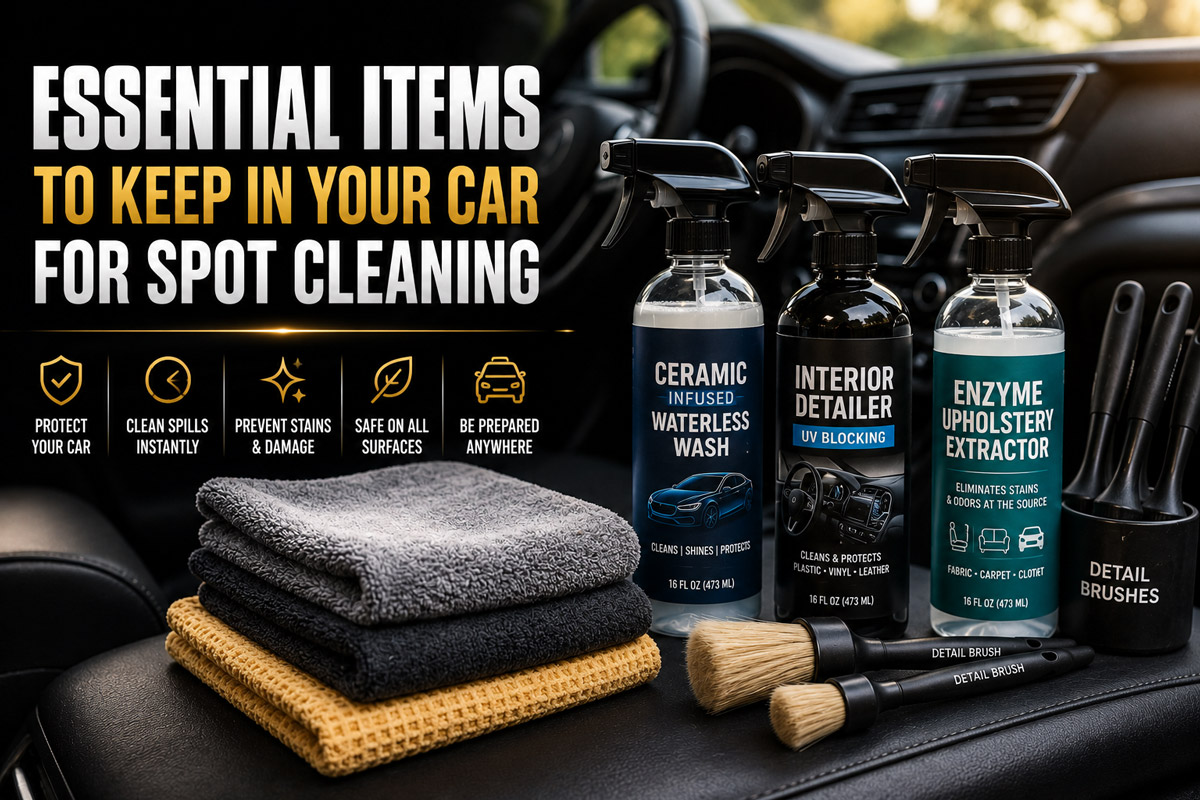
An effective in-car spot cleaning kit requires five essential tools: high-GSM microfiber towels, a polymer-based waterless wash, a UV-blocking interior detailer, an enzyme stain extractor, and soft-bristled detail brushes. Storing these specific items in your vehicle allows you to immediately neutralize acidic contaminants and prevent permanent surface damage.
Key Facts / At a Glance
- Response Time: Bird droppings and tree sap can permanently etch an automotive clear coat in under 48 hours if left untreated.
- Temperature Tolerance: Liquid detailing chemicals degrade quickly in vehicles; store them in insulated trunk bags to survive summer cabin temperatures exceeding 130°F (54°C).
- Average Kit Cost: A comprehensive, high-quality emergency spot cleaning kit costs between $45 and $86.
- Primary Mechanism: Automotive spot cleaning relies on high-lubricity polymers to encapsulate dirt, preventing micro-scratches during wipe-down.
- Material Warning: Household cleaners containing ammonia (like Windex) will permanently dry out leather, degrade automotive plastics, and delaminate aftermarket window tint.
Our Top Picks: The In-Car Spot Cleaning Kit
- Best for Exterior Paint: Ceramic-Infused Waterless Wash
- Best for Dashboard & Plastics: UV-Blocking Interior Detailer
- Best for Seats & Carpets: Enzyme-Based Upholstery Extractor
- Best for Wiping & Buffing: 350+ GSM Split-Weave Microfiber
- Best for Crevices: Boar’s Hair Detail Brushes
How We Chose the Essential Spot Cleaning Tools
To qualify for an in-car emergency kit, a product must meet three strict criteria: it must operate without a primary water source, it must tolerate moderate temperature fluctuations inside a vehicle cabin, and it must offer immediate chemical intervention (encapsulation or enzymatic breakdown) to prevent permanent material damage.
1. Microfiber Towels – Best for Safe Mechanical Cleaning
Microfiber towels are the mechanical foundation of any spot cleaning kit because their split-weave polyester and polyamide fibers create a positive static charge that traps microscopic dirt particles rather than pushing them across the surface.
- Key Specs: 300 to 450 GSM (Grams per Square Meter); 70/30 polyester-to-polyamide blend.
- Cost & Lifespan: $10 to $20 for a 6-pack; survives 50+ wash cycles.
A standard cotton rag pushes abrasive particles into your clear coat. A high-quality microfiber towel features fibers split to 1/100th the diameter of a human hair, creating millions of tiny pockets that absorb liquids and safely lock away grit. Keep at least three types in your car: a 400+ GSM high-pile towel for safely lifting bird droppings from exterior paint, a 300 GSM short-pile towel for interior plastics, and a waffle-weave towel specifically for glass.
- The Drawback: Microfiber is highly sensitive to heat and chemicals. Washing these towels with fabric softener or drying them on high heat melts the microscopic fibers, permanently ruining their absorbency and static charge.
- Choose this if: You need a non-abrasive, highly absorbent medium for applying detailing chemicals.
- Skip it if: You are dealing with heavy, caked-on mud that requires a pressurized water rinse.
2. Waterless Wash Spray – Best for Exterior Paint Contaminants
Waterless wash (or quick detailer) relies on high-lubricity polymers to instantly encapsulate surface dirt, dust, and acidic bird droppings, allowing them to slide off exterior paint without scratching the clear coat.
- Key Specs: Polymer-based or SiO2 (ceramic) infused; pH-neutral formulation.
- Cost & Lifespan: $12 to $22 per 16 oz bottle; 2 to 5-year shelf life.
When a bird dropping lands on your hood, the uric acid immediately begins eating into the clear coat. A waterless wash spray halts this chemical reaction. The surfactants in the spray break the bond between the contaminant and the paint, while the polymers create a temporary, ultra-slick barrier. Modern ceramic-infused quick detailers leave behind a hydrophobic layer that actively repels future water and dust.
- The Drawback: It requires a strictly disciplined wiping technique. Using waterless wash on heavily soiled panels, or rubbing in circles, will grind dirt into the paint and cause swirl marks.
- Choose this if: You need to safely remove isolated bug splats, sap, or droppings while away from a hose.
- Skip it if: The vehicle has driven through heavy rain, mud, or off-road conditions.
3. Interior Detailer – Best for Dashboard and Console Spills
Interior detailers utilize mild surfactants to lower water surface tension for grease removal, while deploying emulsifiers and UV-blocking agents to shield plastics and vinyl from fading and cracking.
- Key Specs: Matte or satin finish (OEM look); anti-static properties.
- Cost & Lifespan: $8 to $15 per 16 oz bottle; 2 to 3-year shelf life.
Coffee splashes and skin oils degrade steering wheels and center consoles over time. A dedicated interior detailer isolates these contaminants without leaving the greasy, high-gloss residue associated with older silicone-based dressings. Premium formulas include anti-static properties that actively repel dust for weeks after application, making them ideal for instrument clusters and navigation screens.
- The Drawback: They lack the heavy chemical bite needed for severe, set-in stains. They are designed for surface-level maintenance, not deep restorative extraction.
- Choose this if: You need to clean sticky cup holders, dusty dashboards, and fingerprint-covered touchscreens.
- Skip it if: You are trying to clean fabric seats, heavily soiled floor mats, or raw suede/Alcantara.
4. Enzyme-Based Upholstery Cleaner – Best for Organic Fabric Stains
Enzyme-based cleaners deploy active biological agents that consume organic odor molecules and deep-penetrating surfactants that break the chemical bonds of set-in fabric stains.
- Key Specs: Foaming or liquid trigger spray; requires 1 to 3 minutes of dwell time.
- Cost & Lifespan: $7 to $14 per can; 1 to 2-year shelf life (enzymes degrade faster in high heat).
When milk, coffee, or pet fluids spill onto cloth seats, simply wiping the surface leaves the liquid trapped in the foam cushion, resulting in permanent odors. Enzymatic cleaners do not mask smells; they physically digest the organic proteins causing them. Foaming variants are particularly effective for in-car use because they suspend the dirt at the top of the fabric fibers, making it easier to blot away without an electric wet-vac.
- The Drawback: Oversaturating the seat can leave distinct white water rings when the fabric dries unevenly. Furthermore, the active enzymes will degrade if left in a sweltering car trunk for multiple summers.
- Choose this if: You frequently transport children, pets, or food, and need to address organic spills before they set.
- Skip it if: You only have leather or vinyl seating, which requires a dedicated pH-balanced leather cleaner instead.
5. Soft-Bristled Detail Brushes – Best for Crevices and Vents
Detail brushes use slender, flexible bristles to mechanically agitate cleaning chemicals deep into textured leather grain, seat stitching, and HVAC air vents where microfiber towels cannot reach.
- Key Specs: Synthetic nylon (for durable plastics) or natural boar’s hair (for delicate trim).
- Cost & Lifespan: $8 to $15 for a multi-size set; lasts 3 to 5 years.
Spray cleaners can only dissolve so much on their own. To lift packed-in dirt from the seams of a leather seat or the tiny crevices around gear shifters, mechanical agitation is mandatory. Brushes whip interior liquid detailers into a thick foam, lifting the suspended dirt to the surface where a towel can quickly swipe it away.
- The Drawback: Using a stiff synthetic brush on modern, high-gloss “piano black” plastic trim will instantly cause thousands of micro-scratches.
- Choose this if: You want a professional-level clean in tight spaces, emblems, and textured materials.
- Skip it if: You are only doing a quick wipe-down of flat, smooth surfaces.
How Do You Safely Spot Clean Car Surfaces?
You safely spot clean car surfaces by relying on chemical lubrication and linear wiping motions, strictly avoiding pressure and circular scrubbing. The goal is to lift the contaminant away from the surface, not grind it downward.
Exterior Paint and Glass Cleaning Steps
- Spray and Saturate: Liberally spray the waterless wash directly onto the bird dropping, bug splat, or sap.
- Dwell Time: Wait 30 to 60 seconds. This allows the high-lubricity polymers to encapsulate the grit and the moisture to soften the hardened contaminant.
- The Linear Wipe: Fold a high-pile microfiber towel into quarters. Gently wipe the spot in one single, straight line. As you wipe, slightly roll the leading edge of the towel upward to lift the dirt away from the paint.
- Buff Dry: Flip the towel to a clean, dry quarter and lightly buff the remaining moisture to prevent water spots.
Interior Fabric and Upholstery Cleaning Steps
- Immediate Blot: Press a dry microfiber towel directly into the fresh spill to absorb maximum liquid. Never rub, as this spreads the stain deeper into the weave.
- Apply and Agitate: Spray the enzyme cleaner onto the stain. Use a soft-bristled brush to gently agitate the area in a cross-hatch pattern (up-and-down, then left-and-right) for 15 seconds.
- Extract: Wrap a dry microfiber towel around your fist and press it firmly into the damp fabric, twisting slightly to lift the foamed dirt out of the textile.
What Are the Most Common Spot Cleaning Mistakes?
The most common spot cleaning mistake is using household glass cleaners, like Windex, which contain ammonia that actively strips UV coatings from automotive displays, dries out leather seats, and permanently bubbles aftermarket window tint.
- Scrubbing in Circles: When addressing exterior paint, circular scrubbing traps sharp particulate matter under the towel and grinds it into the clear coat, creating permanent swirl marks that require machine polishing to fix.
- Spraying Screens Directly: Spraying cleaner directly onto a hot infotainment screen causes the liquid to run down behind the bezel, potentially shorting the electronics. Always mist the towel first, then wipe the screen.
- Ignoring Surface Temperature: Applying waterless wash or detail spray to exterior body panels parked in direct sunlight causes the chemicals to flash-dry instantly, leaving behind stubborn, baked-on chemical streaks.
- Creating Fabric Water Rings: When spot cleaning a localized stain on a car seat, the clean circle will often dry leaving a dark outer ring. Fix this by lightly misting the entire fabric panel with water after treating the spot, allowing the whole seat to dry uniformly.
Which Kit Setup Should You Choose?
You should choose your in-car spot cleaning kit based on your daily passenger types, interior material, and tolerance for trunk clutter.
The Daily Commuter & Parent
- Quick Verdict: Focus on rapid interior spill management.
- Essential Loadout: Enzyme-based fabric cleaner, multi-surface interior detailer, and a 6-pack of utility 300 GSM microfiber towels. Keep these in a small, leak-proof nylon bag behind the passenger seat for instant access when drinks spill.
The Rideshare Driver
- Quick Verdict: Focus on sanitization, odor control, and clear visibility.
- Essential Loadout: Anti-microbial interior detailer, dedicated automotive glass cleaner (ammonia-free), waffle-weave glass towels, and an enzyme extractor for bodily fluids. Store in a rigid trunk organizer.
The Car Enthusiast
- Quick Verdict: Focus on paint preservation and maintaining a high-gloss finish.
- Essential Loadout: SiO2 ceramic quick detailer, 450+ GSM ultra-plush edgeless microfiber towels, natural boar’s hair brushes, and a dedicated pH-neutral leather cleaner.
Frequently Asked Questions
Can I store car cleaning chemicals in my trunk during extreme winter cold?
Liquid detailing products, especially water-based extractors and quick detailers, will freeze and separate in temperatures below 32°F (0°C). Once the chemical emulsion breaks from freezing, the product is often permanently ruined. During deep winter, bring liquid chemicals indoors.
How often should I wash or replace my car’s microfiber towels?
Wash your microfiber towels after every use using a dedicated microfiber detergent or clear liquid laundry soap. Never use fabric softeners or heat drying. Replace them entirely when they lose their static cling or feel physically stiff and scratchy, typically after 40 to 50 wash cycles.
Does spot cleaning replace the need for regular car washing?
No. Spot cleaning is an emergency intervention designed strictly to prevent permanent etching from localized hazards like bird droppings. It does not remove the abrasive road film, brake dust, and iron particles that blanket the entire vehicle and require a traditional two-bucket wash method to safely remove.
How do I remove tree sap if waterless wash isn’t working?
Hardened tree sap requires a chemical solvent to break down the organic resins. Keep a small bottle of 70% isopropyl alcohol or a dedicated automotive tar-and-sap remover in your kit. Apply the solvent to a microfiber towel, press it against the sap for 30 seconds to dissolve it, then gently wipe away.