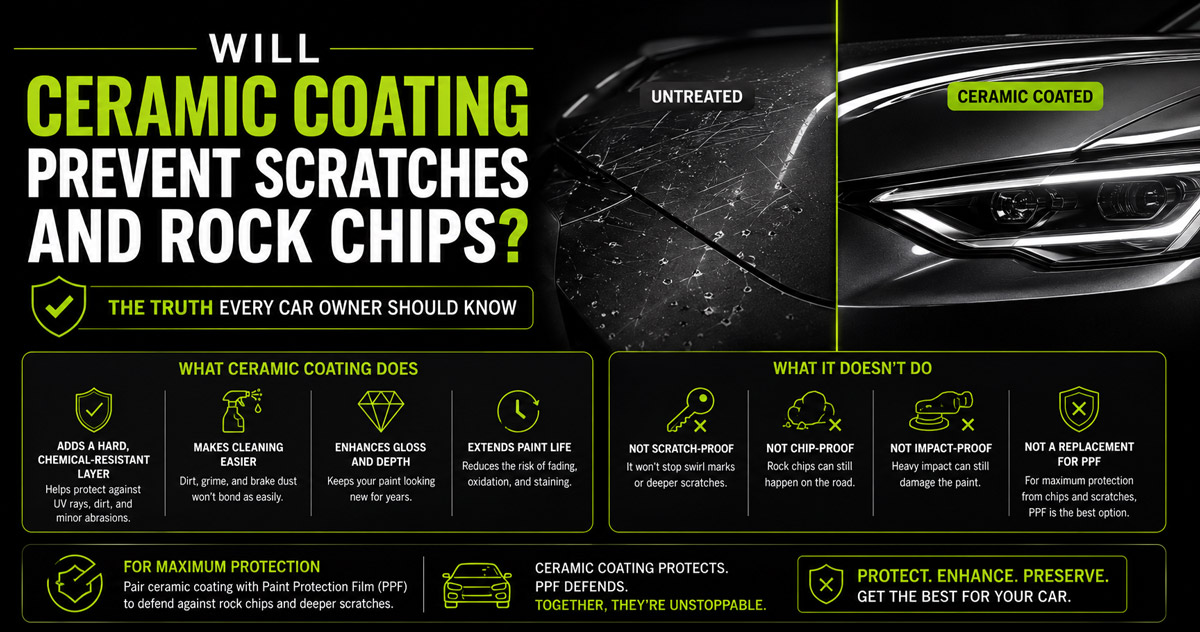
Every car enthusiast or new vehicle owner faces a common dilemma: how to keep that factory-fresh paint looking immaculate for years. Among modern detailing solutions, ceramic coatings have surged in popularity, celebrated for delivering incredible mirror-like gloss and hydrophobic water-beading performance. However, aggressive marketing campaigns and internet myths have led many drivers to believe that ceramic coatings act as an impenetrable, bulletproof shield against all physical road hazards.
If you are wondering whether investing in a professional nano-ceramic coating will stop high-velocity stone impacts or deep key scratches, the short answer is no. While ceramic coatings provide excellent surface defense against chemical oxidation and light wash marring, they are simply not engineered to absorb major physical impacts.
This comprehensive guide unpacks the science behind 9H ceramic coatings, explains why physical road debris bypasses liquid coatings, and outlines the ultimate paint preservation strategy to keep your car pristine.
Understanding the Science: What Is a Ceramic Coating?
To understand why ceramic coatings fail to stop flying gravel, you must look at what a coating actually is on a molecular level. A professional ceramic coating is a liquid polymer formula composed primarily of Silicon Dioxide (SiO₂) or Silicon Carbide (SiC).
When applied to a vehicle’s exterior, the liquid chemically bonds with the factory clear coat, filling microscopic pores and valleys on the surface. Once fully cured, this chemical reaction creates a semi-permanent hydrophobic barrier.
Protection Thickness & Structure
Visual comparison of surface protection layers measured in microns (μm).
Ultra-thin, rigid SiO2 barrier that bonds molecularly to seal microscopic clear coat pores.
Standard transparent gloss layer provided by the vehicle manufacturer for UV protection.
Thick, impact-absorbing thermoplastic layer engineered to absorb physical rock chips and debris.
The 9H Hardness Myth Demystified
Detailers and product manufacturers frequently advertise “9H Hardness” as a major selling point. Consumers naturally confuse this with the Mohs Hardness Scale, where a 9 represents diamond-level scratch resistance.
In the automotive care industry, 9H refers strictly to the Pencil Hardness Test (ASTM D3363). This test involves pushing calibrated graphite pencils across a surface at a 45-degree angle. A 9H rating means the cured coating resists scratch marks from the hardest standard graphite pencil. It does not mean your paint can withstand sharp metal, flying quartz gravel, or vandalism.
Hardness Scale Comparison
Understanding the difference between Pencil Hardness (coatings) and Mohs Hardness (minerals).
Cured Coating Thickness vs. Kinetic Energy
The primary limitation of ceramic coatings is sheer physical mass. The average cured ceramic layer is microscopic, measuring between 1 and 3 microns in thickness. For context:
- A single human hair is roughly 70 to 100 microns thick.
- A standard sheet of copy paper is about 100 microns thick.
When a stone flies off a dump truck tire at 65 mph, it carries substantial kinetic energy. An ultra-thin 2-micron rigid shell lacks the physical volume or flex required to absorb and disperse that impact force. The rock pierces through the ceramic layer instantly, chipping the clear coat and underlying base paint beneath.
What Ceramic Coatings CAN and CANNOT Prevent
To set realistic expectations, let us break down the exact capabilities and clear physical limitations of ceramic formulas.
Capability Matrix at a Glance
What ceramic coatings can—and cannot—protect your vehicle paint against.
| Hazard / Damage Type | Ceramic Coating Effect | Protection Level |
|---|---|---|
| High-Velocity Rock Chips | Prevented? NO | ❌ None (0%) |
| Deep Scratches & Keying | Prevented? NO | ❌ None (0%) |
| Automatic Brush Wash Scratches | Prevented? NO | ❌ None (0%) |
| Light Micro-Swirls (Hand Wash) | Reduced? YES | ⚠️ Moderate |
| Acid Rain & Bird Dropping Etching | Blocked? YES | High (95%) |
| Sun Fading & UV Oxidation | Blocked? YES | High (95%) |
| Dirt Accumulation (Hydrophobic) | Reduced? YES | High (90%) |
What Ceramic Coatings CANNOT Stop
- High-Velocity Rock Chips: Gravel, asphalt chunks, and road debris hit with enough force to breach thin coatings effortlessly.
- Deep Scratches and Vandalism: Keys, runaway shopping carts, tree branches, or fingernails pressed firmly into the panel will cut straight through to the primer or bare metal.
- Automatic Car Wash Friction: The heavy rubber or cloth filaments in automated car washes rotate at high speeds, trapping dirt particles and creating severe swirl marks and deep gouges across ceramic-coated panels.
What Ceramic Coatings DO Protect Against
- Chemical Etching: Environmental contaminants like acidic bird droppings, bug splatter, tree sap, and road salts are blocked before they eat into your clear coat.
- UV Damage and Oxidation: Ceramic coatings contain active UV blockers that keep factory paint from fading, dulling, or chalking under harsh sunlight exposure.
- Light Wash Marring: The ultra-slick surface lowers static friction, allowing dirt and grime to wash off smoothly during safe hand washes, minimizing light spider-web swirls.
- Self-Cleaning Hydrophobic Effect: Water beads up immediately and rolls off, pulling loose dirt away with it and drastically shortening maintenance routine times.
The Real Solution for Physical Impacts: Paint Protection Film (PPF)
If your main goal is stopping physical paint damage, Paint Protection Film (PPF)—frequently called “Clear Bra”—is the industry standard solution.
Unlike liquid ceramic coatings, PPF is a thick, highly durable elastomeric polymer sheet applied directly over vulnerable car panels. High-grade polyurethane films are 150 to 200 microns thick (roughly 100 times thicker than a ceramic coating).
Ceramic Coating vs. PPF Comparison
Understanding the key differences between chemical surface sealants and heavy impact protection films.
| Attribute | Ceramic Coating | Paint Protection Film (PPF) |
|---|---|---|
| Primary Focus | Chemical & Gloss Shield | Heavy Impact Shield |
| Material Structure | Liquid SiO2 Polymer | Polyurethane Film |
| Layer Thickness | 1 – 3 Microns | 150 – 200 Microns |
| Self-Healing Ability | No | Yes (via heat) |
| Impact Resistance | Zero | Exceptional |
| Lifespan Expectancy | 2 to 7 Years | 7 to 10+ Years |
| Average Investment | $800 – $2,500 | $1,500 – $7,000 |
Why PPF Absorbs Rock Chips and Scratches
PPF relies on thermoplastic polyurethane that features natural elasticity. When a high-speed stone strikes a PPF-protected hood, the material flexes and dissipates the kinetic energy, preventing the rock from piercing down into the vehicle’s paint.
PPF Impact Absorption Mechanics
How thermoplastic polyurethane dissipates kinetic energy to protect clear coat.
Elastomeric material compresses to absorb and spread kinetic energy laterally.
Furthermore, modern premium films like XPEL Ultimate Plus, 3M Scotchgard Pro, and SunTek Ultra feature topcoat layers with self-healing properties. Minor scratches, swirl marks, or wash lines vanish entirely when exposed to heat from direct sunlight or warm water.
The Ultimate Paint Preservation Strategy: The Hybrid Setup
You do not have to choose between ceramic coatings and paint protection film. Modern automotive detailing shops recommend combining both into a Hybrid Paint Protection System.
The Hybrid Protection System
The ultimate strategy combining Paint Protection Film (PPF) in critical damage zones with Ceramic Coating across the entire vehicle.
Front Bumper, Hood, Fenders, Mirrors, & Rocker Panels
Roof, Doors, Trunk Lid, & Rear Quarter Panels
How the Hybrid Setup Works
- Install PPF on High-Impact Areas: Apply clear bra coverage to parts of the vehicle vulnerable to highway gravel, including the front bumper, entire hood, front fenders, side mirrors, and lower rocker panels.
- Apply Ceramic Coating Over the Entire Vehicle: Treat the whole exterior—including the newly installed PPF and bare painted panels on the doors, roof, and trunk—with a professional-grade ceramic coating.
This dual-layer approach provides complete protection: PPF absorbs physical kinetic strikes up front, while the slick ceramic coating over top provides chemical resistance, effortless washing, and consistent gloss across every panel.
Proper Maintenance: Extending Paint Life
Regardless of whether you choose a ceramic coating, PPF, or a hybrid combination, proper wash habits are crucial to preserving your investment.
- Adopt the Two-Bucket Hand Wash Technique: Use one bucket for soapy water and a second bucket with clean water to rinse your wash mitt after every panel.
- Use Grit Guards: Place grit guards at the bottom of your wash buckets to trap dislodged dirt and prevent it from transferring back onto your paint.
- Select pH-Neutral Car Shampoos: Avoid harsh dish soaps or aggressive degreasers that break down specialized protective coatings and topcoats.
- Avoid Automated Brush Car Washes: Stick exclusively to touchless automatic washes or careful hand washing to avoid abrasive scratching.
- Apply Ceramic Booster Sprays: Top up your ceramic coating every 3 to 6 months with silica-based maintenance sprays to maintain peak hydrophobic water-beading performance.
Frequently Asked Questions
Can you fix rock chips after applying a ceramic coating?
Yes, but touch-up paint will not adhere directly to a fresh ceramic coating due to its slick hydrophobic qualities. Detailers must lightly wet-sand or chemically strip the coating off the damaged spot before applying touch-up paint, then level and re-coat the area.
Does ceramic coating stop swirl marks?
Ceramic coatings reduce the likelihood of fine swirl marks caused by light friction during routine washing. However, improper washing techniques, dirty towels, or dry wiping will still swirl a ceramic-coated car.
Is ceramic coating worth it if it doesn’t stop rock chips?
Yes. Ceramic coatings excel at chemical resistance, UV shielding, gloss enhancement, and reducing maintenance time. If your primary goal is keeping paint deep, shiny, and easy to clean, ceramic coatings offer exceptional value.
Conclusion: Making the Right Choice for Your Vehicle
While ceramic coatings provide chemical and UV protection alongside deep gloss, they cannot prevent rock chips or severe scratches. Understanding this physical limit prevents costly disappointment.
- Choose Ceramic Coating if you want deep reflections, quick washes, and protection against chemical etching and fading.
- Choose Paint Protection Film (PPF) if your primary concern is stopping physical stone chips and road debris damage on highway drives.
- Choose a Hybrid Setup for maximum comprehensive protection across your entire vehicle.
Ready to Shield Your Vehicle’s Paintwork?
Protecting your car’s exterior requires selecting the right combination of products tailored specifically to your daily driving habits, mileage, and budget.
Contact our team of certified paint protection specialists today for a free consultation and custom vehicle quote!