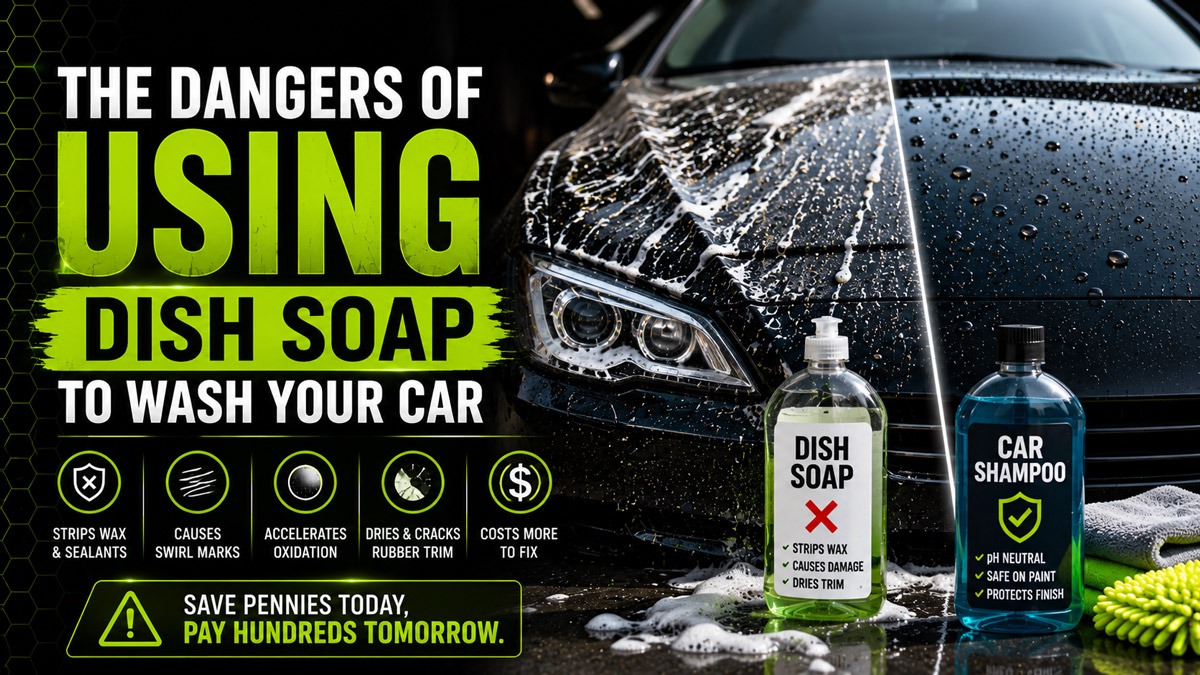
Using dish soap to wash your car acts as an abrasive degreaser that instantly strips essential waxes and sealants from the automotive clear coat. Because household dish soaps possess high alkalinity and low surface lubricity, regular use guarantees micro-marring, accelerated paint oxidation, and the embrittlement of rubber window seals.
Key Facts / At a Glance
- Immediate Wax Removal: A single wash with liquid dish soap completely strips carnauba wax and synthetic sealants.
- High Alkalinity: Dish soaps typically sit at pH 8.5 to 9.5, making them up to 100 times more alkaline than pH-neutral car shampoos.
- Friction Damage: Lacking automotive slickness agents, dish soap causes the wash mitt to drag dirt across the paint, creating microscopic swirl marks.
- Plasticizer Leaching: The chemical degreasers in dish soap extract essential oils from rubber trim and plastic wiper blades, causing irreversible cracking.
- Financial Impact: Saving $0.15 per wash by using dish detergent frequently results in $200–$500 professional paint correction fees to repair clear coat oxidation.
Why Is Dish Soap Bad for Car Paint?
Dish soap is bad for car paint because its chemical structure is engineered to break down baked-on animal fats and food greases, not to safely lift organic road grime. Automotive paint requires a pH-neutral lubricant that encapsulates dirt particles so they glide off the clear coat without scratching. Dish soap performs the exact opposite function: it aggressively binds to oils and strips the surface bare.
Chemical Stripping and the pH Scale
Automotive clear coats rely on a “sacrificial layer” of wax or ceramic sealant to block ultraviolet (UV) radiation and repel water. Dish soaps rely on highly alkaline surfactants—typically registering between 8.5 and 9.5 on the pH scale. Because the pH scale is logarithmic, a pH of 9.0 is 100 times more alkaline than a pH-neutral (7.0) car shampoo. This extreme alkalinity dissolves protective automotive polymers instantly. Furthermore, many modern dish soaps include citrus-derived additives (like limonene), which act as aggressive solvents that melt through synthetic paint sealants on contact.
Low Lubricity and Mechanical Friction
Automotive shampoos contain heavy slickness agents and foaming lubricants that create a frictionless barrier between your wash mitt and the vehicle. Dish soap formulations lack these slickness agents entirely. When washing a vehicle with dish soap, the friction coefficient remains dangerously high. Instead of lifting and suspending abrasive silica particles (road dirt), the wash mitt drags them directly against the unlubricated clear coat.
The Dangers of Using Dish Soap to Wash Your Car: Detailed Breakdown
The dangers of using dish soap to wash your car include immediate water spotting, long-term clear coat failure, and irreversible damage to exterior rubber components. These failures do not happen overnight, but they compound rapidly over 6 to 12 months of improper maintenance.
Immediate Wax Stripping and Water Spotting
Dish soap drastically alters the surface tension of the vehicle’s exterior. By stripping the hydrophobic wax layer, the clear coat becomes hydrophilic. Instead of forming tight water beads that roll off the hood, water “sheets” and clings to the paint. When this stagnant water evaporates, it leaves behind concentrated calcium and magnesium deposits. These hard water spots will etch directly into the unprotected clear coat within 48 hours, requiring chemical decontamination to remove.
Long-Term Clear Coat Oxidation
Without a protective layer of wax or sealant, the factory clear coat absorbs the full brunt of environmental abuse. Oxygen and UV rays attack the exposed polymer chains in the paint. Within 6 to 12 months, this UV degradation causes oxidation—the paint will appear dull, cloudy, and eventually begin to peel or flake off entirely. Once clear coat failure begins, it cannot be polished away; the vehicle must be entirely repainted.
Rubber Embrittlement and Trim Fading
Modern automotive window seals, bumper trim, and wiper blades contain chemical plasticizers (essential oils) that keep them flexible and deeply black. The aggressive degreasing agents in dish soap cannot differentiate between road grease and these structural oils. Each wash leaches plasticizers out of the rubber. Over time, the trim turns a faded gray, becomes brittle, and physically cracks, leading to compromised weather seals and cabin water leaks.
Dish Soap vs. Car Shampoo: What is the Difference?
The primary difference between dish soap and car shampoo lies in their chemical pH and intended target: dish soap uses alkaline degreasers to dissolve heavy fats, while car shampoo uses pH-neutral lubricants to lift dirt safely.
| Feature | Dish Soap (e.g., Dawn) | Automotive Car Shampoo |
| pH Level | Alkaline (pH 8.5–9.5) | Neutral (pH 7.0) |
| Primary Action | Dissolves heavy grease and fats | Encapsulates dirt / Lubricates surface |
| Effect on Wax/Sealants | Strips protective layers instantly | Preserves and rejuvenates wax |
| Lubricity / Slickness | Very Low (Creates high friction) | Very High (Prevents scratching) |
| Effect on Rubber/Plastics | Leaches oils, dries out, cracks | Safe, occasionally conditions |
| Rinsing Behavior | Difficult; leaves a filmy residue | Easy; promotes sheet-rinsing |
| Environmental Runoff | High toxicity to aquatic life | Often formulated as biodegradable |
What Are the Real Costs of Dish Soap Damage?
The perceived cost savings of using household dish soap over dedicated automotive shampoo is a mathematical myth. A typical wash using household dish liquid costs approximately $0.10 in product. A high-quality, pH-neutral car shampoo costs between $0.25 and $0.50 per wash. Over a year of bi-weekly washing, the “savings” amount to roughly $5.00 to $10.00.
However, the mechanical and chemical damage caused by dish soap necessitates professional intervention. A professional “paint correction” (machine compounding and polishing) to remove the swirl marks and oxidation caused by unlubricated dish soap costs between $200 and $500. Replacing embrittled window seals and faded plastic cowl trim easily exceeds $300 in parts alone.
How to Fix a Car Washed With Dish Soap
If you have already washed your car with dish soap, you must immediately remove the chemical residue and reapply a sacrificial protective layer to the bare clear coat. The vehicle is currently defenseless against UV rays and environmental contaminants.
Step 1: Thoroughly Rinse the High-Sudsing Foam
Rinse the vehicle entirely from the roof downward using clean, flowing water. Dish soap is engineered to create high-sudsing foam that clings stubbornly to surfaces. Any residual dish soap left in panel gaps or door jambs will dry into streaks and continue to degrade the clear coat. You’ll know it worked when water runs perfectly clear from all trim lines without trailing bubbles.
Step 2: Perform the Water Beading Test
Spray a gentle mist of water directly onto the hood of the vehicle to assess the remaining protection. If the water sits entirely flat and forms large, uneven puddles, the dish soap has completely stripped the wax. You must proceed immediately to Step 3.
Step 3: Reapply Wax or Synthetic Sealant
Apply a protective layer to shield the naked clear coat. For an immediate fix, spray a liquid ceramic sealant or spray wax onto the wet paint and wipe it down with a microfiber towel (takes 10 minutes). For superior, long-term protection, completely dry the vehicle and apply a high-quality carnauba paste wax or cross-linking synthetic polymer sealant (takes 45 minutes).
Step 4: Restore the Plastic and Rubber Trim
Apply a dedicated rubber and plastic conditioner to all exterior black trim, window seals, and bumper plastics. This replenishes the chemical plasticizers that the dish soap’s alkaline degreasers leached out, preventing the trim from turning gray and cracking in the sun.
When Can You Safely Use Dish Soap on a Car?
You can safely use dish soap on a car only when deliberately stripping old protective layers prior to a full mechanical polish, or as a localized emergency spot-treatment.
- The DIY Detailer (Surface Prep): Some veteran detailers intentionally use heavily diluted dish soap to strip old carnauba wax before applying a modern ceramic coating. However, professional “Strip Wash” shampoos now exist; they safely strip old wax at a neutral pH without drying out rubber seals.
- The Emergency Spot Clean: If your vehicle is hit by highly adhesive tree sap or fresh road tar, the aggressive degreasing power of dish soap is highly effective. Apply a single drop strictly to the contaminated spot, gently wipe, rinse immediately, and re-wax that exact area before driving.
Frequently Asked Questions
Does Dawn dish soap ruin car paint?
Yes, regular use of Dawn dish soap will ruin car paint. While highly effective at cleaning wildlife after oil spills, its high-alkaline degreasers strip away automotive protective waxes, leaving the clear coat vulnerable to severe UV oxidation and peeling.
Can I use baby shampoo to wash my car?
No, baby shampoo is not suitable for washing a car. While it is pH-neutral and gentler than dish soap, it lacks the specific heavy lubricity agents required to safely lift and encapsulate sharp road grime without scratching the clear coat.
Will dish soap remove ceramic coatings?
No, standard dish soap will not remove a professionally applied, fully cured ceramic coating. True ceramic coatings bond with the clear coat at a molecular level and require heavy machine polishing to remove, though dish soap will temporarily mask the coating’s hydrophobic properties by leaving a chemical film.
What is the best alternative if I run out of car soap?
If you run out of car soap, the best alternative is to simply rinse the vehicle heavily with a pressure washer or hose and wait until you can purchase proper automotive shampoo. Using dish soap, laundry detergent, or hand soap will always cause more harm than delaying a wash.