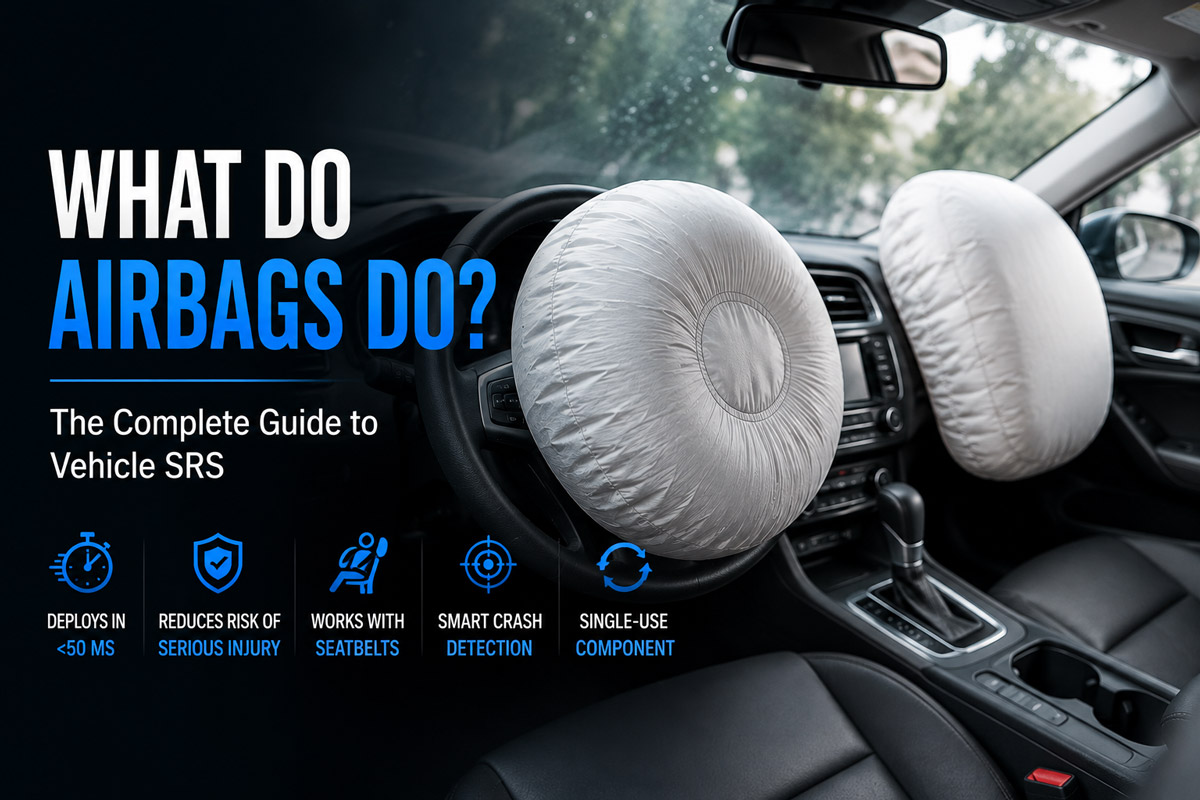
Airbags operate as a supplemental restraint system (SRS) designed to rapidly inflate upon collision, creating an energy-absorbing cushion between vehicle occupants and rigid interior surfaces. By deploying in under 50 milliseconds, airbags extend the duration of the occupant’s deceleration, dissipating kinetic energy and significantly reducing the risk of traumatic brain injuries and blunt-force chest trauma.
Key Facts / At a Glance
- Deployment Speed: The airbag fabric membrane bursts outward at speeds between 150 to 200 mph (241 to 322 km/h).
- Trigger Thresholds: Deployment typically requires deceleration forces equivalent to striking a solid barrier at 10–12 mph (unbelted) or 16 mph (belted).
- Gas Volume: A standard driver-side frontal airbag holds approximately 60 liters of gas; passenger-side units hold up to 120 liters due to the larger dashboard gap.
- Chemical Mechanism: Inflation is driven by the rapid ignition of solid propellants (like guanidine nitrate) expanding into harmless nitrogen or argon gas.
- Single-Use Component: Once deployed, airbag modules, sensors, and often the Airbag Control Unit (ECU) require complete replacement by a certified technician.
How Do Airbags Work? The 100-Millisecond Deployment Sequence
Airbags execute their entire lifecycle—from crash detection to complete deflation—in 50 to 100 milliseconds. For context, a human eye blink takes approximately 300 milliseconds. This rapid sequence requires a synchronized mechanical, electrical, and chemical process orchestrated by the vehicle’s Airbag Control Unit (ECU).
1. Impact Detection and Signal Processing (0–10 ms)
The process begins the exact millisecond a vehicle strikes an obstacle. Micro-electromechanical systems (MEMS) accelerometers and pressure sensors located in the front bumper, doors, and chassis measure the rapid rate of deceleration and structural deformation. The ECU processes this sensor data, comparing the deceleration curve against programmed crash algorithms to verify if the impact severity warrants deployment. Potholes, minor fender benders, and heavy braking are algorithmically filtered out.
2. Ignition and Chemical Propellant Reaction (10–15 ms)
Once the ECU verifies a severe crash, it sends a localized electrical current (an ignition signal) to the airbag module’s squib—a small heating element. This ignites a chemical propellant charge. Historically, manufacturers used sodium azide, but modern vehicles utilize safer compounds like guanidine nitrate, or compressed inert gases like argon and helium in hybrid inflators. This rapid exothermic reaction produces a massive, instantaneous volume of expanding nitrogen gas.
3. Expansion and Full Cushion (15–30 ms)
The expanding nitrogen gas forces the tightly folded nylon fabric to burst through predetermined, weakened seams in the steering wheel hub, dashboard, or seat trim. The airbag accelerates outward at up to 200 mph (322 km/h). By the 30-millisecond mark, the bag achieves full inflation at the exact microsecond the vehicle occupant’s body is thrust forward by inertia.
4. Controlled Deflation and Energy Absorption (50–100 ms)
Airbags are not designed to remain inflated. As the occupant’s body strikes the bag, the internal gas is immediately forced out through carefully calibrated microscopic vent holes in the rear of the nylon fabric. This dynamic venting absorbs the occupant’s kinetic energy, preventing them from violently rebounding backward and ensuring they are not trapped inside a smoke-filled cabin.
What Are the Main Types of Airbags in Modern Vehicles?
Modern automotive safety relies on an interconnected network of specialized airbags, each engineered to protect specific anatomical zones during different crash vectors.
| Airbag Type | Location | Primary Function | Gas Volume |
|---|---|---|---|
| Frontal (Driver) | Steering wheel hub | Prevents traumatic brain injury and sternum impact against the steering column. | ~60 Liters |
| Frontal (Passenger) | Dashboard | Protects the passenger’s head and upper torso; larger to cover the dashboard gap. | ~120 Liters |
| Side-Torso | Outer edge of seat backrests | Cushions the pelvis, ribs, and thorax during T-bone or side-impact collisions. | 15–20 Liters |
| Side-Curtain | Roof lining above windows | Deploys downward to prevent head strikes against glass; remains inflated longer for rollovers. | 30–40 Liters |
| Knee | Lower dashboard | Prevents shattered kneecaps and stops “submarining” (sliding under the seatbelt). | 10–15 Liters |
| Far-Side (Center) | Inner edge of driver’s seat | Prevents the driver and front passenger from violently colliding with each other during a side impact. | 15–20 Liters |
Emerging Airbag Technologies
Advanced engineering has introduced Seat Cushion Airbags, located under the front seat bases, which deploy upward to raise the occupant’s knees, further reducing submarining. Additionally, manufacturers like Volvo have pioneered External Pedestrian Airbags, which deploy from under the hood over the lower windshield to mitigate blunt-force trauma to pedestrians struck by the vehicle.
What Triggers an Airbag? Key Operational Thresholds and Smart Systems
Airbags are triggered by severe deceleration forces, not by vehicle speed or physical bumper damage alone. The standard deployment threshold is equivalent to striking a rigid, immovable wall at 10 to 12 mph for unbelted occupants, and roughly 16 mph for belted occupants. However, if you strike a yielding object (like another parked car), the deployment threshold may require a vehicle speed of 25 to 30 mph to generate the same requisite deceleration G-force.
Modern vehicles utilize Dual-Stage (Smart) Airbags to fine-tune this process. The ECU analyzes the occupant’s weight (via seat sensors), seat position, and the exact severity of the crash. Depending on this data, the ECU can trigger a primary, lower-pressure inflation for a minor crash with a smaller occupant, or a secondary, full-force inflation for a severe high-speed impact involving a larger adult.
Pros and Cons: Frontal vs. Side-Curtain Airbag Systems
All airbags provide life-saving benefits, but the biomechanical realities of deploying a fabric cushion at 200 mph introduce distinct trade-offs depending on the system type.
Frontal Airbags
- Pros: Highly effective at mitigating fatal chest impacts and preventing the skull from shattering against rigid steering columns or windshields. They work in perfect synergy with seatbelt pretensioners.
- Cons: The raw deployment force frequently causes facial abrasions (friction burns). The chemical residue (alkaline dust/cornstarch used to keep the bag pliable) can cause minor chemical skin irritation. Furthermore, the acoustic pressure wave generated inside the cabin (often exceeding 160 decibels) can cause temporary or permanent tinnitus (hearing loss).
Side-Curtain Airbags
- Pros: Side-curtain systems offer critical head tracking protection in side impacts, where vehicle crumple zones are a fraction of the size of the front hood. Unlike frontal airbags, side curtains are designed to stay inflated for several seconds to protect against secondary impacts and rollover spins.
- Cons: Because they cover expansive areas, replacement costs are exorbitantly high. Furthermore, their deployment paths can be dangerously obstructed by bulky aftermarket window tints, pillar gauges, or roof interior modifications.
How Much Does Airbag Replacement Cost?
Airbags cannot be repacked, repaired, or reused after deployment. The intense heat of the chemical reaction melts the internal housing, and the fabric is compromised. Restoring an SRS system requires complete component replacement by certified technicians, which often pushes older vehicles into “total loss” insurance status.
| Component | Average Parts Cost (OEM) | Average Total Cost (Installed) |
|---|---|---|
| Replacement Airbag Module | $450 – $600 | $700 – $1,200 per unit |
| Airbag Control Module (ECU) | $600 – $650 | $750 – $1,000 |
| Impact Sensors | $300 – $350 | $400 – $500 |
| Clock Spring (Steering Hub) | $300 – $350 | $400 – $450 |
A complete system restoration ranges from $1,500 for a single driver-side steering wheel deployment to over $5,000 if the passenger dash, side curtains, and seatbelt pretensioners all deploy simultaneously.
Expert Insight: Never use salvaged or aftermarket airbag modules. Counterfeit airbags often fail to deploy or contain improper propellants that turn the module into a fragmentation grenade. Always demand Original Equipment Manufacturer (OEM) parts.
Troubleshooting the SRS Warning Light
When the SRS (Supplemental Restraint System) warning light illuminates on your dashboard, the ECU has detected a fault and automatically deactivated the entire airbag network as a fail-safe measure. Your airbags will not deploy in a crash while this light is on.
- Symptom 1: SRS light illuminates after vacuuming or detailing. The most common culprit is a disrupted wiring harness connector pin located underneath the driver or front passenger seat, often knocked loose by a vacuum nozzle.
- Symptom 2: SRS light paired with a dead horn or dead steering wheel buttons. This indicates a fractured clock spring inside the steering column, completely severing the electrical circuit between the ECU and the driver’s frontal airbag module.
- Diagnostic Protocol: To identify the exact fault, you must connect an OBD-II scanner equipped with dedicated SRS capabilities to read the alphanumeric fault code. Never attempt to probe airbag electrical terminals with a standard digital multimeter; the low electrical testing current from the meter is enough to accidentally trigger the squib and deploy the airbag in your face.
Expert Safety Recommendations and Common Maintenance Mistakes
Airbags are engineered specifically as supplemental protection. When vehicle owners alter the cabin environment or misunderstand the system, airbags can transition from lifesaving devices to sources of severe trauma.
- The Seatbelt Synergy Mandate: Airbags assume the occupant is wearing a seatbelt. Seatbelt pretensioners retract slack during the first 5 milliseconds of a crash, locking the occupant in place so they meet the airbag after it has fully inflated. Without a seatbelt, the occupant’s body travels forward at the vehicle’s original speed, colliding with an airbag that is still expanding at 200 mph, frequently causing fatal cervical spine (neck) trauma.
- The 10-Inch Clearance Rule: Drivers must maintain a minimum distance of 10 inches between the center of the steering wheel and their breastbone. This gives the airbag the physical space required to expand completely before making body contact. Short-statured occupants should use adjustable pedal extenders rather than sitting flush against the wheel.
- Dashboard Obstruction Dangers: Placing cell phones, heavy mounts, or decorative items directly over the passenger airbag dashboard seam turns those items into high-velocity projectiles. At 200 mph, a smartphone resting on the dash becomes a lethal weapon.
- Aftermarket Seat Covers: Fitting decorative slipcovers over front seats completely blocks the side-torso airbags stitched into the seat bolsters. If a side-impact occurs, the bag will either fail to deploy or misdirect its force, entirely negating the pelvic and thoracic protection.
- Child Seating Rules: Never position a rear-facing infant seat in a front passenger slot equipped with an active airbag. The deployment force will instantly crush the back of the child seat. Children under 13 years old must always sit securely buckled in the rear seats.
Frequently Asked Questions (FAQ)
Can an airbag deploy if the car is turned off?
In most modern vehicles, the airbag system is deactivated when the ignition is turned entirely off. However, the ECU retains a capacitor charge for several minutes after the car is shut down. If a parked car is struck violently within that brief window, or if the ignition is in the “accessory” position, the airbags can still deploy.
Why do airbags smell like smoke after deploying?
The smoke is actually a harmless mixture of alkaline chemical dust, talcum powder, and cornstarch used to lubricate the nylon bag during manufacturing, preventing it from sticking together. The burnt smell originates from the propellant’s thermal reaction, not an actual cabin fire.
Can airbags expire or go bad over time?
Early airbags from the 1990s used chemical seals that degraded, leading manufacturers to recommend replacement after 10 to 15 years. Modern vehicles (post-2000) feature improved glass-to-metal seals designed to last the lifetime of the vehicle, though the ECU self-checks the electrical components every time you turn the key.
Will an airbag deploy if I hit an animal?
It depends entirely on the size of the animal and the resulting deceleration force. Striking a small dog or raccoon will not generate enough G-force to trigger the sensors. Striking a 1,000-pound moose or large deer at highway speeds, however, causes massive structural deformation and rapid deceleration, which will almost certainly trigger a frontal deployment.