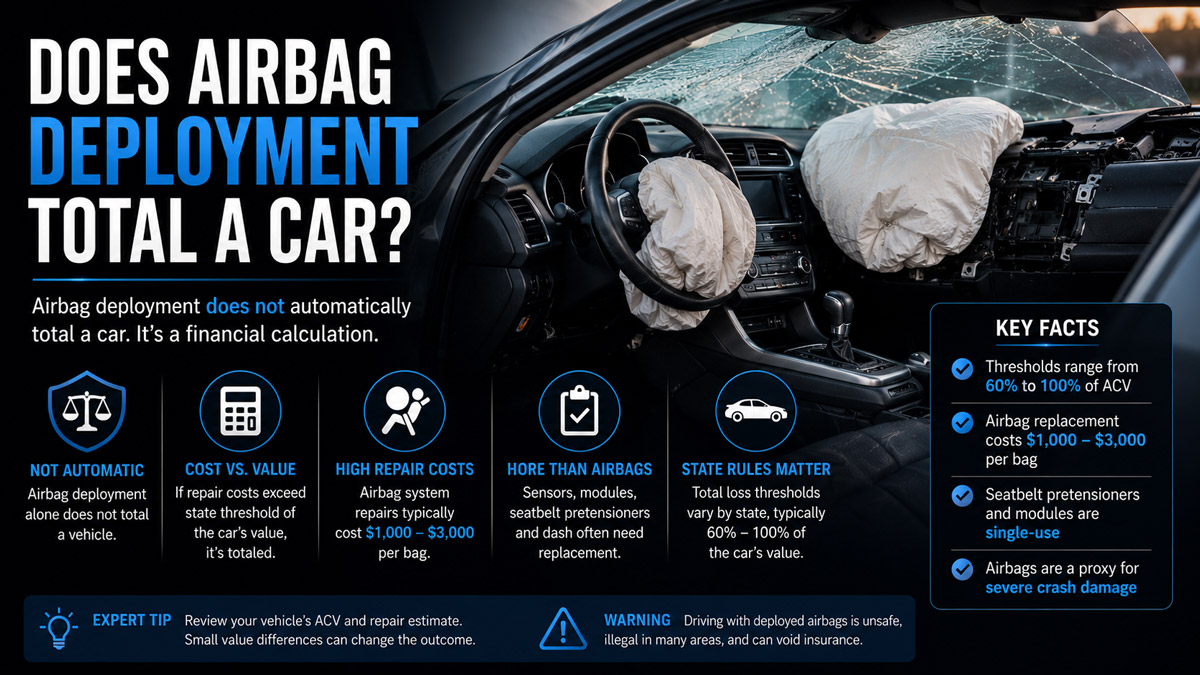
Does airbag deployment total a car? Airbag deployment does not automatically total a car. A vehicle is declared a total loss only when the combined cost of all collision repairs—including the high cost of restoring the airbag system—reaches a state-mandated percentage of its Actual Cash Value (ACV). It is purely a financial calculation.
Key Facts / At a Glance
- The Threshold Rule: Insurance total loss thresholds vary by state, generally ranging from 60% to 100% of a vehicle’s pre-crash value.
- System Costs: Replacing a deployed airbag system costs between $1,000 and $3,000 per bag due to sensors, modules, and dashboard replacements.
- Not Just Fabric: A deployment event fires single-use pyrotechnic seatbelt pretensioners that must also be replaced.
- The Proxy Effect: Airbags do not total cars by law; rather, their deployment is a proxy indicator of severe crash force, often correlating with hidden structural frame damage.
- Warning: Cutting away deflated airbags to continue driving disables the entire Supplemental Restraint System (SRS) and routinely voids insurance coverage.
How Does an Insurance Company Decide to Total a Car?
An insurance company decides to total a car by comparing the line-item repair estimate against the vehicle’s Actual Cash Value (ACV) immediately prior to the crash. If fixing the vehicle is economically impractical based on state insurance laws, the adjuster declares a “constructive total loss.”
To arrive at this decision, insurers calculate the fundamental total loss equation:
$$\text{Total Repair Bill} = \text{Body and Mechanical Damage} + \text{Airbag System Restoration Cost}$$
Once the total repair bill is calculated, adjusters apply one of two distinct legal methodologies to determine the vehicle’s fate, depending on the jurisdiction.
What is the Threshold Method?
In the majority of US states, a vehicle is totaled if the repair bill exceeds a flat statutory percentage of the ACV. These thresholds are rigidly set by state law. For example, New York enforces a 75% threshold, Florida uses 80%, and Texas allows up to 100%. If your car is worth $10,000 in New York, any repair estimate over $7,500 automatically totals the vehicle.
What is the Total Loss Formula (TLF)?
States like California and Illinois utilize the Total Loss Formula (TLF) instead of a flat percentage. Under the TLF, a vehicle is totaled if the cost of repairs plus the scrap value of the wrecked car equals or exceeds the pre-crash ACV:
$$\text{Estimated Repair Cost} + \text{Actual Salvage Value} \ge \text{Actual Cash Value (ACV)}$$
Expert Insight: Adjusters rely on proprietary software like CCC ONE to determine your ACV. If your car is on the borderline of being totaled and you wish to save it, demand the valuation report. Adjusters frequently miss trim packages, recent major maintenance, or aftermarket upgrades that could raise the ACV and keep the car below the total loss threshold.
How Much Does It Cost to Replace Deployed Airbags?
The cost to replace deployed airbags averages $1,000 to $3,000 per deployed bag. Restoring a Supplemental Restraint System (SRS) requires replacing multiple single-use electronic and physical safety structures, not just the nylon fabric cushion.
When an Airbag Control Module (ACM) detects a crash, it initiates a chemical reaction using solid propellants (like sodium azide) to inflate the bags in roughly 30 milliseconds. This violent, one-time pyrotechnic event destroys surrounding interior components.
Line-Item Cost Breakdown
| Component | Function in SRS System | Average Replacement Cost |
|---|---|---|
| Individual Airbags | The physical nylon cushion and gas generator module. | $200 – $700 per bag |
| Airbag Control Module (ACM) | The computer that records crash data and triggers deployment. | $300 – $1,000+ |
| Seatbelt Pretensioners | Pyrotechnic charges that lock seatbelts upon impact. | $150 – $400 each |
| Dashboard Assembly | Structural paneling often shattered by passenger airbag deployment. | $1,000 – $2,500+ |
| ADAS Recalibration | Software alignment for post-crash safety sensors and cameras. | $300 – $800 |
Which Airbag Replacement Parts Should You Use?
Choosing the right replacement parts dictates the safety, legality, and total cost of the repair. If your vehicle is hovering near the total loss threshold, the type of parts selected by the collision center will dictate the final outcome.
1. New OEM (Original Equipment Manufacturer) Parts
New OEM parts are sourced directly from the vehicle manufacturer. They are guaranteed to seamlessly integrate with your vehicle’s crash dynamics and carry full factory safety warranties.
- The Drawback: They are overwhelmingly expensive. Insisting on brand-new OEM dashboard assemblies and curtain modules will frequently push a mid-value car over the total loss threshold.
2. Certified Salvage OEM Parts
Salvage OEM parts are sourced from un-crashed donor vehicles at licensed dismantling yards. They slash repair costs by up to 50%, often saving older vehicles from the salvage yard.
- The Drawback: Legality varies strictly by state. They require rigorous vendor verification to ensure the internal propellants have not degraded from environmental exposure, and they carry no factory warranty.
3. Aftermarket Modules (Avoid)
Aftermarket airbags are manufactured by third-party companies. While cheaper, we strongly advise against their use. Modern SRS networks require exact voltage resistance measurements to function. Aftermarket bags routinely cause software compatibility errors with the ACM, leaving the dashboard airbag warning light illuminated permanently. Furthermore, unregulated online sellers frequently distribute counterfeit replica covers containing no explosives or cushions at all.
Does Vehicle Value Determine the Final Outcome?
Yes, the Actual Cash Value (ACV) of your specific vehicle is the ultimate deciding factor. Because airbag replacement costs are relatively fixed—a Honda Civic airbag costs roughly the same to replace as an Acura airbag—the car’s market equity dictates its survivability.
Older or Low-Value Vehicles (ACV under $8,000)
Airbag deployment almost universally totals these cars. If a $6,000 vehicle requires a $1,500 bumper and $3,500 in airbag restoration, it immediately breaches the threshold. Accept the insurance payout. If the powertrain remains pristine, you can negotiate a “salvage buyback” to keep the car, utilizing mail-in ACM reset services ($50–$100) to safely wipe crash data from the existing module.
Mid-Value Vehicles (ACV $8,000 to $18,000)
This is the volatile “tipping zone.” The decision hinges entirely on secondary body damage. If side curtain airbags deploy alongside a T-bone impact, require the collision shop to perform a structural frame alignment check before committing to repairs.
Expert Insight: If structural steel frame rails are bent alongside airbag deployment on a mid-value car, push your insurance adjuster to declare a total loss. Repairing both compromises the structural integrity of the vehicle in a subsequent crash and leads to chronic tire tracking issues.
Late-Model or Luxury Vehicles (ACV over $20,000)
Vehicles with high equity easily absorb a multi-thousand dollar safety restoration. Insist on a complete repair using exclusively brand-new OEM parts at a certified collision center. Do not permit aftermarket components on late-model vehicles, as modern Advanced Driver Assistance Systems (ADAS) rely on highly calibrated, proprietary factory sensors to operate correctly.
What Are the Common Post-Crash Pitfalls?
Failing to properly manage a vehicle after an airbag deployment introduces severe physical and financial liabilities.
- Cutting out deployed bags: Drivers occasionally cut away deflated fabric cushions with scissors to drive the car home. This leaves the system disabled and flags the vehicle for insurance cancellation.
- Skipping module diagnostics: Merely bolting in a new steering wheel module without clearing the “Hard Crash Data” locked inside the ACM will keep the system offline. If you crash again, the new airbags will not deploy.
- Ignoring the Clockspring: A persistent “Open Circuit” diagnostic code usually indicates a torn steering wheel clockspring—the spiral electrical cable that maintains connection to the driver’s airbag while the wheel turns. It must be replaced alongside the bag.
Frequently Asked Questions (FAQ)
Can you drive a car with deployed airbags?
No, it is highly dangerous and largely illegal to drive a vehicle with deployed airbags. A deployment event disables the entire Supplemental Restraint System, meaning neither the remaining airbags nor the seatbelt pretensioners will function in a secondary collision. Furthermore, deployed bags physically obstruct the driver’s view and steering column.
Do deployed airbags ruin the engine?
Airbag deployment does not directly damage the engine block or internal mechanicals. However, in many modern vehicles, a crash severe enough to trigger the airbags will automatically sever the fuel pump circuit to prevent post-crash fires. This makes the engine temporarily inoperable until the system is reset.
How fast do airbags deploy during a crash?
An airbag deployment is an engineered sequence completed within 100 milliseconds. Upon impact (0 ms), sensors evaluate the crash severity (5–10 ms). If thresholds are met, chemical propellants ignite (15 ms), fully inflating the bag to catch the occupant by 30 milliseconds—a speed of up to 200 mph.
Can I keep my car if the insurance company totals it?
Yes, you can retain possession through a “salvage buyback.” The insurer will deduct the vehicle’s scrap value from your total settlement check. However, the state will re-brand the car with a “Salvage Title,” making it difficult to finance, legally insure for collision, or resell in the future.
Do side curtain airbags cost more to replace than steering wheel airbags?
Yes, side curtain and passenger-side airbags generally cost significantly more to replace in labor alone. While a driver’s steering wheel module takes under an hour to swap, deploying a side curtain usually requires removing the vehicle’s entire interior headliner, pillar trim panels, and occasionally the seats.
The Bottom Line: Does airbag deployment total a car? Not on its own. Totaling a vehicle is a strict accounting procedure. If the sum of the mechanical bodywork plus the extensive cost of replacing airbags, modules, and seatbelts crosses your state’s threshold limit, the car will be totaled.