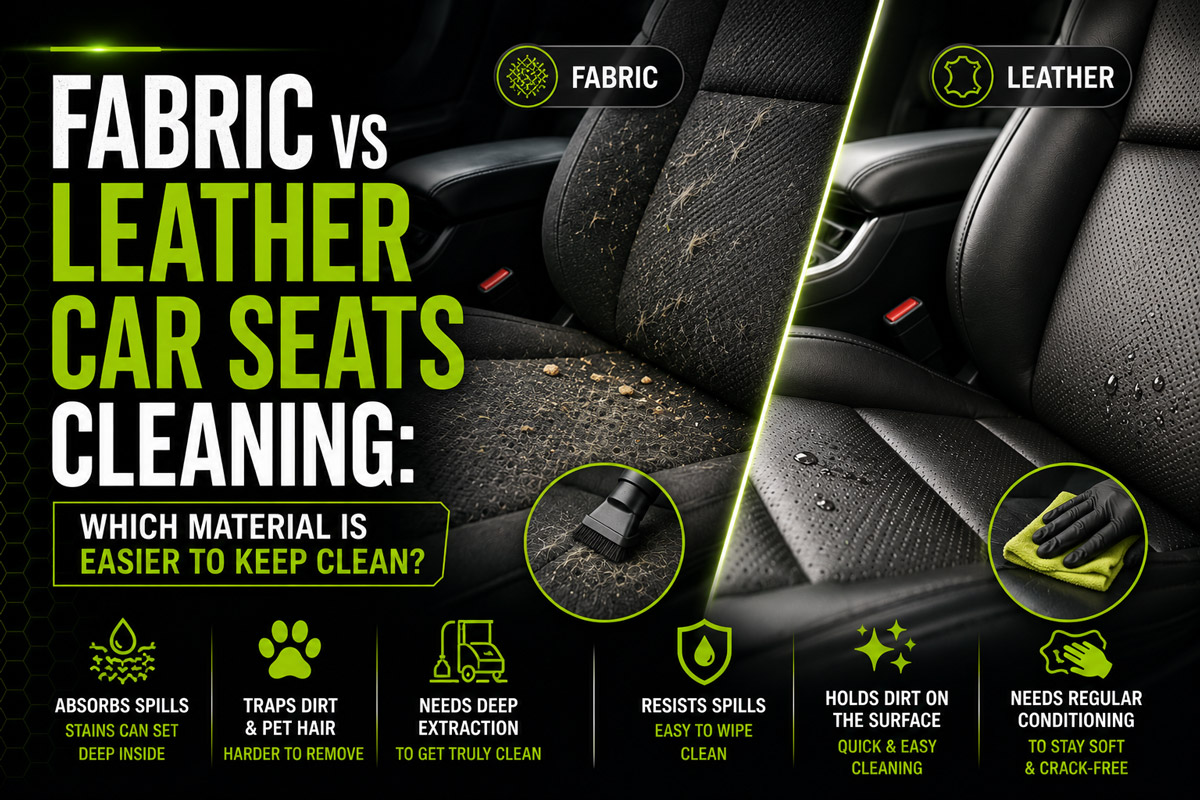
Choosing between fabric and leather car seats is one of the most practical decisions you will make when purchasing or refurbishing a vehicle. While vehicle manufacturers often market leather as a high end luxury feature and fabric as an economical standard, practical vehicle owners care most about daily reality: which surface resists spills, repels dirt, handles pet messes, and requires the least amount of effort to keep spotless over time?
The quick answer is that neither material wins unconditionally across every single maintenance scenario. Genuine leather offers unmatched day to day convenience for liquid spills and surface dust, while fabric offers forgiving structural durability that avoids cracking or requiring special conditioning treatments. Meanwhile, modern synthetic leather alternatives combine the non porous protection of topcoat leather with zero conditioning demands.
In this comprehensive guide, we examine the science of surface porosity, spill dynamics, odor retention, pet hair management, deep extraction methods, and long term conditioning routines so you can choose the ideal interior for your lifestyle.
Spill Mechanics and Surface Porosity: Hydrophobic Leather vs Absorbable Fabric
To understand which seat material is easier to keep clean, you must first understand surface porosity. The speed at which a material absorbs liquid determines whether a spill remains a two second wiping job or becomes a permanent deep stain.
Leather Seats: Hydrophobic Barrier Protection
Standard automotive leather is not raw hide. Modern car interiors utilize sealed leather coated with a clear protective polyurethane topcoat. This coating creates a hydrophobic surface barrier.
When liquid like coffee, soda, juice, or water lands on a clean leather seat, surface tension prevents immediate absorption. The liquid pools on top of the smooth surface, allowing you to wipe it away instantly using a microfiber towel without leaving a mark behind.
Fabric Seats: Rapid Capillary Action
Woven fabric upholstery consists of thousands of synthetic fibers, usually polyester or nylon blends. These woven strands naturally create micro channels that draw liquids downward through capillary action.
When a drink spills onto a cloth seat:
- The liquid penetrates the outer surface within seconds.
- The moisture travels deep into the core fibers of the seat cushion.
- Spills reach the dense polyurethane foam beneath the fabric layer.
Once a liquid reaches the internal seat foam, surface wiping becomes completely ineffective. Removing the liquid requires hot water extraction equipment or chemical shampooing to pull embedded moisture back out.
Surface Absorption Speed Comparison
Day to Day Cleanup: Dust, Debris, and Pet Hair Removal
For routine weekly cleaning during a quick car wash, daily dust and dry debris behave very differently on leather versus cloth.
Dry Debris and Dust Sweeping
- Leather Seats: Dust, crumbs, dirt, and dried sand remain entirely on top of the material. A dry microfiber cloth, a soft interior brush, or a standard vacuum nozzle can remove 100% of loose particles in seconds.
- Fabric Seats: Fine particles like dust, ash, sand, and dry soil work their way down into the weave matrix. Simply running a vacuum across cloth seats often leaves fine dirt embedded inside the fibers, requiring an agitator brush or high powered suction tool to loosen.
The Pet Hair Challenge
If you travel with dogs or cats, pet hair is a major factor in seat maintenance:
- Fabric Interlocking Effect: Short and stiff pet hairs act like tiny needles. They spear into woven fabric meshes, intertwining so tightly that standard vacuuming fails to lift them. Removing pet hair from cloth seats requires rubber squeegees, pumice stones, static brushes, or tedious manual extraction.
- Leather Glide Surface: Fur cannot penetrate or hook into leather. Pet hair rests loosely on top of the seat or slides into seam corners, where it vacuums away instantly.
Deep Cleaning Demands: Fabric Extraction vs Leather Conditioning
While leather wins handily for quick daily wipe downs, the long term maintenance requirements tell a very different story. This is where fabric often earns its reputation as a low upkeep option overall.
Fabric Seat Deep Cleaning: Shampoo and Water Extraction
Fabric requires zero chemical conditioning, UV nourishment, or moisture preservers. Its structural integrity remains intact even if you ignore it for years. However, when fabric becomes heavily soiled, deep cleaning requires dedicated equipment:
- Step 1 Vacuuming: High suction vacuuming to clear dry particulate matter.
- Step 2 Pre Treatment: Spraying specialized fabric shampoo or enzymatic cleaner onto grease or organic spots.
- Step 3 Mechanical Agitation: Using a stiff nylon brush or drill brush attachment to break up embedded grime inside the fiber matrix.
- Step 4 Hot Water Extraction: Using an extractor machine to inject hot water under pressure while simultaneously vacuuming out dirty liquid from the seat foam.
- Step 5 Drying Time: Leaving windows cracked or running air air blowers for several hours to prevent mildew growth inside wet seat padding.
Leather Seat Maintenance: Cleaning and Conditioning Protocol
Leather will never require a water extractor, but it demands consistent preventative maintenance. Without routine conditioning, natural hide loses its essential oils over time, especially when exposed to direct sunlight and cabin heat.
- Cleaning Phase: Wiping seats with a pH balanced leather cleaner to lift body oils, denim dye transfer, and perspiration without stripping protective topcoats.
- Conditioning Phase: Applying a nourishing leather conditioner every 3 to 4 months. Conditioning preserves flexibility, prevents drying out, shields against UV radiation, and stops premature cracking.
- Neglect Consequence: If you completely neglect leather seats for several years in hot climates, the material dries out, hardens, turns shiny, and permanently splits along high flex seams. Deep cracks in leather cannot be washed away; they require professional re-upholstery or color restoration.
The Hidden Trap: Perforated Leather vs Standard Woven Cloth
Many modern vehicles equipped with heated and ventilated seats feature perforated leather upholstery. Perforations are micro holes punched into the leather to allow air from internal cooling fans to circulate through the seat cushion.
While perforated leather feels luxurious, it presents a unique cleaning hazard that often catches vehicle owners off guard:
- Liquid Traps: When drinks spill over perforated leather, liquid shoots straight through the micro holes directly into the internal heating pads and ventilation ducts below.
- Cleaner Clogging: Thicker creamy leather conditioners or liquid cleaners can fill up the tiny perforation holes. Once dry, the product hardens into unsightly white dots inside every hole that are frustratingly difficult to pick out with toothpicks or detail brushes.
- Special Technique Required: Cleaning perforated leather demands light liquid spray onto a towel first rather than spraying directly onto the seat surface, followed by immediate vacuuming with an attachment to pull liquid out of the holes.
Odor Retention and Allergen Control: The Invisible Dirt
Cleanliness is not just about what your eyes can see; smell and microscopic air quality matter just as much.
Fabric: The Sponge for Odors and Allergens
Fabric seat cushions absorb ambient cabin moisture, sweat, body oils, pet dander, spilled milk, and smoke. Over months and years of daily use:
- Bacterial Growth: Moisture combined with spilled organic material trapped in deep foam creates ideal conditions for bacteria, producing lingering odors.
- Dust Mite Habitats: Woven cloth harbors dust mites, pollen, and pet dander, making it challenging for drivers with severe allergies.
- Spill Relapse: Old stains deep in the foam can wick back up to the surface weeks after cleaning as the seat dries.
Leather: Non Porous Barrier for Fresh Cabin Air
- Zero Absorption: Sealed leather does not absorb sweat, smoke, spilled beverages, or pet dander.
- Instant Wipe Away: Odor causing substances stay on top of the surface, where an antibacterial wipe removes them completely.
- Hypoallergenic Environment: Allergens cannot embed themselves inside hide, allowing car owners with asthma or dust sensitivities to maintain a cleaner cabin atmosphere with minimal effort.
Synthetic Leather (Leatherette / Vegan Leather): The Ultimate Upkeep Champion?
If you are evaluating fabric versus leather primarily for ease of cleaning, you should strongly consider synthetic leather options. Known variously as leatherette, faux leather, vegan leather, MB-Tex, Sensatec, or V-Tex, these modern materials are engineered using high grade polyurethane or vinyl layers over a synthetic backing.
Why Synthetic Leather Wins the Upkeep Battle
Synthetic leather offers the best features of both real leather and fabric:
- Stain and Spill Resistance: It is entirely non porous. Coffee, ink, mud, and sticky candy wipe off instantly with a damp cloth.
- No Conditioning Needed: Unlike genuine hide, synthetic vinyl coatings do not dry out, shrink, or require expensive leather nourishing creams to stay supple.
- Superior UV Resistance: High quality synthetic leathers resist heat breakdown and UV cracking far better than unconditioned real leather.
- Cost Effective Care: Standard all purpose interior cleaners or mild soapy water are all you need to keep synthetic seats in factory condition.
Comprehensive Upkeep Feature Comparison
The following table breaks down how each material performs across key cleaning criteria, daily messes, and maintenance costs:
Overall Upkeep Score Graphic
Lifestyle Decision Matrix: Which Material Fits Your Routine?
To decide which seat material will prove easiest to clean in your daily life, match your primary use case to the scenarios below:
1. Families with Young Children
- Recommendation: Synthetic Leather or Sealed Genuine Leather
- Why: Toddlers regularly drop juice boxes, milk cups, ice cream, and sticky snacks. Leather or synthetic leather seats turn what would be permanent cloth stains into a quick 30 second wipe down with a baby wipe or towel.
2. Dog and Cat Owners
- Recommendation: Synthetic Leatherette
- Why: Synthetic leather resists dog claws better than delicate topcoat leather while allowing pet fur to be wiped away instantly. It completely eliminates embedded pet hair frustration and wet dog odor absorption.
3. Tradespeople and Outdoor Adventurers
- Recommendation: Durable Fabric with Custom Water Resistant Seat Covers
- Why: Heavy tools, sharp pocket items, work boots, and dirty gear can gouge or scratch leather coatings. Fabric seats handle physical abuse without tear risks, and high quality waterproof fitted covers can protect the cloth from mud and grease.
4. Daily Commuters and Rideshare Drivers
- Recommendation: Synthetic Leather or Genuine Leather
- Why: Passenger turnover introduces dirt, rain, sweat, and occasional food spills. Smooth leather non porous surfaces can be sanitized with disinfectant wipes between rides to keep the cabin looking and smelling fresh for passengers.
Step by Step Spot Cleaning Action Protocols
Whether your car has fabric or leather, knowing how to react immediately to a fresh spill makes all the difference:
Quick Clean Protocol for Fresh Spills on Leather
- Blot Immediately: Use a clean, dry microfiber cloth to dab up liquid pooling on top of the seat. Avoid aggressive rubbing, which spreads liquid into seam stitching.
- Apply pH Balanced Cleaner: Lightly mist a dedicated leather cleaner onto your microfiber towel, not directly on the seat.
- Gently Wipe Surface: Move in light circular motions to remove residue.
- Buff Dry: Use a separate dry towel to remove excess moisture completely.
Emergency Extraction Protocol for Fresh Spills on Fabric
- Press to Absorb: Immediately press an absorbent dry towel firmly into the spill to draw liquid out of the top fibers before it seeps into the cushion foam.
- Apply Fabric Cleaner: Spray an interior upholstery cleaner or mild detergent solution onto the spot.
- Agitate Gently: Work the cleaner into the fibers using a soft bristle detail brush.
- Blot with Microfiber: Press clean dry towels repeatedly into the area to wick out dirty moisture.
- Air Out: Leave car windows open or turn on fans until the seat padding dries completely.
Conclusion: The Final Verdict on Ease of Cleaning
When evaluating whether fabric or leather seats are easier to keep clean, the winner depends on how you define maintenance:
- For Day to Day Cleanliness: Leather wins decisively. Its non porous clear topcoat repels liquid spills, resists mud stains, prevents odor absorption, and makes pet hair removal quick and painless.
- For Zero Preservative Upkeep: Fabric wins for low structural effort. It never requires specialized leather conditioners, UV preservers, or cracking protection creams.
- For the Absolute Easiest Maintenance Overall: Synthetic Leatherette takes top honors. It provides the spill shedding simplicity of genuine leather without requiring conditioning treatments or being susceptible to UV drying and cracking.
If your priority is maintaining a spotless car interior with minimal daily effort, choosing leather or synthetic leatherette will save you countless hours of scrubbing and deep water extraction over the life of your vehicle.
Next Step: Take Control of Your Car Interior Upkeep
Ready to protect your vehicle seats and make your cleaning routine effortless?
- Explore Our Detailing Guides: Read our expert walkthroughs on selecting pH balanced leather cleaners, soft bristle detail brushes, and interior UV protectants.
- Schedule a Professional Consultation: If your car seats have stubborn set in stains, deep foam odors, or dry leather seams, contact our interior detailing team today for a custom extraction and restoration package!