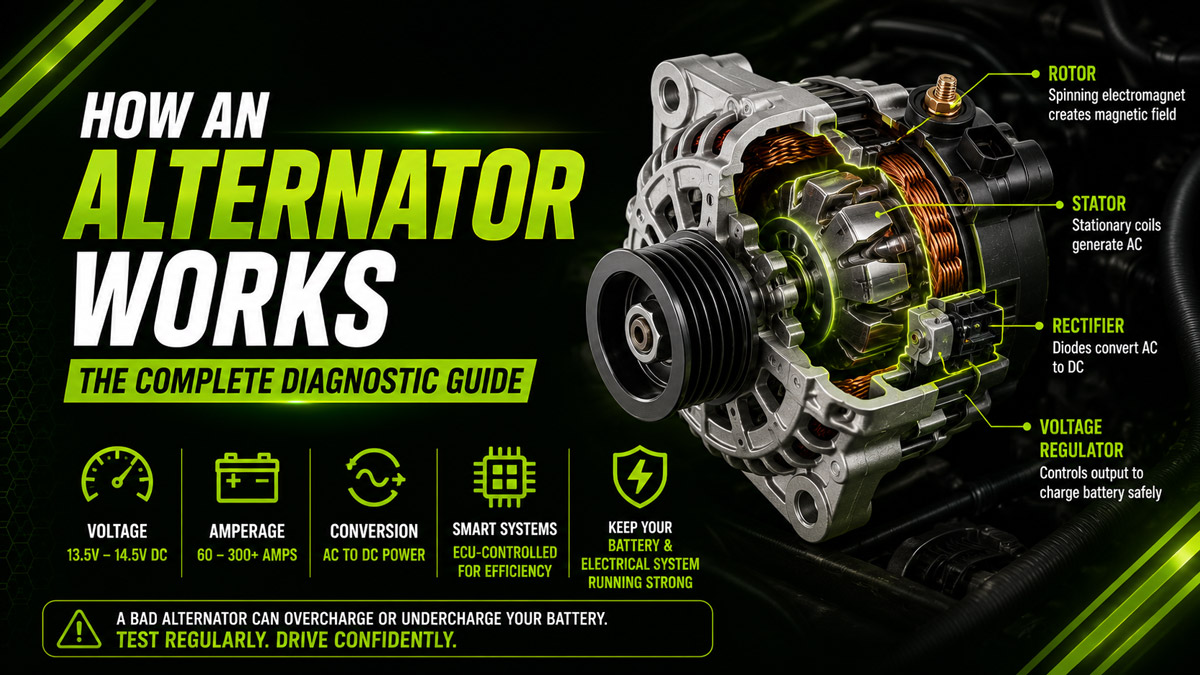
An alternator is a vehicle’s primary electrical generator, converting mechanical energy from the engine into alternating current (AC) through electromagnetic induction. A built-in rectifier then converts this AC power into direct current (DC) to continuously charge the battery and run the vehicle’s electrical systems while the engine is running.
At a Glance:
- Voltage: A healthy standard alternator outputs between 13.5V and 14.5V DC.
- Amperage: Modern units produce 60–120 amps at idle, and up to 300+ amps at peak RPM.
- Conversion: Alternators inherently generate AC power; a 6-diode bridge rectifier converts it to DC.
- Danger: Disconnecting a battery terminal on a running modern car will fry the ECU due to a massive voltage spike.
- Smart Systems: Modern Euro 6 alternators are computer-controlled and will intentionally drop output to 12.2V to save fuel.
What are the main parts of an alternator?
An alternator relies on three primary components to generate and control electricity: the rotor, the stator, and the voltage regulator. The process begins with the engine’s serpentine belt, which spins the alternator’s pulley.
- The Rotor: This is a spinning electromagnet located at the center of the alternator. It receives a small electrical current to create a magnetic field, and it spins at thousands of RPMs inside the housing.
- The Stator: The stator is a stationary iron ring wrapped in three separate nests of heavy copper wire (windings). As the rotor’s magnetic field spins rapidly past these stationary copper coils, it induces a 3-phase alternating current (AC) in the wires.
- The Voltage Regulator: This component monitors the battery’s state of charge and electrical demand. It controls the alternator’s output by adjusting how much power is sent to the rotor’s electromagnet. More power to the rotor equals a stronger magnetic field and higher output.
How does an alternator convert AC to DC?
An alternator converts alternating current (AC) into direct current (DC) using a component called a diode bridge rectifier. Vehicles cannot use AC power because their computers, sensors, and batteries require a steady, one-way flow of electricity.
The rectifier acts as a one-way electrical valve. It consists of six silicon diodes arranged in a specific configuration. As the stator produces the 3-phase AC voltage—which naturally pushes and pulls electricity back and forth in a wave—the diodes block the backward flow. By only allowing the positive half of the wave to pass through to the battery terminal, the rectifier clips off the negative flow, flattening the choppy AC wave into a usable, steady DC output.
What is the difference between an alternator and a generator?
The primary difference lies in what component spins and what stays stationary. In an alternator, the magnetic field (rotor) spins inside stationary wire coils (stator). In a traditional generator, the wire coils spin inside a fixed, stationary magnetic field.
Because an alternator’s heavy output windings remain stationary, it can be built much lighter and spin much faster without flying apart from centrifugal force. Generators must transfer their heavy output current through mechanical carbon brushes (commutators), which wear out quickly and arc at high speeds. Alternators only transfer a tiny field current through their brushes, making them vastly more durable. Crucially, alternators can produce highly usable amperage at low engine idle speeds, whereas old DC generators often left batteries to drain at stoplights.
How much power does an alternator produce?
A typical modern alternator produces between 60 and 120 amps at engine idle, scaling up to a maximum of 140 to over 300 amps at peak operational speeds (typically above 3,000 engine RPM).
Amperage output is not static; it scales based on physical RPM and thermal conditions. Heat is the natural enemy of electrical generation. An alternator’s efficiency drops by roughly 1% for every 10°C rise above an ambient 20°C. In extreme scenarios where under-hood temperatures exceed 100°C, the alternator’s maximum amperage output can be cut by up to 30%. This thermal de-rating is why heavy-duty towing vehicles often feature secondary or liquid-cooled alternators.
How does a smart alternator operate differently?
Smart alternators are computer-controlled units that decouple battery charging from engine RPM to maximize fuel efficiency and reduce emissions. Unlike traditional alternators that blindly maintain a constant 14.2V output whenever the engine is running, a smart alternator receives dynamic commands via a Lin-Bus or CAN-bus network.
If the Powertrain Control Module (PCM) determines the battery is fully charged, it will intentionally command the smart alternator to drop its output down to as low as 12.2V during hard acceleration, effectively shutting off the heavy magnetic drag on the engine to save fuel. Conversely, during regenerative braking or deceleration, the ECU will spike the voltage up to 15.2V to dump “free” kinetic energy into the battery.
Can a bad alternator ruin a brand-new battery?
Yes, a failing alternator will rapidly destroy a brand-new battery. The damage occurs in two distinct ways, depending on how the alternator’s voltage regulator fails.
If the regulator fails in a closed position and overcharges the system (pushing more than 15.0V), the excessive heat will literally boil the electrolyte acid out of a new battery, warping its internal lead plates. Conversely, if the alternator undercharges the system, the vehicle will constantly pull reserve power from the battery. Car batteries are “starting batteries,” not deep-cycle batteries; continuously draining and recharging them causes rapid sulfation. This coats the internal plates with lead sulfate crystals, permanently destroying the battery’s capacity to hold a charge within a matter of weeks.
Why does the alternator squeal when I turn on the headlights?
An alternator squeals under electrical load because the heavy demand for electricity creates intense mechanical resistance, causing a loose or worn serpentine belt to slip against the pulley.
When you turn on high-draw components like headlights, seat heaters, or the rear defroster, the voltage regulator commands the rotor to maximize its magnetic field to meet the demand. This strong magnetic field essentially acts as a brake, making the rotor physically much harder to spin. If the rubber serpentine belt is glazed, cracked, or if the automatic belt tensioner has weakened, the belt lacks the friction to overcome this sudden mechanical resistance. It slips over the metal pulley, producing a high-pitched squeal.
Why is testing an alternator by disconnecting the battery dangerous?
Disconnecting a negative battery cable while the engine is running to test an alternator is highly dangerous because it creates a massive voltage spike—known as a “load dump”—that instantly destroys modern vehicle electronics.
The battery acts as a massive electrical capacitor, absorbing and smoothing out the raw voltage produced by the alternator. If you remove the battery from the circuit while the alternator is generating power, the voltage regulator loses its reference point. The alternator’s output can instantly surge to over 100 volts DC for a fraction of a second. This load dump will permanently fry the Powertrain Control Module (PCM), infotainment systems, and critical engine sensors, resulting in thousands of dollars in catastrophic electrical damage.
What is AC ripple in an alternator?
AC ripple is raw alternating current leaking into a vehicle’s direct current system due to one or more blown diodes in the alternator’s rectifier bridge.
A standard digital multimeter set to DC volts might show a perfectly healthy 14.0V reading, deceiving mechanics into thinking the alternator is fine. However, if a diode fails, the alternator bleeds AC voltage over the DC line. Anything above 0.5V AC is considered a harmful ripple. This AC ripple confuses digital logic circuits, causes random check engine lights, makes gauges twitch erratically, and keeps vehicle computers “awake” after the car is turned off, leading to a dead battery overnight.
What are the signs of a failing alternator?
The earliest symptoms of a failing alternator usually manifest as electrical inconsistencies before the vehicle experiences a complete breakdown. Because modern cars prioritize power delivery, they will shut down non-essential systems first to keep the engine running.
- Battery Warning Light: The red battery icon on the dashboard is actually an alternator charging system warning, indicating the vehicle is running on battery reserve power.
- Dimming or Flickering Lights: Headlights that pulse in time with engine RPM or dim when rolling up power windows point directly to weak voltage regulation.
- Growling or Whining Noises: A mechanical grinding or low growling sound indicates the alternator’s internal bearings are failing, while a high-pitched whine often indicates a shorted stator winding.
- Electrical Gremlins: The radio shutting off abruptly or power steering becoming heavy are signs the car’s computers are load-shedding to preserve power for spark plugs and fuel injectors.
How long does an alternator last, and what does it cost to replace?
A factory original alternator typically lasts between 80,000 and 150,000 miles (roughly 7 to 10 years) under normal driving conditions. Replacement costs generally range from $400 to $900, including both parts and labor.
The cost is highly dependent on the vehicle make and alternator amperage. A standard 100-amp alternator for a domestic sedan may cost $150 in parts and take an hour to install. However, a high-output, computer-controlled smart alternator for a European luxury SUV can cost upwards of $600 just for the part. Additionally, some transverse-mounted engines require the removal of the subframe or cooling fans to access the alternator, pushing labor costs significantly higher.
The Bottom Line
An alternator is the heart of a vehicle’s charging system, using a spinning electromagnet to generate AC power that is then rectified into usable DC power. While traditional units operate on simple mechanical principles to provide a steady 14V, modern vehicles utilize smart alternators controlled by the ECU to dynamically alter voltage for fuel efficiency. Diagnosing electrical issues today requires understanding these computerized nuances; relying on outdated static voltage tests or battery disconnects will likely destroy sensitive electronics rather than fix the problem.