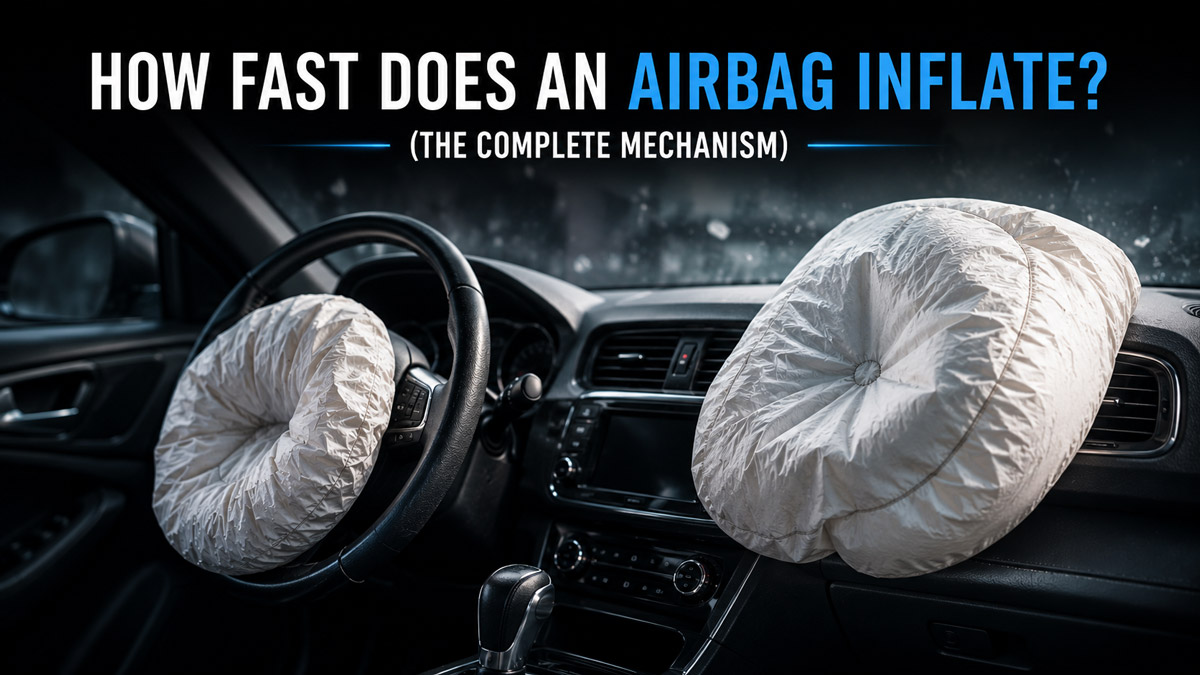
When asking how fast does an airbag inflate, the exact timeline is 20 to 40 milliseconds—roughly 0.02 to 0.04 seconds. This is approximately 10 times faster than the blink of a human eye. During a severe collision, the supplemental restraint system (SRS) deploys the fabric cushion at speeds reaching 200 mph (322 km/h) to safely catch occupants before they strike the vehicle’s interior.
Key Facts / At a Glance
- Driver vs. Passenger: Driver airbags deploy in 20–30 milliseconds; passenger airbags require 30–40 milliseconds due to their larger protective volume.
- Sensor Threshold: Activation requires a sudden deceleration (Delta-V) equivalent to hitting a rigid barrier at 10 to 14 mph.
- Chemical Reaction: Modern inflators ignite gas-generant compounds like Guanidine Nitrate to produce massive volumes of nitrogen gas instantly.
- Deflation Speed: The bag begins deflating through rear vent holes almost immediately (40–100+ milliseconds) to absorb kinetic energy and prevent occupant bounce-back.
- Replacement Cost: A deployed airbag module requires complete replacement, typically costing $1,000 to $4,000+ depending on the vehicle make and model.
How Fast Does an Airbag Inflate by Seat Location?
Different airbags inflate at varying speeds because their volumes and distances from the occupant differ. Side torso and curtain airbags are the fastest, deploying in 10 to 20 milliseconds, because the lateral “crush zone” between a passenger and the side door is drastically smaller than the space between a driver and the front bumper.
Use the interactive explorer below to compare deployment speeds and volumes across different airbag modules in a standard vehicle.
Here is the exact breakdown of inflation times and capacities based on modern automotive engineering standards:
| Airbag Type | Location | Typical Volume | Inflation Time |
|---|---|---|---|
| Driver Frontal | Steering wheel hub | ~60–65 Liters | 20 to 30 ms |
| Passenger Frontal | Upper dashboard | ~120–130 Liters | 30 to 40 ms |
| Side Torso | Seatback outer edges | ~12–15 Liters | 10 to 20 ms |
| Side Curtain | Roof rail above doors | ~30–40 Liters | 15 to 25 ms |
| Knee | Lower dashboard | ~10 Liters | 15 to 25 ms |
How Does the 5-Step Deployment Process Work?
The entire deployment sequence, from initial bumper contact to the occupant resting against a deflating bag, occurs in under a tenth of a second. The system relies on precise electrical and chemical orchestration to beat the physics of a car crash.
Step 1: Collision Detection (0–5 ms)
The process begins when piezoelectric or Micro-Electromechanical Systems (MEMS) sensors detect extreme deceleration. These sensors do not measure raw vehicle speed; instead, they measure Delta-V (change in velocity). The system ignores potholes and hard braking, activating only when deceleration matches hitting a solid rigid wall at 10 to 14 mph.
Step 2: Signal Processing (5–10 ms)
The Airbag Control Unit (ACU) receives the sensor data and runs proprietary crash algorithms to evaluate severity. If the threshold is met, the ACU sends a direct electrical current (the firing signal) to the igniter inside the airbag module.
Step 3: Chemical Ignition (10–15 ms)
The electrical current superheats a thin wire, which ignites a solid propellant. Historically, manufacturers used Sodium Azide ($\text{NaN}_3$), but modern inflators rely on safer, highly stable gas-generant compounds like Guanidine Nitrate. This chemical reaction produces massive amounts of hot gas almost instantly.
Step 4: Rapid Expansion (15–40 ms)
The expanding nitrogen gas ($\text{N}_2$) bursts out of the inflator, tearing through the steering wheel’s plastic cover module along pre-weakened seam lines. The internal gas temperature can reach 600°F (315°C) during this phase. Internal fabric tethers control the bag’s shape, ensuring it expands into a flat, wide cushion rather than a spherical balloon.
Step 5: Controlled Deflation (40–100+ ms)
Airbags are not soft pillows; they are rigid shock absorbers. The moment the occupant’s body strikes the fully inflated nylon bag, the nitrogen gas immediately escapes through precisely sized vent holes in the back. This controlled deflation dampens the kinetic energy, bringing the occupant to a gentle stop and preventing suffocation.
Which Inflation System is Best?
Dual-stage (smart) inflation systems are the best and safest option because they adapt their deployment force to the severity of the crash and the size of the occupant. Older single-stage solid propellant systems deployed with 100% force regardless of context, which sometimes caused secondary injuries to smaller occupants.
| Feature | Solid Propellant (Single-Stage) | Stored Gas (Hybrid) | Dual-Stage (Smart) |
|---|---|---|---|
| Mechanism | Burns solid chemicals | Compressed gas + burn | Two separate initiators |
| Inflation Time | Fast (20–30 ms) | Medium (30–40 ms) | Adaptive (20–50 ms) |
| Safety Logic | 100% force on every deployment | Cooler gas output | Reduces force for minor crashes |
| Drawback | Generates high heat | Bulky storage cylinders | Extremely expensive to replace |
Dual-stage systems communicate with an Occupant Classification System (OCS) housed in the passenger seat. If the OCS detects a weight under 65 lbs (indicating a child or small object), the ACU will entirely disable the passenger airbag to prevent out-of-position (OOP) injuries.
What Are the Real-World Costs of Airbag Replacement?
Airbag replacement costs range from $1,000 to $4,000+ depending on how many modules deployed and the complexity of the vehicle’s interior. Airbags are strictly single-use safety devices; once deployed, the entire module, including the inflator, bag, and often the surrounding trim (like the dashboard or steering wheel cover), must be replaced.
- Parts Cost: The airbag module itself runs between $500 and $1,500.
- Labor Cost: Dealerships and certified body shops charge $200 to $600 for installation and ACU reprogramming.
- Total Loss Risk: If multiple side, front, and knee airbags deploy in an older vehicle, the combined replacement cost often exceeds the car’s actual cash value, leading insurance companies to declare it a total loss.
- Lifespan: Modern SRS modules are designed to last the life of the vehicle (15 to 20 years) without scheduled maintenance, provided the dashboard SRS warning light remains off.
What Are the Most Common Airbag Safety Hazards?
Sitting closer than 10 inches (25 cm) to the steering wheel is the most common hazard, as it exposes the driver’s chest and face to the violent initial deployment phase. Because an airbag inflates at 200 mph, interrupting its expansion can turn a lifesaving device into a dangerous projectile.
To ensure the SRS protects you rather than harms you, avoid these common mistakes:
- Dashboard Obstructions: Resting feet on the dashboard or mounting hard phone cases directly over the passenger airbag flap can turn those objects into high-speed shrapnel.
- Rear-Facing Child Seats: Placing an infant in a rear-facing seat in the front passenger area places the child’s head inches from the deployment zone. Children under 13 should always ride in the back seat.
- Ignoring the SRS Light: If the Supplemental Restraint System (SRS) dashboard light is illuminated, the airbags are disabled due to a detected fault (like a broken clock spring or weight sensor). They will not deploy in a crash.
- Counterfeit Modules: Sourcing cheap replacement airbags online after a collision often results in installing unverified, dangerous counterfeits that fail to detonate or explode with incorrect timing.
Frequently Asked Questions
Can an airbag deployment kill you?
While rare, airbags can cause fatal injuries if the occupant is positioned too close (under 10 inches), not wearing a seatbelt, or if a child is seated in the front passenger seat. Following standard seating guidelines reduces this risk to near zero.
Do airbags deploy if you are not wearing a seatbelt?
Yes, most modern vehicles will still deploy airbags even if the seatbelt is unbuckled, but the exact logic depends on the manufacturer. However, the airbag is designed to supplement the seatbelt; without the belt slowing your forward momentum, the airbag’s 200 mph impact can cause severe trauma.
What is the white powder left behind after an airbag inflates?
The white powder is typically cornstarch or talcum powder, which manufacturers use to coat the nylon fabric so it doesn’t stick together during years of tightly packed storage. It also contains trace amounts of harmless chemical byproducts from the nitrogen gas generation.
Can you repack an airbag yourself?
No, it is impossible to repack a deployed airbag. The chemical inflator is permanently spent, the fabric is often compromised by heat, and the plastic covers are designed to shear apart. You must install an entirely new, OEM-certified module.
How loud is an airbag deployment inside the cabin?
The chemical detonation creates an acoustic boom measuring between 130 and 170 decibels. While this frequently causes temporary ringing in the ears or minor hearing disruption, it is a necessary tradeoff to achieve the 20-millisecond inflation speed required to save your life.
Conclusion: Understanding how fast an airbag inflates highlights the extreme engineering happening behind your dashboard. By respecting the 10-inch clearance zone, maintaining your seatbelts, and understanding the SRS dashboard warnings, you ensure that this 20-millisecond chemical reaction performs exactly as intended when you need it most.