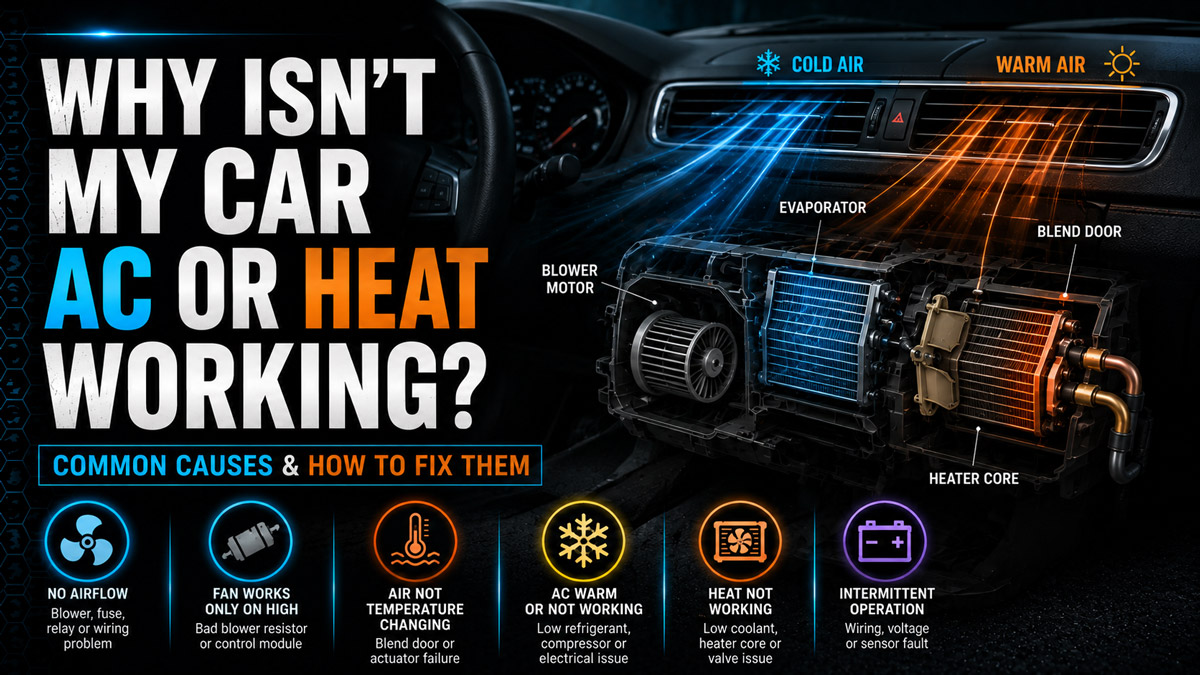
If your car’s AC and heat are not working, first determine whether the vents have lost airflow or whether air still blows but its temperature does not change. When both functions fail together, the most likely cause is a shared HVAC component—such as a fuse, blower motor, blower controller, climate-control panel, blend door, actuator, wiring circuit, or low-voltage condition—rather than simultaneous failure of the separate heating and refrigeration systems.
Key Facts / At a Glance
- No air from any vent usually indicates a blower, fuse, relay, controller, wiring, or power-supply fault.
- A fan that works only on its highest setting commonly indicates a failed resistor or electronic blower-control module.
- Strong airflow that remains near ambient temperature points toward an air-mixing door, actuator, control-panel, or sensor problem.
- Heat and AC use different temperature sources but share the blower, ducts, doors, controls, sensors, and electrical supply.
- Low coolant can eliminate cabin heat and may also indicate an engine-overheating risk.
- Refrigerant should not be added until pressures, leaks, electrical commands, and compressor operation have been tested.
How Do Car AC and Heat Work Together?
A vehicle’s heater and air conditioner create temperature differently, but they use the same HVAC housing to deliver conditioned air into the cabin.
The air-conditioning system circulates refrigerant through a compressor, condenser, expansion device, and evaporator. The evaporator absorbs heat and moisture from cabin air. The heating system sends hot engine coolant through a heater core, which acts like a small radiator inside the dashboard.
The shared air-delivery process is:
- The blower draws outside or recirculated cabin air through the intake.
- Air passes through the cabin filter where one is fitted.
- The blower pushes air through the HVAC housing.
- The evaporator cools and dehumidifies the air when AC is operating.
- The heater core warms some or all of the air when heat is requested.
- A blend door regulates the hot-to-cold mixture.
- Mode doors direct air toward the dashboard, floor, windshield, or combinations of those outlets.
This shared architecture explains the most important diagnostic rule: when AC and heat fail at the same time, test shared components before condemning the compressor or heater core.
What Symptoms Narrow Down the Cause?
The pattern of failure is more informative than the season in which the problem appeared.
Why Is No Air Blowing From the Vents?
No airflow usually means the blower motor is not moving air, even though the heater core and evaporator may still be capable of producing heat or cooling.
Is an HVAC fuse blown?
A blown fuse can disable the blower, climate-control panel, compressor command, actuator circuit, or several functions at once. Consult the owner’s manual because vehicles often have separate fuses for the blower motor, HVAC module, AC clutch, body-control module and ignition-fed controls.
Replace a blown fuse only with the specified amperage. If the replacement immediately fails, stop replacing fuses; the circuit probably has a shorted motor, damaged wire, overheated connector or internally failed module.
Is the blower motor resistor bad?
A traditional blower resistor changes fan speed by adding electrical resistance to the blower circuit. When one or more resistor paths burn open, some speeds disappear while another—often the highest setting—continues to work.
However, “fan works only on high” is a strong clue rather than a universal rule. Many newer vehicles use pulse-width-modulated blower-control modules instead of simple resistor packs, and their failure patterns can include no fan, full-speed operation, erratic speed or a fan that continues after the vehicle is switched off.
Has the blower motor failed?
A failed blower motor may produce silence, intermittent operation, squealing, scraping, vibration or a burning smell. Worn brushes can make the motor restart after hitting a bump or tapping the housing, but that reaction confirms an internal motor problem rather than providing a repair.
A technician should verify battery voltage and ground at the blower connector while the fan is commanded on. Power and ground with no motor rotation strongly implicate the motor; missing power requires circuit diagnosis upstream.
Can a cabin filter stop both heat and AC?
A severely clogged cabin filter can reduce both heated and cooled airflow, but it rarely causes complete silence from the blower. The blower will normally remain audible, and a small amount of air may emerge at maximum speed.
A blocked filter is more likely when airflow weakened gradually, the fan sounds strained, the filter has not been replaced for 15,000–30,000 miles, or the vehicle is routinely exposed to dust, leaves, pollen or construction debris.
Why Does Air Blow but Stay at Outside Temperature?
Air that blows normally but remains at approximately ambient temperature usually indicates that the HVAC housing is not directing air across the appropriate heat exchanger or that neither temperature source is operating.
Is the blend door stuck?
The blend door controls how much air passes through or around the heater core. Depending on vehicle design, a stuck door can leave the system permanently hot, permanently cold or close to ambient temperature.
The fault may involve:
- A stripped actuator gear
- A seized actuator motor
- A cracked door shaft
- A warped or jammed door
- Lost actuator calibration
- Broken linkage in a cable-operated system
- An HVAC module that is not commanding movement
Turn the ignition on and slowly move the temperature setting from minimum to maximum. Clicking, knocking or repeated tapping behind the dashboard often indicates stripped actuator gears, but silence does not prove the actuator is functional.
Could the climate-control panel be faulty?
The control panel may fail to send commands to the blower controller, compressor, heater valve or door actuators. Before replacing it, verify its power, ground, network communication and sensor inputs because a blank or unresponsive panel may be the victim of another electrical fault.
Automatic climate-control systems rely on more than the temperature buttons. They may use an in-car temperature sensor, ambient sensor, sun-load sensor, evaporator sensor, coolant-temperature data and door-position feedback. One implausible input can alter operation without causing a completely dead display.
Can low battery voltage disable climate control?
Low system voltage can cause digital climate controls, body modules and door actuators to behave unpredictably. Common clues include slow engine cranking, flickering lights, multiple warning messages, recently jump-starting the vehicle, or HVAC failure immediately after battery replacement.
Modern modules may suspend compressor operation during low-voltage conditions or lose actuator position calibration when power is interrupted. Test battery and charging-system voltage before replacing multiple HVAC components.
Why Does the Fan Work Only on One Speed?
A blower that operates on only one or two settings usually has a failed resistor, electronic speed controller, fan switch or connector—not a heating or refrigerant problem.
Traditional resistor packs are cooled by air flowing through the HVAC duct. Restricted airflow, a dragging blower motor or an overheated connector can damage the replacement resistor, so replacing the resistor without checking blower current and filter restriction may produce another failure.
Electronic controllers require a scan tool, wiring diagram and command-signal test on many vehicles. The technician should compare the requested blower speed, controller input, output voltage and blower-current draw.
Why Is Air Coming From the Wrong Vents?
Air that remains at the windshield, floor or dashboard regardless of the selected mode indicates a mode-door problem.
Older vehicles may use engine vacuum to position these doors. A disconnected or cracked vacuum line can cause the system to default to defrost under acceleration. Newer vehicles generally use electric actuators that may fail mechanically, electrically or through lost calibration.
Loss of defrost and defogging is more than a comfort problem. Windshield defrosting systems are regulated safety equipment in the United States because visibility must be restored under specified conditions.
Why Does the Heat Work but the AC Does Not?
When heat works and the blower moves air normally, the shared air-delivery system is at least partially functional. Focus on the refrigeration circuit and its electrical controls.
Is the refrigerant low?
Low refrigerant commonly results from leakage at a hose, seal, service port, condenser, compressor shaft seal or evaporator. Refrigerant is not consumed like fuel; a materially low charge indicates loss from the closed system.
Low pressure may cause the control system to prevent compressor operation to protect the compressor. Blindly adding refrigerant can conceal the leak, introduce air or sealant, or overcharge a system whose actual fault is electrical.
Is the compressor operating?
On a clutch-driven compressor, the outer pulley may rotate whenever the engine runs while the center clutch plate engages only when cooling is requested. However, compressor-clutch observation is not conclusive on variable-displacement compressors, clutchless compressors, hybrids or electric vehicles.
A stationary clutch can result from:
- Low or high refrigerant pressure
- Failed clutch coil
- Blown fuse or relay
- Faulty pressure sensor
- Evaporator-temperature protection
- Engine-overheating protection
- Wide-open-throttle strategy
- Cooling-fan failure
- Control-module fault
- Open wiring or poor ground
Keep hands, clothing and tools away from belts and fans during visual inspection.
Can condenser-fan failure stop the AC?
A failed condenser or radiator fan can cause AC cooling to deteriorate at idle while improving at road speed. Without adequate airflow, refrigerant pressure rises and the control module may cycle or disable the compressor.
This pattern is more specific than “the AC needs refrigerant”: cold while driving but warm in traffic strongly justifies checking fan operation, condenser blockage and high-side pressure.
Why Does the AC Work but the Heat Does Not?
When AC and airflow work but heat remains cold, inspect the engine-coolant and heater circuits.
Is the coolant level low?
Low coolant can prevent hot coolant from reaching the heater core. The heater may alternate between warm and cold during turns or acceleration as air moves through the cooling system.
Check the reservoir only according to the manufacturer’s procedure and never remove a pressurized radiator cap from a hot engine. Low coolant requires leak diagnosis; topping it up without finding the cause can allow overheating and severe engine damage.
Is the engine thermostat stuck open?
A thermostat stuck open allows coolant to circulate through the radiator too early, making engine warm-up unusually slow. The temperature gauge may remain below its normal position, cabin heat may be weak at highway speed, and fuel economy may decline.
A thermostat stuck closed causes the opposite and is more urgent: the engine can overheat while cabin heat behaves inconsistently. Stop driving if the temperature warning illuminates, the gauge enters the hot zone or steam appears.
Is the heater core clogged?
A restricted heater core cannot transfer enough engine heat to the cabin. A useful preliminary test compares the temperature of its two hoses after the engine reaches operating temperature:
- Both hoses hot: coolant is probably circulating; inspect the blend door.
- Inlet hot, outlet much cooler: the core or heater valve may be restricted.
- Both hoses cool: coolant may be low, the engine may not be warming, or flow may not be reaching the core.
Hose temperature alone is not a final diagnosis. Infrared readings, coolant flow, vehicle design and heater-valve position must be considered.
What If Neither Heat Nor AC Works?
When neither system changes cabin temperature, separate the diagnosis into three possibilities.
1. No air is moving
Test the blower circuit: fuse, relay, resistor or controller, motor, ground, connectors and control command.
2. Air moves but is routed incorrectly
Test the blend door, mode doors, actuators, mechanical linkages, calibration and HVAC control module.
3. Two independent faults exist
An older vehicle can simultaneously have low AC refrigerant and a heating-system fault. For example, a condenser leak may eliminate cooling while a stuck-open thermostat causes weak heat. Do not force every symptom into one diagnosis merely because the failures were noticed on the same day.
How Do You Diagnose the Problem Step by Step?
Use the following sequence because each test divides the system into smaller functional areas.
Step 1: Check for an urgent safety condition
Stop diagnosis and address the cooling system immediately if the engine is overheating, coolant is pouring out, steam is visible, a belt is damaged, or electrical insulation is burning.
Do not continue driving solely to test the heater. The heater is dependent on engine coolant in most combustion vehicles, so loss of heat can be an early clue that coolant circulation has been lost.
Step 2: Record the exact symptom
Start the engine and test:
- Every blower speed
- Maximum cold and maximum heat
- Fresh-air and recirculation modes
- Dashboard, floor and defrost outlets
- Driver and passenger zones
- Manual and automatic modes
Record whether the display responds, whether airflow changes and whether the problem is constant or intermittent.
Step 3: Test airflow before temperature
Hold a tissue near the center vent while increasing fan speed. No movement directs diagnosis toward the blower circuit; weak but audible airflow suggests a blocked filter, obstructed intake, icing evaporator or damaged blower wheel.
This order prevents wasting time testing refrigerant when the vehicle cannot deliver air into the cabin.
Step 4: Inspect the relevant fuses
Use the fuse diagram and inspect all HVAC-related circuits. A visual check can miss a hairline break, so use a test light or multimeter on both fuse test points with the circuit powered.
A fuse that fails again indicates excessive current or a short circuit. Do not install a higher-amperage fuse.
Step 5: Listen for door-actuator movement
With the vehicle stationary and cabin noise minimized, switch from full cold to full hot and cycle the vent modes. Listen for clicking and note whether airflow direction or temperature changes.
A scan tool capable of reading the HVAC module can command individual actuators and compare commanded positions with feedback values.
Step 6: Check engine temperature and coolant
After a normal warm-up period, confirm that the gauge reaches its typical operating range. Once the engine is completely cool, verify coolant against the reservoir markings.
Low coolant, visible leakage, a sweet smell, damp passenger carpet or persistent windshield film may indicate a cooling-system or heater-core leak.
Step 7: Observe AC operating conditions
Select maximum cooling, recirculation and a high blower speed. Confirm whether the compressor is being commanded, whether radiator or condenser fans operate, and whether refrigerant lines change temperature.
Visual operation alone cannot confirm the refrigerant charge. Accurate diagnosis normally requires pressure readings, temperature measurements, electronic data and leak testing.
Step 8: Scan all relevant modules
A generic engine-code reader may not access the HVAC, body-control or gateway modules. A capable scan tool can reveal actuator, sensor, communication and voltage-related faults even when no check-engine light is illuminated.
Record codes before clearing them. Clearing information first can erase the conditions needed to locate an intermittent fault.
Step 9: Decide whether the repair is DIY-safe
Filters, clearly identified fuses and some accessible blower resistors may be suitable for an informed owner. Refrigerant recovery, heater-core replacement, airbag-adjacent dashboard disassembly, high-current wiring and hybrid or EV climate systems generally require professional equipment and procedures.
Can Resetting the Climate Control Fix It?
A reset can restore operation when an actuator has lost calibration or a control module has entered a temporary error state, but it will not repair stripped gears, broken doors, burnt wiring, refrigerant leaks or failed motors.
Some vehicles recalibrate automatically after battery reconnection; others require a scan-tool procedure or a specific ignition-and-button sequence. Using an internet reset intended for another model can create additional actuator faults, so follow the service information for the exact year, make and model.
What Changes on Hybrid and Electric Vehicles?
Hybrid and electric vehicles may use electrically driven AC compressors, coolant heaters, positive-temperature-coefficient heaters or reversible heat-pump systems. These components can operate when the combustion engine is stopped and may contain high-voltage circuits.
A heat-pump fault can affect both heating and cooling because the same refrigerant circuit reverses direction or changes operating modes. This differs from a conventional combustion vehicle, where engine coolant normally supplies cabin heat independently from the AC refrigerant circuit.
Orange high-voltage cables, electric compressors and high-voltage heaters are not DIY test points. Use a technician trained for the vehicle’s high-voltage system.
How Much Does HVAC Repair Cost?
Typical US repair prices vary by vehicle, refrigerant type, labor rate, component access and the amount of diagnosis required.
A $40 fuse is not a bargain if the underlying short remains. Conversely, a four-figure actuator estimate may be legitimate when most of the dashboard must be removed to reach a $60 component.
Which Repairs Can You Safely Do Yourself?
The safest DIY work is limited to inspection and components specifically accessible under the vehicle’s service procedure.
Reasonable owner-level tasks
- Replace a cabin air filter
- Inspect and test an identified fuse
- Check coolant in a completely cold engine
- Remove leaves from an accessible outside-air intake
- Inspect visible connectors for melting or looseness
- Replace an easily accessible resistor when wiring and blower current test correctly
- Read codes with a compatible scan tool
Repairs better left to a professional
- Opening the refrigerant circuit
- Recovering, evacuating or charging refrigerant
- Removing a dashboard near airbag components
- Repairing melted high-current wiring
- Opening a hot or pressurized cooling system
- Servicing hybrid or EV high-voltage HVAC equipment
- Flushing a contaminated refrigerant system
- Replacing an evaporator or heater core
In the United States, refrigerant generally must be recovered rather than intentionally vented. Technicians servicing motor-vehicle AC systems for compensation must hold EPA Section 609 certification, and EPA-approved servicing equipment is part of compliant refrigerant handling.
What Common Diagnostic Mistakes Waste Money?
Adding refrigerant before testing
A recharge does not repair a leak, blend-door fault, failed fan or electrical lockout. An incorrect charge can reduce performance and increase system pressure.
Replacing a blower resistor repeatedly
A restricted filter, dragging motor or burnt connector may be overloading the resistor. Measure blower current and inspect the connector before fitting another part.
Assuming clicking proves the actuator alone is bad
The actuator may click because the door itself is jammed or its shaft is broken. Confirm that the door moves freely before declaring the repair complete.
Opening the cooling system while hot
Hot coolant can remain pressurized well after the engine is switched off. Follow the manufacturer’s cooling and pressure-release instructions.
Clearing codes before recording them
Stored codes, freeze-frame data and actuator-position values can reveal whether the failure is electrical, mechanical or intermittent.
Diagnosing only while the system works
An intermittent blower may test perfectly after restarting. Voltage, command and ground must be measured during the actual failure whenever possible.
When Should You Stop Driving?
Stop driving if HVAC failure occurs with engine overheating, coolant loss, steam, a damaged drive belt, smoke, an electrical-burning odor or rapidly worsening warning lights.
The vehicle may remain mechanically drivable when a blower or actuator fails, but loss of windshield defogging can make driving unsafe in rain, cold weather or high humidity. Park until visibility can be maintained reliably.
Should You Use a Dealership or Independent Shop?
An experienced independent repair shop is usually appropriate for blower, heater, refrigerant and ordinary electrical diagnosis. Ask whether the shop has model-specific wiring information, an HVAC-capable scan tool, refrigerant-identification equipment and certification for the refrigerant used by your vehicle.
A dealership or marque specialist may be more efficient when the fault involves software updates, network communication, proprietary actuator calibration, luxury multi-zone systems, heat pumps or dashboard removal on an unfamiliar model.
The most useful estimate is not the lowest initial quote. It is the estimate supported by recorded fault codes, voltage tests, pressure and temperature readings, leak-test results and a clear explanation of the failed component.
The Bottom Line
When diagnosing why isn’t my car AC or heat working, start with airflow: test every fan speed, vent mode and temperature setting. No airflow points toward the blower circuit; normal airflow with no temperature change points toward blend-door or control faults; only AC or only heat failing directs diagnosis toward the corresponding refrigerant or coolant system.
Do not add refrigerant or replace major parts based solely on warm air. A symptom-based diagnosis can distinguish a low-cost fuse or resistor failure from a heater-core, compressor, dashboard or high-voltage HVAC repair.
Frequently Asked Questions
Why did my AC and heater stop working suddenly?
A sudden simultaneous failure most often results from lost electrical power, a failed blower circuit, an HVAC control-module fault or a door actuator that can no longer position the airflow. Begin with the display, fan speeds and fuses. Separate compressor and heater-core failures usually produce temperature-specific symptoms rather than instant loss of all airflow.
Can a bad thermostat stop both AC and heat?
A bad engine thermostat primarily affects heat and engine temperature, not the AC refrigeration circuit. However, severe overheating may cause the engine computer to disable the AC compressor, making both functions appear faulty. A stuck-open thermostat usually causes weak heat, while a stuck-closed thermostat creates overheating and requires immediate attention.
Why does the HVAC work after I hit a bump?
Operation after a bump suggests an intermittent electrical or mechanical connection. Common causes include worn blower-motor brushes, a loose connector, a failing relay, damaged wiring or an actuator with worn gears. Test voltage and ground during the failure; tapping components is a diagnostic clue, not a reliable repair.
Why does my heater or AC work only while driving?
AC that improves with road speed often indicates poor condenser airflow from an inoperative fan. Heat that changes with engine speed may indicate low coolant, trapped air or weak coolant circulation. Airflow from the vents increasing without the blower may also indicate a failed blower combined with ram air entering through the fresh-air intake.
Can a dirty cabin filter cause no heat or AC?
A dirty cabin filter can severely restrict the volume of both hot and cold air, but it does not normally stop the heater core or AC system from changing air temperature. If the blower is completely silent, diagnose electrical power and the blower motor. Replace the filter when airflow is weak and the motor remains audible.
Why is one side hot and the other side cold?
Opposite temperatures in a dual-zone vehicle usually indicate a failed zone actuator, stuck blend door, lost calibration or door-position feedback fault. Low refrigerant can also create uneven evaporator cooling in some systems. Scan the HVAC module and command each zone separately before replacing an actuator.