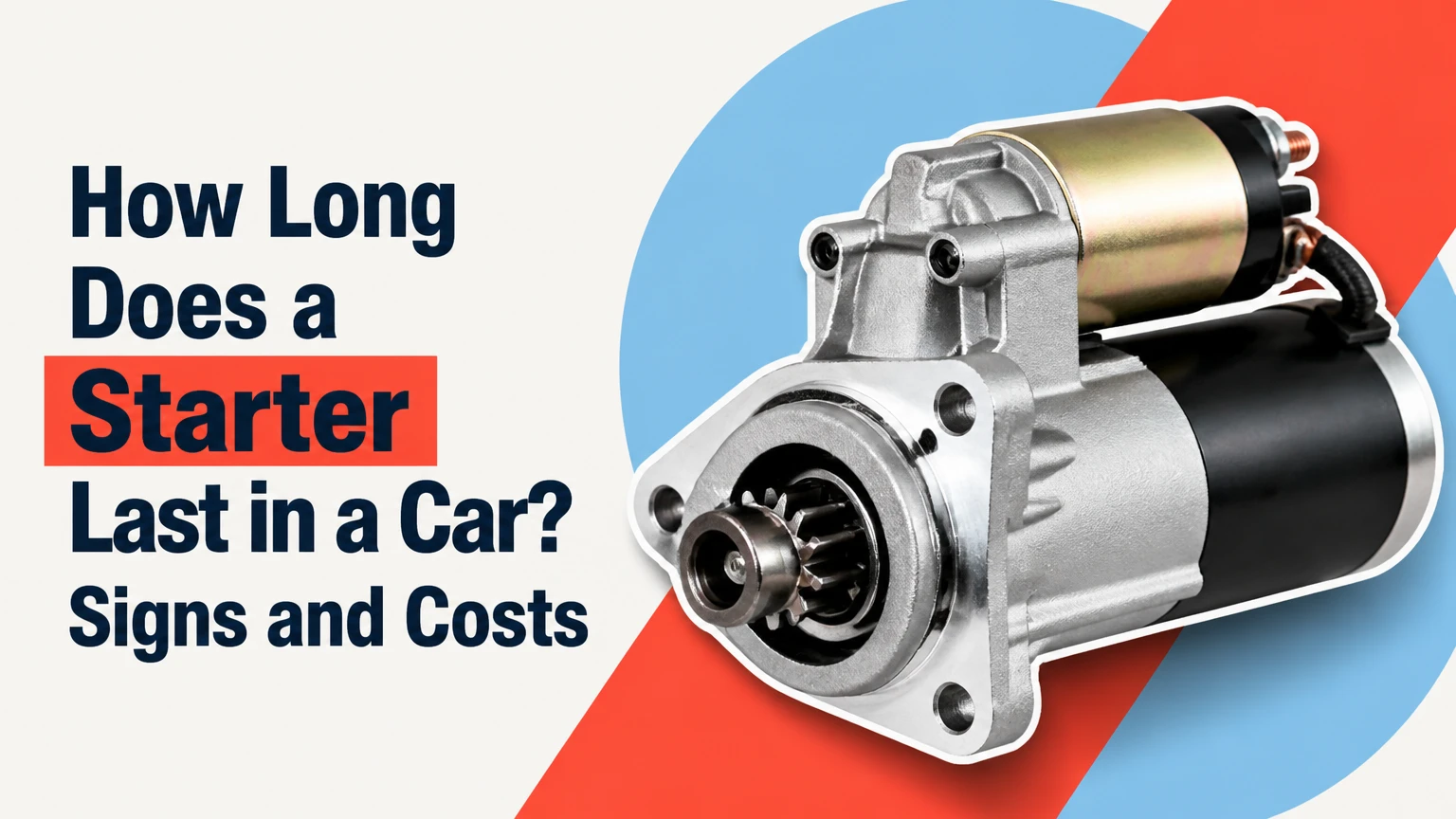
A car starter typically lasts 100,000-150,000 miles, or about 7-10 years, when the vehicle has a healthy battery, clean electrical connections, and normal starting frequency. A starter can fail much earlier after repeated short trips, severe cold, fluid contamination, or thousands of daily start-stop cycles, while lightly used vehicles may keep the original starter beyond 150,000 miles.
Key Facts at a Glance
A conventional starter commonly lasts 100,000-150,000 miles and 7-10 years.
Start frequency, battery condition, temperature, and engine resistance affect starter life more than mileage alone.
A rapid clicking sound usually indicates insufficient battery current, not proof of a failed starter.
A single heavy click with a fully charged battery makes a solenoid or starter motor fault more likely.
Typical replacement cost is $350-$1,000, although some vehicles cost less than $300 and difficult installations can exceed $1,500.
A starter should normally crank the engine for only a few seconds per attempt, with cooling time between repeated attempts.
How Long Does a Starter Last in a Car?
A conventional car starter lasts approximately 100,000-150,000 miles, but the number of engine starts is often a better predictor than the odometer. A commuter who starts an engine twice daily may place less stress on a starter than a delivery driver who makes 30-60 starts every day, even when both vehicles cover similar annual mileage.
Starter manufacturers and vehicle service information generally treat the unit as a wear component rather than a scheduled replacement item. Most automakers do not specify a fixed replacement interval, so replacement is usually based on symptoms, test results, or a confirmed internal fault.
Typical lifespan by vehicle use
| Driving pattern | Typical starts per day | Expected starter-service range | Main stress factor |
|---|---|---|---|
| Occasional private use | 1-3 | 10-15 years, 120,000-180,000 miles | Age, corrosion, battery neglect |
| Daily commuting | 2-6 | 7-12 years, 100,000-160,000 miles | Normal wear and heat |
| Short-trip urban driving | 6-15 | 5-10 years, 70,000-130,000 miles | High cycle count and undercharging |
| Taxi or delivery work | 20-60 | 3-8 years, 40,000-100,000 miles | Repeated thermal and mechanical cycles |
| Stop-start-equipped vehicle | 15-80 | Vehicle-specific, often 8-15 years | Starter-generator and battery design |
These figures are typical field ranges, not guarantees. A replacement starter’s warranty may cover a period such as one year, three years, or a limited lifetime, but warranty length does not prove that the unit will reach a particular mileage.
What Does a Starter Do?
A starter is a high-torque electric motor that turns an internal-combustion engine until combustion can sustain operation. The starter receives high current from the battery, engages a small pinion gear with the engine’s flywheel or flexplate, and rotates the crankshaft through the first few engine revolutions.
The starter assembly usually includes the motor, solenoid, drive gear, one-way clutch, armature, brushes, bearings, and mounting housing. The engine control module may also control a starter relay, clutch switch, neutral-safety switch, immobilizer authorization, or push-button start circuit.
How does the starting system work?
The starting system follows a defined electrical and mechanical sequence:
- The driver requests a start. Turning the ignition key or pressing the start button sends a low-current command through the vehicle’s control circuit.
- The relay and solenoid receive the command. The relay may pass the signal to the starter solenoid, depending on the vehicle design.
- The solenoid closes high-current contacts. Battery power reaches the starter motor while the solenoid’s plunger moves the drive mechanism.
- The pinion gear meshes with the flywheel or flexplate. The starter’s small gear engages the larger ring gear attached to the engine.
- The motor cranks the crankshaft. The crankshaft rotates pistons, allowing fuel injection, ignition, compression, and engine-management systems to begin normal operation.
- The starter disengages. Releasing the start command removes motor power, and a return mechanism retracts the pinion gear. A one-way clutch prevents the running engine from overspeeding the starter.
A starter does not keep the engine running. The alternator supplies electrical power after the engine starts, while the battery supplies the high-current energy needed during cranking.
Which Starter Type Lasts the Longest?
Integrated starter-generators generally handle more automated start-stop events than conventional starters, but no starter type has a universal mileage advantage. Component design, cooling, battery specification, engine compression, and the manufacturer’s duty-cycle target determine the actual service life.
| Starter design | Common application | Typical construction | Typical service expectation |
|---|---|---|---|
| Direct-drive starter | Older cars and trucks | Motor shaft drives pinion directly | 80,000-120,000 miles |
| OSGR gear-reduction starter | Most modern gasoline vehicles | Gearset increases torque and reduces motor size | 100,000-150,000 miles |
| PLGR gear-reduction starter | Modern passenger vehicles and trucks | Planetary reduction gears and compact motor | 100,000-160,000 miles |
| Starter-generator | Mild hybrids and advanced stop-start systems | Motor-generator integrated with belt or engine system | Vehicle-specific, often 8-15 years |
| High-output heavy-duty starter | Diesel trucks and commercial equipment | Higher torque, larger conductors, reinforced components | 100,000-200,000 miles, application dependent |
Direct-drive, OSGR, and PLGR labels describe construction, not a guaranteed lifespan. A gear-reduction starter may draw less current for a given cranking load, but a weak battery, poor ground strap, or high engine oil viscosity can still create severe current and heat stress.
Do hybrid and stop-start vehicles use ordinary starters?
Some hybrid and stop-start vehicles use a reinforced conventional starter, while others use a belt-integrated starter-generator or motor-generator mounted near the engine or transmission. The system must tolerate far more start events than a traditional vehicle, so its battery, control module, starter, and charging strategy are designed as one system.
Stop-start vehicles may require an AGM or EFB battery rather than a conventional flooded lead-acid battery. Installing the wrong battery can cause charging errors, reduced start-stop operation, and premature battery or starting-system problems. The correct battery type, capacity, and registration procedure must come from the vehicle manufacturer’s specifications.
What Shortens a Starter’s Life?
A weak battery is one of the most common indirect causes of starter failure because low battery voltage makes the motor draw high current while producing less useful torque. Repeated low-voltage starts overheat windings, brushes, commutators, solenoid contacts, cables, and ground connections.
| Life-shortening condition | What happens electrically or mechanically | Practical consequence |
|---|---|---|
| Battery below about 12.4 volts at rest | Reduced reserve capacity and high voltage drop | Slow cranking and solenoid chatter |
| Corroded battery or ground terminal | Resistance limits current flow | Hot cables, clicking, intermittent no-crank |
| Cranking longer than 10-15 seconds | Starter heat rises faster than it can dissipate | Brush, winding, and solenoid damage |
| More than 5-10 start attempts in succession | Heat accumulates inside the motor | Temporary failure or permanent burnout |
| Oil, coolant, or power-steering fluid leakage | Contamination reaches housing and electrical parts | Brush wear, insulation damage, slipping drive |
| Engine hydro-lock or excessive mechanical resistance | Motor must overcome abnormal load | High current and gear damage |
| Holding key in START after ignition | Running engine drives starter at excessive speed | Pinion and one-way-clutch failure |
Allow at least 1-2 minutes of cooling after several unsuccessful attempts, and investigate why the engine will not start instead of repeatedly operating the starter. A starter is designed for brief cranking, not continuous motor operation.
An important practitioner rule is that starter replacement without correcting the battery, cable, or engine problem often produces a repeat failure. A new motor cannot compensate for a loose ground strap or an engine that is difficult to rotate.
What Are the Symptoms of a Failing Starter?
A failing starter commonly produces a single click, intermittent no-crank condition, slow cranking despite a verified battery, or a whirring sound without engine rotation. The same symptoms can come from the battery, cables, relay, ignition switch, immobilizer, neutral-safety switch, or engine itself, so sound alone cannot identify the failed part.
| Symptom | Most likely possibilities | First diagnostic direction |
|---|---|---|
| Rapid repeated clicks | Weak battery, loose terminal, poor ground | Measure battery voltage and inspect terminals |
| One loud click, no crank | Solenoid contacts, starter motor, cable, weak battery | Perform voltage-drop and starter-current tests |
| Slow, heavy crank | Low battery, high resistance, failing starter, thick oil | Load-test battery and test cranking voltage |
| Whirring without crankshaft movement | Disengaged pinion, failed overrunning clutch | Inspect starter drive and ring gear |
| Grinding during start | Damaged gear teeth or incorrect starter alignment | Stop cranking and inspect flywheel or flexplate |
| Silence | Relay, fuse, switch, immobilizer, wiring, starter | Check start-command voltage at solenoid |
| Intermittent no-crank when hot | Heat-sensitive solenoid, worn brushes, cable resistance | Test during the failure condition |
Grinding deserves immediate attention because continued cranking can damage the flywheel or flexplate ring gear. Replacing a starter while leaving damaged ring-gear teeth in place may produce the same noise at the same crankshaft position.
Is the Battery or Starter the Problem?
A battery-versus-starter diagnosis requires voltage measurement and voltage-drop testing, not a headlight observation alone. A healthy, fully charged battery usually measures about 12.6 volts at rest, while cranking voltage commonly should remain above approximately 9.6 volts at 70°F, subject to the vehicle and battery manufacturer’s specifications.
A practical diagnostic sequence
- Inspect the terminals. Remove visible corrosion, confirm tight connections, and inspect the negative cable where it attaches to the body and engine.
- Measure resting battery voltage. A reading near 12.6 volts suggests full charge; 12.2 volts indicates substantial discharge, and a lower reading requires charging before further conclusions.
- Load-test the battery. A battery can show acceptable resting voltage but fail under load.
- Observe cranking voltage. A sharp drop below the vehicle’s specified minimum suggests a weak battery, excessive resistance, or excessive starter load.
- Perform voltage-drop tests. During cranking, measure the positive cable and ground path separately. Excessive drop identifies cable or connection resistance.
- Check the solenoid command. If the solenoid receives the correct start signal and battery power but the motor does not turn, the starter becomes a stronger suspect.
- Measure starter current draw. A professional technician compares current draw with the vehicle’s service specification. High draw can indicate internal friction or engine resistance; low draw with no crank can indicate an open circuit or worn motor.
The common headlight test is only a rough clue. Headlights can remain bright with a poor starter circuit, and they can dim because of normal electrical loading, so the test cannot reliably separate a starter fault from a battery, cable, or control fault.
Tapping a starter may temporarily move worn brushes into contact, but it can also damage the housing, create sparks, or place a person near moving belts and hot exhaust components. Treat it as an unsafe emergency workaround, not a diagnosis or repair.
How Much Does Starter Replacement Cost?
Starter replacement typically costs $350-$1,000, including parts and labor, with difficult access, premium vehicles, and integrated systems pushing the total above $1,500. A conventional starter may take 1-3 labor hours, while a unit buried under an intake manifold, exhaust assembly, or engine mount can require substantially longer.
| Replacement scenario | Typical part cost | Typical labor time | Typical total cost |
|---|---|---|---|
| Compact four-cylinder, aftermarket unit | $120-$300 | 1.0-1.5 hours | $300-$650 |
| Common SUV or pickup, new unit | $180-$450 | 1.5-2.5 hours | $450-$900 |
| Difficult V6 or V8 installation | $250-$700 | 3-6 hours | $800-$1,500 |
| Diesel truck starter | $300-$900 | 1.5-3 hours | $650-$1,400 |
| Hybrid starter-generator repair | $600-$2,000+ | 2-6 hours | $1,000-$3,000+ |
Labor rates vary by region and shop type. Dealer labor often costs more than an independent repair shop, while a low advertised part price may exclude a core charge, diagnostic fee, taxes, programming, or required battery replacement.
A proper estimate should identify the exact part number, warranty, labor hours, diagnosis charge, and whether the flywheel or flexplate teeth were inspected.
Should You Buy an OEM, Aftermarket, or Remanufactured Starter?
A new OEM starter is usually the lowest-risk choice for a vehicle with difficult access, a high replacement labor cost, or a known calibration and fitment requirement. A reputable new aftermarket unit can offer strong value, while a remanufactured starter makes the most financial sense when the part is easy to replace and the supplier provides a meaningful warranty.
| Replacement option | Typical part price | Warranty range | Best fit | Main risk |
|---|---|---|---|---|
| New OEM | $250-$800 | 1-3 years | Difficult installation or factory fit | Highest upfront cost |
| Premium new aftermarket | $150-$500 | 1-5 years | Daily driver seeking value | Brand quality variation |
| Economy new aftermarket | $90-$250 | 1-3 years | Low-cost older vehicle | Shorter service consistency |
| Remanufactured | $80-$350 | 1-3 years | Accessible starter and budget repair | Variable rebuild quality |
| Used salvage unit | $40-$180 | 0-90 days | Temporary repair or rare vehicle | Unknown wear and history |
Do not choose a starter by engine size alone. Confirm tooth count, mounting pattern, clocking, terminal position, torque rating, solenoid design, and compatibility with the vehicle’s engine-control and start-stop system.
A lifetime replacement warranty may reduce future part cost but does not eliminate repeated labor charges. For a starter requiring four hours of access work, a higher-quality unit with a longer warranty can cost less over the vehicle’s remaining life.
How Can You Make a Starter Last Longer?
The most effective starter-maintenance strategy is to keep the battery fully charged and the high-current connections clean and tight. Battery testing, charging-system checks, prompt repair of fluid leaks, and short cranking attempts address the conditions that most often turn a normal starter into an early failure.
Use the following maintenance practices:
- Test the battery before winter and whenever cranking slows.
- Keep resting voltage and charging voltage within the vehicle manufacturer’s specification.
- Clean both battery terminals and inspect the engine-to-body ground strap.
- Repair oil or coolant leaks above or beside the starter.
- Do not crank continuously for more than about 10-15 seconds.
- Wait 1-2 minutes between repeated attempts.
- Release the key or start button immediately after the engine fires.
- Use the specified oil viscosity in cold climates to reduce cranking resistance.
- Diagnose hard starting caused by fuel, ignition, glow-plug, or immobilizer problems.
- Inspect the flywheel or flexplate ring gear whenever a starter is removed after grinding.
Cold weather does not usually destroy a healthy starter by itself. Low temperatures reduce battery output and thicken engine oil, so the starter experiences a heavier load precisely when the battery supplies less current.
Short trips create a different problem. Frequent starts consume battery energy, but a five-minute drive may not restore it fully, leaving the battery undercharged and forcing the starter to work under worse conditions at the next start.
Can a Starter Fail Before 100,000 Miles?
A starter can fail before 100,000 miles because mileage does not record start cycles, cranking duration, electrical resistance, or environmental exposure. Early failure is more likely when a vehicle has a defective battery, poor cable connection, severe stop-start use, water intrusion, heat soak, manufacturing defects, or an engine that is difficult to crank.
A starter that fails at 40,000 miles should not automatically be replaced without testing the complete starting and charging system. A defective alternator may leave the battery chronically discharged, while a bad ground strap may overheat the replacement starter’s cables and contacts.
What unusual conditions need special attention?
- Manual transmission: A failed clutch-pedal switch can prevent the starter from receiving a start command.
- Automatic transmission: A faulty park-neutral safety switch can mimic starter failure.
- Immobilizer fault: The vehicle may remain silent even though the starter motor is healthy.
- Flooded engine: Excess fuel can cause repeated cranking and battery depletion without a starter fault.
- Hydro-lock: Coolant or fuel inside a cylinder can prevent normal rotation and damage the starter.
- Hybrid vehicle: High-voltage isolation and manufacturer-specific procedures may make DIY testing unsafe.
- Remote-start system: Additional relays and control modules can create intermittent no-crank symptoms.
- Water intrusion: A starter mounted low in the engine bay may suffer corrosion after flooding or deep water exposure.
When Should You Replace the Starter?
Replace a starter after a qualified test confirms an internal motor, solenoid, or drive fault, especially when the vehicle has a fully charged battery and acceptable cable voltage drop. Do not replace a starter solely because the vehicle has high mileage, since many original units continue operating beyond the common 100,000-150,000-mile range.
Replacement becomes more reasonable when:
- The starter repeatedly fails to crank despite verified battery voltage and cable integrity.
- Current draw is outside the manufacturer’s specification.
- Solenoid contacts are burned or the motor has worn brushes.
- The drive gear slips, whirs, or grinds.
- The starter housing has been contaminated by a persistent fluid leak.
- Labor access is already open during an engine or transmission repair.
Repairing a starter may be worthwhile for a specialist who can replace brushes, bushings, contacts, or a drive assembly. For most ordinary passenger cars, a complete replacement is more predictable because internal parts, labor time, and warranty support are easier to manage.
Frequently Asked Questions
Does a starter give warning before it fails?
A starter sometimes gives warning through intermittent no-crank events, slower cranking, a clicking solenoid, or hot-start failures, but sudden failure is also common. Worn brushes and solenoid contacts may work intermittently for weeks, whereas a broken drive gear or open electrical connection can stop cranking immediately.
How many times can a starter crank an engine?
A conventional starter has no universal published lifetime cycle count because vehicle manufacturers size it for a specific engine, temperature range, and duty cycle. A normal start may last 1-3 seconds, while repeated 10-15-second attempts generate heat rapidly and consume battery capacity.
Does an oil change help a starter last longer?
An oil change does not directly lubricate the starter motor, but the correct engine oil viscosity reduces crankshaft resistance and starter load, especially in cold weather. Repairing an oil leak above the starter matters more because fluid contamination can damage electrical insulation, brushes, and the starter drive.
Can a bad alternator damage the starter?
A bad alternator can indirectly shorten starter life by leaving the battery undercharged. The starter then operates with low voltage and high current demand, but the alternator itself does not normally feed the starter motor directly while the engine is cranking.
Is a starter covered by a car battery warranty?
A battery warranty normally covers the battery, not the starter motor, solenoid, cables, or labor. A replacement starter may carry its own manufacturer or retailer warranty, and extended vehicle warranties may cover the assembly only when the contract lists it as an included component.
Can I drive with a failing starter?
A vehicle with an intermittent starter may drive normally after it starts, but switching off the engine can leave the car stranded. Grinding, smoke, a burning smell, or a starter that remains engaged requires immediate shutdown because continued operation can damage the flywheel, wiring, or starter housing.
The Bottom Line
A car starter usually lasts 100,000-150,000 miles or 7-10 years, but start cycles and electrical conditions matter more than mileage alone. Before replacing one, test the battery, charging system, cables, grounds, start-command circuit, and engine rotation. The right replacement depends on access difficulty, vehicle design, warranty, and whether the underlying battery or wiring problem has been corrected. Knowing how long a starter lasts in a car helps set expectations, but measured diagnosis determines whether replacement is actually necessary.