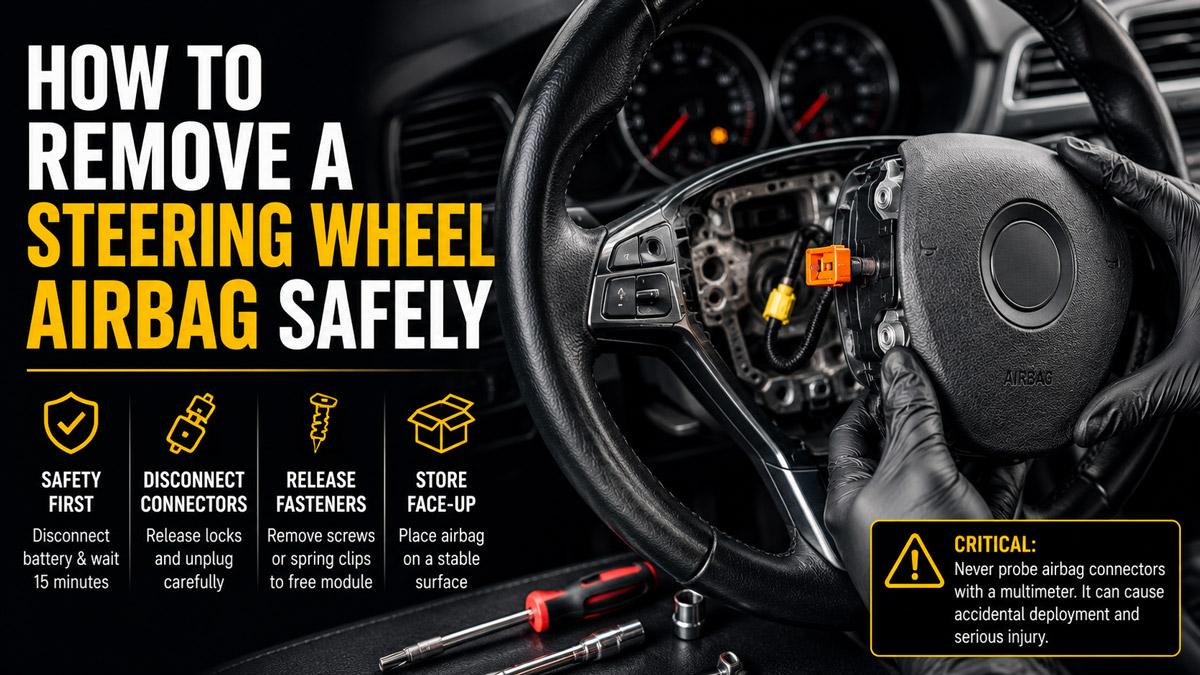
Removing a steering wheel airbag requires disconnecting the vehicle’s negative battery terminal, waiting 15 minutes to drain backup capacitors, and releasing the module’s rear fasteners. You must then carefully unplug the electrical connectors and store the airbag face-up to prevent injury or component damage.
Key Facts / At a Glance
- Supplemental Restraint System (SRS) inflators deploy at speeds between 100 and 200 mph in under 50 milliseconds.
- The SRS control module retains backup voltage; waiting 15 minutes after battery disconnection is non-negotiable.
- Never use a digital multimeter to test airbag connector pins, as the tool’s internal battery will trigger deployment.
- Always store a removed airbag module face-up with the metal housing resting on the floor.
Required Tools and Preparation
Before you attempt to remove a steering wheel airbag, you must gather the correct non-marring and non-conductive tools to prevent accidental short circuits or damage to the steering column plastics.
Time required: 30 to 45 minutes
Difficulty: Intermediate
Prerequisites: Vehicle parked with front wheels dead straight.
Materials and Tools:
- 10mm wrench (for battery terminal isolation)
- T27 or T30 Torx drivers (for older domestic/Japanese threaded systems)
- Flathead screwdrivers or angled awls (for modern spring-clip systems)
- Non-conductive plastic trim picks (for electrical connectors)
- Painter’s tape (to secure the clockspring)
Common Steering Wheel Airbag Fastener Types
Automakers utilize three primary mechanisms to secure the airbag module to the steering wheel skeleton. Identifying your system prevents permanent damage to the structural plastic.
| Specification | Threaded Fastener Systems | Internal Spring Steel Clips | Integrated Plastic Tabs |
|---|---|---|---|
| Typical Applications | Older Domestic, Trucks, Japanese Imports | Modern European (VW, BMW), Ford, GM | Entry-Level Subcompacts |
| Tool Requirements | Torx T27/T30 Drivers, Hex sockets | Angled Awls, Flat Screwdrivers | Rigid plastic trim tools |
| Core Advantage | Positive engagement; zero chance of stripping structural plastic. | Rapid assembly; clean look without bulky side screws. | Lightweight; lowest manufacturing cost overhead. |
| Core Risk | Cross-threading into aluminum upon reassembly. | Blind manipulation required; easy to tear underlying wires. | Highly brittle in cold weather; prone to snapping permanently. |
How Do You Remove a Steering Wheel Airbag?
The following procedure outlines the strict de-energizing and mechanical release sequence required for safe airbag removal. Failing to follow this order risks severe physical injury.
1.Isolate Power and Drain Capacitors:Wait 15 minutes after this step.
Disconnect the vehicle’s negative (-) battery terminal using a 10mm wrench and tuck the cable safely away from the battery post. You must wait a minimum of 15 minutes before proceeding. This window allows the backup capacitors inside the SRS diagnostic control module to completely bleed off their stored voltage, neutralizing the detonation circuit.
2.Center the Steering Wheel:
Insert the key and turn the ignition to the “ON” position (with the battery disconnected) to unlock the steering column. Turn the steering wheel so it is perfectly centered, with the front wheels pointing dead straight. This alignment is critical to protect the delicate clockspring ribbon cable during reassembly.
3.Release the Rear Mechanical Fasteners:
Locate the access ports on the back or sides of the steering wheel shroud. For threaded systems, back out the T27/T30 Torx screws completely. For spring-clip systems, insert a flathead screwdriver into the holes, push inward against the heavy wire spring bars, and gently pry the airbag module forward. You will hear a distinct click as each side releases.
4.Unplug the Connector Position Assurance (CPA) Locks:Use only non-conductive plastic tools.
Pull the airbag module forward just enough to access the rear wiring. Locate the electrical plugs, which feature brightly colored (usually orange or yellow) Connector Position Assurance (CPA) locking tabs. Use a plastic pick to pop the CPA tabs upward, then squeeze the release latches to pull the plugs straight out of the metal inflator housing. Do not force them; they should release smoothly once unlocked.
5.Store the Airbag Module Securely:
Carry the airbag module with both hands and place it in a safe location with the vinyl trim cover facing upward and the heavy metal plate resting flat on the floor. If a static discharge triggers an accidental deployment, the nylon bag will expand harmlessly into the open air. Placing it face-down turns the metal housing into a heavy, lethal projectile.
What Are the Most Common Airbag Removal Mistakes?
Even experienced mechanics can trigger costly damage by ignoring the sensitive nature of the SRS loop. Avoid these three frequent failures.
The Multimeter Catastrophe
Never probe the electrical pins of an airbag module with a digital multimeter to test continuity or resistance. The internal battery of a standard multimeter pushes an electrical current through the circuit that is easily strong enough to detonate the chemical squib instantly.
Clockspring Over-Rotation
Once the airbag and steering wheel are removed, do not allow the steering shaft or the clockspring mechanism to spin freely. The clockspring is a spiraled ribbon cable that maintains electrical contact as the wheel turns. If it loses center, turning the wheel fully lock-to-lock upon reassembly will snap the ribbon, permanently disabling your horn, wheel controls, and SRS safety loop. Tape the clockspring in place immediately after removing the wheel.
Reconnecting the Battery Prematurely
Reconnecting the vehicle’s battery before the airbag module is securely plugged back into the network loop will trigger a hard SRS fault code on the dashboard. This light cannot be cleared by simply disconnecting the battery again; it requires a dedicated bi-directional OBD-II scan tool to wipe the memory.
Frequently Asked Questions
Why do I only disconnect the negative battery terminal?
Disconnecting the negative terminal breaks the electrical ground circuit, achieving full power isolation. If your wrench touches the vehicle body while loosening the negative terminal, nothing happens. If you start with the positive terminal and your wrench touches metal, it creates a massive short circuit that can weld the tool, spark a fire, or damage ECUs.
Can a steering wheel airbag go off when the battery is dead?
Yes, an airbag can still deploy if the SRS control module’s backup capacitors remain charged. These capacitors are specifically designed to hold enough voltage to detonate the airbag in the event a severe crash severs the main battery cables before the sensors trigger the inflator.
How do I know if the airbag electrical connectors are fully seated upon reinstall?
The colored Connector Position Assurance (CPA) locking tabs will not click downward into the locked position unless the primary connector is pushed completely flush into the inflator housing socket. If the CPA tab resists being pressed down, the plug is crooked or not inserted deep enough.
Can I legally throw away an old, undeployed airbag?
No. An undeployed airbag contains a live pyrotechnic charge and hazardous chemical propellants. It is classified as hazardous waste and cannot be legally disposed of in standard municipal trash. You must deploy it safely using specialized remote tools or surrender it to an authorized automotive recycling facility.
Watch this Volkswagen Driver Airbag Removal Tutorial to see exactly how to manipulate the tricky internal spring clips without breaking the steering wheel trim.