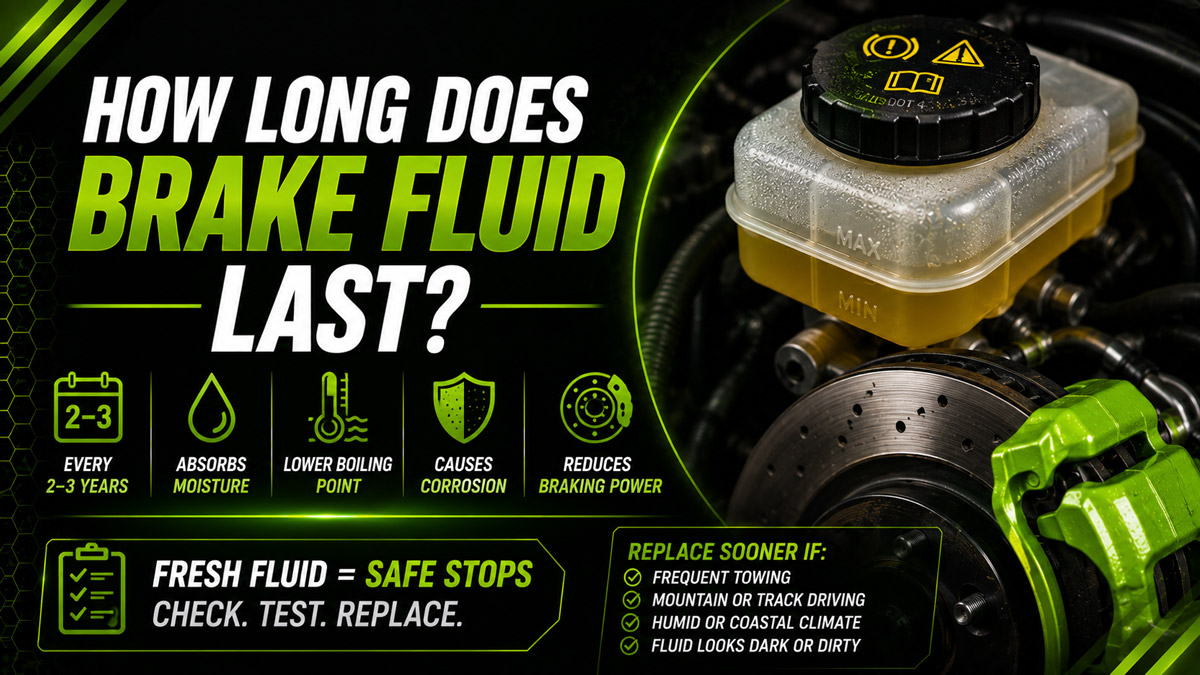
Brake fluid typically lasts 2 to 3 years or about 20,000 to 45,000 miles in a passenger vehicle, although the manufacturer’s maintenance schedule should take priority. Humidity, towing, mountain driving, repeated hard braking, fluid type, and brake-system condition can shorten the safe replacement interval.
Key Facts: At a Glance
- Most vehicles need fresh brake fluid every 2 to 3 years.
- Time can degrade brake fluid even when the vehicle is driven very little.
- DOT 3, DOT 4, and DOT 5.1 fluids absorb atmospheric moisture.
- Moisture lowers the fluid’s boiling point and encourages internal corrosion.
- DOT 5 silicone fluid must not be mixed with DOT 3, DOT 4, or DOT 5.1.
- A brake-fluid flush commonly costs $90 to $180, with specialized vehicles costing more.
How Long Does Brake Fluid Last in a Car?
Brake fluid commonly remains serviceable for 24 to 36 months, but there is no universal interval that fits every vehicle. Some manufacturers specify a fixed time interval, while others recommend inspections, moisture testing, or replacement at a particular mileage.
A practical replacement schedule is:
| Vehicle use | Typical replacement interval |
| Normal commuting | Every 2–3 years |
| Low-mileage vehicle | Every 2–3 years |
| Humid or coastal climate | About every 2 years |
| Frequent towing | Every 1–2 years |
| Mountain driving | Every 1–2 years |
| Performance street driving | Every 1–2 years |
| Regular track use | Every 6–12 months or after severe events |
| Vehicle with contaminated fluid | Immediately after diagnosis |
| Manufacturer-specific schedule | Follow the owner’s manual |
Mileage is only a secondary guide because brake fluid continues aging while the vehicle is parked. A ten-year-old car driven 2,000 miles annually can have more moisture-contaminated fluid than a newer highway vehicle with substantially higher mileage.
Why Does Brake Fluid Wear Out?
Brake fluid deteriorates mainly because glycol-based fluids are hygroscopic, meaning they absorb moisture from the surrounding atmosphere. Moisture can gradually enter through reservoir vents, rubber hoses, seals, service openings, and improperly sealed containers.
As water content increases, three problems develop:
- The boiling point decreases.
- Internal metal components become more vulnerable to corrosion.
- Braking performance becomes less consistent under high heat.
Brake fluid does not normally wear out because hydraulic operation “uses it up.” Its chemical and thermal properties change as it absorbs moisture and collects microscopic contaminants from the braking system.
Why does the boiling point matter?
The boiling point determines how well brake fluid resists vapor formation during heavy braking. Fresh fluid remains liquid at high temperatures, allowing it to transfer pedal pressure efficiently.
Contaminated fluid can boil around hot calipers. The resulting vapor bubbles compress under pressure, unlike hydraulic liquid. This can create a soft pedal, excessive pedal travel, brake fade, or temporarily reduced stopping performance.
This risk is greatest during:
- Long downhill descents
- Repeated emergency stops
- Heavy towing
- Track driving
- Aggressive mountain driving
- Operation with dragging brakes
- Driving with overloaded vehicles
Does Brake Fluid Expire Based on Time or Mileage?
Brake fluid usually ages more predictably by time than mileage because moisture absorption continues whether the vehicle is moving or parked. Mileage still matters because frequent braking creates heat cycles and may accelerate contamination from component wear.
Use mileage as an additional trigger rather than the only trigger. Replacement may be appropriate when either the time limit or mileage limit is reached, whichever occurs first.
For example, a maintenance schedule stating “three years or 36,000 miles” means:
- Replace it after three years even if the vehicle has only 15,000 miles.
- Replace it at 36,000 miles even if the vehicle reaches that mileage in two years.
The owner’s manual remains the controlling source because some vehicles specify different procedures, fluid standards, or diagnostic tests.
How Does Brake Fluid Work?
Brake fluid transfers force from the brake pedal to the wheel brakes through a sealed hydraulic circuit. The operating sequence is:
Brake pedal pressed → master cylinder moves → fluid pressure rises → pressure travels through brake lines → caliper or wheel-cylinder pistons move → pads or shoes contact the braking surface
The system depends on liquid remaining nearly incompressible. Air, vapor, leaks, or insufficient fluid interrupt that pressure transfer.
Modern vehicles may also route pressure through an anti-lock braking system hydraulic control unit. ABS, traction control, automatic emergency braking, and electronic stability control can rapidly modulate hydraulic pressure through valves and pumps, making clean, correctly specified fluid especially important.
How Long Do Different Brake-Fluid Types Last?
DOT designation does not establish one guaranteed service life. Driving conditions, moisture exposure, formulation, system design, and manufacturer requirements still determine replacement timing.
| Fluid type | Base material | Minimum dry boiling point | Minimum wet boiling point | Common application |
| DOT 3 | Glycol ether | 401°F / 205°C | 284°F / 140°C | Older vehicles and normal commuting |
| DOT 4 | Glycol ether and borate ester | 446°F / 230°C | 311°F / 155°C | Modern passenger and European vehicles |
| DOT 5 | Silicone | 500°F / 260°C | 356°F / 180°C | Certain classic, military, and specialty vehicles |
| DOT 5.1 | Glycol ether | 518°F / 270°C | 375°F / 190°C | Performance, towing, and low-viscosity applications |
“Dry” refers to fresh fluid with minimal moisture. “Wet” refers to fluid that has absorbed a defined amount of water during standardized testing.
How long does DOT 3 brake fluid last?
DOT 3 fluid commonly needs replacement every 2 to 3 years, although humid conditions or severe braking can justify a shorter interval. DOT 3 has lower minimum boiling points than DOT 4 and DOT 5.1, making contamination more significant during high-temperature use.
How long does DOT 4 brake fluid last?
DOT 4 brake fluid typically lasts about 2 years to 3 years, subject to the vehicle manufacturer’s specification. High-performance DOT 4 products may offer exceptional dry boiling points but can still absorb moisture, so a premium label does not automatically produce a longer service interval.
How long does DOT 5 brake fluid last?
DOT 5 silicone fluid does not absorb water in the same way as glycol-based fluid, but it is not maintenance-free. Free water can collect in low points, air can remain suspended in the fluid, and compatibility concerns may limit its suitability.
DOT 5 is not a universal upgrade. It should only be used in a system specifically designed or properly converted for it.
How long does DOT 5.1 brake fluid last?
DOT 5.1 fluid generally follows a similar 1-to-3-year service window depending on use. Its high boiling points and low-temperature viscosity benefit demanding brake systems, but it remains hygroscopic and may require frequent replacement under high-performance conditions.
Can Different Brake-Fluid Types Be Mixed?
DOT 3, DOT 4, and DOT 5.1 are glycol-based and may be chemically compatible in limited circumstances, but mixing them can reduce the resulting fluid’s boiling-point performance. The safest practice is to use the exact specification printed on the reservoir cap or listed in the owner’s manual.
DOT 5 silicone fluid must not be mixed with DOT 3, DOT 4, or DOT 5.1. Mixing incompatible fluids can produce braking problems, contamination, seal concerns, and an expensive system-cleaning requirement.
Do not choose fluid based only on the higher DOT number. DOT 5.1 and DOT 5 have different chemical bases despite their similar names.
What Are the Signs of Old Brake Fluid?
Old brake fluid may cause dark fluid, inconsistent pedal response, reduced resistance to brake fade, corrosion-related component problems, or evidence of moisture contamination. However, visual appearance alone cannot prove that fluid has reached the end of its service life.
Common warning signs include:
- Fluid that is dark brown, cloudy, or visibly contaminated
- A soft or spongy brake pedal
- Increased pedal travel
- Reduced braking consistency after repeated stops
- ABS or brake warning lights
- Corrosion inside the reservoir
- Seized calipers or hydraulic components
- Fluid level below the minimum mark
- A burning smell or excessive wheel heat
- A known service interval that has been exceeded
A sudden soft pedal, sinking pedal, active leak, or red brake warning light should be treated as a potential brake-system fault rather than ordinary maintenance.
Does dark brake fluid always need replacement?
Dark fluid supports a replacement decision, but color cannot measure water content or boiling point accurately. Some new fluids are darker than others, and rubber or metallic particles can discolor fluid before water concentration becomes excessive.
Use color as an inspection clue, not a laboratory test. Service history, manufacturer interval, moisture testing, fluid specification, pedal condition, and contamination should be considered together.
Does a spongy pedal mean the fluid is old?
A spongy pedal can result from air in the lines, overheated fluid, an external leak, flexible hose expansion, poor bleeding, a master-cylinder fault, or brake-system adjustment problems. Old fluid is one possible cause, not the only one.
A brake-fluid flush will not repair a leaking caliper, damaged hose, failing master cylinder, or mechanically worn brake component. The underlying fault must be diagnosed before assuming fluid replacement will correct pedal feel.
How Is Brake Fluid Tested?
Brake fluid can be evaluated by service history, moisture measurement, boiling-point testing, visual inspection, and inspection for contamination. No single inexpensive test identifies every possible fluid problem.
Common methods include:
Electronic moisture testers
Electronic testers estimate water content by measuring electrical properties. They are convenient but can produce misleading readings when fluid formulations, contamination, tester quality, or calibration vary.
Boiling-point testers
A boiling-point tester heats a sample and measures its actual boiling temperature. This provides more direct information about heat resistance but requires proper equipment and careful handling.
Test strips
Chemical strips may identify copper ions or other contamination indicators. They can help reveal internal system degradation but do not replace every other inspection method.
Maintenance records
A documented replacement date is often the most reliable practical guide. When the history is unknown, many technicians recommend establishing a baseline by inspecting the system and replacing the fluid if its age or condition cannot be verified.
How Long Does Brake Fluid Last in a Bottle?
Brake-fluid storage life depends heavily on whether the container remains factory sealed.
| Storage condition | Practical guidance |
| Factory-sealed bottle | Follow the manufacturer’s expiration and storage instructions |
| Recently opened and tightly capped | Use promptly |
| Opened for several months | Replace rather than risk moisture contamination |
| Left uncapped | Do not use |
| Stored in heat or direct sunlight | Replace if condition is uncertain |
| Fluid transferred to an unmarked container | Do not use |
An unopened bottle may remain usable for years when stored correctly, but it should not automatically be considered indefinite. Check the manufacturer’s date code, packaging condition, and stated shelf life.
Once opened, the fluid begins exchanging moisture with the atmosphere. Many technicians avoid storing partial bottles for future brake work, especially in humid regions.
Does Climate Affect Brake-Fluid Life?
Humid and coastal climates can shorten brake-fluid life because moisture is more available whenever the hydraulic system or container exchanges air with the environment. A two-year replacement interval is a reasonable conservative approach when the manufacturer does not specify otherwise.
Climate-related risk increases with:
- Coastal salt exposure
- High year-round humidity
- Large temperature swings
- Flood exposure
- Outdoor vehicle storage
- Damaged reservoir caps or seals
- Frequent service that leaves the system open
Floodwater exposure requires more than a routine fluid change. The braking system should be professionally inspected for contaminated fluid, damaged electrical connectors, corroded components, and water intrusion.
Does Driving Style Change the Replacement Interval?
Driving style changes how much thermal stress the fluid experiences. A lightly driven commuter may follow the normal manufacturer interval, while towing, repeated downhill braking, and track driving justify more frequent service.
Daily commuting
Normal commuters can usually follow the factory interval, commonly around two to three years. Stop-and-go traffic creates frequent heat cycles but rarely produces the sustained temperatures seen in towing or mountain use.
Towing and hauling
Towing converts more vehicle energy into brake heat. Drivers who tow heavy trailers should consider annual inspections and fluid replacement every one to two years, depending on vehicle requirements and brake temperatures.
Mountain driving
Long descents can keep calipers hot for extended periods. Selecting lower gears, using engine braking, and avoiding continuous pedal pressure reduce heat, but the brake fluid still deserves a shorter inspection interval.
Track driving
Track vehicles may require fluid replacement every six months, before major events, or after sessions that produced pedal fade or fluid overheating. Track preparation should prioritize the manufacturer’s required fluid class and the fluid’s documented boiling points.
Do Electric and Hybrid Vehicles Need Brake Fluid Changes?
Electric and hybrid vehicles still use hydraulic brake fluid even though regenerative braking reduces friction-brake use. Lower pad wear does not prevent the fluid from absorbing moisture with age.
In some cases, reduced mechanical brake use can allow corrosion or sticking components to develop unnoticed. EV and hybrid owners should follow the manufacturer’s time-based brake-fluid schedule rather than assuming regenerative braking eliminates fluid maintenance.
How Much Does a Brake-Fluid Change Cost?
A professional brake-fluid flush typically costs $90 to $180 for a common passenger vehicle. European, luxury, performance, or specialized braking systems may cost $150 to $275 or more.
Typical costs include:
| Service | Typical cost |
| Brake fluid only | $10–$40 |
| Basic DIY supplies | $20–$80 |
| Standard professional flush | $90–$180 |
| Luxury or specialized vehicle | $150–$275+ |
| Diagnostic work or leak repair | Additional cost |
The final price depends on labor rates, fluid quantity, fluid specification, vehicle access, corrosion, bleeder condition, and whether a scan tool is needed to operate ABS valves or complete a manufacturer-specific bleeding routine.
What Happens During a Brake-Fluid Flush?
A brake-fluid flush removes aged fluid from the reservoir and hydraulic lines while replacing it with fresh fluid of the correct specification. The technician must prevent the reservoir from running dry because introducing air into the master cylinder or ABS unit can complicate bleeding.
A typical service includes:
- Confirm the required fluid specification.
- Inspect the reservoir, hoses, lines, calipers, and wheel cylinders.
- Remove aged fluid from the reservoir.
- Refill the reservoir with new fluid.
- Connect equipment to the bleeder valves.
- Flush each brake circuit in the specified sequence.
- Continue until clean, bubble-free fluid exits.
- Maintain the reservoir level throughout the procedure.
- Tighten bleeders to specification.
- Check pedal feel, fluid level, leaks, and warning lights.
The traditional sequence begins with the wheel farthest from the master cylinder, but this is not universal. Some vehicles require a different wheel order, pressure setting, scan-tool command, or ABS bleeding procedure.
Is Flushing the Same as Bleeding the Brakes?
Flushing and bleeding overlap but have different primary purposes. Bleeding removes trapped air, while flushing replaces old or contaminated fluid throughout the hydraulic system.
A technician may bleed one circuit after replacing a caliper or hose without replacing all the vehicle’s fluid. A complete flush moves enough new fluid through every required circuit to remove most aged fluid.
Neither procedure repairs leaks or failed hydraulic components.
Can You Just Top Off Old Brake Fluid?
Topping off restores reservoir level but does not renew the fluid already inside the brake lines, calipers, master cylinder, or ABS hydraulic unit. Adding fresh fluid to old fluid cannot remove absorbed moisture or contamination.
Low brake fluid may indicate:
- Normal brake-pad wear
- A leaking caliper or wheel cylinder
- A damaged brake hose
- A leaking steel line
- A master-cylinder leak
- Incorrect fluid level after previous service
Do not repeatedly top off a falling reservoir without identifying the cause. A leak can result in partial or complete loss of braking.
What Are the Most Common Brake-Fluid Mistakes?
Using the wrong specification
A higher DOT number is not automatically safer or better. Use the exact type and performance standard required by the vehicle manufacturer.
Leaving the bottle open
An uncapped bottle can absorb moisture from the air. Keep the cap closed except while dispensing fluid and avoid using fluid from a container with uncertain storage history.
Letting the reservoir run dry
Allowing the reservoir to empty during flushing can introduce air into the master cylinder or ABS hydraulic unit. This may require additional bleeding procedures or a diagnostic scan tool.
Treating color as the only test
Dark fluid suggests aging or contamination but cannot independently measure boiling point, moisture content, or chemical compatibility.
Spilling fluid on painted surfaces
Glycol-based brake fluid can damage automotive paint. Rinse affected bodywork promptly with plenty of water and follow appropriate cleaning procedures without aggressively wiping the contaminated surface.
Assuming a flush fixes mechanical problems
Fresh fluid cannot correct seized slide pins, warped rotors, worn pads, damaged hoses, leaking seals, or a failing master cylinder.
When Should Brake Fluid Be Replaced Immediately?
Replace or professionally inspect the fluid immediately when contamination, incorrect fluid, overheating, or system opening creates a clear safety concern.
Urgent situations include:
- Petroleum product added to the reservoir
- DOT 5 mixed into a glycol-based system
- Floodwater exposure
- Severe fluid overheating
- A hydraulic component failure that contaminated the system
- Unknown fluid used during service
- Visible debris or sludge
- Brake-system repairs requiring the hydraulic circuit to be opened
- Testing that confirms an unsafe boiling point
- Manufacturer instructions requiring replacement after a specific event
Petroleum contamination can swell rubber seals throughout the braking system. A simple flush may be insufficient, and extensive component replacement may be necessary.
How Can You Make Brake Fluid Last Longer?
Brake-fluid aging cannot be stopped completely, but contamination and heat exposure can be reduced.
- Keep the reservoir cap and surrounding area clean.
- Do not open the reservoir unnecessarily.
- Use only new fluid from a properly sealed container.
- Repair torn boots, leaks, and damaged caps.
- Avoid riding the brakes on long descents.
- Use lower gears during mountain driving.
- Service dragging calipers promptly.
- Follow towing and payload limits.
- Store opened fluid only according to manufacturer instructions.
- Record the replacement date and fluid specification.
The objective is not to extend fluid use indefinitely. It is to maintain the hydraulic system so the fluid performs reliably throughout the recommended interval.
How Do You Decide Whether to Replace Brake Fluid?
Replace brake fluid when the manufacturer’s interval is due, the service history is unknown, testing identifies degradation, or operating conditions justify earlier service. A two-to-three-year baseline is appropriate for many passenger vehicles, but the vehicle’s manual remains the primary authority.
Use this decision checklist:
- Has the fluid been installed for more than two or three years?
- Has the manufacturer’s stated interval been reached?
- Is the vehicle used for towing, track driving, or mountain descents?
- Is the vehicle operated in a humid or coastal climate?
- Is the fluid visibly contaminated?
- Has moisture or boiling-point testing failed?
- Has the hydraulic system recently been opened?
- Is the fluid type unknown?
- Are there leaks, warning lights, or pedal changes?
A “yes” does not always prove that fluid alone is responsible, but it justifies inspection and may support replacement.
Frequently Asked Questions
Can brake fluid last five years?
Brake fluid can remain in a vehicle for five years, but that does not establish that it is still performing safely. Moisture absorption, corrosion protection, system design, climate, and braking temperatures vary. When a manufacturer permits a long interval, follow its requirements; otherwise, a two-to-three-year replacement baseline is more conservative.
What happens if brake fluid is never changed?
Never changing brake fluid can lower its boiling point and increase the risk of internal corrosion. Possible long-term consequences include brake fade, seized components, damaged ABS hydraulic parts, leaking seals, and expensive repairs. The vehicle may still feel normal during gentle driving while the fluid performs poorly under sustained braking heat.
Can new brake fluid improve braking?
New brake fluid can restore thermal resistance and consistent hydraulic operation when the old fluid is moisture-contaminated or overheated. It will not increase friction from worn pads or repair defective hardware. Noticeable pedal improvement after a flush usually indicates that air, vapor, degraded fluid, or poor previous bleeding affected the system.
Is brake fluid replacement necessary with low mileage?
Brake fluid replacement can be necessary even with low mileage because glycol-based fluid absorbs moisture according to time and exposure, not only wheel rotation. Stored vehicles may also develop corrosion from inactivity. Owners should follow time-based maintenance intervals even when annual mileage is very low.
Can brake fluid evaporate?
Brake fluid does not normally disappear rapidly from a sealed, healthy brake system. A falling reservoir level usually results from brake-pad wear, a leak, or incorrect previous filling. Any sudden or repeated drop should be inspected rather than attributed to ordinary evaporation.
Should brake fluid be changed when replacing brake pads?
Brake-fluid replacement is not automatically required every time pads are changed, but pad service is a convenient time to inspect fluid age, condition, level, and service history. Replace it when the scheduled interval is due, contamination is present, the hydraulic system is opened, or test results show degraded performance.
The Bottom Line
How long does brake fluid last? For most passenger vehicles, the practical answer is 2 to 3 years or approximately 20,000 to 45,000 miles, unless the manufacturer specifies a different interval.
Time, humidity, fluid chemistry, towing, mountain driving, track use, overheating, and hydraulic-system condition all influence service life. Follow the owner’s manual, use the exact required fluid, and treat soft pedals, leaks, warning lights, or sudden fluid loss as brake-system faults requiring immediate diagnosis.