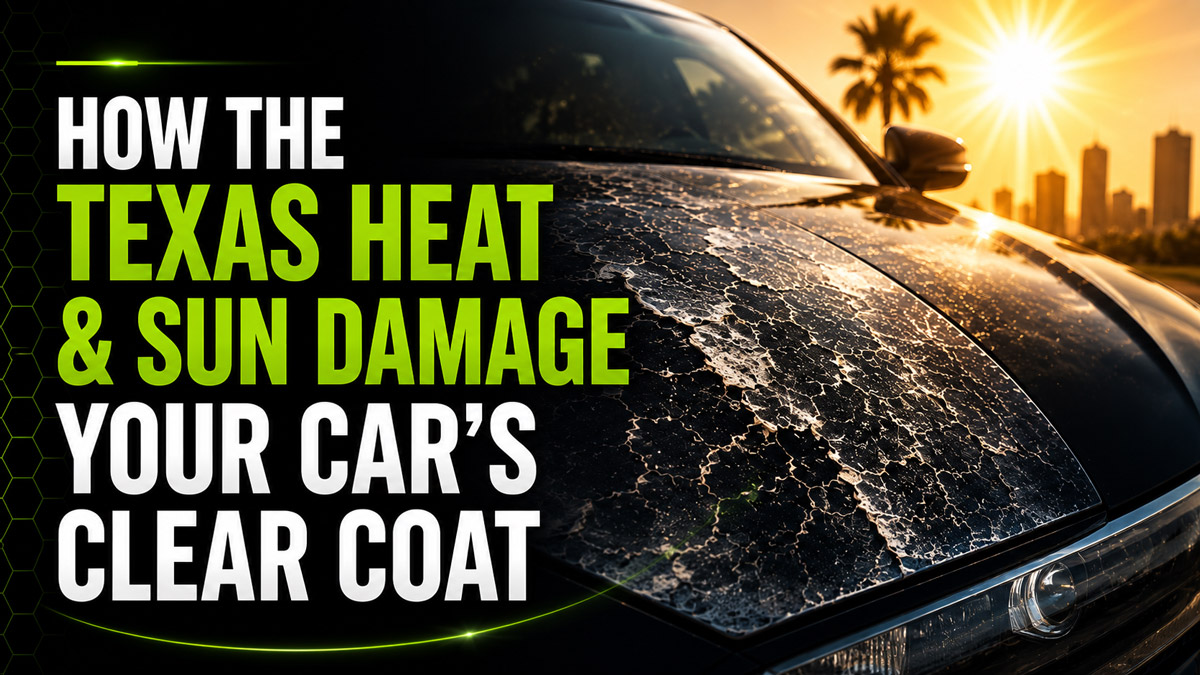
The Texas heat and sun damage a car’s clear coat through a destructive dual attack: extreme UV radiation chemically fractures the polymer bonds causing white oxidation, while 150°F+ surface temperatures force the paint layers to physically stretch. This constant thermal shock eventually causes the clear coat to irreversibly peel away from the base color.
At a Glance: Texas Clear Coat Destruction
- Unprotected clear coat in Texas begins showing visible oxidation in just 2 to 3 years, compared to 5 to 7 years in northern climates.
- The Texas UV Index routinely hits 11+ (Extreme) from May through September, accelerating chemical degradation (photo-oxidation).
- Dark-colored vehicles can reach surface temperatures of 145°F to 160°F+ on a 100°F summer day.
- Traditional carnauba wax softens and evaporates at 140°F, leaving Texas vehicles completely unprotected within days.
- Once the clear coat visibly peels or cracks, it cannot be polished or patched; the entire panel requires a full repaint.
The Mechanics of Sun and Heat Damage
What is the difference between UV oxidation and thermal shock?
UV oxidation is a chemical breakdown, whereas thermal shock is a physical separation of the paint layers. Texas weather inflicts both simultaneously, creating a synergistic attack on automotive finishes.
At what surface temperature does a car’s clear coat degrade?
Automotive clear coat begins to experience accelerated degradation when surface temperatures exceed 140°F. At this threshold, the polymers soften, standard waxes evaporate, and the chemical structure becomes highly vulnerable to environmental contaminants.
During a 100°F Texas summer day, a dark vehicle parked in direct sunlight routinely hits 145°F to over 160°F. These extreme temperatures stretch the clear coat’s coefficient of thermal expansion to its absolute limit. When the surface temperature repeatedly crests 150°F day after day, the clear coat loses its elasticity, becoming brittle and highly susceptible to microscopic stress fractures (known as crow’s feet) that eventually lead to full delamination.
Why do bird droppings ruin clear coat faster in high heat?
Bird droppings ruin automotive clear coat much faster in extreme heat because soaring surface temperatures rapidly evaporate the water content in the droppings, concentrating the highly corrosive uric acid directly against the paint.
In cooler climates, a bird dropping might take several days to permanently etch the paint. On a 160°F black hood in a Texas parking lot, that same uric acid can burn through whatever wax is present and permanently scar the clear coat in just minutes to a few hours. The intense heat causes the paint pores to expand, allowing the acidic compounds to penetrate deeper into the resin layers, resulting in permanent, irreversible etching that requires heavy machine compounding to remove.
Car Colors and Paint Types in Extreme Heat
Which car colors survive the Texas sun best?
White and silver are the best car colors for surviving the Texas sun, while black and dark blue suffer the fastest clear coat failure. The longevity of a vehicle’s paint in the sun correlates directly to its light reflectivity and heat retention.
- White: The safest color for Texas longevity. White paint reflects the majority of solar radiation and typically stays 20°F to 25°F cooler than a black vehicle in the exact same conditions. This massive reduction in thermal load dramatically limits thermal delamination.
- Silver/Light Gray: Highly reflective and masks early signs of micro-scratching or mild oxidation.
- Red: Historically vulnerable to UV degradation (fading or turning pink), though modern clear coats have mitigated this. Red still retains significant heat.
- Black/Dark Blue: The absolute worst for extreme climates. Dark colors absorb maximum solar energy, ensuring the vehicle consistently reaches the 145°F+ danger zone that triggers rapid thermal shock.
How does matte paint react differently to heat and UV rays?
Matte and satin paint finishes suffer from the same heat and UV degradation as glossy finishes, but matte paint cannot be polished to fix early oxidation. If the Texas sun oxidizes a matte clear coat, the damage is completely irreversible without a full physical repaint.
Standard automotive clear coats can be lightly compounded to remove microscopic dead layers of chalky oxidation. Attempting to buff or polish matte paint will instantly level the microscopic textured dimples that give the paint its flat appearance, resulting in permanent, uneven glossy patches. Owners of matte vehicles in high-heat states must apply specialized, non-glossy silica sealants regularly, as there is zero margin for error once UV damage begins.
What happens to older cars with single-stage paint in the sun?
Older cars painted before the 1980s generally utilize single-stage paint, which means the color pigment and the protective resin are mixed into one layer, rather than utilizing a separate transparent clear coat on top.
When single-stage paint bakes in the Texas sun, the color itself directly oxidizes, turning aggressively chalky and dull. However, unlike modern clear coat failure, single-stage paint oxidation is heavily correctable. A detailer can aggressively polish the surface to remove the dead, sun-baked pigment, revealing fresh, shiny color underneath. Because there is no separate clear layer to physically peel off, single-stage paints suffer from fading rather than delamination.
Why Standard Paint Protection Fails in Texas
Why does traditional carnauba wax melt in the Texas summer?
Traditional carnauba wax fails in extreme summer heat because its natural melting and softening point rests between 140°F and 160°F. When applied to a dark vehicle in a southern climate, the wax literally liquefies on the panel.
Once the surface temperature breaches 145°F on a July afternoon, the wax breaks down chemically. Within a matter of days, the liquefied wax either evaporates off the hot metal or is effortlessly washed away by the next brief rain shower. Relying on a monthly carnauba wax routine in Texas leaves the vehicle’s paint completely naked and exposed to UV radiation for 25 days out of the month.
Do car covers protect your paint from the sun?
No, car covers generally cause more damage to a vehicle’s clear coat in extreme heat environments than they prevent. While a cover physically blocks UV rays, it introduces severe mechanical and thermal hazards.
First, standard covers create an aggressive sandpaper effect; if the car or the inside of the cover is even slightly dirty, the Texas wind will grind that dust directly into the clear coat, creating thousands of micro-scratches. Second, non-breathable waterproof covers trap the ambient heat and ground moisture underneath the fabric. This creates a highly destructive “oven effect” that can bake chemical stains permanently into the paint and physically warp plastic automotive trim.
Does parking under a tree prevent UV paint damage?
Parking under a tree blocks direct UV radiation, but it introduces localized chemical threats—tree sap and bird droppings—that can destroy a heat-softened clear coat much faster than sunlight alone.
While the shade lowers the vehicle’s surface temperature, sticky tree sap bonds instantly to warm automotive paint. When the vehicle is eventually driven back into the sun, the sap bakes into an impenetrable resin that requires aggressive solvents to remove, often marring the clear coat in the process. Shade is only beneficial for clear coat longevity if it comes from an artificial structure like a garage, carport, or covered parking garage.
The Best Ways to Protect Clear Coat from Sun Damage
Is ceramic coating worth the cost for UV protection?
Yes, a high-quality ceramic coating is highly effective and worth the investment in Texas specifically because it provides long-term, heat-resistant UV protection that traditional waxes cannot match.
Ceramic coatings are formulated with silicon dioxide (SiO2), making them chemically stable at temperatures well beyond 160°F. Unlike waxes that melt off, a ceramic coating cures into a rigid, semi-permanent sacrificial layer over the clear coat. It does not prevent rock chips, but it successfully intercepts the UV photons that cause photo-oxidation and sheds the intense surface heat that accelerates chemical etching from bugs and bird droppings.
Does Paint Protection Film (PPF) prevent thermal delamination?
Yes, Paint Protection Film (PPF) is the single most effective method for preventing thermal delamination and UV oxidation on modern vehicles. PPF is an 8-mil thick, transparent polyurethane plastic sheet physically wrapped over the painted panels.
Unlike liquid coatings, PPF provides a thick physical barrier that absorbs the brunt of daily thermal expansion and contraction, radically reducing the shear stress on the factory clear coat beneath it. Modern PPF brands also embed heavy UV inhibitors into the film’s topcoat, meaning the film takes 100% of the sun’s abuse. If the film eventually chalks or yellows after 5 to 10 years in the Texas sun, it can be peeled off, leaving perfectly preserved factory paint underneath.
Troubleshooting and Fixing Clear Coat Failure
How can you tell if clear coat damage is fixable oxidation or permanent failure?
You can diagnose clear coat damage by performing a simple water test: pour a cup of water over the damaged, cloudy area and observe how the paint reacts while wet.
- Fixable Oxidation: If the cloudy, white patch temporarily disappears and the paint looks glossy and perfectly normal while wet, the damage is microscopic surface oxidation. This can still be machine polished and saved.
- Permanent Failure: If the white, cloudy spots remain highly visible through the water, or if you can drag your fingernail across the surface and feel a jagged, physical edge, the clear coat has structurally failed. Delamination has occurred, and polishing will not fix it.
Can you buff out clear coat that has already started to peel?
No, you absolutely cannot buff or polish a clear coat once it has begun to physically peel or display tiny checking cracks (crow’s feet).
Polishing is an abrasive process designed to level out microscopic imperfections by removing a fraction of a millimeter of the clear coat layer. When the clear coat is peeling, there is literally no structural material left to polish. The clear coat has separated from the base color. Attempting to hit peeling paint with a machine buffer will simply grab the loose edges of the clear coat and rip larger chunks of it completely off the car.
Can you spray new clear coat over a peeling car panel?
No, spraying a fresh layer of automotive clear coat directly over a peeling panel will fail immediately. The new clear coat will not chemically bond to the compromised surface.
Automotive clear coat requires a uniform, chemically prepped surface to adhere properly. If sprayed over peeling edges, the new liquid clear will simply bridge over the gaps, trap air, and flake off alongside the old clear coat within weeks. Furthermore, the base color coat beneath the peeled sections has already been oxidized by the sun. To repair a peeling panel, a body shop must mechanically sand the entire panel completely down to the primer and respray both the color base coat and the clear coat.
How much does it cost to fix peeling clear coat?
Repairing peeling clear coat typically costs between $500 and $1,500 per affected panel, depending on the vehicle size and the body shop’s labor rates. Because peeling clear coat requires a full strip and repaint, it is an expensive, labor-intensive correction.
If the roof, hood, and trunk are all suffering from severe thermal delamination, the cost quickly escalates. A complete, high-quality exterior strip and respray for a standard sedan in a high-heat market like Texas generally ranges from $3,000 to $8,000. This steep repair cost is exactly why proactive UV protection is vital in extreme southern climates.
The Bottom Line
The Texas environment destroys clear coat rapidly through a combination of extreme heat forcing the panels to expand, and severe UV radiation breaking down the chemical resins. Standard car care advice often fails here; carnauba waxes melt off in days, and car covers trap destructive heat against the paint. To ensure long-term survival, vehicle owners must rely on temperature-stable solutions like SiO2 ceramic coatings or Paint Protection Film, and immediately prioritize shaded, structured parking whenever possible.