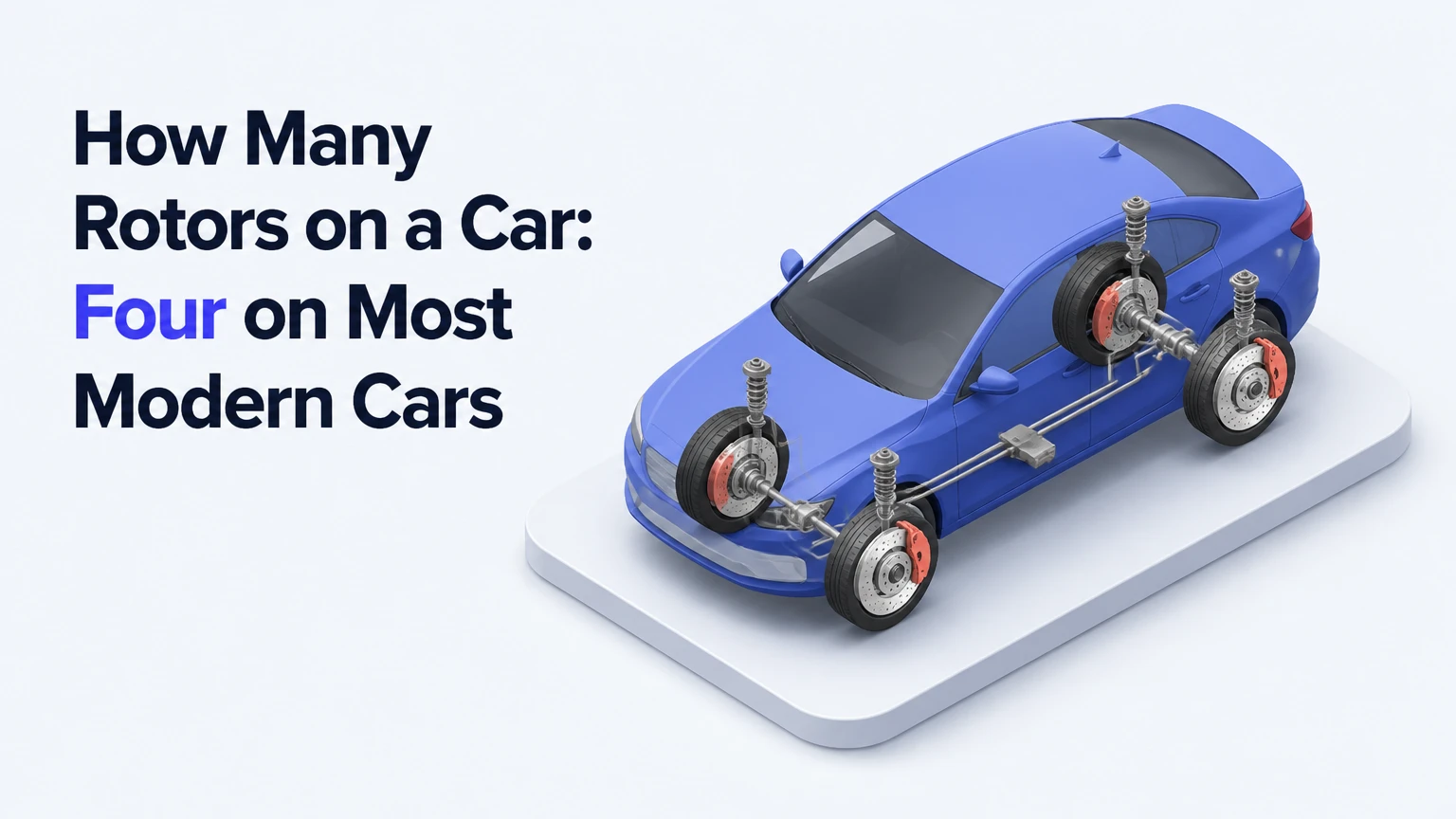
Most modern cars have four brake rotors, with one brake rotor mounted at each wheel. Some vehicles use front disc brakes and rear drum brakes, giving them only two rotors, while certain specialty vehicles use different configurations. The exact count depends on whether the rear axle uses discs or drums, not on whether the car has two-wheel or four-wheel drive.
Key Facts
A four-wheel disc-brake car normally has four brake rotors, one at each wheel.
A car with front disc brakes and rear drum brakes normally has two rotors.
A brake rotor is a rotating disc attached to the wheel hub; brake pads clamp it to slow the vehicle.
Brake drums are alternative friction components and do not count as rotors.
Brake rotors on the same axle are normally replaced or resurfaced as a matched pair.
Rotor replacement depends on minimum thickness, damage, runout, and surface condition rather than mileage alone.
How Many Rotors Does a Car Usually Have?
A typical modern passenger car has four brake rotors because manufacturers commonly fit disc brakes to all four wheels. Each rotor turns with its wheel, and a caliper presses brake pads against both sides of the rotor to create friction.
The important exception is a car with rear drum brakes. That arrangement has two front rotors and two rear drums, so the vehicle still has braking hardware at all four wheels but only two components that qualify as rotors. A car’s drivetrain does not determine the count: front-wheel-drive, rear-wheel-drive, all-wheel-drive, and electric cars can use either two or four rotors.
Common brake layouts
| Vehicle brake layout | Front components | Rear components | Rotor count |
|---|---|---|---|
| Four-wheel disc brakes | 2 rotors | 2 rotors | 4 |
| Front discs, rear drums | 2 rotors | 2 drums | 2 |
| Four-wheel drum brakes, older design | 2 drums | 2 drums | 0 |
| Performance disc system | 2 large rotors | 2 large rotors | 4 |
| Disc brakes with an integrated parking drum | 2 rotors | 2 rotors with inner drums | 4 |
A rotor count is therefore a brake-system question, not simply a wheel-count question. Most cars have four wheels, but four wheels do not guarantee four rotors.
What Is a Brake Rotor?
A brake rotor, also called a brake disc, is a circular metal component bolted to or integrated with a wheel hub assembly. The rotor rotates at wheel speed, while the brake caliper and brake pads remain fixed relative to the suspension.
During braking, hydraulic pressure moves caliper pistons. The pistons force the brake pads against the rotor’s two friction surfaces, converting vehicle motion into heat. The rotor then releases much of that heat into surrounding air through its mass, vents, and rotating airflow.
A rotor is not the same part as a brake pad or caliper. The pad creates the friction material, the caliper supplies clamping force, and the rotor provides the rotating surface that absorbs and disperses heat.
How does a rotor stop a car?
A brake rotor stops a car through friction between its rotating faces and stationary brake pads. The driver’s pedal activates the master cylinder, hydraulic fluid moves through brake lines, and caliper pistons clamp the pads against the disc.
The braking force acts at the rotor’s effective radius. A larger rotor can produce more braking torque with the same clamp force, although tire grip, pad friction, cooling, caliper stiffness, vehicle weight, and electronic brake control also determine stopping performance.
The rotor must withstand repeated temperature cycles. Hard braking can raise conventional cast-iron rotor temperatures several hundred degrees Fahrenheit, while racing systems may operate at substantially higher temperatures. Excessive heat can cause pad fade, surface cracking, distortion, or friction-material transfer.
Practitioner insight: Drivers often describe a rotor as “warped,” but many vibration complaints result from uneven friction-material deposits or disc thickness variation rather than a permanently bent disc. Measuring lateral runout and thickness variation separates those conditions.
Do All Four Wheels Have Rotors?
No. A car can have four wheels but only two rotors if the rear axle uses drum brakes. Four-wheel disc brakes are widespread on newer vehicles, larger SUVs, performance cars, and many EVs, but manufacturers still use rear drums on some small, inexpensive, or low-demand models.
Front brakes perform more work because braking shifts vehicle weight toward the front axle. Depending on vehicle design and driving conditions, the front axle may provide roughly 60-80% of the braking effort. That allows a manufacturer to use smaller rear brakes or drums while meeting braking requirements.
Rear drums also package the parking-brake mechanism efficiently and can cost less to manufacture. Their disadvantages include heavier rotating hardware, more difficult inspection, and less consistent cooling during repeated high-energy stops.
How can you tell whether a car has rear rotors or drums?
Look through the openings in a wheel or check behind the wheel with a flashlight. A rotor appears as a flat, exposed disc with a visible caliper clamped around its edge. A drum appears as a broad, enclosed metal housing with no exposed disc face.
Wheel designs can hide the difference. The reliable methods are:
- Check the owner’s manual or factory parts catalog.
- Search the vehicle’s VIN through a manufacturer or reputable parts database.
- Ask a repair shop to identify the rear assembly.
- Remove the wheel only if you can safely support the vehicle with correctly rated jack stands.
Do not identify the brake type from trim level alone. The same model name may have different brakes by engine, payload rating, market, production date, or performance package.
Why Do Some Cars Use Drums Instead of Rear Rotors?
Rear drum brakes use curved shoes that press outward against the inside of a rotating drum. Rear disc brakes use pads that clamp the outside surfaces of a rotor. Both systems convert kinetic energy into heat, but their mechanical layouts and service characteristics differ.
Drums can provide strong mechanical self-energizing action, meaning the shoe geometry helps maintain braking force after initial contact. That feature makes drums effective for parking brakes and economical rear applications. Drums are enclosed, however, so inspection and heat removal are less convenient.
Rotor brakes versus drum brakes
| Attribute | Disc brake and rotor | Drum brake |
|---|---|---|
| Friction parts | Flat pads | Curved shoes |
| Rotating component | Exposed rotor | Enclosed drum |
| Typical inspection | Visible through wheel openings | Usually requires drum removal |
| Heat release | Generally faster | Generally slower |
| Parking-brake integration | Separate mechanism or small inner drum | Natural mechanical integration |
| Common current use | Front and four-wheel systems | Rear economy cars and some trucks |
Disc brakes are usually preferable for repeated downhill driving, towing, performance use, or high thermal loads because their exposed surfaces and vents release heat more effectively. Drum brakes are not automatically unsafe or defective; the complete system must meet the vehicle’s engineering and regulatory requirements.
What Types of Brake Rotors Are Available?
The main rotor choices are blank, vented, slotted, drilled, drilled-and-slotted, and carbon-ceramic. The correct choice depends on the vehicle’s original specification, braking temperature, wheel clearance, pad compound, weather, and intended use.
| Rotor type | Typical construction | Suitable use | Main limitation |
|---|---|---|---|
| Solid blank | Single cast-iron disc | Rear brakes, compact cars, light duty | Lower heat capacity than vented designs |
| Vented blank | Two iron faces with internal vanes | Front axles, SUVs, daily driving | Costs more than a solid disc |
| Slotted | Machined grooves across friction faces | Towing, repeated heavy braking | More noise and pad wear |
| Drilled | Holes through friction faces | Some performance street systems | Hole-edge cracking under severe heat |
| Drilled and slotted | Holes plus grooves | Appearance and occasional performance use | Highest wear and noise among iron options |
| Carbon-ceramic | Carbon fiber and silicon-carbide composite | Exotic cars and high-end track use | Very high replacement cost and weaker cold bite |
Are drilled rotors better for ordinary driving?
Drilled rotors are not automatically better for ordinary street driving. Drilled holes can reduce mass and help evacuate water, but modern pad and rotor materials already handle normal rain effectively; the holes also create stress concentrations and may promote cracking under severe thermal cycling.
Slotted rotors can maintain a cleaner pad surface during heavy work, but they may increase noise and wear. Blank or plain vented rotors usually provide the quietest, most economical result for commuting when they match the factory design.
Carbon-ceramic rotors have exceptional heat and weight characteristics, but their replacement price can reach several thousand dollars per axle on some luxury and performance vehicles. They are a poor value for routine commuting unless the vehicle was engineered around them.
How Long Do Brake Rotors Last?
Brake rotors commonly last about 30,000-80,000 miles in mixed street service, but mileage is only a rough planning range. A heavy SUV used in mountains may wear rotors sooner than a lightweight sedan driven mostly on highways, while corrosion can damage an infrequently driven car before friction wear reaches the limit.
Vehicle manufacturers specify a minimum allowable thickness, often marked on the rotor hat or listed in the service information. A technician must measure the disc with a micrometer at multiple points and compare the result with that specification.
| Driving condition | Typical rotor service range | Main wear factor |
|---|---|---|
| Highway commuter, light sedan | 60,000-100,000 miles | Low brake heat and fewer stops |
| Mixed city and highway | 40,000-80,000 miles | Normal pad and heat cycles |
| Mountain roads or frequent towing | 25,000-60,000 miles | High thermal load |
| Salt, moisture, and low use | 20,000-70,000 miles | Corrosion and surface pitting |
| Track or repeated heavy stops | 5,000-30,000 miles | Extreme heat and pad deposits |
These ranges are typical practitioner estimates, not replacement schedules. A rotor that remains above its minimum thickness can still require replacement if it has deep grooves, heat checking, cracks, severe rust, or excessive thickness variation.
Practitioner insight: Replacing pads twice does not guarantee that a rotor is ready for a third pad set. Rotor condition depends on measured thickness and surface quality, while pad life depends heavily on friction material, driving style, and axle loading.
When Should Rotors Be Replaced?
Rotors should be replaced when measurement or visible damage shows that the component cannot safely provide the required friction surface. Replace both rotors on the same axle when one rotor fails because mismatched friction and heat behavior can produce uneven braking.
Common replacement triggers include:
- Thickness below the manufacturer’s discard specification.
- Cracks extending from drilled holes, slots, or the outer edge.
- Deep grooves that remain after the pads are removed.
- Severe rust flaking or pitting across the pad contact area.
- Disc thickness variation that causes pedal pulsation.
- Lateral runout above the vehicle’s specified limit.
- Blue heat spots accompanied by friction loss or repeated vibration.
Rotors do not always need replacement whenever pads are changed. A shop may reuse a rotor if measurements meet specifications and the friction surface is smooth, even, and free from structural damage. Resurfacing is possible on some iron rotors, but the final thickness must remain above the discard limit.
Should rotors be replaced in pairs?
Yes, rotors should normally be replaced in axle pairs, meaning both front rotors or both rear rotors. Pair replacement keeps braking response more consistent from left to right and avoids combining a new high-friction surface with an older, thinner, heat-damaged one.
A rotor on the opposite axle does not need replacement merely because one axle receives new parts. Front and rear brakes perform different amounts of work, so each axle is evaluated separately.
How Much Does Rotor Replacement Cost?
Typical parts-only pricing is about $40-$150 per iron rotor, while a professional pads-and-rotors job commonly costs $300-$600 for one axle. A complete four-wheel service often costs $600-$1,200, although labor rates, vehicle size, brand, corrosion, electronic parking brakes, and premium materials can move the total substantially.
| Repair scope | Typical parts cost | Typical installed cost | Typical shop time |
|---|---|---|---|
| One economy rotor | $25-$60 | Not usually quoted alone | 0.5-1.0 hour |
| One axle, pads and iron rotors | $120-$350 | $300-$600 | 1.0-2.0 hours |
| Four-wheel iron rotors and pads | $250-$700 | $600-$1,200 | 2.0-4.0 hours |
| Performance iron rotors, one axle | $250-$700 | $500-$1,000 | 1.0-2.5 hours |
| Carbon-ceramic rotor pair | $2,000-$10,000+ | $3,000-$15,000+ | Vehicle-dependent |
The figures are typical North American ranges, not guaranteed quotes. Parts catalogs can also show multiple rotor sizes for one model, so the correct part requires VIN, production date, engine, axle, and sometimes brake-package information.
What Problems Indicate a Bad Rotor?
Rotor problems can cause steering-wheel vibration, brake-pedal pulsation, scraping, grinding, unusual scoring, or reduced braking consistency. The same symptoms can also come from worn pads, seized caliper slides, wheel bearings, loose suspension parts, tire defects, or rust between the hub and rotor.
| Symptom | Likely brake-related cause | Required response |
|---|---|---|
| Steering wheel shakes during braking | Front thickness variation or runout | Measure front rotors and inspect hubs |
| Brake pedal pulses | Rotor thickness variation or ABS activation | Compare speed and pedal conditions |
| Metallic grinding | Pad friction material exhausted | Stop driving until inspected |
| One wheel runs hot | Seized caliper, hose, or parking brake | Inspect immediately |
| Light scraping after rain | Temporary surface rust | Short test drive, monitor persistence |
| Repeated squeal after service | Pad transfer, hardware, or bedding issue | Inspect pad fit and rotor surface |
A high-pitched squeal can come from a pad wear indicator, but it can also result from vibration between pad, shim, and caliper hardware. Grinding usually signals metal-to-metal contact and can destroy a rotor rapidly.
Can a rotor be repaired instead of replaced?
A rotor can sometimes be cleaned or resurfaced, but cracks, severe corrosion, undersize thickness, and major heat damage require replacement. Light overnight rust is usually harmless and often clears after several normal stops, whereas flaking rust on the braking track can reduce contact and contaminate pads.
Hub preparation matters. Rust trapped between the hub and rotor can tilt the disc enough to create measurable runout after installation. A technician should clean the hub mating face, install the rotor correctly, and tighten wheel nuts with a calibrated torque wrench.
Practitioner insight: Wheel-nut torque is part of brake service. Uneven or excessive torque can distort the hub and create a vibration that drivers incorrectly attribute to a defective new rotor.
How Do You Confirm the Rotor Count on Your Car?
Confirm the rotor count by identifying the brake type at each wheel, then verify the result with the vehicle’s service information. A visible disc and caliper indicate a rotor, while an enclosed drum indicates a drum brake.
Use this practical sequence:
- Park on level ground and allow the brakes to cool.
- Look through each wheel opening with a flashlight.
- Identify a flat disc and caliper at the front wheels.
- Inspect the rear wheels for either exposed discs or enclosed drums.
- Confirm the result using the owner’s manual or VIN-specific parts catalog.
- Do not crawl beneath a vehicle supported only by a jack.
A rotor count can also differ from the number of brake components a vehicle has. For example, a rear rotor may contain a small internal drum used only for the parking brake. That assembly still counts as one rotor, not two rotors.
Do Electric and Hybrid Cars Have Four Rotors?
Many electric and hybrid cars have four rotors, but regenerative braking changes how often the friction brakes operate. The motor-generator absorbs part of the vehicle’s kinetic energy, so brake pads and rotors may experience less friction wear than those on a comparable gasoline vehicle.
Reduced use creates a separate corrosion risk. A rotor can develop rust or friction-material deposits when regenerative braking handles most gentle stops and the mechanical brakes remain lightly used.
Some EVs use rear drums because drums can resist corrosion and reduce cost, while others use large four-wheel discs for weight, performance, or thermal requirements. Battery weight, tire traction, towing capacity, acceleration, and software calibration influence the brake design.
What Mistakes Should You Avoid During Rotor Service?
The most expensive mistakes are installing pads on damaged rotors, skipping hub cleaning, using the wrong rotor size, and failing to bed the new friction surfaces. Each error can create noise, vibration, uneven wear, or reduced braking performance.
Avoid these failures:
- Pad slapping: New pads on deeply grooved or undersize rotors may never seat correctly.
- Wrong application: Similar model names can conceal different diameters, thicknesses, or parking-brake designs.
- Dirty hub face: Rust under the rotor can create lateral runout.
- Improper wheel torque: Uneven tightening can contribute to vibration and mounting distortion.
- Skipped bedding: Follow the pad manufacturer’s procedure, usually a series of moderate stops with cooling intervals.
- Chemical contamination: Grease, oil, and anti-seize must never contact the friction surfaces.
New rotors often carry a protective oil film. Remove it with the manufacturer-approved brake cleaner before installation. Bedding instructions vary by pad compound, so a generic procedure should not override the supplied instructions.
Frequently Asked Questions
Does a four-wheel-drive car have four rotors?
A four-wheel-drive car may have four rotors, but four-wheel drive does not determine the brake layout. The vehicle can use four-wheel discs, front discs with rear drums, or another factory configuration. Check the rear assemblies or VIN-specific service data instead of assuming the drivetrain determines the rotor count.
Are front rotors larger than rear rotors?
Front rotors are usually larger or thicker than rear rotors because the front axle handles more braking load during weight transfer. The exact dimensions depend on vehicle mass, tire size, brake balance, cooling requirements, and whether the rear axle uses discs or drums.
How many brake pads does a car with four rotors use?
A car with four rotors normally uses eight friction pads, with two pads clamping each rotor. Some calipers use unusual multi-pad designs, and drum brakes use shoes instead, so the pad count cannot be inferred from the rotor count on every vehicle.
Can you drive with a cracked rotor?
Do not drive normally with a cracked rotor. A crack can grow under repeated heat and braking loads, potentially reducing friction contact or causing structural failure. Arrange immediate inspection and towing when necessary, especially if the crack reaches a drilled hole, outer edge, or mounting area.
Does rotor color show that replacement is necessary?
Blue or purple discoloration indicates substantial heat exposure, but color alone does not prove that a rotor must be replaced. Measure thickness and runout, inspect for cracks and heat checking, and evaluate the pad surface. Severe discoloration combined with vibration, cracking, or friction loss requires replacement.
The Bottom Line
Most modern cars have four brake rotors, one at each wheel, because they use four-wheel disc brakes. A car with front disc brakes and rear drum brakes has two rotors, and older four-wheel drum vehicles have none. For the exact answer to “how many rotors on a car,” inspect each axle and verify the vehicle’s VIN-specific brake specification.
Rotor replacement should follow measurements and damage criteria, not a universal mileage rule. Replace rotors in axle pairs when thickness, runout, grooves, corrosion, cracks, or heat damage make reuse unsafe.