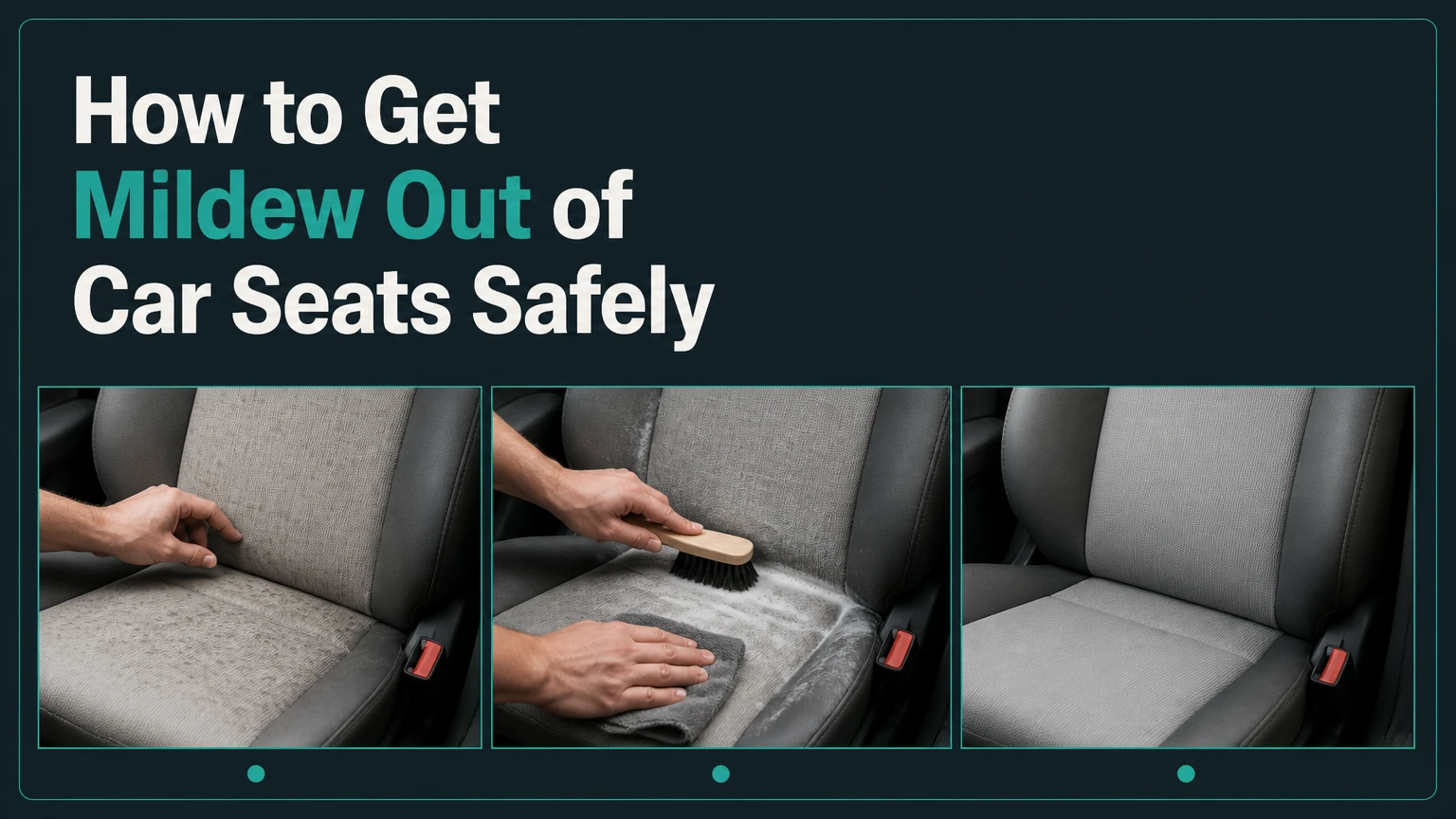
To get mildew out of car seats, remove loose growth, clean the seat with a material-safe detergent or specialist product, extract or blot without soaking the foam, and dry it completely within 24 hours. The most important step is fixing the moisture source, because cleaning a damp seat without repairing a leak usually leads to recurrence.
Key Facts
Mildew on a car seat is a moisture problem as well as a cleaning problem.
Fabric seats require low-moisture cleaning and thorough foam drying.
Leather and vinyl need pH-appropriate products; bleach can damage their finishes.
A HEPA vacuum should remove loose dry debris before wet treatment, not after it.
A typical light surface treatment takes 2-6 hours, including drying.
Flooded interiors, recurring growth, and contaminated foam often require professional remediation or seat replacement.
How to Get Mildew Out of Car Seats: The Safe Method
A light, isolated patch on a fabric seat can usually be treated at home in seven steps: isolate the vehicle, dry-vacuum loose growth, apply a controlled cleaner, agitate gently, blot or extract, dry the cushion, and inspect the moisture source. Allow 30-60 minutes for cleaning and typically 4-24 hours for complete drying, depending on humidity and foam depth.
Do not begin by spraying a large quantity of water or household bleach. Both choices can create a larger problem: water can remain inside polyurethane foam, while bleach may discolor upholstery, weaken fibers, corrode metal, or damage leather and vinyl coatings.
Before You Start
| Requirement | Typical specification | Why it matters |
|---|---|---|
| Cleaning time | 30-60 minutes | Covers one or two affected seat panels |
| Drying time | 4-24 hours | Depends on humidity, airflow, and cushion thickness |
| Mask | N95 or better | Reduces inhalation of disturbed particles |
| Gloves | Nitrile, 5-8 mil | Protects skin from cleaners and contamination |
| Vacuum | HEPA-filtered, dry-use | Captures loose debris more effectively than open exhaust |
| Towels | 6-10 white microfiber towels | Prevents dye transfer and supports repeated blotting |
| Brush | 1 soft upholstery brush | Agitates fibers without grinding growth deeper |
| Airflow | 1-2 fans, doors open | Speeds evaporation after treatment |
Park outside only when weather is dry and the vehicle can remain supervised. Sunlight can warm and dry surfaces, but sunlight is not a dependable disinfectant and does not replace cleaning.
Protect electrical connectors, seat-mounted airbags, occupancy sensors, and heated-seat controls. Never flood the gap beneath a powered seat. If the vehicle has a child-restraint seat installed, remove it and follow the manufacturer’s cleaning instructions separately.
Step 1: Find and Stop the Moisture Source
Find the moisture source before cleaning the seat. Common causes include a leaking door seal, blocked sunroof drain, wet carpet, windshield seal failure, condensation, spilled drinks, damp clothing, and a cabin filter or HVAC problem.
Inspect the seat seams, carpet under the seat, door sills, trunk, roof liner, and spare-wheel well. Feel the carpet padding rather than checking only the visible surface. A dry seat above wet foam or carpet can develop mildew again within days.
The U.S. Environmental Protection Agency states, “The key to mold control is moisture control.” The EPA also recommends keeping indoor relative humidity below 60%, ideally between 30% and 50%; that range is useful for a vehicle parked in a humid environment, although car cabins can change rapidly.
What moisture clues indicate a leak?
| Clue | Likely source | First inspection |
|---|---|---|
| Wet front passenger carpet | Windshield, HVAC drain, door seal | Check carpet edge and glove-box area |
| Wet rear footwell | Door membrane, sunroof drain, body seam | Inspect door sill and headliner |
| Damp seatback after rain | Roof seal or window seal | Run a controlled hose test |
| Musty smell after air conditioning | Evaporator or cabin filter area | Inspect filter and drain outlet |
| Water in the trunk | Tail-light seal or hatch seal | Lift cargo floor and spare-wheel cover |
| Mildew after a flood | Saturated carpet and seat foam | Arrange professional inspection |
A controlled hose test uses a gentle stream over one area at a time while a second person watches from inside. Do not use a pressure washer, because high-pressure water can force moisture behind trim and seals.
Step 2: Isolate and Dry-Vacuum the Seat
Isolate the affected seat before disturbing mildew. Remove floor mats and loose objects, open the doors, and keep children, pets, and vulnerable people away from the work area.
Wear gloves and an N95 mask. Use a HEPA-filtered vacuum with a crevice tool held slightly above the fabric. Avoid pressing the nozzle into the growth, because pressure can drive particles into the weave and cushion.
Vacuum adjacent seams, the seatback, seat rails, carpet, and the underside of removable cushions when accessible. Do not use a household vacuum that exhausts unfiltered air into the cabin. Seal disposable vacuum bags and contaminated towels in a plastic bag before placing them in outdoor waste.
Should you vacuum mildew while it is wet?
No. Vacuuming wet mildew can spread contaminated moisture and damage a standard vacuum. Dry-vacuum loose material only when the seat surface is dry; otherwise, use a controlled damp-cleaning process and arrange professional help for extensive growth.
Step 3: Choose a Material-Safe Cleaner
Choose the cleaner according to the seat material, not according to the color of the growth. Fabric can tolerate a low-moisture upholstery detergent or compatible enzyme cleaner, while finished leather and vinyl need products formulated for those surfaces.
Always read the vehicle owner’s manual and the cleaner label. Patch-test a hidden area for color loss, tackiness, whitening, cracking, or dye transfer, then wait until the test spot dries before treating the visible seat.
Which cleaner is best for fabric, leather, or vinyl?
| Seat material | Preferred product | Typical working amount | Main restriction |
|---|---|---|---|
| Woven fabric | Upholstery detergent or enzyme cleaner | 10-20 mL concentrate per 500 mL water, if label allows | Do not saturate foam |
| Synthetic cloth | Low-foam fabric cleaner | 100-150 mL ready-to-use spray per seat panel | Avoid heavy fragrance residue |
| Finished leather | pH-balanced leather cleaner | 5-10 mL on a damp cloth | Do not use vinegar, bleach, or peroxide |
| Vinyl | Vinyl-safe cleaner or mild detergent | 10-15 mL per 500 mL water | Avoid solvents and abrasive pads |
| Alcantara or suede-like trim | Manufacturer-approved cleaner | Label quantity only | Avoid household remedies |
| Child car-seat fabric | Manufacturer-approved method | Manual-specific | Do not use unapproved chemicals |
Can vinegar remove mildew from a car seat?
Diluted white vinegar may help with a light surface odor or small patch on compatible synthetic fabric, but vinegar is not a guaranteed mold-remediation product and should not be used on leather, suede, or some coated materials. Never mix vinegar with bleach, ammonia, or peroxide.
A practical test mixture is one part white vinegar to one part water, applied sparingly to a hidden fabric area. The widely repeated claim that vinegar kills 82% of mold species comes from general household-cleaning discussions, not a reliable guarantee for a car seat’s mixed fabric, foam, soil, and fungal growth. Treat the number as unsuitable for predicting your result.
Baking soda can absorb some odor after the seat is clean and dry. It does not replace removal of embedded growth, and brushing dry powder into a damp cushion can create residue that is difficult to extract.
Are enzyme cleaners suitable?
An enzyme cleaner can break down organic residue that supports odor, but enzyme products do not all kill fungi. Use one only when the label identifies the intended material and dwell time. A fungicidal or mold-control product may have a different label, and “removes odor” does not mean “removes mold.”
Step 4: Apply Cleaner Without Soaking the Foam
Apply cleaner to a microfiber towel or lightly mist the fabric instead of flooding the seat. Work in an area of approximately 30 by 30 centimeters, using 10-20 sprays or the manufacturer’s stated dose, then allow the label’s dwell time, commonly 5-15 minutes.
Keep the product away from seat-belt buckles, electrical switches, airbag seams, and seat tracks. Do not pry open upholstery or remove a seat cover unless you understand the restraint system and can reinstall it correctly.
For leather and vinyl, dampen a cloth rather than spraying the surface. Clean one panel at a time, then wipe with a second cloth dampened with clean water if the product label requires rinsing.
You will know the application is controlled when the surface is evenly damp, not glossy with pooled liquid, and no fluid runs into seams. The common mistake is treating a seat like a removable carpet and saturating the cushion.
Step 5: Agitate and Blot the Growth
Agitate fabric with a soft nylon upholstery brush using short strokes in one direction. Lift the growth from the fibers rather than scrubbing aggressively, because hard brushing can spread residue and roughen synthetic upholstery.
Use a soft horsehair or leather brush only where the leather manufacturer permits it. For vinyl, a microfiber cloth is usually safer than a stiff brush, especially on embossed grain and stitched seams.
Blot with clean white towels, rotating to a dry section as soon as the towel becomes damp or discolored. If you have a wet-dry extractor, use the smallest practical amount of cleaning solution and make several slow extraction passes without adding more water.
What is the correct extraction endpoint?
Stop when the towel picks up little visible residue and the fabric feels damp rather than wet. A typical seat cushion should not release water when pressed through a towel. The foam may remain wet even when the surface appears clean, so drying is a separate required step.
Step 6: Dry the Seat and Cabin Completely
Dry the seat immediately with doors open, a fan aimed across the surface, and low cabin humidity. A typical surface dries in 2-6 hours under strong airflow, but thick foam, cool weather, or high humidity can extend drying to 12-24 hours.
Do not close the windows overnight while the cushion is damp. Do not reinstall a child car seat, seat cover, or floor mat until the underlying upholstery and carpet are fully dry.
A moisture meter can help identify hidden dampness, but readings vary by fabric, foam, and meter type. The practical checkpoint is repeated: press a dry towel into seams and cushion edges, check for cool dampness, and inspect the carpet below the seat.
The EPA’s 30%-50% relative-humidity guidance is an indoor benchmark rather than a promise that a car will dry within a fixed time. Warm air alone is insufficient if humid air cannot leave the cabin.
Step 7: Reinspect and Repeat Only When Dry
Inspect the seat after it dries, not while cleaner darkens the fabric. A remaining discoloration may be a dead stain, dye change, or embedded residue rather than living mildew.
Repeat one controlled treatment if the seat has no material damage and the smell is improving. Do not perform repeated wet cycles when the odor remains strong or growth reappears, because the source may be inside the foam, carpet padding, or HVAC system.
How can you tell whether mildew is gone?
Mildew is more likely to be controlled when the seat is dry, no new growth appears after several days, the musty odor does not return after the cabin warms, and the moisture source is repaired. Color alone cannot prove that fungal contamination has been eliminated.
Which Cleaning Method Should You Choose?
For a small surface patch, low-moisture detergent cleaning is the safest starting point. Professional extraction becomes more appropriate when mildew reaches the cushion, carpet, seat underside, or multiple interior components.
| Method | Typical cost | Active cleaning time | Drying window | Best use |
|---|---|---|---|---|
| Low-moisture upholstery cleaner | $10-$30 | 30-60 minutes | 4-8 hours | One small fabric area |
| Enzyme cleaner | $12-$35 | 30-60 minutes | 4-12 hours | Organic odor and fabric residue |
| Consumer steam cleaner | $50-$180 purchase or $30-$70 rental | 45-120 minutes | 8-24 hours | Controlled surface cleaning |
| Professional interior detail | $150-$400 | 3-8 hours | 8-24 hours | Several seats or persistent odor |
| Mold remediation specialist | $500-$2,000 or more | 1-3 days | 24-72 hours | Flooding or widespread contamination |
| Seat-cover replacement | $100-$800 per seat, typical | 1-4 hours | None after installation | Irreversibly contaminated upholstery |
Prices are typical U.S. consumer ranges, not fixed quotations. Labor, vehicle size, local humidity, seat removal, contamination depth, and replacement parts produce large regional differences.
Is steam cleaning a good option?
Steam cleaning can loosen surface soil and expose fabric to high heat, but a 60°C or 140°F nozzle temperature does not guarantee that every spore inside a cushion reaches that temperature for a sufficient time. Steam also adds water, and wet foam is difficult to dry.
Use a fabric attachment, make brief passes, and extract or towel-dry immediately. Avoid steam around leather coatings, glued trim, electronics, airbag labels, and seat-belt mechanisms unless the manufacturer specifically permits it.
Does ozone remove mildew odor?
Ozone can react with some odor compounds, but ozone treatment does not remove contaminated debris, repair wet foam, or replace cleaning. The EPA warns that ozone generators can produce harmful indoor concentrations, and ozone can irritate the lungs and damage rubber, plastics, dyes, and leather finishes.
Do not use ozone while people or animals are inside the vehicle. Professional operators should measure concentration, control exposure, ventilate fully, and clean the source first. For most small seat problems, source removal and ventilation are more defensible than consumer ozone use.
What Should You Avoid?
Avoid bleach, uncontrolled peroxide, excessive water, hard dry-brushing, and chemical mixing. These practices either damage vehicle materials or spread contamination without addressing the underlying moisture.
| Product or mistake | Likely damage | Safer correction |
|---|---|---|
| Chlorine bleach on fabric | Color loss and fiber damage | Use labeled upholstery cleaner |
| Bleach on leather or vinyl | Finish failure and discoloration | Use material-specific cleaner |
| Vinegar on leather | Drying, odor, or coating damage | Use pH-balanced leather cleaner |
| Hydrogen peroxide on dark fabric | Light spots and dye change | Test hidden area; avoid dark materials |
| Excess extractor water | Damp foam and recurring odor | Use fewer solution passes |
| Hard brushing | Embedded debris and rough fibers | Use soft, controlled agitation |
| Closed windows during drying | Trapped humidity | Keep airflow moving outward |
| Ozone before cleaning | Exposure without source removal | Clean, dry, then reassess odor |
Never mix vinegar with bleach. The combination can release chlorine gas. Never mix hydrogen peroxide with vinegar in the same container, because the resulting peracetic acid can irritate skin, eyes, and airways.
Material-Specific Variations
Fabric seats with a small spot
Treat one seat panel with low-moisture upholstery cleaner, blot repeatedly, and dry with a fan. If the patch covers more than roughly 0.1 square meter, reaches stitching, or returns after two treatments, inspect the foam and nearby carpet rather than continuing surface sprays.
Leather seats
Remove dry surface debris with a soft cloth, then use a leather cleaner on a damp cloth. Wipe away residue and apply a compatible conditioner only after the leather is fully clean and dry. Conditioner will not kill mildew and can trap residue if applied too soon.
Finished leather can conceal growth in perforations and stitching. Do not force liquid into perforated seats, because moisture can remain beneath the top layer.
Vinyl seats
Clean vinyl with a manufacturer-approved vinyl product or mild detergent solution. Use a soft cloth around seams and wipe residue away. Avoid acetone, petroleum solvents, abrasive melamine pads, and strong alkaline cleaners, which can strip plasticizers or leave a dull surface.
Child car seats
A child safety seat is a separate safety product, not ordinary upholstery. Follow the seat manufacturer’s manual for removable-cover washing, harness cleaning, and replacement rules; many manufacturers prohibit bleach, disinfectant, steam, and soaking the harness.
Replace the child seat if the manual requires replacement after mold exposure, flooding, unknown chemical treatment, or damaged webbing. Never improvise a disinfecting solution for harness straps.
When Should You Call a Professional or Replace the Seat?
Call a professional when mildew covers multiple seats, appears beneath upholstery, follows flooding, returns after moisture repair, or produces a persistent odor after two complete dry-cleaning cycles. Professional remediation may include controlled disassembly, extraction, antimicrobial treatment, HVAC inspection, and moisture measurement.
Replacement is often more sensible when foam remains contaminated, the seat has absorbed floodwater, mold has penetrated bonded layers, or the upholstery has permanent staining and odor. Cleaning a visibly improved surface does not make a flooded vehicle safe when padding, wiring, and insulation remain wet.
People with asthma, severe allergies, immune suppression, or significant respiratory sensitivity should avoid disturbing extensive growth. The Centers for Disease Control and Prevention recommends reducing exposure to mold, and vulnerable occupants may need to stay out of the vehicle until cleaning is complete.
What does professional remediation include?
| Service component | Typical duration | Typical output |
|---|---|---|
| Moisture-source inspection | 30-90 minutes | Leak or condensation diagnosis |
| Interior HEPA vacuuming | 1-3 hours | Removal of loose contamination |
| Upholstery extraction | 2-5 hours | Reduced soil and odor load |
| HVAC and cabin-filter inspection | 30-60 minutes | Filter or drain recommendation |
| Drying and dehumidification | 12-48 hours | Lower cushion moisture |
| Seat or carpet replacement | 2-8 hours | Removal of irreversibly affected materials |
A detailer can improve appearance and odor, but not every detailing package is mold remediation. Ask whether the provider inspects foam, carpet padding, HVAC pathways, and moisture sources rather than promising a universal kill percentage.
How Do You Prevent Mildew From Returning?
Prevent recurrence by keeping the cabin dry, removing wet objects promptly, maintaining door and sunroof drains, and replacing a contaminated cabin air filter when appropriate. Inspect the vehicle after rain and after air-conditioning use, especially if the smell returns only when the blower starts.
Use these prevention controls:
- Dry umbrellas, towels, clothing, and floor mats outside the vehicle.
- Open doors briefly after cleaning when weather permits.
- Check door seals and sunroof drains at least twice yearly.
- Keep carpet edges and seat rails free of trapped debris.
- Replace the cabin filter according to the vehicle manual.
- Run air conditioning long enough to drain condensation normally.
- Use a moisture absorber only as a temporary aid, not as a leak repair.
- Store the vehicle with ventilation only when security and weather allow it.
Can a cabin filter spread mildew to the seats?
A dirty or damp cabin filter can contribute to musty airflow, but it is not automatically the source of seat mildew. Inspect the filter housing, evaporator area, and HVAC drain when odor increases with the blower; replace the filter if the manual and filter condition support replacement.
Troubleshooting Persistent Problems
The stain remains after cleaning
A remaining stain may be pigment damage or dead residue. On light, colorfast synthetic fabric only, patch-test a small amount of 3% hydrogen peroxide, allow it to work briefly, blot, and rinse minimally according to the product instructions.
Do not use peroxide on leather, dark fabric, suede-like trim, or any material that fails the hidden-spot test. Stain removal and fungal decontamination are different tasks.
The musty odor persists
Check the cushion underside, carpet padding, seat belt webbing, trunk, spare-wheel well, cabin filter, and HVAC drain. Fragrance sprays mask odor compounds and can make diagnosis harder.
A professional extractor may reduce odor when contamination is shallow. Persistent odor after extraction usually indicates moisture or contamination in a hidden layer.
Mildew returns within one week
A one-week recurrence strongly suggests unresolved moisture, not a weak deodorizer. Recheck door membranes, sunroof drains, windshield seals, seat foam, carpet padding, and the HVAC system before applying another cleaner.
The seat is wet after 24 hours
Stop using the vehicle until the cushion dries. Increase cross-ventilation, use a dehumidifier or fan outside the vehicle with safe electrical routing, and arrange extraction if the foam remains wet. Do not cover the seat or close the cabin around trapped moisture.
Expert Rules That Prevent Failed Cleanups
Practitioner rule one: clean the perimeter, not only the visible dot. Mildew often spreads along seams, piping, and the underside where condensation or spilled liquid collects. Treating only the center leaves a contaminated edge that can seed the surface again.
Practitioner rule two: drying capacity determines water quantity. A powerful extractor does not make saturation safe when humidity is high and airflow is poor. Use less solution in a closed cabin than on a removable household cushion.
Practitioner rule three: odor is a diagnostic signal, not a finish line. A fragrance-free, dry seat with no returning odor is a stronger endpoint than a heavily scented seat that still contains wet foam.
Practitioner rule four: never promise a kill percentage from a household method. Product efficacy depends on species, concentration, contact time, surface porosity, and whether the product label covers that use. Appearance and smell cannot establish a laboratory kill rate.
Frequently Asked Questions
Can I remove mildew from car seats without removing them?
Yes, small surface contamination can usually be cleaned in place, provided you protect electrical components and use minimal liquid. Remove the seat only when the manufacturer or a qualified technician permits it, because seat removal can involve airbags, occupancy sensors, wiring, and calibrated mounting hardware.
How long should vinegar sit on a car seat?
For a patch-tested, compatible synthetic fabric, a diluted vinegar solution may remain for approximately 5-15 minutes before blotting, but the product is not a guaranteed mold treatment. Do not leave vinegar on leather, suede-like trim, or sensitive dyed fabric, and never combine it with bleach or peroxide.
Can baking soda kill mildew in car upholstery?
Baking soda does not reliably kill mildew embedded in upholstery or foam. It can reduce some odor after the seat has been cleaned and completely dried, but vacuum the powder thoroughly and do not use it to conceal a damp cushion or unresolved leak.
Should I wash removable seat covers in a washing machine?
Wash removable covers only if the vehicle or seat-cover manufacturer permits machine washing. Use the specified water temperature and detergent, avoid bleach unless explicitly approved, and dry the cover completely before reinstalling it; a damp cover can transfer moisture back into the foam.
Is visible mildew on a car seat dangerous?
Visible mildew can release particles that irritate the eyes, skin, and respiratory tract, with greater concern for people with asthma, allergies, or immune suppression. Wear respiratory protection during minor cleaning, avoid disturbing extensive contamination, and keep vulnerable occupants out until the cabin is cleaned and dry.
Can I drive the car while the seat is drying?
Avoid driving while the seat remains wet, especially if moisture could reach wiring, sensors, seat heaters, or airbag components. If a short trip is unavoidable, keep the seat uncovered and ventilated, but complete drying before normal use is the safer choice.
The Bottom Line
The safest way to get mildew out of car seats is to repair the moisture source, remove loose contamination with controlled vacuuming, use a cleaner made for the seat material, and dry the cushion completely. Fabric tolerates low-moisture upholstery cleaning, while leather and vinyl require specialized products. Escalate flooded, recurring, widespread, or deeply embedded contamination instead of repeatedly wetting the seat.