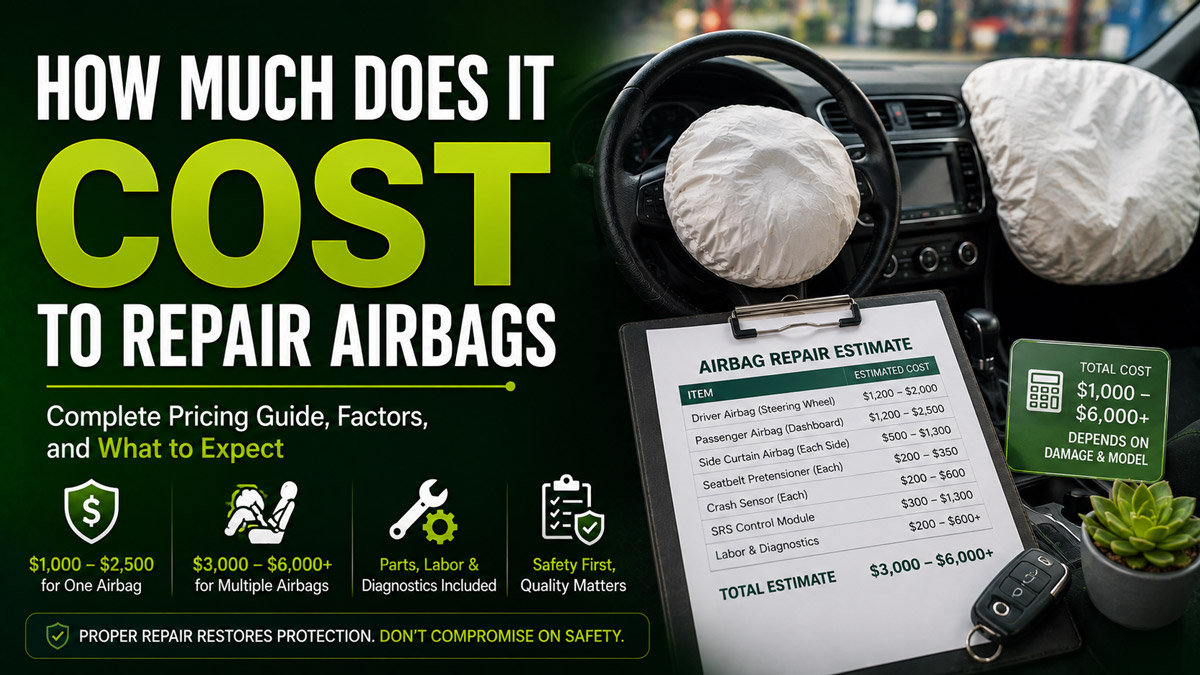
It typically costs $1,000 to $2,500 to replace one deployed airbag, while repairing a vehicle with several deployed airbags can cost $3,000 to more than $6,000. A deployed airbag cannot be patched, refilled, folded back into place, or repaired; the complete airbag module and any activated supporting components must be replaced.
Key Facts at a Glance
- A single deployed airbag commonly costs $1,000–$2,500 to replace.
- A multi-airbag collision repair may exceed $6,000.
- Airbags are single-use components and cannot be safely repaired after deployment.
- Seatbelt pretensioners, crash sensors and the airbag control module may also require service.
- Passenger and curtain airbags generally cost more to install because dashboard or headliner removal is required.
- Airbag deployment can cause an older or lower-value vehicle to be declared a total loss.
How Much Does It Cost to Repair Airbags on Average?
The total cost usually falls between $1,000 and $2,500 for one airbag and between $3,000 and $6,000 or more for several airbags. The final estimate depends on the airbag location, vehicle design, parts availability, labor rate and number of supporting SRS components activated during the crash.
A relatively simple driver-airbag replacement may require the airbag module, steering-wheel trim and diagnostic labor. A severe collision may require driver, passenger, curtain and knee airbags, seatbelt pretensioners, crash sensors, interior trim, wiring repairs and control-module programming.
Typical Cost by Repair Situation
| Repair Situation | Typical Total Cost |
| SRS diagnosis without deployment | $100–$250 |
| Clock spring or wiring repair | $250–$600 |
| One deployed airbag | $1,000–$2,500 |
| Driver and passenger airbags | $2,500–$5,000 |
| Multiple airbags and pretensioners | $3,000–$6,000+ |
| Extensive dashboard and interior damage | $5,000–$10,000+ |
These are typical ranges rather than guaranteed prices. Luxury vehicles, rare parts, advanced seat sensors and extensive interior damage can push the total significantly higher.
Can a Deployed Airbag Be Repaired?
No. A deployed airbag must be replaced because the inflator has fired, the cushion has expanded, and the module is no longer capable of performing another controlled deployment.
The term “airbag repair” normally refers to repairing the entire Supplemental Restraint System after a crash. This may include replacing the deployed airbag, restoring wiring, servicing the control module, replacing pretensioners and clearing SRS faults after all damaged components have been corrected.
A shop that offers to repack or reseal a deployed airbag should not be trusted. The unit is a pyrotechnic safety component, not a reusable mechanical part.
What Is Included in the Airbag Repair Cost?
Airbag repair costs include much more than the fabric cushion. The Supplemental Restraint System may contain airbags, impact sensors, an airbag control module, seatbelt pretensioners, occupancy sensors, wiring, steering-wheel components and interior panels.
| Component | Typical Installed Cost | Typical Repair Time |
| Driver airbag | $1,000–$2,470 | 1–2 hours |
| Passenger airbag | $1,000–$1,500+ | 2–4 hours |
| Side-curtain airbag | $500–$1,300+ | 3–5 hours |
| Knee airbag | $250–$600 | 1–2 hours |
| Airbag control module | $300–$1,300 | 1–2 hours |
| Crash sensor | $200–$600 each | 0.5–1 hour |
| Clock spring | $350–$440 | About 1 hour |
| Seatbelt pretensioner | $200–$350 each | About 1 hour |
Driver Airbag
The driver airbag is normally located in the steering wheel. Replacement may involve the airbag module, steering-wheel cover, mounting hardware and clock spring.
Labor is often lower than for a passenger airbag because technicians usually do not need to remove the dashboard. However, steering-column or steering-wheel damage can increase the estimate.
Passenger Airbag
The passenger airbag is usually mounted behind or within the dashboard. Replacement often requires extensive dashboard disassembly and may require a complete dashboard pad or upper instrument panel.
This additional interior work can make the passenger-side repair more expensive even when the airbag module itself costs a similar amount to the driver unit.
Side and Curtain Airbags
Seat-mounted side airbags may require seat-cover replacement or upholstery work. Curtain airbags are mounted along the roof rail and normally require removal of the headliner, pillar trim and weather seals.
A curtain-airbag deployment can therefore produce several secondary costs even when the replacement airbag is not especially expensive.
Knee Airbags
Knee airbags are usually mounted below the dashboard. They tend to be less expensive than passenger or curtain airbags, but trim panels, brackets and wiring may also require replacement.
Seatbelt Pretensioners
Seatbelt pretensioners tighten the belt during a collision and are often activated at the same time as the airbags. Once triggered, they usually remain locked or display a fault and must be replaced or professionally rebuilt where legally permitted.
Replacing the airbags without correcting activated pretensioners may leave the SRS warning light illuminated and the restraint system disabled.
Airbag Control Module
The airbag control module records collision data and controls deployment decisions. Depending on the vehicle and crash, the module may require replacement, manufacturer programming or professional crash-data service.
A reset does not repair a deployed airbag. It only addresses stored collision data in a module that has been inspected and determined suitable for continued use.
Why Does Airbag Replacement Cost So Much?
Airbag replacement is expensive because it combines regulated safety components, specialized diagnostics, interior disassembly, programming and liability-sensitive labor.
The replacement airbag may represent only part of the invoice. A shop must also identify every activated or damaged SRS component and confirm that the complete system passes its self-test after repair.
Parts Must Match the Vehicle
Airbags are designed for specific vehicle positions, model years, trim levels and control systems. The correct replacement may depend on the vehicle identification number, steering-wheel design, seat configuration and electrical connectors.
Using an incompatible component can cause warning lights, communication faults or incorrect deployment behavior.
Labor Can Be Extensive
A driver airbag may be accessible through the steering wheel, while a passenger airbag may require dashboard removal. Curtain-airbag replacement can involve removing roof trim, handles, pillar covers and the headliner.
Labor rates commonly vary by shop type and location. Dealership and specialist collision-center rates are often higher than general mechanical-shop rates.
Programming May Be Required
Control modules, occupant sensors and other SRS components may require VIN-specific programming, zero-point calibration or manufacturer scan-tool procedures.
Modern vehicles may also require inspection or calibration of related advanced driver-assistance systems after collision repairs.
What Factors Change the Final Cost?
The largest cost factors are the number of deployed airbags, their location and the amount of surrounding damage.
Number of Deployed Airbags
One deployed driver airbag is far less expensive to address than a collision involving front, side, curtain and knee airbags. Costs multiply because every airbag is a separate module with its own labor requirements.
Vehicle Make and Model
Luxury, performance and low-production vehicles generally have more expensive parts. Some models also integrate airbags into costly dashboards, seats or trim assemblies.
An older mass-market vehicle may have cheaper recycled parts available, but age can create availability problems for new components.
Interior Damage
Airbags can split steering-wheel covers, tear dashboards, damage headliners and break pillar trim during deployment. These cosmetic and structural interior parts are separate from the airbag itself.
A quote that includes only the airbag module may therefore understate the actual cost of restoring the vehicle.
Sensor and Wiring Damage
Crash forces may damage sensors, connectors, brackets or wiring harnesses. Water, fire-extinguisher residue or body-repair work can also affect electrical connections.
Every active SRS fault must be diagnosed rather than simply erased.
Labor Rate
A dealership may charge more because it uses factory procedures, brand-specific tools and original components. An independent collision center may offer lower labor rates while still using OEM parts and qualified technicians.
Price should not be the only deciding factor. SRS training, diagnostic capability and documented parts sourcing are more important than obtaining the cheapest quote.
How Are Airbags Replaced After a Crash?
Airbag replacement normally follows a controlled eight-stage process.
Step 1: Disable the Electrical System
The technician disconnects the battery and follows the manufacturer’s waiting procedure so stored electrical energy can dissipate.
This step reduces the risk of accidental deployment while SRS connectors and modules are being handled.
Step 2: Scan the SRS System
A professional scanner retrieves airbag, sensor, pretensioner, occupancy-system and control-module fault codes.
The technician records the codes before disconnecting components because they help identify what activated during the collision.
Step 3: Inspect the Collision Damage
The vehicle is inspected for structural damage, damaged mounting brackets, wiring problems, steering-column movement and broken interior parts.
Installing new airbags before confirming structural integrity can produce an incomplete or unsafe repair.
Step 4: Remove Deployed Components
The deployed airbags, triggered pretensioners and damaged trim are removed using vehicle-specific procedures.
Passenger and curtain airbags may require substantial dashboard or headliner disassembly.
Step 5: Replace Required SRS Parts
New or properly sourced replacement airbags, sensors, pretensioners, clock springs and wiring components are installed.
Every connector and fastener must be secured according to the manufacturer’s procedure.
Step 6: Service the Control Module
The control module is replaced, programmed or professionally serviced when permitted by the manufacturer and applicable regulations.
A module should never be cleared merely to hide an unresolved fault.
Step 7: Program and Calibrate the System
The technician performs required VIN programming, occupant-classification calibration and related initialization procedures.
Seat removal or sensor replacement may require recalibration before the passenger airbag can operate correctly.
Step 8: Complete the Final Safety Scan
After reassembly, the battery is reconnected and the ignition is cycled. The SRS warning light should illuminate briefly during its self-test and then turn off.
The technician completes a final scan to confirm that no current or pending SRS faults remain.
How Long Does Airbag Repair Take?
A simple single-airbag replacement may take one working day, while a multi-airbag collision repair can take several days or longer. Parts availability, dashboard removal, body repairs, module programming and insurance approval frequently determine the actual completion time.
Approximate active labor times include:
- Driver airbag: 1–2 hours
- Passenger airbag: 2–4 hours
- Curtain airbag: 3–5 hours
- Control module: 1–2 hours
- Pretensioner: about 1 hour per seating position
The vehicle may remain at the shop much longer than the active labor total if parts must be ordered.
Is It Cheaper at a Dealership or Independent Shop?
An independent collision center is usually less expensive, while a dealership generally offers the most direct access to factory parts, software and repair procedures.
| Repair Provider | Typical Cost | Best For | Main Limitation |
| Dealership | $1,000–$2,500 per airbag | Newer or insured vehicles | Highest labor and parts prices |
| Qualified independent shop | $500–$1,500+ per airbag | Out-of-pocket repairs | Capability varies by shop |
| Module-reset service | $50–$150 for module service | Eligible original modules | Does not replace deployed airbags |
| Automotive recycler parts | Varies widely | Older repairable vehicles | Condition and compatibility risks |
A qualified independent shop can be a good choice when it uses correct OEM components, has proper SRS scan equipment and documents every replacement part.
Are Used Airbags Safe?
Used airbags introduce uncertainty because their storage conditions, crash history, moisture exposure and recall status may be unknown. Even an undeployed module may be unsuitable if it came from a flood-damaged vehicle or has damaged connectors.
Some budget repairs use intact OEM airbags from reputable licensed recyclers. This approach should only be considered when the exact part number, donor history and legal requirements can be verified by a qualified professional.
Avoid suspiciously cheap airbags from anonymous online sellers. Counterfeit inflators and improperly handled modules create serious injury risks.
Will Insurance Pay for Airbag Replacement?
Collision coverage normally pays for airbag replacement when the airbags deploy in a covered crash, subject to the policy deductible and the insurer’s total-loss decision. Comprehensive coverage may apply in limited non-collision situations, but policy terms vary.
Liability-only insurance generally does not pay to repair your own vehicle after an at-fault accident. The responsible driver’s liability coverage may pay when another driver caused the collision.
Before authorizing repairs, ask whether the estimate includes:
- Every deployed airbag
- Seatbelt pretensioners
- SRS sensors
- Control-module service
- Dashboard, seat or headliner repairs
- Programming and calibration
- A final diagnostic scan
Does Airbag Deployment Total a Car?
Airbag deployment does not automatically total a vehicle. A car is usually declared a total loss when the projected repair cost reaches or exceeds the insurer’s economic threshold relative to the vehicle’s pre-accident value.
For example, a vehicle worth $7,000 may be uneconomical to repair if collision damage, airbags, paint and structural work total $6,000. A vehicle worth $45,000 may still be repaired even when its SRS restoration costs several thousand dollars.
A practical calculation is:
Estimated repair cost ÷ pre-accident vehicle value × 100
If a $5,000 repair is required on an $8,000 vehicle, the repair-to-value ratio is 62.5%. The insurer will also consider salvage value, local total-loss rules and hidden-damage risk.
Common Airbag Repair Mistakes
Replacing Only the Visible Airbag
The deployed cushion is only one part of the restraint system. Activated pretensioners, sensors or control-module faults can keep the entire system disabled.
Clearing Codes Without Fixing the Cause
Deleting an SRS code does not repair a broken clock spring, disconnected occupancy sensor or deployed component. The warning light normally returns because the control unit detects the unresolved fault.
Using Unverified Salvage Parts
A low-cost part may be incorrect, recalled, counterfeit or damaged by water. Airbag modules should have traceable part numbers and verifiable sourcing.
Ignoring Dashboard and Seat Damage
The estimate should include the panels, upholstery and structural mounting components damaged during deployment. Otherwise, the final invoice may be much higher than the initial airbag quote.
Choosing a Shop Without SRS Equipment
A general scanner may read engine codes but not manufacturer-specific airbag faults. The shop should have SRS-capable diagnostic equipment and access to required programming procedures.
How to Compare Airbag Repair Quotes
Compare the scope of work rather than the final number alone. One quote may appear cheaper because it excludes pretensioners, trim, module programming or final calibration.
Ask each shop to identify:
- Which airbags are being replaced
- Whether the parts are new OEM, recycled OEM or aftermarket
- Which sensors and pretensioners are included
- Whether control-module programming is included
- Whether dashboard or headliner repairs are included
- Whether a post-repair SRS scan is provided
- What warranty applies to parts and labor
A complete written estimate is more useful than a verbal price per airbag.
When Is Airbag Repair Worth the Cost?
Airbag repair is generally worthwhile when the vehicle has a high pre-accident value, limited structural damage, available parts and insurance coverage. It is less attractive when a low-value vehicle has several deployed airbags plus major body or frame damage.
Consider repairing the vehicle when:
- The structure can be restored to specification.
- The repair cost is well below the vehicle’s value.
- Correct replacement components are available.
- The shop can document a complete SRS restoration.
- The vehicle has no severe flood, fire or wiring damage.
Consider selling or accepting a total-loss settlement when the airbag work is only one part of a much larger collision estimate.
Frequently Asked Questions
Can I drive with the airbag warning light on?
The vehicle may remain drivable, but the SRS may not protect occupants correctly during a crash. Depending on the fault, one or more airbags or pretensioners may be disabled. Have the system scanned promptly by a technician with SRS-capable equipment.
Can I replace an airbag myself?
Airbag replacement is not a suitable beginner repair. Airbag modules contain pyrotechnic inflators and can cause severe injury if handled or powered incorrectly. The system may also require manufacturer-specific programming, torque procedures and occupant-sensor calibration.
How much does an airbag diagnostic test cost?
An SRS diagnostic inspection commonly costs $100–$250, depending on the shop and vehicle. This normally covers code retrieval and initial testing, but extensive wiring diagnosis or interior disassembly may cost extra.
Can the airbag control module be reset?
Some modules can be professionally serviced after the vehicle has been fully repaired, while other manufacturers require replacement and programming. A reset should only address stored crash data; it cannot restore deployed airbags, activated pretensioners or damaged sensors.
Why is the airbag light still on after replacement?
The light may remain on because another SRS component is faulty, the control module still contains crash data, a connector is loose, or an occupancy sensor requires calibration. A complete diagnostic scan is required to identify the remaining fault.
How much does it cost to repair airbags without insurance?
Out-of-pocket costs are commonly $1,000–$2,500 for one airbag and $3,000–$6,000 or more for several airbags. Request itemized estimates from a dealership and a qualified independent collision center before deciding whether the vehicle is economical to repair.
The Bottom Line
The answer to how much does it cost to repair airbags is usually $1,000–$2,500 for one deployed airbag and $3,000–$6,000 or more for a multi-airbag repair. Because deployed airbags cannot be repaired, the estimate must cover complete replacement plus any activated sensors, pretensioners, control-module work, programming and damaged interior components.
The safest and most accurate decision comes from comparing the complete repair estimate with the vehicle’s pre-accident value—not from comparing airbag-module prices alone.