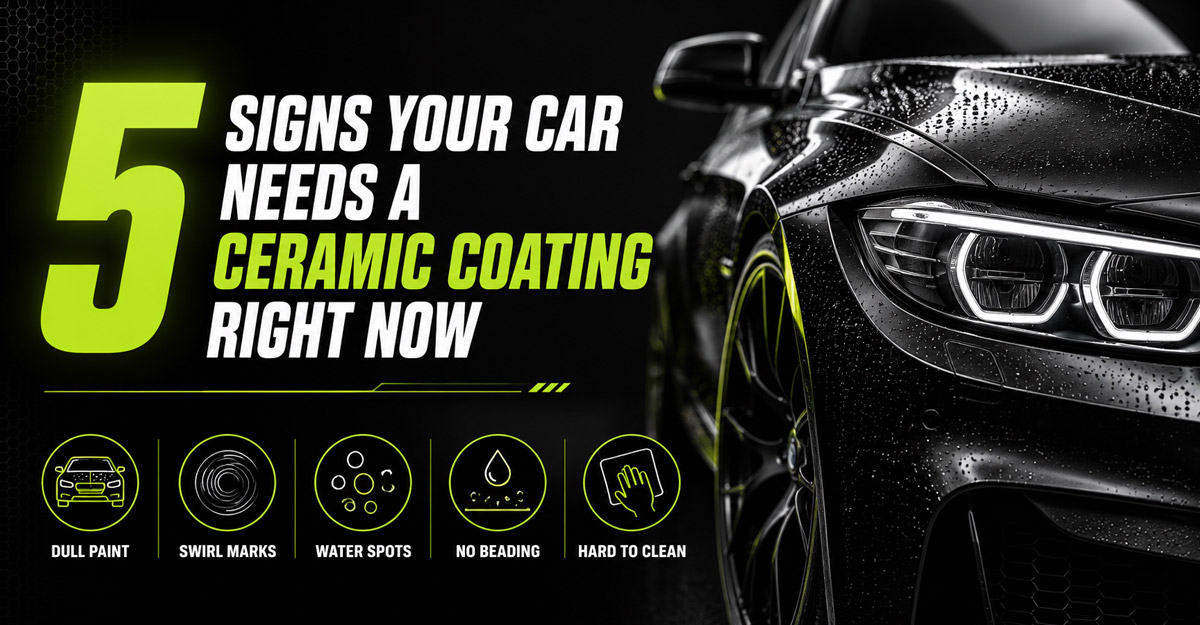
Modern automotive paint formulations are thinner and softer than ever before. While environmental regulations have forced car manufacturers to shift toward water-borne paint systems, these clear coats are increasingly prone to premature micro-marring, UV degradation, industrial fallout etching, and chemical staining.
If you have noticed that your vehicle no longer retains its showroom brilliance despite frequent washes, your automotive finish is sounding an alarm. Left untreated, minor surface issues progress into irreversible clear coat oxidation, requiring multi-stage paint correction or complete panel resprays costing thousands of dollars.
Applying a nanostructured liquid polymer (ceramic coating) creates a permanent or semi-permanent chemical bond with your factory clear coat. This guide breaks down the five unequivocal physical signs that your vehicle requires immediate ceramic protection, the molecular science behind why these issues occur, and a complete financial breakdown comparing traditional wax to modern nano-ceramic protection.
Sign 1: Water Sheets and Pools Flat Instead of Forming Hydrophobic Beads
The most immediate indicator of compromised paint protection is how liquid interacts with the clear coat. Healthy, protected vehicle paint exhibits high contact angle hydrophobicity. When water hits a protected surface, high surface tension forces the water to form tight, spherical beads with contact angles exceeding 100 to 110 degrees. These beads roll off effortlessly, carrying surface dirt away with them.
When your clear coat loses its hydrophobic properties, water no longer beads. Instead, it sheets flat across panels, forming massive stagnant pools across horizontal surfaces like the hood, roof, and trunk lid.
Why Flat Water Retention Destroys Automotive Finishes
Flat water retention is more than a cosmetic nuisance. Rainwater and rinse water contain dissolved minerals such as calcium, magnesium, iron, and silica, alongside industrial pollutants. When standing water pools on your vehicle and evaporates under direct sunlight, these dissolved solids concentrate and form hard mineral deposits.
- Topical Water Spotting: Alkaline mineral deposits sit on top of the clear coat, creating a milky ring structure.
- Sub-Surface Etching: Solar heat causes the clear coat to expand while heating the acidic mineral pool. The minerals etch into the microscopic pores of the clear coat.
- Permanent Thermal Damage: Once etched beneath the surface layer, standard hand washing or chemical decontamination cannot remove the marks. Mechanical machine polishing becomes mandatory to level the clear coat down to the depth of the damage.
A professional-grade silicon dioxide ($SiO_2$) or silicon carbide ($SiC$) ceramic coating alters the microscopic topography of your paint. By filling in the natural valleys of the clear coat, it creates a slick surface where liquids cannot grip, restoring hydrophobic water behavior instantly.
Sign 2: The Paint Looks Dull, Hazy, or Exhibits Early Stage UV Oxidation
When sunlight hits a brand new vehicle, light rays pass cleanly through the transparent clear coat, reflect off the underlying base coat (color layer), and pass back out to your eyes. This creates optical clarity, depth, and mirror-like reflections.
If your vehicle looks chalky, hazy, or muted even immediately after a thorough hand wash, UV radiation has begun breaking down the polyurethane polymer chains within your clear coat.
The Chemistry of Paint Oxidation
Ultraviolet A and Ultraviolet B radiation generate free radicals within unprotected clear coats. These free radicals disrupt chemical bonds, leading to photo-oxidation. The microscopic surface of the paint becomes rough and pitted, causing light rays to scatter in random directions rather than reflecting cleanly back to the viewer.
| Stage of Degradation | Visual Symptoms | Required Corrective Action | Ceramic Coating Role |
|---|---|---|---|
| Stage 1 Surface Gloss Reduction | Slight loss of depth, micro-swirling visible under direct light. | Light finishing polish (1-step refinement) | Ideal Entry Point Seals in maximum gloss, halts further UV attack. |
| Stage 2 Moderate Hazing & Chalkiness | Faded color tones, greyish hue on top panels, persistent water spots. | 2-stage compound & polish correction | Mandatory Rebuilds protective barrier after removing dead clear coat. |
| Stage 3 Clear Coat Failure (Peeling) | Flaking clear coat, exposed base coat, white patchy spots. | Panel repaint body shop intervention | Too Late Ceramic coatings cannot repair missing clear coat structure. |
By applying a ceramic coating, you introduce a dense quartz-like shield embedded with UV blockers. This barrier absorbs and disperses solar radiation before it reaches the vulnerable organic clear coat layer beneath.
Sign 3: The Paint Surface Feels Rough and Gritty to the Touch
A smooth finish is not just an aesthetic luxury; it is a structural necessity for paint longevity. After washing and drying your car, run your bare hand (or your hand inside a thin plastic sandwich bag) across the horizontal panels. If you feel a texture resembling fine sandpaper, your clear coat is saturated with bonded microscopic contaminants.
Unprotected Paint Surface
Contaminants embed directly into microscopic clear coat pores
Ceramic Coated Surface
Slick SiO2 barrier repels surface contaminants
Common Surface Contaminants and Their Threats
- Rail Dust and Brake Dust: Hot metallic particles generated by vehicle braking fly into the air and land on your paint. These ferrous particles melt into the clear coat and begin rusting, expanding and creating pinpoint rust spots.
- Tree Sap and Organic Resins: Sap contains organic acids that contract as they dry under heat, pulling at the clear coat structure and causing localized fracturing.
- Industrial Fallout and Acid Rain: Chemical emissions from manufacturing and transport dissolve in humidity, creating mild acidic deposits that etch into bare paint surfaces.
Standard washing techniques cannot remove these embedded solids. While mechanical decontamination via a clay bar removes surface grit, it leaves the microscopic pores of the clear coat open and vulnerable. A nano ceramic coating completely caps these microscopic valleys, creating an ultra-smooth finish that prevents airborne pollutants from anchoring to the panel.
Sign 4: You Are Trapped in an Exhaustive, Constant Wash Schedule
Do you find that your vehicle collects a layer of dark road film, traffic grime, and dust within 24 to 48 hours of a full detail? When clear coat paint lacks hydrophobic and oleophobic (oil-repellent) qualities, microscopic oils from wet roads, diesel exhaust fumes, and atmospheric soot bond to the surface.
This forces car owners into an exhausting cycle of weekly washing, heavy scrubbing, and aggressive chemical cleaners.
The Self-Cleaning Mechanism of Ceramic Coatings
Ceramic coatings operate on low surface energy principles similar to non-stick kitchenware. By lowering the surface free energy of the vehicle panels, dirt particles cannot establish strong atomic bonds with the surface.
When rain falls or when you perform a gentle pressure rinse on a ceramic coated vehicle, the rolling water beads gather dust and surface grime, sweeping them off the bodywork naturally. This self-cleaning effect yields significant maintenance benefits:
- 70% Reduction in Maintenance Time: Dirt releases effortlessly without aggressive scrubbing.
- Minimization of Swirl Marks: Since dirt rinses away easily, you avoid rubbing abrasive dust across the paint during contact washes.
- Chemical Resistance: Ceramic coatings resist harsh detergents with pH levels ranging from pH 2 (acidic) to pH 12 (alkaline), whereas traditional protection breaks down rapidly under strong car wash soaps.
Sign 5: Traditional Waxes and Polymer Sealants Vanish Within Weeks
For decades, natural carnauba wax was the industry standard for automotive paint protection. However, organic waxes are poorly suited for modern environmental conditions and thermal stress.
Carnauba wax has a melting point of roughly 180°F (82°C). Under summer sun, dark vehicle paint temperatures easily reach 160°F to 195°F. At these temperatures, natural waxes soften, liquefy, and wash away during subsequent maintenance washes or rain showers. Synthetic polymer sealants offer slightly improved durability, but still degrade within two to four months due to UV exposure and road salts.
If you find yourself reapplying wax every month or watching your water-beading disappear after a couple of standard car washes, continuing with traditional products is a waste of time and money. Investing in a true nano-ceramic coating solves this cycle by forming a chemical covalent bond directly with the clear coat molecules, providing years of uninterrupted protection.
The Step-by-Step Installation Process: Preparation Matters
A ceramic coating is only as effective as the surface preparation beneath it. You cannot simply apply a professional-grade nano coating over oxidized, dirty, or scratched paint. Doing so locks in defects permanently under a glass-like barrier.
1.Chemical Decontamination Wash: Time: 1 – 2 Hours.
Perform a multi-stage wash using a high-pH strip shampoo to strip old waxes and sealants. Follow with an iron-removes spray to chemically dissolve embedded brake dust and ferrous particles.
2.Mechanical Clay Bar Treatment: Time: 1 Hour.
Glide an automotive clay bar over all painted surfaces using dedicated lubricant to shear off bonded tree sap, overspray, and industrial fallout, leaving the paint surface glass-smooth.
3.Paint Correction & Polishing: Time: 4 – 12 Hours.
Execute machine polishing (single-stage or multi-stage) using dual-action polishers to remove swirl marks, scratches, and haze. This restores 95%+ optical depth prior to sealing.
4.Isopropanol Surface Wipe: Time: 30 Minutes.
Wipe down every panel with an Isopropyl Alcohol (IPA) panel wipe solution to eliminate polishing oils and residue, exposing pure, raw clear coat for maximum molecular bonding.
5.Nanocoating Application & Curing: Time: 2 – 4 Hours + 24 Hours Curing.
Apply the liquid ceramic coating panel by panel in cross-hatch motions. Monitor for flashing (rainbowing effect), buff off excess residue with microfiber towels, and keep the vehicle dry for at least 24 hours to ensure initial bond curing.
Cost-Benefit Analysis: DIY Consumer Products vs. Professional Installation
When deciding to protect your car with a ceramic coating, vehicle owners face two primary avenues: DIY consumer kits or professional shop installations.
Consumer DIY Ceramic Coating Kits ($50 – $150)
- Formulation: Lower percentage of active silicon dioxide ($SiO_2$) content to allow safer, easier home application.
- Longevity: Typically lasts between 1 to 2 years.
- Risk Factor: Improper application can lead to “high spots” (dark, cloudy streaks) that require hand sanding or heavy machine compounding to remove.
Professional Ceramic Coating Services ($800 – $2,500)
- Formulation: High-solids professional $SiO_2$/$SiC$ formulas available exclusively to certified detailers.
- Longevity: Backed by real-world warranties ranging from 3 to 7 years (and often reported to carfax history reports).
- Included Service: Includes professional multi-stage paint correction, infrared light curing, and precise climate-controlled installation environments.
Over a 5-year ownership period, professional ceramic coatings prove far more economical than paying for quarterly detail waxes, periodic acid baths, and eventual paint restoration procedures.
Frequently Asked Questions About Ceramic Coatings
Does a ceramic coating make my car scratch-proof?
No protection product makes paint completely scratch-proof. While ceramic coatings carry high hardness ratings (up to 9H on the pencil hardness scale), they are designed to absorb ultra-fine micro-marring, wash swirls, and minor towel scratches. They will not prevent deep key scratches, rock chips, or heavy impact damage (for impact protection, consider combining ceramic coating with Paint Protection Film/PPF).
Can I run my ceramic-coated car through an automatic car wash?
You should completely avoid automatic brush car washes. The coarse, dirty nylon bristles in automated wash bays act like sandpaper, battering your coating with friction and heavy swirl marks. Touchless car washes are safer, but they utilize extremely harsh alkaline chemicals (pH 12+) that shorten the hydrophobic lifespan of consumer coatings over time. Hand washing using the two-bucket method or a foam cannon remains the gold standard.
How do I maintain my ceramic coating after application?
Maintain your ceramic coating by hand washing your vehicle every 2 to 3 weeks using a pH-neutral, wax-free ceramic car wash shampoo. Every 6 months, apply a ceramic booster spray during drying to top up the top-layer hydrophobicity and slickness.
Protect Your Automotive Investment Today
If your vehicle is showing any of the 5 warning signs—water pooling, dull paint, rough surface texture, high cleaning maintenance, or rapidly failing wax—your clear coat is vulnerable to irreversible environmental degradation. Acting early stops minor surface defects from escalating into costly paint correction repairs.
Contact our expert auto detailing team today for a custom paint evaluation and a tailored ceramic coating price quote designed to protect your car for years to come.