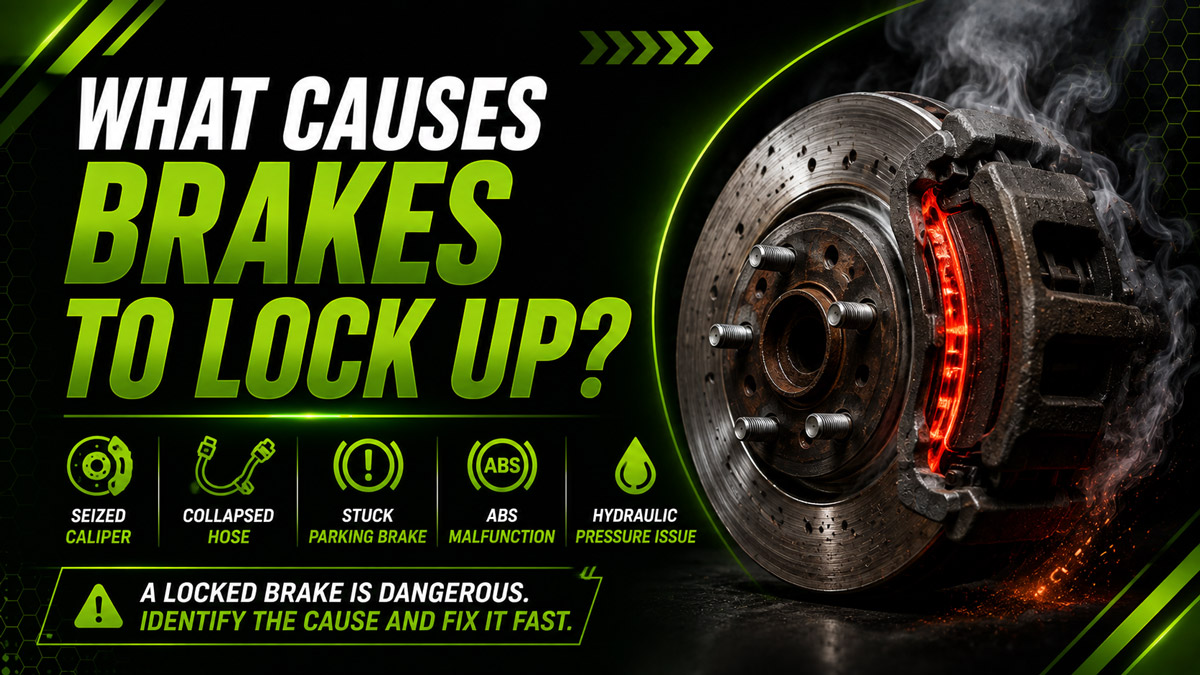
Brakes lock up when a wheel stops rotating while the vehicle is moving or when a brake remains applied after the driver releases the pedal. The most common causes are excessive braking force, a seized caliper, a collapsed brake hose, blocked hydraulic return flow, stuck parking-brake parts, or an ABS malfunction.
Key Facts / At a Glance
- A wheel that locks only during a panic stop may have exceeded the tire’s available traction.
- A wheel that remains locked after releasing the pedal usually has a hydraulic or mechanical fault.
- One unusually hot wheel commonly indicates a seized caliper, restricted hose, or parking-brake problem.
- Multiple brakes that tighten as the vehicle warms may indicate blocked master-cylinder return flow.
- Opening a bleeder screw can help distinguish trapped hydraulic pressure from a mechanically seized brake.
- A vehicle with a dragging or locked brake should not be driven except far enough to reach a safe stopping place.
What Does Brake Lockup Mean?
Brake lockup describes two related but different conditions.
Dynamic wheel lockup happens during braking when the tire stops rotating and skids across the road. It may occur because the driver applies more braking force than the tire can transfer to the pavement.
Mechanical or hydraulic lockup occurs when a brake stays applied after the pedal is released. The vehicle may pull, resist acceleration, overheat a wheel, smell like burning friction material, or become unable to move.
The distinction matters because panic-stop lockup may involve traction and driver input, while a brake that remains stuck usually requires component repair.
Why Does a Wheel Lock During Hard Braking?
A wheel locks during hard braking when brake torque exceeds the tire’s available grip. The tire transitions from controlled rolling to sliding, reducing steering authority and frequently increasing stopping distance.
Available grip changes with:
- Wet, icy, sandy, or gravel-covered pavement
- Worn, hardened, or underinflated tires
- Uneven vehicle loading
- Sudden weight transfer during braking
- Brake imbalance between wheels
- ABS availability and operation
The maximum stopping force occurs near the tire’s traction limit, before the wheel becomes completely stationary. This technique is called threshold braking.
When a non-ABS vehicle locks its front wheels, steering input has little effect because the tires are sliding rather than directing the vehicle. Rear-wheel lockup can make the rear of the vehicle rotate or fishtail.
How Does ABS Prevent Brake Lockup?
An anti-lock braking system prevents sustained wheel lock by monitoring wheel-speed sensors and rapidly adjusting hydraulic pressure. When the control module detects that one wheel is decelerating toward lockup, it commands valves and a pump to reduce and reapply pressure.
During emergency braking, normal ABS operation may produce:
- Rapid pedal pulsation
- Clicking or buzzing sounds
- A firm pedal that moves slightly
- Intermittent tire chirping
- Continued steering control
Drivers should maintain firm pedal pressure and steer toward a safe path. Pumping the brake pedal can interfere with ABS operation.
ABS cannot create traction that the tires and road do not provide. It also cannot correct a seized caliper, collapsed hose, damaged hydraulic component, or mechanically jammed parking brake.
What Causes Brakes to Stay Locked After Release?
Brakes that remain applied after pedal release usually result from trapped hydraulic pressure or a component that cannot retract. The symptom pattern often identifies which category is responsible.
| Cause | How it creates lockup | Typical clues |
| Seized caliper piston | Corrosion or damaged seals prevent piston retraction | One hot wheel, pulling, rapid pad wear |
| Stuck slide pins | Floating caliper cannot center or release properly | Inner and outer pads wear differently |
| Collapsed brake hose | Internal liner allows pressure in but restricts return | Wheel releases when bleeder is opened |
| Blocked master-cylinder port | Expanding fluid cannot return to reservoir | Several or all brakes tighten when hot |
| Incorrect pushrod or pedal adjustment | Master-cylinder piston cannot uncover return port | Brakes progressively drag after service |
| Stuck parking-brake cable | Corrosion holds rear brake applied | Rear wheel hot; lever or pedal may feel abnormal |
| Drum-brake hardware failure | Broken spring or displaced shoe jams drum | Rear wheel locks, scrapes, or will not rotate |
| Contaminated brake fluid | Petroleum contamination swells rubber seals | Multiple hydraulic components begin sticking |
| ABS hydraulic fault | Valve traps or misdirects pressure | Irregular application, warning light, stored codes |
Can a Seized Caliper Lock a Wheel?
A seized caliper can keep one wheel partially or completely applied. Caliper pistons commonly seize because moisture promotes corrosion inside the bore, while torn dust boots allow water and debris to reach the piston surface.
Common signs include:
- The vehicle pulls toward or away from one side
- One wheel produces much more brake dust
- A burning smell appears after driving
- Fuel economy decreases
- The vehicle feels as though it is towing extra weight
- One pad wears much faster than its matching pad
- The affected wheel becomes substantially hotter
A stuck slide pin creates similar symptoms. On a floating caliper, the pins must move freely so both pads can apply and release evenly. Corroded pins can leave one pad pressed against the rotor even when the piston retracts.
A caliper that cannot be compressed should not automatically be condemned until the bleeder screw is opened. If the piston retracts after opening the bleeder, trapped hydraulic pressure—not necessarily the caliper—is holding it.
How Does a Collapsed Brake Hose Cause Lockup?
A collapsed flexible brake hose can behave like a one-way valve. Pedal pressure forces fluid toward the caliper, but the damaged internal liner restricts fluid returning after the pedal is released.
The brake may work normally when cold and begin dragging after repeated applications. The vehicle can pull to one side, and the affected wheel may release after cooling.
A technician can test for trapped pressure by safely raising the vehicle and opening the caliper bleeder:
- Confirm that the wheel is difficult to rotate.
- Open the bleeder screw carefully.
- Watch for pressurized fluid.
- Check whether the wheel immediately rotates more freely.
If pressure escapes and the brake releases, the restriction is upstream of the piston. The hose is a common cause, but the master cylinder, ABS hydraulic unit, or incorrectly adjusted linkage must also be considered.
Can the Master Cylinder Lock All Four Brakes?
A blocked compensating port or a master-cylinder piston that cannot return fully can cause several brakes to drag simultaneously. As the brake system heats, expanding fluid cannot return to the reservoir, so residual pressure increases.
Typical symptoms include:
- Brakes operate normally when the vehicle is cold
- Acceleration becomes progressively harder
- The pedal becomes unusually firm
- Several wheels become hot
- The brakes release after cooling
- Opening a hydraulic connection relieves the condition
The problem may begin after master-cylinder, brake-booster, pedal, or pushrod work. Insufficient pedal free play can hold the piston slightly forward and cover the fluid-return port.
All-wheel drag is less likely to be caused by four calipers failing simultaneously. A shared upstream cause should be investigated before replacing individual wheel components.
Can a Parking Brake Cause Rear-Wheel Lockup?
A parking brake can lock a rear wheel when its cable, lever, shoe, or caliper mechanism fails to return. Corrosion is especially common where the cable enters its outer housing.
Disc-brake vehicles may use a mechanical lever built into the rear caliper or a separate drum-style parking brake inside the rotor hat. Either design can seize after long storage, road-salt exposure, water intrusion, or infrequent use.
A stuck parking brake often produces:
- Heat at one or both rear wheels
- Poor acceleration
- A loose or abnormal parking-brake control
- Scraping from inside a rear rotor
- A vehicle that will not roll after being parked
- A rear wheel that remains stuck without hydraulic pressure
Do not force the vehicle forward with heavy throttle. Doing so can destroy pads, shoes, rotors, bearings, tires, or the parking-brake mechanism.
Why Do Brakes Lock After Driving for a While?
Brakes that lock only after several minutes usually involve heat expansion combined with restricted release. Initial brake drag creates heat; the heat expands the fluid and surrounding components; the additional pressure increases drag further.
The progression often follows this pattern:
- A hose, return port, piston, or parking-brake component restricts release.
- The pad or shoe remains in light contact.
- Friction raises rotor, drum, caliper, and fluid temperature.
- Expanding fluid or hardware increases clamping force.
- The brake becomes severely applied or completely locked.
Cooling may temporarily restore movement, but cooling does not repair the cause. Driving again commonly recreates the condition and can cause brake fade, rotor damage, wheel-bearing damage, tire failure, or fire.
Can Bad Brake Fluid Cause Lockup?
Old brake fluid contributes indirectly to lockup by absorbing moisture and promoting corrosion inside calipers, wheel cylinders, ABS valves, and the master cylinder. Petroleum-contaminated fluid can directly swell rubber seals and cause widespread sticking.
Moisture-contaminated fluid is more commonly associated with reduced boiling resistance and internal corrosion than immediate lockup. Boiling fluid usually causes a soft pedal or braking loss because compressible vapor forms inside the hydraulic system.
This distinction is important: overheated fluid does not normally expand until it locks healthy brakes. Lockup requires restricted return flow, swollen seals, incorrect adjustment, or another fault that traps pressure.
Use only the fluid specification listed on the reservoir cap or in the owner’s manual. DOT 3, DOT 4, and DOT 5.1 are glycol-based fluids, while silicone-based DOT 5 must not be mixed into systems that are not designed for it.
Can an ABS Sensor Make the Brakes Lock?
A faulty wheel-speed sensor can cause inappropriate ABS activation, especially at low speeds, but a sensor failure does not commonly hold a brake continuously applied after pedal release. It may make the pedal pulse unexpectedly or alter braking pressure at one wheel.
Possible ABS-related symptoms include:
- ABS or stability-control warning lights
- Pulsation during gentle braking on dry pavement
- Activation immediately before stopping
- Stored wheel-speed or hydraulic-control codes
- Erratic wheel-speed data on a scan tool
Rust beneath a sensor, damaged wiring, a cracked tone ring, or excessive wheel-bearing play can distort the speed signal. Diagnosis should include live wheel-speed data rather than replacing the sensor based only on the warning light.
Which Symptoms Point to Each Failure?
The number of affected wheels, operating temperature, and response to opening the bleeder provide useful diagnostic direction.
| Symptom | Most likely areas to inspect |
| One front wheel hot | Caliper piston, slide pins, hose |
| One rear wheel hot | Caliper, wheel cylinder, parking brake, drum hardware |
| Both wheels on one axle drag | Shared hydraulic circuit, ABS unit, incorrect service work |
| All wheels tighten when warm | Master-cylinder return port, pushrod adjustment, contaminated fluid |
| Wheel releases when bleeder opens | Trapped hydraulic pressure |
| Wheel stays locked with bleeder open | Mechanical caliper, shoe, bearing, or parking-brake fault |
| Lockup only during panic braking | Traction limit, tire condition, brake balance, ABS operation |
| Pulsation at very low speed | Wheel-speed sensor, tone ring, bearing play |
| Rear wheels lock first | Brake imbalance, load-sensitive valve, rear adjustment, poor rear traction |
These patterns narrow the inspection but do not replace hands-on testing. More than one failure can exist, especially after prolonged overheating.
What Should You Do If the Brakes Lock While Driving?
If a brake locks while driving, reduce speed smoothly, activate the hazard lights, and move away from traffic without continuing farther than necessary. Avoid abrupt steering, repeated hard braking, or applying more throttle to overcome the drag.
Follow these steps:
- Release the accelerator. Allow the vehicle to slow without adding engine load.
- Maintain control. Hold the steering wheel firmly because the vehicle may pull sharply.
- Use the brakes carefully. If only one brake is dragging, additional pressure may worsen the pull.
- Stop in a safe location. Choose a level area away from traffic and combustible vegetation.
- Do not touch the wheel or rotor. Brake components may be hot enough to cause severe burns.
- Look for smoke or fire. Move away from the vehicle and contact emergency services if flames appear.
- Arrange towing. A brake that has locked once can lock again without warning.
Do not pour water onto a hot rotor or drum. Rapid cooling can crack or distort components and may produce steam burns.
How Do Technicians Diagnose a Locked Brake?
Technicians first determine whether the problem is hydraulic or mechanical. The most useful test is whether releasing hydraulic pressure allows the wheel to rotate.
A typical workflow is:
- Confirm the complaint while the brakes are hot, when safe.
- Compare wheel temperatures with an infrared thermometer.
- Raise and support the vehicle correctly.
- Rotate each wheel by hand.
- Open the affected caliper or wheel-cylinder bleeder.
- Recheck wheel rotation.
- Inspect caliper movement, slide pins, shoes, cables, and bearings.
- Measure pedal free play and verify master-cylinder return.
- Scan ABS and stability-control modules.
- Road-test the repaired vehicle and recheck temperatures.
A bleeder that releases the wheel confirms trapped pressure but does not identify the exact upstream component by itself. Isolating the hose, master cylinder, or ABS hydraulic unit may require additional pressure testing.
How Much Does It Cost to Repair Locked Brakes?
Repair costs typically range from about $100 for basic service to more than $1,200 for complex hydraulic or ABS repairs. Vehicle design, labor rates, corrosion, and heat damage can change the final price substantially.
| Repair | Typical installed cost | Typical time |
| Brake-fluid flush | $100–$180 | 0.5–1.0 hour |
| Slide-pin cleaning or service | $100–$250 | 0.5–1.5 hours |
| Flexible brake hose | $150–$350 | 1.0–1.5 hours |
| Caliper replacement | $250–$600 each | 1.0–2.0 hours |
| Rear parking-brake repair | $200–$700 | 1.5–4.0 hours |
| Master-cylinder replacement | $350–$750 | 2.0–3.5 hours |
| ABS hydraulic unit | $700–$1,500+ | 2.0–5.0 hours |
Calipers are often replaced in axle pairs to maintain consistent braking and because both components have experienced similar age and contamination. Pair replacement is a service recommendation, not a universal mechanical requirement; the correct choice depends on condition, manufacturer guidance, and the cause of failure.
Overheated pads, rotors, seals, hoses, wheel bearings, or tires may also require replacement even after the original fault is corrected.
How Can Brake Lockup Be Prevented?
Brake lockup risk is reduced through fluid maintenance, corrosion control, correct lubrication, and early investigation of heat or pulling.
Recommended practices include:
- Inspect pads, rotors, hoses, calipers, and parking-brake parts during routine service.
- Replace brake fluid according to the vehicle manufacturer’s schedule or test results.
- Use brake-compatible silicone or synthetic lubricant on specified slide-pin surfaces.
- Never apply petroleum grease to brake rubber.
- Investigate pulling, burning odors, abnormal dust, or reduced fuel economy promptly.
- Confirm pedal free play after master-cylinder or booster work.
- Use lower gears on long descents rather than continuously riding the brakes.
- Inspect towing vehicles more frequently because added mass generates more heat.
- Release and operate mechanical parking brakes periodically where appropriate to prevent seizure.
Expert Insight: Temperature Comparison Finds Problems Early
A temperature difference between wheels after similar driving is often more useful than pad thickness alone. One significantly hotter wheel indicates friction is continuing after the driver has released the pedal.
Expert Insight: Do Not Replace the Caliper Too Quickly
A caliper that appears frozen may be held by trapped hydraulic pressure. Opening the bleeder before forcing the piston helps prevent replacing a functional caliper while leaving a collapsed hose or blocked return path unresolved.
Expert Insight: Four Hot Wheels Suggest One Shared Cause
When every brake drags, inspect shared components and recent service work first. Four calipers rarely seize at the same moment, but one blocked return port or incorrect pushrod adjustment can affect the entire system.
Frequently Asked Questions
Can brakes unlock after cooling down?
Yes. Brakes held by heat-related hydraulic pressure may release after 20–60 minutes of cooling. Temporary release strongly suggests thermal expansion combined with restricted return flow, but it does not make the vehicle safe. The brake is likely to drag and lock again during the next drive.
Why does my car pull when a brake locks?
A locked or dragging brake creates much more resistance on one side of the vehicle. A front-brake problem usually produces a noticeable steering pull, while a rear-brake problem may feel like resistance, instability, or rear-end movement. Tire pressure and alignment can also cause pulling, so wheel temperature should be compared.
Can worn brake pads cause a wheel to lock?
Worn pads do not normally cause hydraulic lockup by themselves. However, severely worn material can allow a piston to overextend, damaged friction material can wedge against a rotor, or metal debris can interfere with movement. The underlying caliper, hardware, or maintenance failure must still be corrected.
Can a bad wheel bearing feel like locked brakes?
Yes. A severely damaged wheel bearing can create drag, heat, grinding, and eventually prevent the wheel from rotating. If opening the brake bleeder does not release the wheel, technicians should inspect the bearing, brake hardware, parking brake, and drivetrain rather than assuming the hydraulic system is responsible.
Should I drive with a sticking brake caliper?
No. A sticking caliper can rapidly overheat the rotor, boil or damage fluid, destroy pads, damage the wheel bearing, overheat the tire, and start a fire. Continued driving may also reduce braking performance at the other wheels because the system is exposed to excessive heat.
Why do rear brakes lock before the front brakes?
Rear brakes may lock first because of incorrect adjustment, a faulty proportioning system, contaminated shoes, light rear-axle loading, poor rear tires, or slippery pavement. Because braking transfers weight forward, the rear tires have less available traction and require carefully controlled brake pressure.
The Bottom Line
What causes brakes to lock up depends on whether the wheel skids only during hard braking or remains applied afterward. Panic-stop lockup results when braking force exceeds traction, while persistent lockup usually points to a seized caliper, collapsed hose, trapped hydraulic pressure, stuck parking brake, damaged drum hardware, or master-cylinder return problem.
A locked brake is a safety-critical failure. Stop driving, allow overheated components to cool without touching them, and have the vehicle towed for diagnosis. Testing whether the wheel releases when its bleeder is opened is one of the fastest ways to separate a hydraulic restriction from a mechanical seizure.