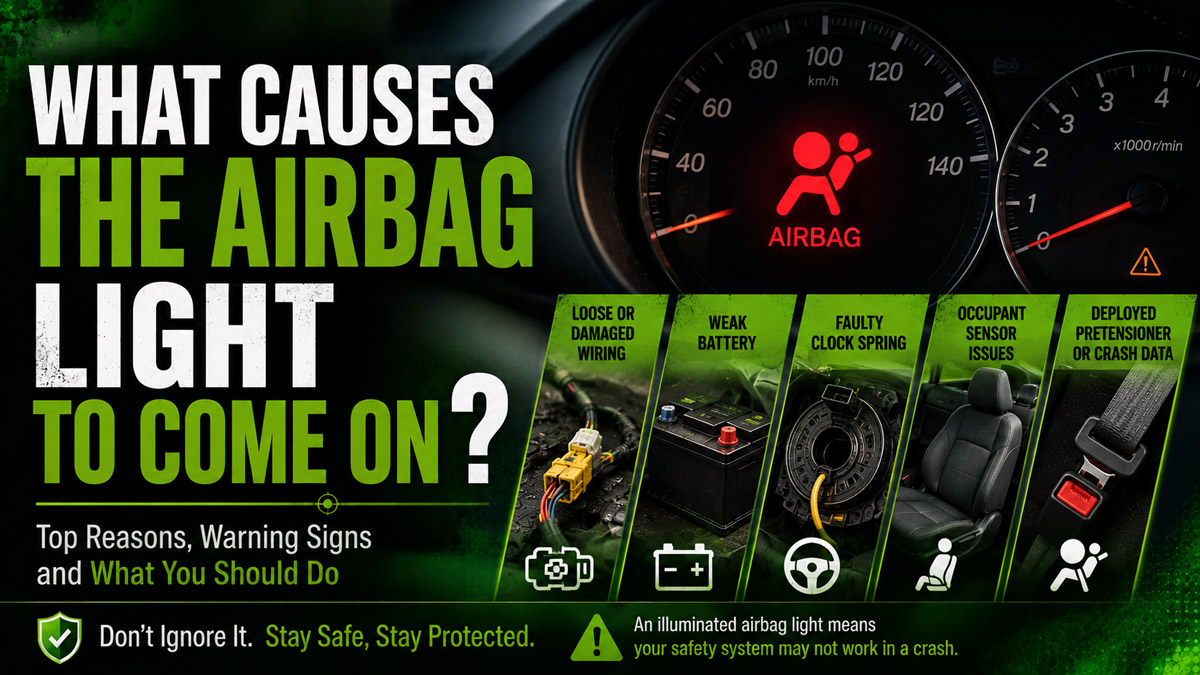
The airbag light comes on when the Supplemental Restraint System detects an electrical, sensor, communication, voltage, or crash-related fault. Common causes include damaged wiring under a seat, a weak battery, a failed clock spring, a faulty occupant sensor, deployed seatbelt pretensioners, stored crash data, or corrosion inside the SRS control module.
At a Glance
- An illuminated airbag light means the SRS has detected a fault that may prevent one or more airbags or seatbelt pretensioners from operating.
- Loose connectors and damaged wiring under the front seats are among the most common causes.
- Low battery voltage during engine starting can store an SRS fault even when the vehicle starts normally afterward.
- A failed clock spring can disable the driver’s airbag while the horn and steering-wheel buttons continue working.
- Standard engine-code readers often cannot access airbag trouble codes.
- Disconnecting the battery does not repair the underlying fault or reliably erase stored SRS codes.
What Does an Illuminated Airbag Light Mean?
An illuminated airbag light means the Supplemental Restraint System has detected a malfunction and cannot confirm that every safety component will operate correctly. Depending on the vehicle and fault, the system may disable one airbag, one seatbelt pretensioner, or a larger portion of the restraint network.
The SRS includes more than the airbags visible in the steering wheel and dashboard. It can also include:
- Seatbelt pretensioners
- Impact sensors
- Passenger-seat occupancy sensors
- Seat-position sensors
- Steering-wheel clock springs
- Airbag wiring and connectors
- The airbag control module
- Backup power circuits
The light normally appears for several seconds when the ignition is switched on. During this period, the control module performs a self-test. The light should then turn off.
A light that remains on, begins flashing, or returns while driving indicates a stored or active fault. The vehicle may still drive normally because the SRS operates independently from the engine and transmission, but crash protection may be reduced.
What Are the Most Common Causes of an Airbag Light?
The most common causes are loose seat connectors, damaged wiring, low battery voltage, a worn clock spring, seatbelt pretensioner faults, occupant-detection problems, and stored crash data.
Common causes include:
- Loose wiring beneath a front seatFront seats move repeatedly, pulling on the wiring harnesses beneath them. A partially disconnected plug or broken wire can interrupt the airbag or seatbelt pretensioner circuit.
- A weak or recently discharged batteryBattery voltage may fall too low while the starter is cranking. The SRS module can record a low-voltage code even if the alternator restores normal voltage immediately afterward.
- A damaged clock springThe clock spring carries electrical signals between the stationary steering column and the rotating steering wheel. Internal ribbon wires can crack and interrupt the driver-airbag circuit.
- A faulty passenger-seat occupancy sensorModern vehicles use a pressure mat or electronic sensor to determine whether the passenger airbag should be activated. Incorrect readings can trigger a warning.
- A seatbelt buckle or pretensioner faultThe SRS monitors explosive pretensioners that tighten the seatbelts during a crash. Damaged wiring, an internal failure, or previous activation can illuminate the light.
- Stored crash informationA collision can cause the control module to store crash data even when the main airbags do not deploy.
Can Loose Wiring Under a Seat Cause the Airbag Light?
Yes. Loose, stretched, contaminated, or broken wiring beneath a front seat is a frequent cause of intermittent airbag warnings.
The wiring under a seat may connect the side airbag, seatbelt buckle switch, pretensioner, seat-position sensor, and passenger occupancy system. Moving the seat forward or backward repeatedly places physical stress on these wires and connectors.
Typical clues include:
- The light appears after adjusting the seat.
- The warning disappears temporarily when the seat is moved.
- The light comes on only when a particular person drives.
- The fault occurs after interior cleaning or vacuuming.
- Items stored under the seat have pulled on the wiring.
A connector may look attached while its locking tab is not fully engaged. Corrosion, spilled drinks, bent terminals, or stretched copper strands can also increase circuit resistance enough for the SRS module to detect a problem.
Do not repeatedly unplug yellow SRS connectors while the battery is connected. Airbag circuits require manufacturer-specific disabling procedures and a waiting period before components are handled.
Can a Weak Battery Trigger the Airbag Warning?
Yes. A weak battery can cause the airbag light to come on when voltage drops below the SRS module’s acceptable range during startup.
The battery may appear functional because it still starts the engine. However, voltage can fall sharply for a fraction of a second while the starter motor is operating. The airbag controller may record that drop as a low-voltage condition.
This commonly happens after:
- A dead battery has been jump-started
- The battery has recently been replaced
- The vehicle has been stored for weeks
- Battery terminals have become loose or corroded
- The alternator is not charging correctly
- The engine cranks slowly in cold weather
Repairing or replacing the battery does not always turn the warning off immediately. Some vehicles clear temporary voltage codes after several successful drive cycles, while others require an SRS-capable scanner.
Battery and charging-system testing should therefore be part of the diagnosis, but a low-voltage code should not automatically be blamed on the battery. Poor grounds, damaged cables, or module communication faults can produce similar symptoms.
Can a Bad Clock Spring Turn On the Airbag Light?
Yes. A worn or broken clock spring can open the driver-airbag circuit and illuminate the airbag light.
The clock spring is a coiled ribbon cable mounted inside the steering column. It maintains electrical contact with the driver’s airbag, horn, steering-wheel controls, and sometimes the cruise-control system while the wheel rotates.
Common symptoms include:
- An airbag warning
- A horn that works intermittently
- Steering-wheel buttons that stop responding
- Cruise-control faults
- Clicking or rubbing noises while turning
- A warning that changes when the steering wheel moves
The horn and radio controls may continue working even when the driver-airbag circuit has failed. The internal ribbon contains multiple separate electrical tracks, so one track can break while the others remain intact.
Clock-spring replacement requires careful steering-wheel and airbag removal. The new component must also be centered correctly. Installing it off-center can tear the ribbon when the steering wheel reaches full lock.
Can the Passenger-Seat Sensor Cause an SRS Warning?
Yes. A faulty occupant classification sensor can trigger an airbag warning when the system cannot determine whether the passenger airbag should be enabled.
The occupant classification system uses sensors in or beneath the passenger seat. It evaluates seat pressure, occupant weight, seatbelt status, and sometimes seat position.
A heavy bag, laptop case, child restraint, or pet may cause the “Passenger Airbag Off” indicator to change. That does not always indicate a malfunction. The system may simply be responding to the weight placed on the seat.
A true fault is more likely when:
- The main SRS light remains illuminated.
- The passenger indicator behaves erratically.
- The warning appears with an adult seated correctly.
- The seat has recently been removed.
- Upholstery or seat padding has been replaced.
- Water or cleaning solution has entered the seat.
- Calibration was not performed after a repair.
Some occupant sensors require zero-point calibration with a professional scan tool. The seat must usually be empty, correctly installed, and positioned according to the manufacturer’s procedure.
Can a Seatbelt Pretensioner Cause the Light?
Yes. A damaged, disconnected, or previously activated seatbelt pretensioner can illuminate the airbag light.
Seatbelt pretensioners use a controlled pyrotechnic charge to tighten the belt during certain collisions. The airbag module continuously monitors the pretensioner circuit in the same way it monitors an airbag inflator.
A pretensioner fault may result from:
- A previous collision
- A damaged seatbelt buckle
- Wiring stretched by seat movement
- Corrosion inside a connector
- A replacement seat from another vehicle
- An unplugged buckle sensor
- Internal resistance outside the expected range
A pretensioner can activate even when the visible airbags do not deploy. This is common in lower-severity collisions where the control module determines that belt tightening is necessary but frontal airbag deployment is not.
An activated pretensioner normally requires replacement. Installing a new unit may not clear the warning if crash data remains stored in the SRS module.
Can Water Damage Make the Airbag Light Come On?
Yes. Water entering the cabin can corrode SRS wiring, connectors, grounds, or the airbag control module.
The airbag control module is often mounted low in the center of the vehicle, such as beneath the center console or carpet. This location helps it measure crash forces accurately, but it can also expose the module to pooled water.
Possible sources include:
- Blocked sunroof drains
- A leaking windshield seal
- Floodwater
- A damaged door membrane
- A leaking heater core
- Air-conditioning condensate leakage
- Drinks spilled near the console
Water damage may create several symptoms at once. The airbag light may appear alongside communication errors, power-window problems, seat warnings, or other electrical faults.
Drying the carpet does not reverse corrosion inside a connector or module. The source of the leak must be repaired, and affected components must be inspected. A water-damaged SRS module may need replacement and programming rather than simple code clearing.
Can a Collision Trigger the Light Without Deploying Airbags?
Yes. A collision can trigger an airbag warning even when the main airbags do not deploy.
Airbag deployment depends on crash direction, deceleration, sensor input, occupant status, and the manufacturer’s deployment strategy. A low-speed impact may activate a seatbelt pretensioner, store an impact event, damage a sensor, or interrupt wiring without firing the steering-wheel or dashboard airbags.
Possible post-collision causes include:
- Stored crash data
- Activated pretensioners
- Damaged impact sensors
- Broken seat wiring
- A damaged clock spring
- Low battery voltage after the crash
- Improperly installed replacement parts
Some airbag modules store non-erasable crash information in internal memory. An ordinary scanner may display a code such as “Crash Event Stored” but cannot remove it.
The module may need replacement or specialized resetting. All deployed or damaged restraint components must also be replaced before the system can pass its self-test.
Why Does the Airbag Light Come On Intermittently?
An intermittent airbag light usually indicates a loose connection, internally broken wire, changing resistance, unstable voltage, or a component affected by movement.
The timing of the warning often provides useful diagnostic evidence:
| When the light appears | Likely area to inspect |
|---|---|
| After moving the seat | Under-seat wiring or pretensioner circuit |
| While turning the wheel | Clock spring |
| During engine starting | Battery voltage or power supply |
| After rain or washing | Water intrusion |
| With a passenger seated | Occupant classification system |
| After a collision | Crash data, sensors, or pretensioners |
| Over bumps | Loose connector, ground, or damaged harness |
An intermittent fault should not be dismissed because the light later turns off. The SRS may store a history code showing which circuit temporarily failed.
Technicians often inspect live data while carefully moving the seat, steering wheel, or wiring harness. This helps reproduce the fault without replacing components based only on assumptions.
Is It Safe to Drive With the Airbag Light On?
The vehicle may remain mechanically drivable, but driving with the airbag light on is not considered safe because part or all of the supplemental restraint system may be unavailable.
Brakes, steering, and engine operation usually continue normally. The safety risk appears during a collision, when an affected airbag or seatbelt pretensioner may not activate as intended.
The exact level of risk depends on the stored code. A passenger-seat sensor fault may affect only the passenger airbag, while a module power or communication failure may affect several restraint components.
Practical guidance:
- Avoid carrying a front-seat passenger when the passenger-airbag system is faulty.
- Arrange diagnosis as soon as reasonably possible.
- Do not cover the warning or remove the dashboard bulb.
- Do not assume the system works because the warning occasionally disappears.
- Have the vehicle towed when there is visible crash damage, exposed wiring, deployed components, smoke, or water around the SRS module.
The airbag system is a backup safety system, but it is designed to work with the seatbelts. All occupants should continue wearing seatbelts correctly.
Will Disconnecting the Battery Reset the Airbag Light?
Usually not. Disconnecting the battery may remove a temporary power condition, but it does not repair the fault or reliably erase an SRS trouble code.
Airbag modules use memory that can preserve safety-related codes after electrical power is removed. If the fault is still present, the module will detect it again during the next self-test.
Battery disconnection also introduces additional risks:
- Radio or security codes may be lost.
- Window and steering-angle settings may require relearning.
- Disconnecting power incorrectly can create voltage spikes.
- Handling SRS connectors too soon may be unsafe.
- Existing diagnostic information may become harder to evaluate.
The correct process is to read the SRS code, identify the affected circuit, repair the fault, verify the repair, and then clear the code with an appropriate scan tool.
A battery reset should not be treated as an airbag repair method.
Can a Standard OBD2 Scanner Read Airbag Codes?
Usually not. Basic OBD2 scanners are designed primarily for engine and emissions codes and may not communicate with the Supplemental Restraint System.
An SRS-capable scanner must support the vehicle’s make, model, year, and airbag-control protocol. A tool that reads airbag codes on one vehicle may not support another.
A suitable scanner may provide:
- Manufacturer-specific B-codes
- Circuit descriptions
- Current and stored fault status
- Seatbelt buckle data
- Passenger occupancy information
- Pretensioner status
- Impact-sensor communication
- Module voltage
- Code-clearing functions
A code identifies the circuit or condition detected by the module, not necessarily the exact failed part. For example, a “driver airbag circuit open” code could be caused by the airbag, clock spring, connector, wiring harness, or control module.
Diagnosis should therefore include inspection and testing rather than automatic component replacement.
Can an Airbag Circuit Be Tested With a Multimeter?
A standard multimeter should not be connected directly across an airbag inflator or pretensioner without manufacturer-approved procedures.
A multimeter sends a small test current through a circuit when measuring resistance. Although the current is normally low, pyrotechnic restraint components must be treated as potentially deployable devices.
Professional diagnosis may involve:
- Disabling the SRS according to manufacturer instructions.
- Waiting the specified time for backup capacitors to discharge.
- Disconnecting the restraint component.
- Testing only approved sections of the wiring.
- Using a manufacturer-approved simulator or test load.
- Reading resistance data through an SRS scan tool.
- Reconnecting and verifying the system self-test.
Never probe airbag connectors with improvised test leads, jumper wires, test lights, or powered probes. Do not substitute a resistor as a permanent repair or use one to deceive the control module.
How Is an Airbag-Light Problem Diagnosed?
An airbag-light problem is diagnosed by reading SRS codes, inspecting the affected circuit, testing battery voltage and wiring, repairing the confirmed fault, and verifying that the warning stays off.
Diagnostic process
- Confirm the warning behaviorSwitch on the ignition and observe whether the light remains on, flashes, or returns after initially turning off.
- Check recent eventsNote any dead battery, collision, seat removal, interior detailing, water leak, steering repair, or seat adjustment.
- Scan the SRS moduleUse a scanner that supports the vehicle’s airbag system. Record every code before clearing anything.
- Check battery and charging voltageInspect battery condition, terminal tightness, grounds, and alternator output.
- Inspect the indicated areaExamine under-seat connectors, the clock spring, seatbelt wiring, impact sensors, or module connections according to the code.
- Follow manufacturer testing proceduresUse wiring diagrams, approved test tools, and specified resistance or voltage checks.
- Repair the confirmed problemRepair wiring or replace the failed component. Programming or calibration may be required.
- Clear the codes and retestRun the SRS self-test, move the seat and steering wheel, and confirm that the warning does not return.
Why Does the Light Stay On After a Part Is Replaced?
The airbag light may remain on because the original diagnosis was incorrect, the code was not cleared, calibration is required, another fault exists, or crash data remains stored.
Common examples include:
- A clock spring was replaced, but the open circuit is farther down the steering-column harness.
- A passenger seat was repaired, but the occupant sensor was not recalibrated.
- A pretensioner was replaced, but the control module still contains crash data.
- A connector was reattached, but one terminal is bent or pushed backward.
- The original low-voltage problem remains because the alternator is failing.
- A used module was installed without correct programming.
Professional technicians compare the code present before the repair with the code present afterward. A different code may indicate that the first repair succeeded but another problem remains.
Clearing codes without documenting them first can remove valuable diagnostic clues.
How Much Does It Cost to Fix an Airbag Light?
Airbag-light repair can cost from under $100 for a simple diagnostic or connector repair to more than $1,500 when modules, airbags, pretensioners, or occupant sensors require replacement.
Typical broad ranges include:
| Repair | Approximate cost |
| SRS diagnostic scan | $80–$200 |
| Connector or minor wiring repair | $100–$300 |
| Battery or terminal repair | $150–$400 |
| Seatbelt buckle or pretensioner | $200–$700 |
| Clock spring replacement | $250–$800 |
| Occupant sensor or seat mat | $500–$1,500+ |
| SRS module replacement and programming | $500–$1,500+ |
| Multiple post-collision components | $1,000–$5,000+ |
Actual pricing depends on the vehicle, labor rate, component availability, required programming, and whether crash damage is involved.
Diagnosis before replacement is especially important. Replacing a $500 clock spring will not solve a damaged wire or stored crash-event code.
The Bottom Line
The airbag light comes on when the Supplemental Restraint System detects a fault in its wiring, power supply, sensors, airbags, seatbelt pretensioners, occupant-detection system, clock spring, or control module. Loose under-seat wiring and low battery voltage are common, but collision data, water damage, and failed modules can create more complex problems. The vehicle may continue driving normally, yet crash protection may be reduced. The correct solution is to read the SRS codes, diagnose the identified circuit safely, complete the repair, and verify that the warning remains off.