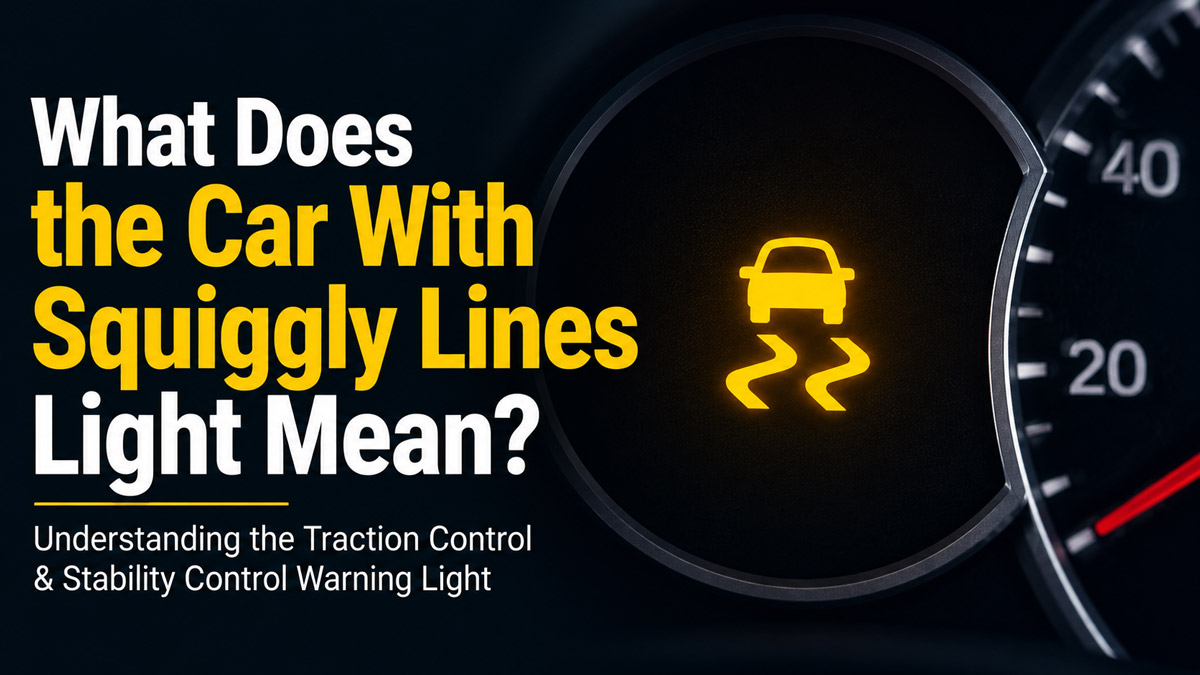
The car with squiggly lines light is the traction control or electronic stability control indicator. A flashing light normally means the system is actively correcting wheel slip, while a solid light may mean the system is switched off or has detected a fault.
Key Facts at a Glance
- The symbol represents traction control, electronic stability control, or both.
- A flashing light means the vehicle is detecting and correcting a loss of grip.
- A solid light may indicate a disabled system or a stored stability-control fault.
- Wheel-speed sensor problems are among the most common causes of a persistent warning.
- The vehicle may still drive with the light on, but skid protection can be reduced.
- A scanner must support ABS or ESC codes; a basic engine-code reader may not detect the problem.
What System Does the Squiggly-Lines Light Represent?
The car-and-squiggly-lines symbol usually represents the Traction Control System, commonly abbreviated as TCS, or the Electronic Stability Control system, commonly abbreviated as ESC.
Manufacturers use different names for closely related technology:
| Manufacturer term | General meaning |
| TCS | Traction Control System |
| ESC | Electronic Stability Control |
| ESP | Electronic Stability Program |
| VSC | Vehicle Stability Control |
| DSC | Dynamic Stability Control |
| StabiliTrak | General Motors stability-control system |
| VSA | Honda Vehicle Stability Assist |
Traction control mainly limits individual wheelspin during acceleration. Electronic stability control performs a broader job by comparing the driver’s intended direction with the vehicle’s actual movement.
Most modern vehicles combine both functions under one control system and may use one dashboard symbol for both.
What Does a Flashing Squiggly-Lines Light Mean?
A flashing squiggly-lines light means the traction or stability-control system is actively intervening because one or more tires are losing grip.
The warning may flash when you:
- Accelerate hard on a wet road
- Drive over ice, snow, sand, or loose gravel
- Turn sharply at excessive speed
- Hydroplane through standing water
- Accelerate with worn or uneven tires
- Drive over a slippery painted road marking
The system may reduce engine torque, close the electronic throttle, change transmission behavior, or apply an individual wheel brake. These actions help return the vehicle to the direction indicated by the steering wheel.
A brief flash is normally not evidence of a mechanical failure. It is a warning that available tire grip is limited.
What should you do when it flashes?
Ease off the accelerator, hold the steering wheel smoothly, and avoid sudden braking or steering inputs. The system can assist with stability, but it cannot create traction when the tires have little contact with the road.
Repeated flashing during ordinary dry-road driving may indicate worn tires, incorrect tire pressure, mismatched tire sizes, alignment problems, or a sensor fault.
What Does a Solid Squiggly-Lines Light Mean?
A solid squiggly-lines light usually means the system has been manually disabled or a fault has caused traction and stability assistance to shut down.
Look closely at the symbol:
| Light condition | Likely meaning |
| Light flashes briefly | System is actively controlling wheel slip |
| Light stays on after startup | System fault or disabled function |
| Light includes “OFF” | Driver switched traction or stability control off |
| Light appears with ABS warning | Shared sensor, wiring, or ABS control fault |
| Light appears with check-engine light | Engine fault may prevent traction-control operation |
The light should normally illuminate for several seconds when the ignition is switched on. This is a self-test. It should turn off after the engine starts unless the system is disabled or a fault remains.
How Does Traction and Stability Control Work?
Traction and stability control use several sensors to calculate whether the vehicle is following the path requested by the driver.
Wheel-speed sensors
A wheel-speed sensor monitors the rotational speed of each wheel. If one drive wheel spins much faster than the others, the control module identifies a loss of traction.
Steering-angle sensor
The steering-angle sensor measures the direction and speed of steering-wheel movement. It tells the stability-control module where the driver intends to go.
Yaw-rate sensor
The yaw-rate sensor measures how quickly the vehicle rotates around its vertical axis. This allows the module to recognize oversteer or understeer.
Lateral-acceleration sensor
The lateral-acceleration sensor measures sideways movement. Its data helps determine whether the vehicle is sliding away from the intended path.
ABS and engine controls
After detecting instability, the system can pulse an individual brake through the ABS hydraulic unit and request lower engine torque from the powertrain control module.
These corrections happen rapidly, often before the driver fully recognizes the skid.
Why Is the Squiggly-Lines Light Staying On?
A persistent traction-control light can be caused by the system being switched off, a sensor failure, tire-related inconsistencies, electrical problems, or a fault in a connected system.
1. Traction control was manually switched off
The traction-control button may have been pressed accidentally. It usually shows the same car-and-squiggly-lines symbol, sometimes with the word “OFF.”
Press the button once while the vehicle is stationary. Some vehicles require holding it for several seconds or navigating through a dashboard menu.
2. A wheel-speed sensor is dirty or damaged
Wheel-speed sensors operate near the wheel hubs, where they are exposed to water, dirt, metal particles, road salt, and impact damage.
A failed sensor may also trigger:
- ABS warning light
- Cruise-control malfunction
- Hill-start assist warning
- Stability-control warning
- Abnormal transmission shifting in some vehicles
3. A sensor wire or connector is damaged
The sensor itself may work correctly while its wiring is broken, corroded, stretched, or disconnected. Wiring damage often occurs after suspension, bearing, brake, or axle work.
4. Tire pressures are significantly unequal
A low tire has a smaller effective rolling radius and rotates at a different speed. The control module may interpret that difference as wheel slip.
Check all tires when cold and inflate them to the pressure printed on the driver’s door-jamb label, not the maximum pressure printed on the tire sidewall.
5. The tires do not match
Different tire diameters can create inconsistent wheel-speed readings. Common examples include:
- One new tire paired with three heavily worn tires
- Incorrect front-to-rear tire sizes
- A temporary spare tire
- Tires with different aspect ratios
- Uneven tread depth on an all-wheel-drive vehicle
6. The steering-angle sensor needs calibration
The steering-angle sensor may lose its reference point after:
- Wheel alignment
- Steering-rack replacement
- Battery disconnection
- Suspension repair
- Steering-column repair
- Control-module programming
The system may require a scan-tool calibration rather than a component replacement.
7. The battery voltage is low
Low system voltage can cause temporary ABS, ESC, steering, and traction-control warnings. This frequently happens after a weak-battery start or battery replacement.
A healthy charging system generally produces approximately 13.5 to 14.8 volts with the engine running, although specifications vary by vehicle and charging strategy.
8. The ABS or ESC module has failed
The ABS/ESC module processes wheel-speed information and controls hydraulic brake pressure. Internal electronic faults, pump failures, communication errors, or damaged power supplies can disable multiple safety systems simultaneously.
Can You Drive With the Squiggly-Lines Light On?
You can often drive a short distance with a solid traction-control light if the brakes feel normal, the road is dry, and no red brake warning is illuminated. However, the vehicle may not provide electronic assistance during wheelspin or a skid.
Reduce speed and arrange diagnosis promptly.
Stop driving or seek immediate help when:
- A red brake warning appears
- The brake pedal feels soft or unusually hard
- The vehicle pulls strongly while braking
- Multiple stability and steering warnings appear
- The engine runs poorly or enters reduced-power mode
- The light follows collision, flood, or major suspension damage
- Road conditions are icy, snowy, or severely wet
Electronic stability control is a backup safety system, not a substitute for tire grip. Driving without it is much riskier on wet or slippery roads.
How Do You Diagnose the Squiggly-Lines Light?
Diagnose a solid warning in a logical order, beginning with simple driver-controlled conditions before testing sensors and modules.
Step 1: Check the traction-control button
Confirm that the system was not switched off manually. Restart the vehicle after re-enabling it.
Step 2: Inspect all dashboard warnings
Record whether the ABS, brake, check-engine, tire-pressure, steering, or battery lights are also illuminated. Combined warnings narrow the likely cause.
Step 3: Check the tires
Inspect:
- Cold tire pressure
- Tire size on each sidewall
- Tread-depth differences
- Temporary spare installation
- Visible tire or wheel damage
Correct tire issues before replacing electronic components.
Step 4: Restart the vehicle
A restart may clear a temporary voltage or communication error. A warning that returns immediately indicates a stored or active fault that requires diagnosis.
Step 5: Scan the ABS and ESC modules
Use a diagnostic scanner that specifically supports ABS, traction-control, and stability-control systems.
A basic OBD2 reader may only access engine and emissions codes. It may show no codes even though the ABS module contains several faults.
Step 6: Review live wheel-speed data
During a slow test drive, compare the reported speed of all four wheels. A sensor that drops to zero, spikes, or differs from the other wheels can identify the affected corner.
Step 7: Inspect the sensor and wiring
Check the suspected wheel for:
- Damaged wiring
- Loose connectors
- Corrosion
- Metal debris
- Cracked tone rings
- Excessive wheel-bearing play
- Incorrect sensor air gap
Step 8: Complete calibration or repairs
Replace the confirmed faulty part or perform the required calibration. Clear the codes and road-test the vehicle to verify that the warning does not return.
How Much Does It Cost to Fix the Light?
The repair cost depends on whether the cause is tire pressure, calibration, a wheel sensor, wiring, or the ABS/ESC control unit.
| Repair | Typical total cost |
| Tire-pressure correction | $0–$20 |
| Diagnostic scan | $80–$180 |
| Steering-angle calibration | $80–$250 |
| Wheel-speed sensor replacement | $150–$400 per wheel |
| Sensor wiring repair | $100–$400 |
| Wheel bearing with integrated sensor | $300–$800 |
| Steering-angle sensor replacement | $300–$700 |
| ABS/ESC module repair | $400–$1,000 |
| New ABS/ESC module | $800–$2,500+ |
Costs vary by vehicle design, labor rates, corrosion, programming requirements, and whether the wheel-speed sensor is sold separately from the wheel-bearing assembly.
A scan should come before parts replacement. Replacing a wheel-speed sensor based only on the warning symbol can waste money when the real cause is damaged wiring, a cracked tone ring, or bearing movement.
Why Did the Light Appear After a Battery Change?
The traction-control light may appear after a battery replacement because low voltage, lost sensor calibration, or temporary module communication faults occurred during disconnection.
First, start the engine and turn the steering wheel slowly from full left to full right, then return it to the center. Some vehicles relearn steering position during a short straight drive.
If the warning remains, scan the ABS and ESC modules. Do not assume that disconnecting the battery again will permanently reset the system.
Should Traction Control Ever Be Turned Off?
Traction control should remain enabled during normal road driving. Temporary deactivation may help when controlled wheelspin is necessary to escape deep snow, sand, or mud.
For example, rocking a stuck vehicle may require enough wheelspin to clear material from the tread. Traction control may repeatedly cut engine power and prevent movement.
Turn the system back on as soon as the vehicle reaches a stable surface. Stability control is especially valuable during highway driving, rain, emergency lane changes, and unexpected loss of grip.
Common Mistakes to Avoid
Ignoring an ABS light
A combined ABS and traction-control warning often means both systems have lost important sensor information. Normal braking may remain, but anti-lock and stability functions may be unavailable.
Replacing parts without scanning
The warning symbol does not identify the failed component. Retrieve module-specific codes and live data before buying parts.
Installing one incorrect tire
Even a small tire-diameter difference can cause wheel-speed discrepancies, especially on all-wheel-drive vehicles.
Leaving traction control off
Disabling the system for ordinary driving increases the risk of wheelspin, oversteer, understeer, and loss of directional control.
Assuming stability control can prevent every crash
ESC cannot overcome excessive speed, bald tires, deep standing water, or a complete lack of road grip. It can only work within the physical traction available.
Frequently Asked Questions
Is the squiggly-lines light the same as the check-engine light?
No. The squiggly-lines light belongs to the traction or stability-control system. However, an engine fault can disable traction control because the system depends on electronic throttle and engine-torque control. Both lights may therefore appear together.
Why does the light flash when I accelerate?
The light flashes because a drive wheel is spinning faster than the vehicle’s available traction allows. Ease off the accelerator and inspect the tires if it happens repeatedly on dry pavement.
Can low tire pressure turn on the traction-control light?
Yes. Significant pressure differences change tire circumference and wheel speed. The control module may interpret the difference as slip or implausible sensor data.
Will disconnecting the battery reset the light?
Disconnecting the battery may temporarily clear some warnings, but it will not repair an active sensor, wiring, calibration, or module fault. It can also erase useful diagnostic information or create additional calibration warnings.
Why are the ABS and squiggly-lines lights on together?
The ABS and stability-control systems share wheel-speed sensors, wiring, hydraulic components, and control modules. A fault in one shared component can disable both systems.
Does the light mean I need new tires?
Not always. Tires should be inspected for low pressure, mismatched sizes, uneven tread, and excessive wear, but the cause may instead be a wheel-speed sensor, wiring fault, steering-angle calibration, low voltage, or ABS module problem.
The Bottom Line
The answer to “what does the car with squiggly lines light mean?” depends on how the light behaves. A flashing light means traction or stability control is actively correcting tire slip, while a solid light means the system is disabled or has detected a fault.
Check the control button, tire pressures, tire sizes, and other warning lights first. If the symbol remains on, use an ABS/ESC-capable scanner to identify the fault before replacing parts. Drive cautiously until the system has been restored, especially in rain, snow, ice, or other low-traction conditions.