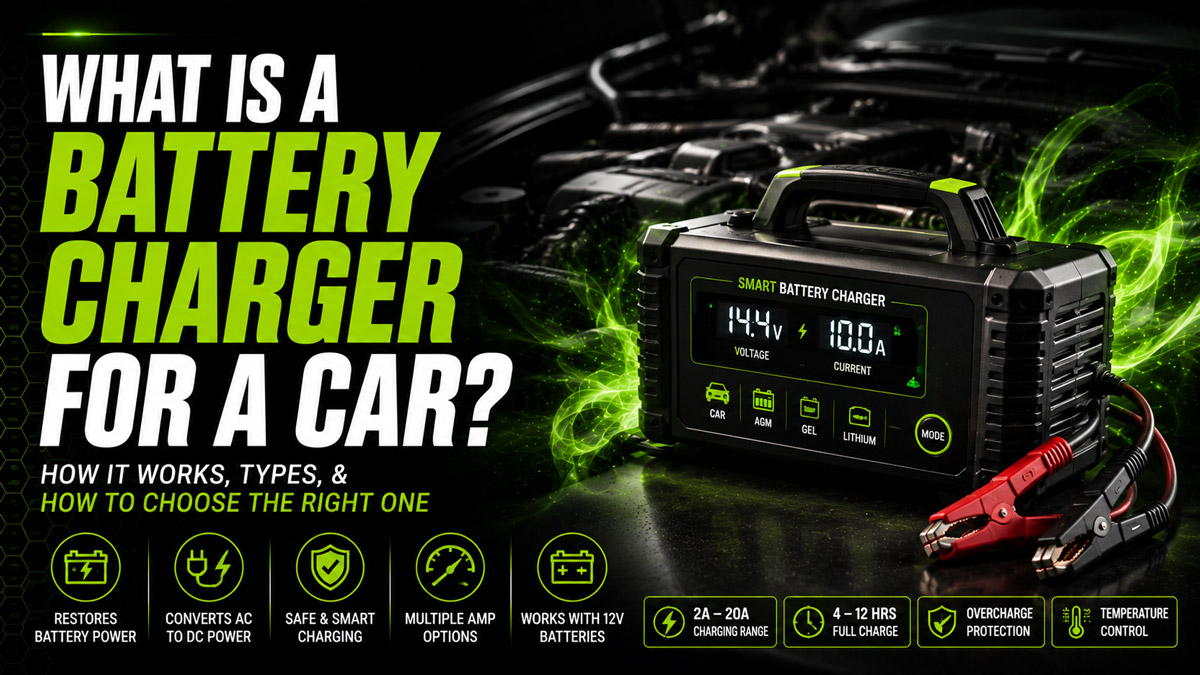
A car battery charger is an external diagnostic and power supply device that restores electrical capacity to a depleted 12-volt automotive battery. It converts standard alternating current (AC) from a wall outlet into direct current (DC), safely forcing electrical energy back into the battery to reverse its internal chemical discharge process.
At a Glance
- Standard Capacity: Most passenger vehicles use a 12-volt (12V) electrical system with batteries ranging from 40 to 100 Amp-hours (Ah).
- Output Requirement: Chargers must output between 13.8V and 14.7V to successfully push current into a resting 12V battery.
- Speed: A 10-Amp fast charger restores a dead battery in 4 to 6 hours; a 2-Amp trickle charger takes up to 30 hours.
- Chemistry Matters: AGM and Gel batteries require strict voltage limits; standard lead-acid batteries tolerate more aggressive charging.
- Smart Limitations: Microprocessor-controlled chargers will safely automatically shut off, but they often refuse to charge batteries depleted below 8 volts.
What Voltage and Amperage Does a Car Battery Charger Use?
A standard car battery charger outputs a voltage between 13.8V and 14.7V and delivers an electrical current ranging from 2 Amps (trickle) to 20 Amps (fast charge). Because a healthy, fully charged automotive battery rests at 12.6V, the charger must supply a higher electrical pressure (voltage) to force the chemical reaction to reverse.
Amperage dictates the speed of the charge. A 2A to 4A setting is used for slow, gentle maintenance charging, which preserves the health of the internal lead plates. A 10A to 20A setting forces a rapid recharge, suitable for getting a stranded vehicle back on the road in a few hours. High-end shop chargers also feature a 40A to 100A+ “Engine Start” mode, which abandons safe charging parameters to deliver a massive, temporary 10-second burst of current designed purely to spin the starter motor.
How Long Does It Take to Charge a Completely Dead Car Battery?
It takes approximately 10 to 12 hours to fully recharge a standard 60 Amp-hour (Ah) car battery using a 5-Amp charger. Charging time is a mathematical relationship between the battery’s total storage capacity and the volume of current the charger pushes per hour.
You can estimate the baseline charging time using this formula:
$$\text{Time (hours)} = \frac{\text{Battery Capacity (Ah)}}{\text{Charger Amperage (A)}}$$
However, this formula assumes 100% efficiency. In reality, charging efficiency drops as the battery fills up. A smart charger pushes heavy current up to 80% capacity, then significantly throttles the amperage to prevent the internal acid from boiling. Therefore, a completely dead 60Ah battery on a 10A charger will take roughly 6 hours, while the same battery on a 2A trickle charger requires over 30 hours.
What Size Battery Charger Do I Need for My Specific Vehicle?
You need a battery charger capable of delivering an amperage equal to roughly 10% to 20% of your vehicle battery’s total Amp-hour (Ah) rating. Using a charger that is too small wastes time, while a charger that is too powerful will overheat the battery plates and warp them permanently.
For a standard compact car with a 45Ah battery, a 4-Amp or 5-Amp charger is the ideal size for a safe, overnight charge. For large pickup trucks, SUVs, or diesel vehicles utilizing massive 90Ah to 100Ah batteries, a 10-Amp to 15-Amp charger is required to overcome the battery’s natural internal resistance. If you own multiple vehicles, purchase an automatic “smart” charger capable of variable output (e.g., automatically switching between 2A, 10A, and 15A), which allows the device to self-regulate the load based on the battery it detects.
Does the Charger Need to Match My Battery Chemistry (AGM, Gel, Lithium)?
Yes, a car battery charger must match the specific chemical makeup of your battery to prevent permanent damage or dangerous thermal runaway. While traditional flooded (wet cell) lead-acid batteries are robust and can safely absorb charging voltages up to 14.7V, modern alternative chemistries require entirely different charging algorithms.
AGM (Absorbed Glass Mat) batteries, common in vehicles with start-stop technology, dry out and fail rapidly if exposed to voltages above 14.4V. Gel cell batteries, often used in deep-cycle applications, are highly sensitive to heat and require a strict cap of 14.1V. Lithium-Ion (LiFePO4) batteries—increasingly found in performance cars and high-end audio builds—are the most restrictive. Charging a lithium battery on a standard lead-acid setting can bypass internal battery management systems, triggering fires or immediate cell destruction. Always select a charger with a dedicated mode switch for your specific battery type.
What Is the Difference Between a Battery Charger, Maintainer, and Jump Starter?
A battery charger restores a depleted battery over several hours, a maintainer keeps a healthy battery full during long-term storage, and a jump starter provides a massive instant spike of power to start the engine without actually charging the battery.
- Battery Charger: Operates at 2A to 20A. Designed to take a dead battery from 0% to 100% capacity over a span of 4 to 12 hours.
- Battery Maintainer (Trickle/Float): Operates at 0.5A to 2A. Used for winterizing sports cars or motorcycles. Once the battery hits 100%, it shuts off, then intermittently pulses a tiny “float” charge (around 13.2V) to counteract the battery’s natural self-discharge.
- Jump Starter: A portable lithium-ion pack or large capacitor that dumps 300A to 2000A+ of current in a few seconds. It forces the starter motor to crank but leaves the battery dead; the vehicle’s alternator must recharge the battery once the engine is running.
Can I Charge a Car Battery While It Is Still Connected to the Car?
Yes, you can safely charge a car battery while it remains fully connected to the vehicle’s electrical system, provided you use the correct grounding method. Modern smart chargers produce clean DC power that will not fry your vehicle’s onboard computers (ECUs).
To do this safely: First, connect the red positive (+) charger clamp directly to the positive battery terminal. Second, connect the black negative (-) charger clamp to a heavy, unpainted metal part of the vehicle’s chassis or engine block, at least a foot away from the battery. This prevents any electrical sparks from igniting the highly flammable hydrogen gas that lead-acid batteries vent during the charging process.
What Happens if You Connect the Battery Charger Clamps Backwards?
If you connect the battery charger clamps backwards—positive to negative and negative to positive—you create a reverse polarity short circuit. On older, manual “dumb” chargers, this instantly throws a massive shower of sparks, melts the clamp cables, and can potentially blow the main electrical fuses inside your vehicle or permanently fry the engine control unit.
Fortunately, 99% of modern “smart” chargers feature built-in reverse polarity protection. If you cross the cables on a modern unit, internal solid-state relays prevent the charger from outputting any current. A red error light or audible alarm will trigger, and the device will remain in standby mode until you correct the clamp orientation.
Can I Leave a Car Battery Charger Connected Overnight?
You can leave a modern, microprocessor-controlled smart charger connected overnight safely, but you should never leave a manual, older-style charger unattended for extended periods.
Modern smart chargers monitor the battery’s internal resistance. Once the battery reaches 100% capacity, they automatically stop pushing bulk current and enter a “float mode.” In float mode, the charger only supplies a fraction of an amp to offset natural drain, keeping the battery safely topped off indefinitely. Conversely, old-school manual chargers push a constant current regardless of the battery’s state. Leaving one on overnight will overcharge the battery, boil the sulfuric acid electrolyte out of the vents, and ruin the internal plates.
Why Won’t a Smart Charger Fix a Completely Dead (0V) Battery?
Modern smart chargers refuse to charge a completely dead battery because they require a baseline voltage (usually between 2V and 8V) to recognize that a battery is actually connected. If a battery is drained down to 0V or 1V by leaving headlights on for a week, the charger’s safety software assumes the clamps are simply touching each other or connected to a dead piece of metal.
To fix this “dead battery paradox,” you must manually bypass the safety checks. The industry trick is to connect the dead battery to a healthy 12V battery using jumper cables for 10 to 15 minutes. This temporarily raises the dead battery’s surface voltage above the charger’s minimum threshold. Once you remove the jumper cables, the smart charger will successfully “see” the battery and begin the charging cycle.
What Is Battery Sulfation and How Do Desulfators Work?
Battery sulfation is the hardening of lead sulfate crystals on a battery’s internal plates, which permanently reduces its capacity if the battery is left in a discharged state for weeks. When a battery discharges, soft lead sulfate forms; if recharged immediately, it dissolves. If left uncharged, it crystallizes into an impenetrable barrier.
A heavily sulfated battery will trick a standard charger into reading “100% Full” in just 15 minutes because the hardened plates create massive internal electrical resistance. However, the battery will die instantly under load. Desulfators (or chargers equipped with a “Repair” mode) attempt to fix this by sending rapid, high-voltage, low-current pulses (up to 16V at high frequencies) through the plates to shatter the hardened crystals and force them back into the liquid electrolyte.
How Do Extreme Hot and Cold Temperatures Affect Charging?
Extreme temperatures alter the chemical resistance inside a lead-acid battery, requiring the charger to adjust its voltage output to compensate. A charger must work much harder in freezing conditions and much more gently in severe heat.
At 0°F (-18°C), the internal chemical reactions slow to a crawl. A standard 14.4V charge will simply bounce off the battery plates; the charger must elevate its output up to 14.9V to force the current inside. Conversely, at 110°F (43°C), the battery accepts current rapidly. If the charger pushes a standard 14.4V in extreme heat, the battery will aggressively overcharge, boil, and vent toxic gas. High-quality chargers feature automatic temperature compensation, utilizing ambient air sensors to dynamically adjust the voltage curve based on the weather. Never attempt to charge a physically frozen battery, as expanding ice can cause the casing to explode under electrical pressure.
How Do I Know if My Battery Is Permanently Bad or Just Discharged?
You can determine if a battery is permanently damaged by monitoring its behavior while hooked up to a charger. A healthy but deeply discharged battery will accept a charge steadily and remain relatively cool to the touch throughout the multi-hour process.
If the battery gets extremely hot—hot enough that it is uncomfortable to rest your hand on the plastic casing—it has an internal short circuit and must be recycled immediately. Alternatively, if your smart charger throws a specific “Bad Cell” error code, or if the battery rapidly charges to 100% in 20 minutes but cannot even turn on the vehicle’s dome lights, the internal capacity is destroyed by sulfation. For a definitive answer, take the fully charged battery to an auto parts store for an electronic load test.
The Bottom Line
A car battery charger is an essential garage tool that restores 12V automotive batteries by converting AC wall power into direct DC current. To use one successfully, you must ensure the charger’s amperage matches the physical size of your battery and that its mode is set to your specific battery chemistry (Standard, AGM, or Lithium). Remember that while modern smart chargers are incredibly safe and can be left connected overnight, their internal safety relays often require a manual jump-start workaround if your battery is drained completely flat to zero volts.