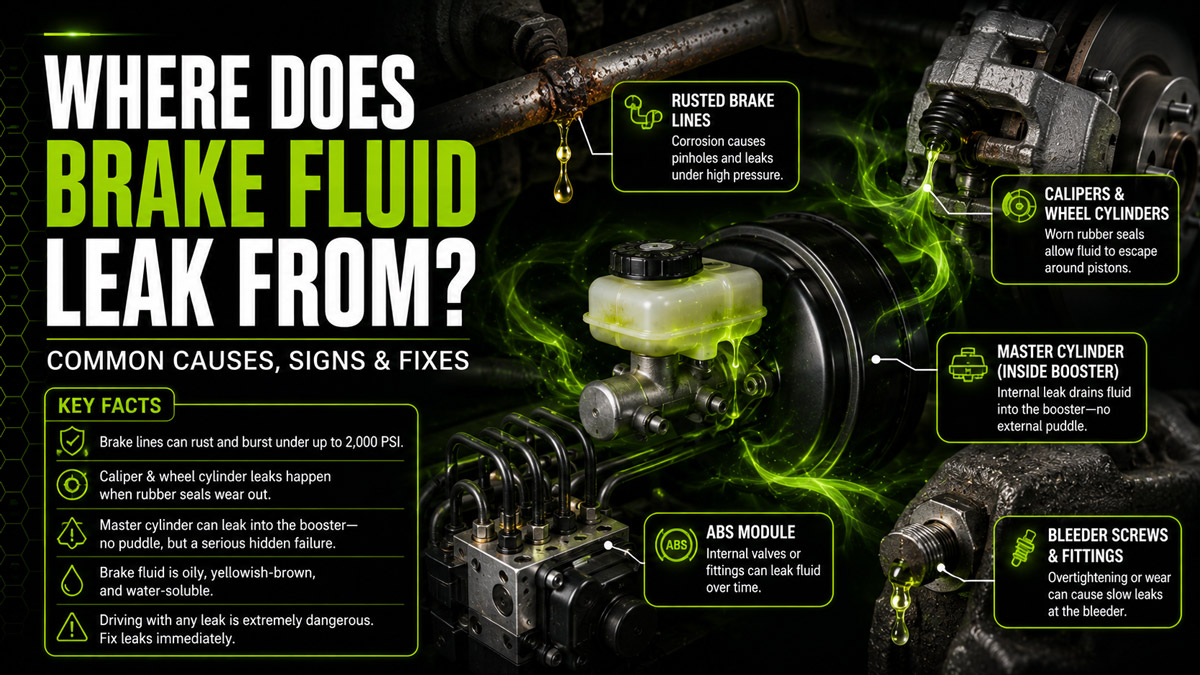
Brake fluid typically leaks from rusted metal brake lines, degraded caliper piston seals, failing rear wheel cylinders, or a worn master cylinder. An internal master cylinder failure can leak brake fluid directly into the brake booster, draining the reservoir without leaving any visible puddle under the vehicle.
At a Glance
- Brake lines withstand up to 2,000 PSI and frequently fail due to rust in salt-belt states.
- Caliper and wheel cylinder leaks result from worn internal rubber seals that degrade over time.
- Internal master cylinder leaks hide inside the brake booster, destroying the vacuum diaphragm while leaving no drips on the driveway.
- Brake fluid is oily, yellowish-brown, and water-soluble, distinguishing it easily from clear A/C condensation.
- Driving a vehicle with any brake fluid leak is highly dangerous because the hydraulic loop requires full pressure integrity to function.
Identifying the Fluid
What does leaking brake fluid look and smell like?
Brake fluid looks clear to yellowish-brown when fresh and turns dark brown or black as it ages. The fluid feels highly oily to the touch and carries a distinct, mildly acrid or fishy chemical odor.
Unlike engine oil, brake fluid acts as a powerful solvent. If brake fluid drips onto a painted car component, the fluid will strip the paint down to bare metal within hours. Drivers finding an unidentified puddle should look for a slick, oily texture with a yellowish tint near the wheels or directly under the firewall.
How can you tell brake fluid from motor oil or water?
You can distinguish brake fluid from motor oil by testing its water solubility; brake fluid dissolves instantly in water, whereas motor oil smears and beads up.
Many drivers misdiagnose clear puddles under the front of the engine as brake fluid. If the puddle is clear, odorless, and evaporates quickly in the sun, the liquid is harmless air conditioning condensation. Old brake fluid often mimics the black appearance of used motor oil, but washing the driveway with a garden hose will immediately reveal the difference: water washes brake fluid away but leaves motor oil behind as an oily slick.
Common Brake Fluid Leak Locations
Why do brake lines leak, and where do they fail?
Brake lines leak when rust creates pinholes in the metal tubing or when road debris strikes the vehicle’s undercarriage. These steel tubes run underneath the car from the engine bay to each wheel and must withstand 800 to 1,200 PSI during normal stopping.
In panic stop situations, brake line pressure spikes up to 2,000 PSI. Rust significantly weakens the steel walls, causing the line to burst under this intense hydraulic pressure. Vehicles driven in “salt belt” states face the highest risk of brake line failure due to winter road treatments accelerating the corrosion process.
What causes brake calipers and wheel cylinders to leak?
Brake calipers and wheel cylinders leak when their internal rubber piston seals degrade from heat, age, or contaminated fluid. Calipers sit behind the wheels on disc brake systems, while wheel cylinders operate inside the drums of rear drum brakes.
A stuck brake caliper can overheat the fluid, causing the liquid to boil, expand, and force its way past the dust boots and piston seals. Wheel cylinders rely on internal rubber cups that routinely degrade and fail after 100,000 miles. When a wheel cylinder leaks, the fluid saturates the brake shoes, permanently ruining the friction material and requiring complete replacement.
Can a master cylinder leak without leaving a puddle?
Yes, a master cylinder can leak internally without leaving a puddle by bypassing its rear seal and draining directly into the brake booster. The brake booster acts as a hidden holding tank, catching liters of brake fluid before the driver ever spots a drop on the driveway.
This failure represents the most dangerous and elusive brake leak. The master cylinder sits bolted to the large, black brake booster canister on the firewall. When fluid leaks backward into the booster’s vacuum chamber, the corrosive fluid slowly eats away the booster’s internal rubber diaphragm. This creates a dual failure: the vehicle loses hydraulic braking pressure and the vacuum power assist simultaneously.
Why do bleeder screws leak after a brake service?
Bleeder screws leak after a brake service primarily because mechanics or DIYers overtighten the valves and strip the delicate threads. These small fittings sit on the calipers to bleed air from the system and require a precise, low torque specification.
The proper torque for a bleeder screw is usually only 10 to 15 ft-lbs (14 Nm). Applying excessive force warps the conical seat inside the caliper housing, preventing the screw from sealing completely. Once the threads strip or the seat warps, the bleeder screw will cause a permanent, slow weep of fluid at the caliper.
Does the ABS module leak brake fluid?
The Anti-lock Braking System (ABS) module can leak brake fluid from its internal proportioning valves, its reservoir body, or the numerous hard-line fittings connecting to the pump block.
While ABS module leaks occur rarely compared to line or caliper failures, the ABS unit handles thousands of rapid pressure pulses. When internal seals fail, fluid escapes around the pump motor housing. Replacing a leaking ABS module ranks among the most expensive brake repairs, as the parts alone frequently exceed $600 and require specialized scan tools to bleed the system afterward.
Symptoms and System Behavior
Does a sinking brake pedal always mean fluid is leaking?
A sinking brake pedal does not always indicate an external fluid leak; it frequently points to an internal fluid bypass within the master cylinder. During an internal bypass, fluid slips backward past worn piston seals into the reservoir rather than pushing out to the brake calipers.
When an internal bypass occurs, the brake fluid level in the reservoir remains full, yet the pedal slowly sinks to the floorboards while stopped at a red light. No fluid escapes the closed system, but the loss of hydraulic pressure drastically compromises braking power.
How much brake fluid does a typical car hold?
Most passenger vehicles hold exactly 1 to 1.5 liters (1 to 1.5 quarts) of brake fluid for the entire hydraulic system. This minimal volume circulates through the master cylinder, ABS pump, brake lines, and all four wheel calipers.
Because the total volume is so small, losing just a few ounces drops the reservoir level dangerously low. If the master cylinder reservoir runs dry, the pump pulls atmospheric air into the ABS module and brake lines, resulting in an immediate loss of pedal pressure and total brake failure.
How fast does a braking system lose fluid when leaking?
A braking system can lose its entire fluid volume in seconds if a pressurized line bursts, whereas a weeping caliper seal might lose an ounce per month. The rate of fluid loss depends entirely on the location and severity of the failure.
During a hard stop, a rusted brake line experiencing 2,000 PSI will blow out instantly, dumping the reservoir onto the street and plunging the brake pedal to the floor. Conversely, a degraded reservoir cap diaphragm might only allow fluid to slosh out slowly during sharp cornering, taking months to trigger a dashboard warning light.
Troubleshooting and Risk Management
How do mechanics find a hidden brake fluid leak?
Mechanics locate hidden brake fluid leaks by unbolting the master cylinder from the brake booster, applying a UV dye to the reservoir, or using a pressurized bleeder tool to force fluid through the system while inspecting the undercarriage.
To diagnose the elusive internal master cylinder leak, mechanics unbolt the two mounting nuts securing the cylinder to the brake booster. Pulling the cylinder slightly forward reveals wetness at the connection point if the rear seal has failed. For pinhole line leaks, a pressure bleeder pressurizes the system while the car is on a lift, forcing the fluid out of the rusted section for visual confirmation.
Is it safe to drive with a minor brake fluid leak?
No, it is never safe to drive with a minor brake fluid leak because the hydraulic system requires absolute pressure integrity to stop the vehicle. A small, slow drip indicates compromised structural integrity.
A weeping brake line or caliper seal can instantly turn into a catastrophic blowout during a panic stop when the line pressure spikes. Furthermore, as fluid slowly escapes, the master cylinder reservoir drops. Once air enters the system, the brake pedal will go completely soft, leaving the driver entirely unable to stop the heavy vehicle.
Can you just top off leaking brake fluid?
You cannot safely top off a leaking brake system and continue driving, as the fluid loss indicates either a dangerous structural leak or severely worn brake pads. The braking loop is entirely sealed.
Unlike engine oil, which naturally burns off over time, brake fluid never evaporates. If the reservoir reads low, the fluid has physically escaped the system, or the caliper pistons have extended exceptionally far to compensate for dangerously thin brake pads. Introducing fresh fluid masks the warning signs of impending brake failure.
Repair Costs and Insurance
How much does it cost to fix a brake fluid leak?
Fixing a brake fluid leak costs between $150 and $1,000, depending entirely on which component failed and the vehicle’s make. Replacing a single brake caliper averages $300 to $800 per wheel including labor.
Patching a small, accessible section of a rusted brake line costs roughly $150 to $300. However, if the corrosion extends along the entire undercarriage, a full brake line replacement often exceeds $1,000 due to the intensive labor required to bend and route new metal lines around the engine and exhaust components.
Does car insurance cover brake fluid leaks?
Car insurance does not cover brake fluid leaks caused by mechanical wear, rust, or degraded rubber seals, as these fall strictly under standard vehicle maintenance. Wear-and-tear items are universally excluded from auto policies.
However, comprehensive or collision insurance will cover a severed brake line if the damage resulted from an accident or a specific road debris impact. If a driver runs over a large object on the highway that rips the brake line from the chassis, the repair qualifies as an insurance claim subject to the policy deductible.
The Bottom Line
Brake fluid leaks originate most frequently from rusted metal lines under the vehicle, worn rubber seals inside the calipers, or a failing master cylinder. The most dangerous leak occurs internally when a bad master cylinder seal dumps fluid into the brake booster, leaving no puddle on the ground while emptying the reservoir. Because the braking system relies on intense hydraulic pressure, any leak requires immediate professional repair; topping off the fluid and driving risks catastrophic brake failure.