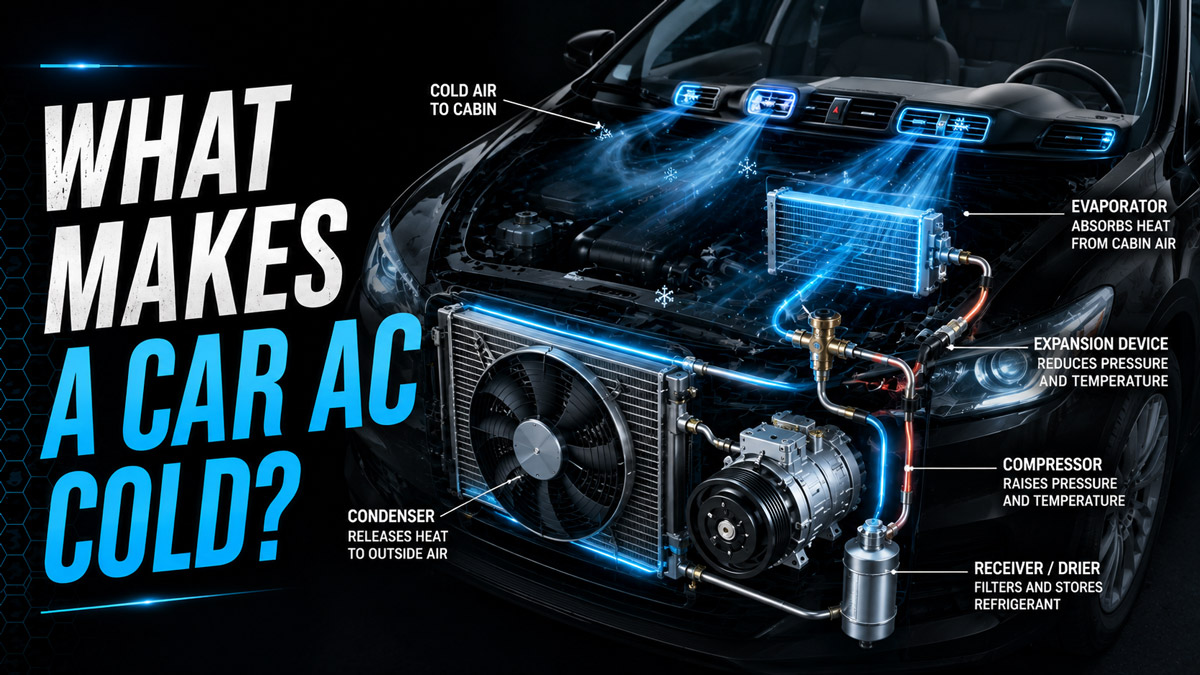
A car AC becomes cold when refrigerant absorbs heat from cabin air inside the evaporator and releases that heat outside through the condenser. The compressor, condenser, expansion device, evaporator, blower, and cooling fans must work together at the correct pressures, airflow rates, and refrigerant charge for effective cooling.
At a Glance
- A car air conditioner removes heat from the cabin rather than producing coldness directly.
- Refrigerant absorbs cabin heat when it evaporates at low pressure inside the evaporator.
- The compressor maintains the pressure difference that keeps refrigerant circulating.
- The condenser releases absorbed heat into the outside air.
- Recirculation usually cools the cabin faster because the system repeatedly cools already-conditioned air.
- Refrigerant quantity, airflow, humidity, vehicle speed, and ambient temperature all affect vent temperature.
How Does a Car AC Refrigeration Cycle Work?
A car AC works through a continuous vapor-compression refrigeration cycle that moves heat from inside the cabin to the outside air. The cycle depends on changing the refrigerant’s pressure, temperature, and physical state as it passes through four main components.
The process follows these stages:
- Compression: The compressor pulls in low-pressure refrigerant vapor and compresses it into a hot, high-pressure vapor.
- Condensation: The condenser releases heat from that vapor, causing the refrigerant to become a high-pressure liquid.
- Expansion: An expansion valve or orifice tube restricts refrigerant flow, sharply reducing its pressure and temperature.
- Evaporation: The cold, low-pressure refrigerant enters the evaporator, absorbs heat from cabin air, and boils back into vapor.
- Return: The refrigerant vapor returns to the compressor so the cycle can repeat.
The system does not consume refrigerant during normal operation. Refrigerant continuously circulates in a sealed loop. A low charge therefore usually indicates leakage rather than normal use.
What Does Refrigerant Do in a Car AC System?
Refrigerant carries heat from the passenger compartment to the outside of the vehicle. Refrigerant can perform this job because its boiling temperature changes with pressure, allowing it to evaporate at a low temperature inside the dashboard and condense at a much higher temperature near the front grille.
Inside the evaporator, low-pressure refrigerant absorbs heat and changes from a liquid-vapor mixture into a gas. The compressor then raises the gas pressure and temperature. At the condenser, the refrigerant releases its stored heat and becomes liquid again.
Common automotive refrigerants include:
| Refrigerant | Typical application | Important consideration |
|---|---|---|
| R-12 | Many older vehicles originally built before the mid-1990s | Requires specialized service and must not be mixed with newer refrigerants |
| R-134a | Many vehicles from the 1990s through the 2010s | Uses vehicle-specific oil and charge quantities |
| R-1234yf | Many newer vehicles | Requires compatible service equipment and careful handling |
Refrigerants are not interchangeable. Mixing refrigerants or adding an incompatible oil can reduce cooling, damage components, and contaminate recovery equipment.
How Does the AC Compressor Help Create Cold Air?
The AC compressor creates the pressure difference that allows refrigerant to absorb heat in the evaporator and release it in the condenser. Without adequate compression and circulation, the refrigerant cannot complete the heat-transfer cycle.
A traditional compressor is driven by the engine through a belt and electromagnetic clutch. When AC is requested, the clutch engages and turns the compressor. Many newer vehicles use variable-displacement compressors that remain mechanically engaged while internally changing pumping capacity according to cooling demand.
The compressor does not directly make refrigerant cold. Compression actually makes the refrigerant hotter. The compressor’s purpose is to move refrigerant and create two operating zones:
- A high-pressure side through the condenser
- A low-pressure side through the evaporator
Weak compression can produce pressure readings that are too similar on both sides. Common causes include internal wear, a failed control valve, clutch problems, inadequate electrical commands, or system contamination.
A professional diagnosis considers pressures, line temperatures, compressor control signals, ambient temperature, and refrigerant mass. A single low-side gauge cannot reliably confirm compressor condition.
How Do the Condenser and Cooling Fans Affect AC?
The condenser and cooling fans allow the AC system to release cabin heat into the outside air. When condenser airflow is insufficient, high-side pressure rises and cooling becomes weak, especially while the vehicle is stopped.
The condenser resembles a thin radiator and is normally installed in front of the engine radiator. Hot, high-pressure refrigerant enters the condenser as vapor. Outside air removes heat from the refrigerant until it condenses into liquid.
Condenser performance depends on:
- Vehicle speed
- Electric cooling-fan operation
- Mechanical fan-clutch condition
- Clean, undamaged condenser fins
- Outdoor temperature
- Engine cooling performance
A vehicle moving at highway speed receives strong ram airflow through the grille. At idle, the AC depends heavily on electric fans or a mechanical fan. That difference explains why a failed condenser fan may cause cold air while driving but warm air at traffic lights.
Leaves, plastic bags, insects, dirt, bent fins, or an overheating engine can also reduce heat rejection. Washing the condenser gently may help if it is externally blocked, but high-pressure water can flatten its delicate fins.
Why Does the Expansion Valve Make Refrigerant Cold?
The expansion valve or orifice tube makes cooling possible by restricting refrigerant flow and separating the system’s high-pressure and low-pressure sides. The resulting pressure drop allows part of the liquid refrigerant to flash into vapor and enter the evaporator at a much lower temperature.
The expansion device does not create energy or add coldness. It controls how much refrigerant enters the evaporator. As pressure falls, the refrigerant’s boiling point also falls. The refrigerant can then boil while absorbing heat from air passing across the evaporator.
Two common designs are used:
- A thermostatic expansion valve adjusts flow according to evaporator conditions.
- A fixed orifice tube uses a calibrated opening and relies on other controls to regulate operation.
A restricted expansion device can starve the evaporator, producing abnormally low suction pressure and weak cooling. A valve stuck too far open can flood the evaporator and produce excessive suction pressure.
Frost at one precise point in a refrigerant line may indicate a restriction. Frost across much of the evaporator or suction line may instead indicate airflow problems, control faults, or other pressure abnormalities.
How Does the Evaporator Cool and Dry Cabin Air?
The evaporator cools cabin air by transferring its heat into low-pressure refrigerant. The evaporator also removes moisture because water vapor condenses on its cold aluminum fins.
The evaporator is located inside the HVAC housing behind the dashboard. The blower pushes cabin or outside air across the evaporator fins. Refrigerant flowing inside the evaporator absorbs heat, boils into vapor, and returns to the compressor.
Moisture collected on the fins falls into a drain pan and exits through an evaporator drain tube. A clear water puddle under the vehicle after AC operation is therefore normally harmless. The liquid should look and feel like clean water rather than oily refrigerant or colored engine coolant.
The evaporator must remain cold without freezing solid. If airflow is restricted by a dirty cabin filter, weak blower, blocked evaporator, or incorrect control signal, ice can form and gradually stop airflow.
Moisture remaining on the evaporator can also support microbial growth. Running the blower briefly after switching off the compressor may help dry the core, although severe odors may require evaporator cleaning and a new cabin filter.
How Cold Should Air From a Car AC Vent Be?
Many healthy car AC systems can produce approximately 38°F to 50°F, or 3°C to 10°C, at the center vent under favorable test conditions. However, a correct target must account for outdoor temperature, humidity, blower speed, vehicle speed, sun load, and the manufacturer’s test procedure.
A typical performance test uses:
- Doors and windows closed
- Recirculation mode selected
- Maximum cooling selected
- Blower at a specified medium or high speed
- Engine held above idle when required
- Temperature measured at the center vent
- Several minutes allowed for stabilization
Vent temperature alone does not prove whether the system is correctly charged. On a humid day, the evaporator must remove both sensible heat and moisture, which can raise the measured discharge temperature. A vehicle sitting in direct sunlight may also have dashboard and interior surfaces exceeding 140°F or 60°C.
Professionals compare vent temperature with inlet-air temperature rather than relying on one universal number. A temperature reduction of roughly 20°F to 30°F during initial operation can indicate meaningful cooling, but manufacturer specifications remain the correct standard.
What Determines How Cold a Car AC Can Get?
A car AC’s cooling capacity is determined by outdoor conditions, refrigerant charge, component efficiency, airflow, cabin heat load, control strategy, and vehicle design. The same vehicle can therefore produce different vent temperatures on two different days without having a mechanical fault.
The most important factors include:
- Ambient temperature: The condenser has more difficulty releasing heat when outside air is extremely hot.
- Humidity: The evaporator spends part of its capacity condensing water from humid air.
- Sun load: Glass, seats, and dashboards absorb solar energy and continue releasing heat after the AC starts.
- Condenser airflow: Cooling fans and vehicle movement determine how effectively heat leaves the refrigerant.
- Evaporator airflow: A dirty cabin filter or weak blower reduces heat transfer.
- Refrigerant charge: Both undercharging and overcharging reduce performance.
- Compressor capacity: Variable compressors may intentionally reduce output when demand is low.
- Door-seal and insulation condition: Hot outside air entering the cabin increases the load.
Dark vehicles with large glass areas often take longer to cool after sitting in direct sun. Opening the doors briefly to release trapped hot air can reduce the initial load before selecting recirculation.
Does Recirculation Make a Car AC Colder?
Yes. Recirculation usually makes a car AC cool the cabin faster because the system repeatedly processes air that has already been cooled and dehumidified instead of continuously pulling in hot, humid outside air.
For example, when the outside temperature is 95°F but the cabin has already cooled to 75°F, recirculation gives the evaporator air that is approximately 20°F cooler before heat transfer even begins. The compressor and evaporator can then reduce cabin temperature more efficiently.
A practical cooling method is:
- Open the doors or windows briefly after the vehicle has been parked in direct sun.
- Start the engine and select maximum cooling.
- Use outside-air mode for a short period to push extremely hot trapped air out.
- Close the windows and select recirculation.
- Reduce blower speed after the cabin becomes comfortable.
Recirculation should not necessarily remain selected in every situation. Outside-air mode can help clear fogged windows and refresh cabin air during long journeys. Some automatic climate-control systems also change intake position without displaying every adjustment to the driver.
A broken recirculation door or actuator can reduce cooling even when the control panel indicates recirculation mode.
Why Is the AC Cold While Driving but Warm at Idle?
A car AC that is cold while driving but warm at idle most commonly has inadequate airflow through the condenser. Vehicle movement forces air through the condenser at speed, but a failed fan, weak fan clutch, blocked condenser, or fan-control problem leaves insufficient airflow when the car stops.
Start diagnosis with these checks:
- Turn on the AC and observe whether the required electric cooling fan operates.
- Check whether fan speed increases as refrigerant pressure or engine temperature rises.
- Inspect the condenser for debris, bent fins, or blockage.
- Confirm that engine temperature remains normal.
- Measure high-side and low-side pressures under the manufacturer’s specified conditions.
High-side pressure that climbs rapidly at idle but falls when airflow is added strongly suggests a heat-rejection problem. Technicians may use a shop fan to reproduce the effect of road airflow during diagnosis.
Other possibilities include an overcharged system, non-condensable air inside the refrigerant loop, weak compressor output at low speed, or an engine cooling fault. Adding refrigerant without checking condenser airflow can make the high-pressure condition worse.
Can Low Refrigerant Stop a Car AC From Getting Cold?
Yes. Low refrigerant reduces the evaporator’s ability to absorb heat and may cause the pressure sensor or control module to disable the compressor. Because automotive AC systems are sealed, a low charge normally means refrigerant has escaped through a leak.
Common leak locations include:
- Compressor shaft seals
- Hose crimps
- Service-port valves
- Condenser damage
- Evaporator corrosion
- O-rings and pipe joints
Low refrigerant can cause intermittent cooling, rapid clutch cycling on applicable systems, low suction pressure, poor cooling at idle, or evaporator icing. However, those symptoms are not exclusive to low charge.
Pressure alone cannot reveal the exact refrigerant quantity. A partially charged system can show deceptively normal static pressure because static pressure is strongly influenced by refrigerant temperature. The accurate method is to recover the remaining refrigerant, evacuate the system, verify that it holds vacuum as required, repair identified leaks, and recharge by the exact weight printed on the under-hood label.
Adding refrigerant repeatedly without repairing the leak delays the failure and may release more refrigerant into the atmosphere.
Can Too Much Refrigerant Make the AC Blow Warm?
Yes. Too much refrigerant can reduce cooling, raise system pressure, overload the compressor, and trigger high-pressure protection. Overcharging is a common result of adding refrigerant based only on a low-side gauge.
An overcharged system contains less usable space for the refrigerant to change state correctly. The condenser may remain excessively filled with liquid, limiting the area available for condensation and heat release. High-side pressure rises, compressor load increases, and vent temperature may become warmer rather than colder.
Possible signs include:
- Excessively high high-side pressure
- Frequent compressor shutdown
- Poor cooling at low speed
- Unusual compressor noise
- Cooling that worsened immediately after charging
- Elevated engine temperature in severe cases
Non-condensable air can create similar symptoms. Air may enter when a system is opened without proper evacuation or when incorrect charging procedures are used. The result cannot always be distinguished from overcharging through symptoms alone.
The correct charge is a specified weight, often printed in grams and ounces on a label under the hood. Even two trims of the same model may use different amounts because of hose length, rear AC, condenser size, or powertrain configuration.
Why Can the AC System Be Cold but the Vents Blow Warm?
A car AC system can be producing a cold evaporator while the vents blow warm because the HVAC housing is mixing cooled air with heat from the heater core. A failed blend door, actuator, temperature sensor, control module, or heater valve can create this condition.
The blend door determines how much air passes through or around the heater core. If the door remains in the heating position, air leaving a cold evaporator may be reheated before reaching the vents.
Clues include:
- One side blows cold while the other blows warm
- Clicking behind the dashboard
- Temperature does not change when the control is adjusted
- Cooling changes after restarting the vehicle
- Scan-tool faults for HVAC actuators
- Heater hoses remain hot when cooling is requested
Dual-zone systems often contain multiple blend doors, so one failed actuator can affect only the driver or passenger side.
Air-distribution faults can also be mistaken for weak AC. A mode door may send most airflow toward the floor or windshield, while a restricted cabin filter can make the vents feel ineffective despite a cold evaporator.
Technicians verify evaporator temperature, vent temperature, heater-core influence, actuator movement, and HVAC control data before opening the refrigerant system.
Do Hybrid and Electric Vehicle AC Systems Work Differently?
Hybrid and electric vehicle AC systems use the same basic refrigeration principle but often use a high-voltage electric compressor instead of an engine-driven compressor. This allows cabin cooling while the gasoline engine is off and may also support battery thermal management.
Electric compressors can operate independently of engine speed. Their output is controlled electronically according to cabin demand, battery temperature, electrical load, and energy-management strategy.
Servicing these systems requires special precautions:
- The compressor may operate at several hundred volts.
- The specified oil must have the correct electrical-insulation properties.
- Conventional PAG oil may be prohibited in systems requiring specialized POE or another manufacturer-specified lubricant.
- Contaminated gauges, hoses, injectors, or recovery equipment can introduce incompatible oil.
- Some refrigerant circuits cool both the cabin and high-voltage battery.
Not every hybrid or electric vehicle uses the same refrigerant, lubricant, or architecture. The service label and manufacturer information must be checked before connecting equipment.
Incorrect oil does not necessarily destroy every system immediately, but contamination can reduce electrical isolation and create serious safety, reliability, or diagnostic problems. High-voltage AC service should therefore be handled by technicians trained for that vehicle platform.
Should You Use a DIY Car AC Recharge Kit?
A DIY recharge kit is not the best first repair because it cannot determine refrigerant weight, inspect the high-pressure side, identify contamination, or confirm why refrigerant was lost. A single-gauge kit may temporarily improve an undercharged system, but it can also overcharge a correctly filled or misdiagnosed system.
Retail kits are especially inappropriate when:
- The compressor does not engage for an electrical reason
- The condenser fan is not operating
- The system was recently repaired
- The refrigerant type is uncertain
- The vehicle is hybrid or electric
- The system contains sealant
- Pressure is already excessive
- The compressor has failed internally
- Refrigerant has leaked out completely
Sealant-containing products can harden when exposed to moisture or air. Some repair facilities refuse contaminated systems because sealant can damage recovery equipment.
The safer process is to identify the refrigerant type, inspect for obvious faults, test both pressure sides, recover and weigh the existing charge, find and repair leaks, evacuate the system, and recharge it with the manufacturer-specified mass.
Never vent refrigerant deliberately. Refrigerant can cause frostbite, and liquid refrigerant near the eyes can cause severe injury. Local laws may also restrict refrigerant handling and require certified recovery equipment.
The Bottom Line
A car AC becomes cold by using refrigerant to absorb heat inside the evaporator and discharge that heat outside through the condenser. The compressor creates the pressure difference that keeps this heat-transfer cycle operating, while the blower and condenser fans provide the airflow required on both sides.
Cold-air performance depends on more than refrigerant pressure alone. Charge weight, outdoor temperature, humidity, condenser airflow, blend-door operation, and compressor control must all be considered. When cooling becomes weak, measuring both sides of the system and following the vehicle manufacturer’s test procedure is more reliable than adding refrigerant blindly.
A car AC becomes cold when refrigerant absorbs heat from cabin air inside the evaporator and releases that heat outside through the condenser. The compressor, condenser, expansion device, evaporator, blower, and cooling fans must work together at the correct pressures, airflow rates, and refrigerant charge for effective cooling.
At a Glance
- A car air conditioner removes heat from the cabin rather than producing coldness directly.
- Refrigerant absorbs cabin heat when it evaporates at low pressure inside the evaporator.
- The compressor maintains the pressure difference that keeps refrigerant circulating.
- The condenser releases absorbed heat into the outside air.
- Recirculation usually cools the cabin faster because the system repeatedly cools already-conditioned air.
- Refrigerant quantity, airflow, humidity, vehicle speed, and ambient temperature all affect vent temperature.
How Does a Car AC Refrigeration Cycle Work?
A car AC works through a continuous vapor-compression refrigeration cycle that moves heat from inside the cabin to the outside air. The cycle depends on changing the refrigerant’s pressure, temperature, and physical state as it passes through four main components.
The process follows these stages:
- Compression: The compressor pulls in low-pressure refrigerant vapor and compresses it into a hot, high-pressure vapor.
- Condensation: The condenser releases heat from that vapor, causing the refrigerant to become a high-pressure liquid.
- Expansion: An expansion valve or orifice tube restricts refrigerant flow, sharply reducing its pressure and temperature.
- Evaporation: The cold, low-pressure refrigerant enters the evaporator, absorbs heat from cabin air, and boils back into vapor.
- Return: The refrigerant vapor returns to the compressor so the cycle can repeat.
The system does not consume refrigerant during normal operation. Refrigerant continuously circulates in a sealed loop. A low charge therefore usually indicates leakage rather than normal use.
What Does Refrigerant Do in a Car AC System?
Refrigerant carries heat from the passenger compartment to the outside of the vehicle. Refrigerant can perform this job because its boiling temperature changes with pressure, allowing it to evaporate at a low temperature inside the dashboard and condense at a much higher temperature near the front grille.
Inside the evaporator, low-pressure refrigerant absorbs heat and changes from a liquid-vapor mixture into a gas. The compressor then raises the gas pressure and temperature. At the condenser, the refrigerant releases its stored heat and becomes liquid again.
Common automotive refrigerants include:
| Refrigerant | Typical application | Important consideration |
|---|---|---|
| R-12 | Many older vehicles originally built before the mid-1990s | Requires specialized service and must not be mixed with newer refrigerants |
| R-134a | Many vehicles from the 1990s through the 2010s | Uses vehicle-specific oil and charge quantities |
| R-1234yf | Many newer vehicles | Requires compatible service equipment and careful handling |
Refrigerants are not interchangeable. Mixing refrigerants or adding an incompatible oil can reduce cooling, damage components, and contaminate recovery equipment.
How Does the AC Compressor Help Create Cold Air?
The AC compressor creates the pressure difference that allows refrigerant to absorb heat in the evaporator and release it in the condenser. Without adequate compression and circulation, the refrigerant cannot complete the heat-transfer cycle.
A traditional compressor is driven by the engine through a belt and electromagnetic clutch. When AC is requested, the clutch engages and turns the compressor. Many newer vehicles use variable-displacement compressors that remain mechanically engaged while internally changing pumping capacity according to cooling demand.
The compressor does not directly make refrigerant cold. Compression actually makes the refrigerant hotter. The compressor’s purpose is to move refrigerant and create two operating zones:
- A high-pressure side through the condenser
- A low-pressure side through the evaporator
Weak compression can produce pressure readings that are too similar on both sides. Common causes include internal wear, a failed control valve, clutch problems, inadequate electrical commands, or system contamination.
A professional diagnosis considers pressures, line temperatures, compressor control signals, ambient temperature, and refrigerant mass. A single low-side gauge cannot reliably confirm compressor condition.
How Do the Condenser and Cooling Fans Affect AC?
The condenser and cooling fans allow the AC system to release cabin heat into the outside air. When condenser airflow is insufficient, high-side pressure rises and cooling becomes weak, especially while the vehicle is stopped.
The condenser resembles a thin radiator and is normally installed in front of the engine radiator. Hot, high-pressure refrigerant enters the condenser as vapor. Outside air removes heat from the refrigerant until it condenses into liquid.
Condenser performance depends on:
- Vehicle speed
- Electric cooling-fan operation
- Mechanical fan-clutch condition
- Clean, undamaged condenser fins
- Outdoor temperature
- Engine cooling performance
A vehicle moving at highway speed receives strong ram airflow through the grille. At idle, the AC depends heavily on electric fans or a mechanical fan. That difference explains why a failed condenser fan may cause cold air while driving but warm air at traffic lights.
Leaves, plastic bags, insects, dirt, bent fins, or an overheating engine can also reduce heat rejection. Washing the condenser gently may help if it is externally blocked, but high-pressure water can flatten its delicate fins.
Why Does the Expansion Valve Make Refrigerant Cold?
The expansion valve or orifice tube makes cooling possible by restricting refrigerant flow and separating the system’s high-pressure and low-pressure sides. The resulting pressure drop allows part of the liquid refrigerant to flash into vapor and enter the evaporator at a much lower temperature.
The expansion device does not create energy or add coldness. It controls how much refrigerant enters the evaporator. As pressure falls, the refrigerant’s boiling point also falls. The refrigerant can then boil while absorbing heat from air passing across the evaporator.
Two common designs are used:
- A thermostatic expansion valve adjusts flow according to evaporator conditions.
- A fixed orifice tube uses a calibrated opening and relies on other controls to regulate operation.
A restricted expansion device can starve the evaporator, producing abnormally low suction pressure and weak cooling. A valve stuck too far open can flood the evaporator and produce excessive suction pressure.
Frost at one precise point in a refrigerant line may indicate a restriction. Frost across much of the evaporator or suction line may instead indicate airflow problems, control faults, or other pressure abnormalities.
How Does the Evaporator Cool and Dry Cabin Air?
The evaporator cools cabin air by transferring its heat into low-pressure refrigerant. The evaporator also removes moisture because water vapor condenses on its cold aluminum fins.
The evaporator is located inside the HVAC housing behind the dashboard. The blower pushes cabin or outside air across the evaporator fins. Refrigerant flowing inside the evaporator absorbs heat, boils into vapor, and returns to the compressor.
Moisture collected on the fins falls into a drain pan and exits through an evaporator drain tube. A clear water puddle under the vehicle after AC operation is therefore normally harmless. The liquid should look and feel like clean water rather than oily refrigerant or colored engine coolant.
The evaporator must remain cold without freezing solid. If airflow is restricted by a dirty cabin filter, weak blower, blocked evaporator, or incorrect control signal, ice can form and gradually stop airflow.
Moisture remaining on the evaporator can also support microbial growth. Running the blower briefly after switching off the compressor may help dry the core, although severe odors may require evaporator cleaning and a new cabin filter.
How Cold Should Air From a Car AC Vent Be?
Many healthy car AC systems can produce approximately 38°F to 50°F, or 3°C to 10°C, at the center vent under favorable test conditions. However, a correct target must account for outdoor temperature, humidity, blower speed, vehicle speed, sun load, and the manufacturer’s test procedure.
A typical performance test uses:
- Doors and windows closed
- Recirculation mode selected
- Maximum cooling selected
- Blower at a specified medium or high speed
- Engine held above idle when required
- Temperature measured at the center vent
- Several minutes allowed for stabilization
Vent temperature alone does not prove whether the system is correctly charged. On a humid day, the evaporator must remove both sensible heat and moisture, which can raise the measured discharge temperature. A vehicle sitting in direct sunlight may also have dashboard and interior surfaces exceeding 140°F or 60°C.
Professionals compare vent temperature with inlet-air temperature rather than relying on one universal number. A temperature reduction of roughly 20°F to 30°F during initial operation can indicate meaningful cooling, but manufacturer specifications remain the correct standard.
What Determines How Cold a Car AC Can Get?
A car AC’s cooling capacity is determined by outdoor conditions, refrigerant charge, component efficiency, airflow, cabin heat load, control strategy, and vehicle design. The same vehicle can therefore produce different vent temperatures on two different days without having a mechanical fault.
The most important factors include:
- Ambient temperature: The condenser has more difficulty releasing heat when outside air is extremely hot.
- Humidity: The evaporator spends part of its capacity condensing water from humid air.
- Sun load: Glass, seats, and dashboards absorb solar energy and continue releasing heat after the AC starts.
- Condenser airflow: Cooling fans and vehicle movement determine how effectively heat leaves the refrigerant.
- Evaporator airflow: A dirty cabin filter or weak blower reduces heat transfer.
- Refrigerant charge: Both undercharging and overcharging reduce performance.
- Compressor capacity: Variable compressors may intentionally reduce output when demand is low.
- Door-seal and insulation condition: Hot outside air entering the cabin increases the load.
Dark vehicles with large glass areas often take longer to cool after sitting in direct sun. Opening the doors briefly to release trapped hot air can reduce the initial load before selecting recirculation.
Does Recirculation Make a Car AC Colder?
Yes. Recirculation usually makes a car AC cool the cabin faster because the system repeatedly processes air that has already been cooled and dehumidified instead of continuously pulling in hot, humid outside air.
For example, when the outside temperature is 95°F but the cabin has already cooled to 75°F, recirculation gives the evaporator air that is approximately 20°F cooler before heat transfer even begins. The compressor and evaporator can then reduce cabin temperature more efficiently.
A practical cooling method is:
- Open the doors or windows briefly after the vehicle has been parked in direct sun.
- Start the engine and select maximum cooling.
- Use outside-air mode for a short period to push extremely hot trapped air out.
- Close the windows and select recirculation.
- Reduce blower speed after the cabin becomes comfortable.
Recirculation should not necessarily remain selected in every situation. Outside-air mode can help clear fogged windows and refresh cabin air during long journeys. Some automatic climate-control systems also change intake position without displaying every adjustment to the driver.
A broken recirculation door or actuator can reduce cooling even when the control panel indicates recirculation mode.
Why Is the AC Cold While Driving but Warm at Idle?
A car AC that is cold while driving but warm at idle most commonly has inadequate airflow through the condenser. Vehicle movement forces air through the condenser at speed, but a failed fan, weak fan clutch, blocked condenser, or fan-control problem leaves insufficient airflow when the car stops.
Start diagnosis with these checks:
- Turn on the AC and observe whether the required electric cooling fan operates.
- Check whether fan speed increases as refrigerant pressure or engine temperature rises.
- Inspect the condenser for debris, bent fins, or blockage.
- Confirm that engine temperature remains normal.
- Measure high-side and low-side pressures under the manufacturer’s specified conditions.
High-side pressure that climbs rapidly at idle but falls when airflow is added strongly suggests a heat-rejection problem. Technicians may use a shop fan to reproduce the effect of road airflow during diagnosis.
Other possibilities include an overcharged system, non-condensable air inside the refrigerant loop, weak compressor output at low speed, or an engine cooling fault. Adding refrigerant without checking condenser airflow can make the high-pressure condition worse.
Can Low Refrigerant Stop a Car AC From Getting Cold?
Yes. Low refrigerant reduces the evaporator’s ability to absorb heat and may cause the pressure sensor or control module to disable the compressor. Because automotive AC systems are sealed, a low charge normally means refrigerant has escaped through a leak.
Common leak locations include:
- Compressor shaft seals
- Hose crimps
- Service-port valves
- Condenser damage
- Evaporator corrosion
- O-rings and pipe joints
Low refrigerant can cause intermittent cooling, rapid clutch cycling on applicable systems, low suction pressure, poor cooling at idle, or evaporator icing. However, those symptoms are not exclusive to low charge.
Pressure alone cannot reveal the exact refrigerant quantity. A partially charged system can show deceptively normal static pressure because static pressure is strongly influenced by refrigerant temperature. The accurate method is to recover the remaining refrigerant, evacuate the system, verify that it holds vacuum as required, repair identified leaks, and recharge by the exact weight printed on the under-hood label.
Adding refrigerant repeatedly without repairing the leak delays the failure and may release more refrigerant into the atmosphere.
Can Too Much Refrigerant Make the AC Blow Warm?
Yes. Too much refrigerant can reduce cooling, raise system pressure, overload the compressor, and trigger high-pressure protection. Overcharging is a common result of adding refrigerant based only on a low-side gauge.
An overcharged system contains less usable space for the refrigerant to change state correctly. The condenser may remain excessively filled with liquid, limiting the area available for condensation and heat release. High-side pressure rises, compressor load increases, and vent temperature may become warmer rather than colder.
Possible signs include:
- Excessively high high-side pressure
- Frequent compressor shutdown
- Poor cooling at low speed
- Unusual compressor noise
- Cooling that worsened immediately after charging
- Elevated engine temperature in severe cases
Non-condensable air can create similar symptoms. Air may enter when a system is opened without proper evacuation or when incorrect charging procedures are used. The result cannot always be distinguished from overcharging through symptoms alone.
The correct charge is a specified weight, often printed in grams and ounces on a label under the hood. Even two trims of the same model may use different amounts because of hose length, rear AC, condenser size, or powertrain configuration.
Why Can the AC System Be Cold but the Vents Blow Warm?
A car AC system can be producing a cold evaporator while the vents blow warm because the HVAC housing is mixing cooled air with heat from the heater core. A failed blend door, actuator, temperature sensor, control module, or heater valve can create this condition.
The blend door determines how much air passes through or around the heater core. If the door remains in the heating position, air leaving a cold evaporator may be reheated before reaching the vents.
Clues include:
- One side blows cold while the other blows warm
- Clicking behind the dashboard
- Temperature does not change when the control is adjusted
- Cooling changes after restarting the vehicle
- Scan-tool faults for HVAC actuators
- Heater hoses remain hot when cooling is requested
Dual-zone systems often contain multiple blend doors, so one failed actuator can affect only the driver or passenger side.
Air-distribution faults can also be mistaken for weak AC. A mode door may send most airflow toward the floor or windshield, while a restricted cabin filter can make the vents feel ineffective despite a cold evaporator.
Technicians verify evaporator temperature, vent temperature, heater-core influence, actuator movement, and HVAC control data before opening the refrigerant system.
Do Hybrid and Electric Vehicle AC Systems Work Differently?
Hybrid and electric vehicle AC systems use the same basic refrigeration principle but often use a high-voltage electric compressor instead of an engine-driven compressor. This allows cabin cooling while the gasoline engine is off and may also support battery thermal management.
Electric compressors can operate independently of engine speed. Their output is controlled electronically according to cabin demand, battery temperature, electrical load, and energy-management strategy.
Servicing these systems requires special precautions:
- The compressor may operate at several hundred volts.
- The specified oil must have the correct electrical-insulation properties.
- Conventional PAG oil may be prohibited in systems requiring specialized POE or another manufacturer-specified lubricant.
- Contaminated gauges, hoses, injectors, or recovery equipment can introduce incompatible oil.
- Some refrigerant circuits cool both the cabin and high-voltage battery.
Not every hybrid or electric vehicle uses the same refrigerant, lubricant, or architecture. The service label and manufacturer information must be checked before connecting equipment.
Incorrect oil does not necessarily destroy every system immediately, but contamination can reduce electrical isolation and create serious safety, reliability, or diagnostic problems. High-voltage AC service should therefore be handled by technicians trained for that vehicle platform.
Should You Use a DIY Car AC Recharge Kit?
A DIY recharge kit is not the best first repair because it cannot determine refrigerant weight, inspect the high-pressure side, identify contamination, or confirm why refrigerant was lost. A single-gauge kit may temporarily improve an undercharged system, but it can also overcharge a correctly filled or misdiagnosed system.
Retail kits are especially inappropriate when:
- The compressor does not engage for an electrical reason
- The condenser fan is not operating
- The system was recently repaired
- The refrigerant type is uncertain
- The vehicle is hybrid or electric
- The system contains sealant
- Pressure is already excessive
- The compressor has failed internally
- Refrigerant has leaked out completely
Sealant-containing products can harden when exposed to moisture or air. Some repair facilities refuse contaminated systems because sealant can damage recovery equipment.
The safer process is to identify the refrigerant type, inspect for obvious faults, test both pressure sides, recover and weigh the existing charge, find and repair leaks, evacuate the system, and recharge it with the manufacturer-specified mass.
Never vent refrigerant deliberately. Refrigerant can cause frostbite, and liquid refrigerant near the eyes can cause severe injury. Local laws may also restrict refrigerant handling and require certified recovery equipment.
The Bottom Line
A car AC becomes cold by using refrigerant to absorb heat inside the evaporator and discharge that heat outside through the condenser. The compressor creates the pressure difference that keeps this heat-transfer cycle operating, while the blower and condenser fans provide the airflow required on both sides.
Cold-air performance depends on more than refrigerant pressure alone. Charge weight, outdoor temperature, humidity, condenser airflow, blend-door operation, and compressor control must all be considered. When cooling becomes weak, measuring both sides of the system and following the vehicle manufacturer’s test procedure is more reliable than adding refrigerant blindly.
What Makes a Car AC Cold?
A car AC becomes cold when refrigerant absorbs heat from cabin air inside the evaporator and releases that heat outside through the condenser. The compressor, condenser, expansion device, evaporator, blower, and cooling fans must work together at the correct pressures, airflow rates, and refrigerant charge for effective cooling.
At a Glance
- A car air conditioner removes heat from the cabin rather than producing coldness directly.
- Refrigerant absorbs cabin heat when it evaporates at low pressure inside the evaporator.
- The compressor maintains the pressure difference that keeps refrigerant circulating.
- The condenser releases absorbed heat into the outside air.
- Recirculation usually cools the cabin faster because the system repeatedly cools already-conditioned air.
- Refrigerant quantity, airflow, humidity, vehicle speed, and ambient temperature all affect vent temperature.
How Does a Car AC Refrigeration Cycle Work?
A car AC works through a continuous vapor-compression refrigeration cycle that moves heat from inside the cabin to the outside air. The cycle depends on changing the refrigerant’s pressure, temperature, and physical state as it passes through four main components.
The process follows these stages:
- Compression: The compressor pulls in low-pressure refrigerant vapor and compresses it into a hot, high-pressure vapor.
- Condensation: The condenser releases heat from that vapor, causing the refrigerant to become a high-pressure liquid.
- Expansion: An expansion valve or orifice tube restricts refrigerant flow, sharply reducing its pressure and temperature.
- Evaporation: The cold, low-pressure refrigerant enters the evaporator, absorbs heat from cabin air, and boils back into vapor.
- Return: The refrigerant vapor returns to the compressor so the cycle can repeat.
The system does not consume refrigerant during normal operation. Refrigerant continuously circulates in a sealed loop. A low charge therefore usually indicates leakage rather than normal use.
What Does Refrigerant Do in a Car AC System?
Refrigerant carries heat from the passenger compartment to the outside of the vehicle. Refrigerant can perform this job because its boiling temperature changes with pressure, allowing it to evaporate at a low temperature inside the dashboard and condense at a much higher temperature near the front grille.
Inside the evaporator, low-pressure refrigerant absorbs heat and changes from a liquid-vapor mixture into a gas. The compressor then raises the gas pressure and temperature. At the condenser, the refrigerant releases its stored heat and becomes liquid again.
Common automotive refrigerants include:
| Refrigerant | Typical application | Important consideration |
|---|---|---|
| R-12 | Many older vehicles originally built before the mid-1990s | Requires specialized service and must not be mixed with newer refrigerants |
| R-134a | Many vehicles from the 1990s through the 2010s | Uses vehicle-specific oil and charge quantities |
| R-1234yf | Many newer vehicles | Requires compatible service equipment and careful handling |
Refrigerants are not interchangeable. Mixing refrigerants or adding an incompatible oil can reduce cooling, damage components, and contaminate recovery equipment.
How Does the AC Compressor Help Create Cold Air?
The AC compressor creates the pressure difference that allows refrigerant to absorb heat in the evaporator and release it in the condenser. Without adequate compression and circulation, the refrigerant cannot complete the heat-transfer cycle.
A traditional compressor is driven by the engine through a belt and electromagnetic clutch. When AC is requested, the clutch engages and turns the compressor. Many newer vehicles use variable-displacement compressors that remain mechanically engaged while internally changing pumping capacity according to cooling demand.
The compressor does not directly make refrigerant cold. Compression actually makes the refrigerant hotter. The compressor’s purpose is to move refrigerant and create two operating zones:
- A high-pressure side through the condenser
- A low-pressure side through the evaporator
Weak compression can produce pressure readings that are too similar on both sides. Common causes include internal wear, a failed control valve, clutch problems, inadequate electrical commands, or system contamination.
A professional diagnosis considers pressures, line temperatures, compressor control signals, ambient temperature, and refrigerant mass. A single low-side gauge cannot reliably confirm compressor condition.
How Do the Condenser and Cooling Fans Affect AC?
The condenser and cooling fans allow the AC system to release cabin heat into the outside air. When condenser airflow is insufficient, high-side pressure rises and cooling becomes weak, especially while the vehicle is stopped.
The condenser resembles a thin radiator and is normally installed in front of the engine radiator. Hot, high-pressure refrigerant enters the condenser as vapor. Outside air removes heat from the refrigerant until it condenses into liquid.
Condenser performance depends on:
- Vehicle speed
- Electric cooling-fan operation
- Mechanical fan-clutch condition
- Clean, undamaged condenser fins
- Outdoor temperature
- Engine cooling performance
A vehicle moving at highway speed receives strong ram airflow through the grille. At idle, the AC depends heavily on electric fans or a mechanical fan. That difference explains why a failed condenser fan may cause cold air while driving but warm air at traffic lights.
Leaves, plastic bags, insects, dirt, bent fins, or an overheating engine can also reduce heat rejection. Washing the condenser gently may help if it is externally blocked, but high-pressure water can flatten its delicate fins.
Why Does the Expansion Valve Make Refrigerant Cold?
The expansion valve or orifice tube makes cooling possible by restricting refrigerant flow and separating the system’s high-pressure and low-pressure sides. The resulting pressure drop allows part of the liquid refrigerant to flash into vapor and enter the evaporator at a much lower temperature.
The expansion device does not create energy or add coldness. It controls how much refrigerant enters the evaporator. As pressure falls, the refrigerant’s boiling point also falls. The refrigerant can then boil while absorbing heat from air passing across the evaporator.
Two common designs are used:
- A thermostatic expansion valve adjusts flow according to evaporator conditions.
- A fixed orifice tube uses a calibrated opening and relies on other controls to regulate operation.
A restricted expansion device can starve the evaporator, producing abnormally low suction pressure and weak cooling. A valve stuck too far open can flood the evaporator and produce excessive suction pressure.
Frost at one precise point in a refrigerant line may indicate a restriction. Frost across much of the evaporator or suction line may instead indicate airflow problems, control faults, or other pressure abnormalities.
How Does the Evaporator Cool and Dry Cabin Air?
The evaporator cools cabin air by transferring its heat into low-pressure refrigerant. The evaporator also removes moisture because water vapor condenses on its cold aluminum fins.
The evaporator is located inside the HVAC housing behind the dashboard. The blower pushes cabin or outside air across the evaporator fins. Refrigerant flowing inside the evaporator absorbs heat, boils into vapor, and returns to the compressor.
Moisture collected on the fins falls into a drain pan and exits through an evaporator drain tube. A clear water puddle under the vehicle after AC operation is therefore normally harmless. The liquid should look and feel like clean water rather than oily refrigerant or colored engine coolant.
The evaporator must remain cold without freezing solid. If airflow is restricted by a dirty cabin filter, weak blower, blocked evaporator, or incorrect control signal, ice can form and gradually stop airflow.
Moisture remaining on the evaporator can also support microbial growth. Running the blower briefly after switching off the compressor may help dry the core, although severe odors may require evaporator cleaning and a new cabin filter.
How Cold Should Air From a Car AC Vent Be?
Many healthy car AC systems can produce approximately 38°F to 50°F, or 3°C to 10°C, at the center vent under favorable test conditions. However, a correct target must account for outdoor temperature, humidity, blower speed, vehicle speed, sun load, and the manufacturer’s test procedure.
A typical performance test uses:
- Doors and windows closed
- Recirculation mode selected
- Maximum cooling selected
- Blower at a specified medium or high speed
- Engine held above idle when required
- Temperature measured at the center vent
- Several minutes allowed for stabilization
Vent temperature alone does not prove whether the system is correctly charged. On a humid day, the evaporator must remove both sensible heat and moisture, which can raise the measured discharge temperature. A vehicle sitting in direct sunlight may also have dashboard and interior surfaces exceeding 140°F or 60°C.
Professionals compare vent temperature with inlet-air temperature rather than relying on one universal number. A temperature reduction of roughly 20°F to 30°F during initial operation can indicate meaningful cooling, but manufacturer specifications remain the correct standard.
What Determines How Cold a Car AC Can Get?
A car AC’s cooling capacity is determined by outdoor conditions, refrigerant charge, component efficiency, airflow, cabin heat load, control strategy, and vehicle design. The same vehicle can therefore produce different vent temperatures on two different days without having a mechanical fault.
The most important factors include:
- Ambient temperature: The condenser has more difficulty releasing heat when outside air is extremely hot.
- Humidity: The evaporator spends part of its capacity condensing water from humid air.
- Sun load: Glass, seats, and dashboards absorb solar energy and continue releasing heat after the AC starts.
- Condenser airflow: Cooling fans and vehicle movement determine how effectively heat leaves the refrigerant.
- Evaporator airflow: A dirty cabin filter or weak blower reduces heat transfer.
- Refrigerant charge: Both undercharging and overcharging reduce performance.
- Compressor capacity: Variable compressors may intentionally reduce output when demand is low.
- Door-seal and insulation condition: Hot outside air entering the cabin increases the load.
Dark vehicles with large glass areas often take longer to cool after sitting in direct sun. Opening the doors briefly to release trapped hot air can reduce the initial load before selecting recirculation.
Does Recirculation Make a Car AC Colder?
Yes. Recirculation usually makes a car AC cool the cabin faster because the system repeatedly processes air that has already been cooled and dehumidified instead of continuously pulling in hot, humid outside air.
For example, when the outside temperature is 95°F but the cabin has already cooled to 75°F, recirculation gives the evaporator air that is approximately 20°F cooler before heat transfer even begins. The compressor and evaporator can then reduce cabin temperature more efficiently.
A practical cooling method is:
- Open the doors or windows briefly after the vehicle has been parked in direct sun.
- Start the engine and select maximum cooling.
- Use outside-air mode for a short period to push extremely hot trapped air out.
- Close the windows and select recirculation.
- Reduce blower speed after the cabin becomes comfortable.
Recirculation should not necessarily remain selected in every situation. Outside-air mode can help clear fogged windows and refresh cabin air during long journeys. Some automatic climate-control systems also change intake position without displaying every adjustment to the driver.
A broken recirculation door or actuator can reduce cooling even when the control panel indicates recirculation mode.
Why Is the AC Cold While Driving but Warm at Idle?
A car AC that is cold while driving but warm at idle most commonly has inadequate airflow through the condenser. Vehicle movement forces air through the condenser at speed, but a failed fan, weak fan clutch, blocked condenser, or fan-control problem leaves insufficient airflow when the car stops.
Start diagnosis with these checks:
- Turn on the AC and observe whether the required electric cooling fan operates.
- Check whether fan speed increases as refrigerant pressure or engine temperature rises.
- Inspect the condenser for debris, bent fins, or blockage.
- Confirm that engine temperature remains normal.
- Measure high-side and low-side pressures under the manufacturer’s specified conditions.
High-side pressure that climbs rapidly at idle but falls when airflow is added strongly suggests a heat-rejection problem. Technicians may use a shop fan to reproduce the effect of road airflow during diagnosis.
Other possibilities include an overcharged system, non-condensable air inside the refrigerant loop, weak compressor output at low speed, or an engine cooling fault. Adding refrigerant without checking condenser airflow can make the high-pressure condition worse.
Can Low Refrigerant Stop a Car AC From Getting Cold?
Yes. Low refrigerant reduces the evaporator’s ability to absorb heat and may cause the pressure sensor or control module to disable the compressor. Because automotive AC systems are sealed, a low charge normally means refrigerant has escaped through a leak.
Common leak locations include:
- Compressor shaft seals
- Hose crimps
- Service-port valves
- Condenser damage
- Evaporator corrosion
- O-rings and pipe joints
Low refrigerant can cause intermittent cooling, rapid clutch cycling on applicable systems, low suction pressure, poor cooling at idle, or evaporator icing. However, those symptoms are not exclusive to low charge.
Pressure alone cannot reveal the exact refrigerant quantity. A partially charged system can show deceptively normal static pressure because static pressure is strongly influenced by refrigerant temperature. The accurate method is to recover the remaining refrigerant, evacuate the system, verify that it holds vacuum as required, repair identified leaks, and recharge by the exact weight printed on the under-hood label.
Adding refrigerant repeatedly without repairing the leak delays the failure and may release more refrigerant into the atmosphere.
Can Too Much Refrigerant Make the AC Blow Warm?
Yes. Too much refrigerant can reduce cooling, raise system pressure, overload the compressor, and trigger high-pressure protection. Overcharging is a common result of adding refrigerant based only on a low-side gauge.
An overcharged system contains less usable space for the refrigerant to change state correctly. The condenser may remain excessively filled with liquid, limiting the area available for condensation and heat release. High-side pressure rises, compressor load increases, and vent temperature may become warmer rather than colder.
Possible signs include:
- Excessively high high-side pressure
- Frequent compressor shutdown
- Poor cooling at low speed
- Unusual compressor noise
- Cooling that worsened immediately after charging
- Elevated engine temperature in severe cases
Non-condensable air can create similar symptoms. Air may enter when a system is opened without proper evacuation or when incorrect charging procedures are used. The result cannot always be distinguished from overcharging through symptoms alone.
The correct charge is a specified weight, often printed in grams and ounces on a label under the hood. Even two trims of the same model may use different amounts because of hose length, rear AC, condenser size, or powertrain configuration.
Why Can the AC System Be Cold but the Vents Blow Warm?
A car AC system can be producing a cold evaporator while the vents blow warm because the HVAC housing is mixing cooled air with heat from the heater core. A failed blend door, actuator, temperature sensor, control module, or heater valve can create this condition.
The blend door determines how much air passes through or around the heater core. If the door remains in the heating position, air leaving a cold evaporator may be reheated before reaching the vents.
Clues include:
- One side blows cold while the other blows warm
- Clicking behind the dashboard
- Temperature does not change when the control is adjusted
- Cooling changes after restarting the vehicle
- Scan-tool faults for HVAC actuators
- Heater hoses remain hot when cooling is requested
Dual-zone systems often contain multiple blend doors, so one failed actuator can affect only the driver or passenger side.
Air-distribution faults can also be mistaken for weak AC. A mode door may send most airflow toward the floor or windshield, while a restricted cabin filter can make the vents feel ineffective despite a cold evaporator.
Technicians verify evaporator temperature, vent temperature, heater-core influence, actuator movement, and HVAC control data before opening the refrigerant system.
Do Hybrid and Electric Vehicle AC Systems Work Differently?
Hybrid and electric vehicle AC systems use the same basic refrigeration principle but often use a high-voltage electric compressor instead of an engine-driven compressor. This allows cabin cooling while the gasoline engine is off and may also support battery thermal management.
Electric compressors can operate independently of engine speed. Their output is controlled electronically according to cabin demand, battery temperature, electrical load, and energy-management strategy.
Servicing these systems requires special precautions:
- The compressor may operate at several hundred volts.
- The specified oil must have the correct electrical-insulation properties.
- Conventional PAG oil may be prohibited in systems requiring specialized POE or another manufacturer-specified lubricant.
- Contaminated gauges, hoses, injectors, or recovery equipment can introduce incompatible oil.
- Some refrigerant circuits cool both the cabin and high-voltage battery.
Not every hybrid or electric vehicle uses the same refrigerant, lubricant, or architecture. The service label and manufacturer information must be checked before connecting equipment.
Incorrect oil does not necessarily destroy every system immediately, but contamination can reduce electrical isolation and create serious safety, reliability, or diagnostic problems. High-voltage AC service should therefore be handled by technicians trained for that vehicle platform.
Should You Use a DIY Car AC Recharge Kit?
A DIY recharge kit is not the best first repair because it cannot determine refrigerant weight, inspect the high-pressure side, identify contamination, or confirm why refrigerant was lost. A single-gauge kit may temporarily improve an undercharged system, but it can also overcharge a correctly filled or misdiagnosed system.
Retail kits are especially inappropriate when:
- The compressor does not engage for an electrical reason
- The condenser fan is not operating
- The system was recently repaired
- The refrigerant type is uncertain
- The vehicle is hybrid or electric
- The system contains sealant
- Pressure is already excessive
- The compressor has failed internally
- Refrigerant has leaked out completely
Sealant-containing products can harden when exposed to moisture or air. Some repair facilities refuse contaminated systems because sealant can damage recovery equipment.
The safer process is to identify the refrigerant type, inspect for obvious faults, test both pressure sides, recover and weigh the existing charge, find and repair leaks, evacuate the system, and recharge it with the manufacturer-specified mass.
Never vent refrigerant deliberately. Refrigerant can cause frostbite, and liquid refrigerant near the eyes can cause severe injury. Local laws may also restrict refrigerant handling and require certified recovery equipment.
The Bottom Line
A car AC becomes cold by using refrigerant to absorb heat inside the evaporator and discharge that heat outside through the condenser. The compressor creates the pressure difference that keeps this heat-transfer cycle operating, while the blower and condenser fans provide the airflow required on both sides.
Cold-air performance depends on more than refrigerant pressure alone. Charge weight, outdoor temperature, humidity, condenser airflow, blend-door operation, and compressor control must all be considered. When cooling becomes weak, measuring both sides of the system and following the vehicle manufacturer’s test procedure is more reliable than adding refrigerant blindly.
A car AC becomes cold when refrigerant absorbs heat from cabin air inside the evaporator and releases that heat outside through the condenser. The compressor, condenser, expansion device, evaporator, blower, and cooling fans must work together at the correct pressures, airflow rates, and refrigerant charge for effective cooling.
At a Glance
- A car air conditioner removes heat from the cabin rather than producing coldness directly.
- Refrigerant absorbs cabin heat when it evaporates at low pressure inside the evaporator.
- The compressor maintains the pressure difference that keeps refrigerant circulating.
- The condenser releases absorbed heat into the outside air.
- Recirculation usually cools the cabin faster because the system repeatedly cools already-conditioned air.
- Refrigerant quantity, airflow, humidity, vehicle speed, and ambient temperature all affect vent temperature.
How Does a Car AC Refrigeration Cycle Work?
A car AC works through a continuous vapor-compression refrigeration cycle that moves heat from inside the cabin to the outside air. The cycle depends on changing the refrigerant’s pressure, temperature, and physical state as it passes through four main components.
The process follows these stages:
- Compression: The compressor pulls in low-pressure refrigerant vapor and compresses it into a hot, high-pressure vapor.
- Condensation: The condenser releases heat from that vapor, causing the refrigerant to become a high-pressure liquid.
- Expansion: An expansion valve or orifice tube restricts refrigerant flow, sharply reducing its pressure and temperature.
- Evaporation: The cold, low-pressure refrigerant enters the evaporator, absorbs heat from cabin air, and boils back into vapor.
- Return: The refrigerant vapor returns to the compressor so the cycle can repeat.
The system does not consume refrigerant during normal operation. Refrigerant continuously circulates in a sealed loop. A low charge therefore usually indicates leakage rather than normal use.
What Does Refrigerant Do in a Car AC System?
Refrigerant carries heat from the passenger compartment to the outside of the vehicle. Refrigerant can perform this job because its boiling temperature changes with pressure, allowing it to evaporate at a low temperature inside the dashboard and condense at a much higher temperature near the front grille.
Inside the evaporator, low-pressure refrigerant absorbs heat and changes from a liquid-vapor mixture into a gas. The compressor then raises the gas pressure and temperature. At the condenser, the refrigerant releases its stored heat and becomes liquid again.
Common automotive refrigerants include:
Refrigerants are not interchangeable. Mixing refrigerants or adding an incompatible oil can reduce cooling, damage components, and contaminate recovery equipment.
How Does the AC Compressor Help Create Cold Air?
The AC compressor creates the pressure difference that allows refrigerant to absorb heat in the evaporator and release it in the condenser. Without adequate compression and circulation, the refrigerant cannot complete the heat-transfer cycle.
A traditional compressor is driven by the engine through a belt and electromagnetic clutch. When AC is requested, the clutch engages and turns the compressor. Many newer vehicles use variable-displacement compressors that remain mechanically engaged while internally changing pumping capacity according to cooling demand.
The compressor does not directly make refrigerant cold. Compression actually makes the refrigerant hotter. The compressor’s purpose is to move refrigerant and create two operating zones:
- A high-pressure side through the condenser
- A low-pressure side through the evaporator
Weak compression can produce pressure readings that are too similar on both sides. Common causes include internal wear, a failed control valve, clutch problems, inadequate electrical commands, or system contamination.
A professional diagnosis considers pressures, line temperatures, compressor control signals, ambient temperature, and refrigerant mass. A single low-side gauge cannot reliably confirm compressor condition.
How Do the Condenser and Cooling Fans Affect AC?
The condenser and cooling fans allow the AC system to release cabin heat into the outside air. When condenser airflow is insufficient, high-side pressure rises and cooling becomes weak, especially while the vehicle is stopped.
The condenser resembles a thin radiator and is normally installed in front of the engine radiator. Hot, high-pressure refrigerant enters the condenser as vapor. Outside air removes heat from the refrigerant until it condenses into liquid.
Condenser performance depends on:
- Vehicle speed
- Electric cooling-fan operation
- Mechanical fan-clutch condition
- Clean, undamaged condenser fins
- Outdoor temperature
- Engine cooling performance
A vehicle moving at highway speed receives strong ram airflow through the grille. At idle, the AC depends heavily on electric fans or a mechanical fan. That difference explains why a failed condenser fan may cause cold air while driving but warm air at traffic lights.
Leaves, plastic bags, insects, dirt, bent fins, or an overheating engine can also reduce heat rejection. Washing the condenser gently may help if it is externally blocked, but high-pressure water can flatten its delicate fins.
Why Does the Expansion Valve Make Refrigerant Cold?
The expansion valve or orifice tube makes cooling possible by restricting refrigerant flow and separating the system’s high-pressure and low-pressure sides. The resulting pressure drop allows part of the liquid refrigerant to flash into vapor and enter the evaporator at a much lower temperature.
The expansion device does not create energy or add coldness. It controls how much refrigerant enters the evaporator. As pressure falls, the refrigerant’s boiling point also falls. The refrigerant can then boil while absorbing heat from air passing across the evaporator.
Two common designs are used:
- A thermostatic expansion valve adjusts flow according to evaporator conditions.
- A fixed orifice tube uses a calibrated opening and relies on other controls to regulate operation.
A restricted expansion device can starve the evaporator, producing abnormally low suction pressure and weak cooling. A valve stuck too far open can flood the evaporator and produce excessive suction pressure.
Frost at one precise point in a refrigerant line may indicate a restriction. Frost across much of the evaporator or suction line may instead indicate airflow problems, control faults, or other pressure abnormalities.
How Does the Evaporator Cool and Dry Cabin Air?
The evaporator cools cabin air by transferring its heat into low-pressure refrigerant. The evaporator also removes moisture because water vapor condenses on its cold aluminum fins.
The evaporator is located inside the HVAC housing behind the dashboard. The blower pushes cabin or outside air across the evaporator fins. Refrigerant flowing inside the evaporator absorbs heat, boils into vapor, and returns to the compressor.
Moisture collected on the fins falls into a drain pan and exits through an evaporator drain tube. A clear water puddle under the vehicle after AC operation is therefore normally harmless. The liquid should look and feel like clean water rather than oily refrigerant or colored engine coolant.
The evaporator must remain cold without freezing solid. If airflow is restricted by a dirty cabin filter, weak blower, blocked evaporator, or incorrect control signal, ice can form and gradually stop airflow.
Moisture remaining on the evaporator can also support microbial growth. Running the blower briefly after switching off the compressor may help dry the core, although severe odors may require evaporator cleaning and a new cabin filter.
How Cold Should Air From a Car AC Vent Be?
Many healthy car AC systems can produce approximately 38°F to 50°F, or 3°C to 10°C, at the center vent under favorable test conditions. However, a correct target must account for outdoor temperature, humidity, blower speed, vehicle speed, sun load, and the manufacturer’s test procedure.
A typical performance test uses:
- Doors and windows closed
- Recirculation mode selected
- Maximum cooling selected
- Blower at a specified medium or high speed
- Engine held above idle when required
- Temperature measured at the center vent
- Several minutes allowed for stabilization
Vent temperature alone does not prove whether the system is correctly charged. On a humid day, the evaporator must remove both sensible heat and moisture, which can raise the measured discharge temperature. A vehicle sitting in direct sunlight may also have dashboard and interior surfaces exceeding 140°F or 60°C.
Professionals compare vent temperature with inlet-air temperature rather than relying on one universal number. A temperature reduction of roughly 20°F to 30°F during initial operation can indicate meaningful cooling, but manufacturer specifications remain the correct standard.
What Determines How Cold a Car AC Can Get?
A car AC’s cooling capacity is determined by outdoor conditions, refrigerant charge, component efficiency, airflow, cabin heat load, control strategy, and vehicle design. The same vehicle can therefore produce different vent temperatures on two different days without having a mechanical fault.
The most important factors include:
- Ambient temperature: The condenser has more difficulty releasing heat when outside air is extremely hot.
- Humidity: The evaporator spends part of its capacity condensing water from humid air.
- Sun load: Glass, seats, and dashboards absorb solar energy and continue releasing heat after the AC starts.
- Condenser airflow: Cooling fans and vehicle movement determine how effectively heat leaves the refrigerant.
- Evaporator airflow: A dirty cabin filter or weak blower reduces heat transfer.
- Refrigerant charge: Both undercharging and overcharging reduce performance.
- Compressor capacity: Variable compressors may intentionally reduce output when demand is low.
- Door-seal and insulation condition: Hot outside air entering the cabin increases the load.
Dark vehicles with large glass areas often take longer to cool after sitting in direct sun. Opening the doors briefly to release trapped hot air can reduce the initial load before selecting recirculation.
Does Recirculation Make a Car AC Colder?
Yes. Recirculation usually makes a car AC cool the cabin faster because the system repeatedly processes air that has already been cooled and dehumidified instead of continuously pulling in hot, humid outside air.
For example, when the outside temperature is 95°F but the cabin has already cooled to 75°F, recirculation gives the evaporator air that is approximately 20°F cooler before heat transfer even begins. The compressor and evaporator can then reduce cabin temperature more efficiently.
A practical cooling method is:
- Open the doors or windows briefly after the vehicle has been parked in direct sun.
- Start the engine and select maximum cooling.
- Use outside-air mode for a short period to push extremely hot trapped air out.
- Close the windows and select recirculation.
- Reduce blower speed after the cabin becomes comfortable.
Recirculation should not necessarily remain selected in every situation. Outside-air mode can help clear fogged windows and refresh cabin air during long journeys. Some automatic climate-control systems also change intake position without displaying every adjustment to the driver.
A broken recirculation door or actuator can reduce cooling even when the control panel indicates recirculation mode.
Why Is the AC Cold While Driving but Warm at Idle?
A car AC that is cold while driving but warm at idle most commonly has inadequate airflow through the condenser. Vehicle movement forces air through the condenser at speed, but a failed fan, weak fan clutch, blocked condenser, or fan-control problem leaves insufficient airflow when the car stops.
Start diagnosis with these checks:
- Turn on the AC and observe whether the required electric cooling fan operates.
- Check whether fan speed increases as refrigerant pressure or engine temperature rises.
- Inspect the condenser for debris, bent fins, or blockage.
- Confirm that engine temperature remains normal.
- Measure high-side and low-side pressures under the manufacturer’s specified conditions.
High-side pressure that climbs rapidly at idle but falls when airflow is added strongly suggests a heat-rejection problem. Technicians may use a shop fan to reproduce the effect of road airflow during diagnosis.
Other possibilities include an overcharged system, non-condensable air inside the refrigerant loop, weak compressor output at low speed, or an engine cooling fault. Adding refrigerant without checking condenser airflow can make the high-pressure condition worse.
Can Low Refrigerant Stop a Car AC From Getting Cold?
Yes. Low refrigerant reduces the evaporator’s ability to absorb heat and may cause the pressure sensor or control module to disable the compressor. Because automotive AC systems are sealed, a low charge normally means refrigerant has escaped through a leak.
Common leak locations include:
- Compressor shaft seals
- Hose crimps
- Service-port valves
- Condenser damage
- Evaporator corrosion
- O-rings and pipe joints
Low refrigerant can cause intermittent cooling, rapid clutch cycling on applicable systems, low suction pressure, poor cooling at idle, or evaporator icing. However, those symptoms are not exclusive to low charge.
Pressure alone cannot reveal the exact refrigerant quantity. A partially charged system can show deceptively normal static pressure because static pressure is strongly influenced by refrigerant temperature. The accurate method is to recover the remaining refrigerant, evacuate the system, verify that it holds vacuum as required, repair identified leaks, and recharge by the exact weight printed on the under-hood label.
Adding refrigerant repeatedly without repairing the leak delays the failure and may release more refrigerant into the atmosphere.
Can Too Much Refrigerant Make the AC Blow Warm?
Yes. Too much refrigerant can reduce cooling, raise system pressure, overload the compressor, and trigger high-pressure protection. Overcharging is a common result of adding refrigerant based only on a low-side gauge.
An overcharged system contains less usable space for the refrigerant to change state correctly. The condenser may remain excessively filled with liquid, limiting the area available for condensation and heat release. High-side pressure rises, compressor load increases, and vent temperature may become warmer rather than colder.
Possible signs include:
- Excessively high high-side pressure
- Frequent compressor shutdown
- Poor cooling at low speed
- Unusual compressor noise
- Cooling that worsened immediately after charging
- Elevated engine temperature in severe cases
Non-condensable air can create similar symptoms. Air may enter when a system is opened without proper evacuation or when incorrect charging procedures are used. The result cannot always be distinguished from overcharging through symptoms alone.
The correct charge is a specified weight, often printed in grams and ounces on a label under the hood. Even two trims of the same model may use different amounts because of hose length, rear AC, condenser size, or powertrain configuration.
Why Can the AC System Be Cold but the Vents Blow Warm?
A car AC system can be producing a cold evaporator while the vents blow warm because the HVAC housing is mixing cooled air with heat from the heater core. A failed blend door, actuator, temperature sensor, control module, or heater valve can create this condition.
The blend door determines how much air passes through or around the heater core. If the door remains in the heating position, air leaving a cold evaporator may be reheated before reaching the vents.
Clues include:
- One side blows cold while the other blows warm
- Clicking behind the dashboard
- Temperature does not change when the control is adjusted
- Cooling changes after restarting the vehicle
- Scan-tool faults for HVAC actuators
- Heater hoses remain hot when cooling is requested
Dual-zone systems often contain multiple blend doors, so one failed actuator can affect only the driver or passenger side.
Air-distribution faults can also be mistaken for weak AC. A mode door may send most airflow toward the floor or windshield, while a restricted cabin filter can make the vents feel ineffective despite a cold evaporator.
Technicians verify evaporator temperature, vent temperature, heater-core influence, actuator movement, and HVAC control data before opening the refrigerant system.
Do Hybrid and Electric Vehicle AC Systems Work Differently?
Hybrid and electric vehicle AC systems use the same basic refrigeration principle but often use a high-voltage electric compressor instead of an engine-driven compressor. This allows cabin cooling while the gasoline engine is off and may also support battery thermal management.
Electric compressors can operate independently of engine speed. Their output is controlled electronically according to cabin demand, battery temperature, electrical load, and energy-management strategy.
Servicing these systems requires special precautions:
- The compressor may operate at several hundred volts.
- The specified oil must have the correct electrical-insulation properties.
- Conventional PAG oil may be prohibited in systems requiring specialized POE or another manufacturer-specified lubricant.
- Contaminated gauges, hoses, injectors, or recovery equipment can introduce incompatible oil.
- Some refrigerant circuits cool both the cabin and high-voltage battery.
Not every hybrid or electric vehicle uses the same refrigerant, lubricant, or architecture. The service label and manufacturer information must be checked before connecting equipment.
Incorrect oil does not necessarily destroy every system immediately, but contamination can reduce electrical isolation and create serious safety, reliability, or diagnostic problems. High-voltage AC service should therefore be handled by technicians trained for that vehicle platform.
Should You Use a DIY Car AC Recharge Kit?
A DIY recharge kit is not the best first repair because it cannot determine refrigerant weight, inspect the high-pressure side, identify contamination, or confirm why refrigerant was lost. A single-gauge kit may temporarily improve an undercharged system, but it can also overcharge a correctly filled or misdiagnosed system.
Retail kits are especially inappropriate when:
- The compressor does not engage for an electrical reason
- The condenser fan is not operating
- The system was recently repaired
- The refrigerant type is uncertain
- The vehicle is hybrid or electric
- The system contains sealant
- Pressure is already excessive
- The compressor has failed internally
- Refrigerant has leaked out completely
Sealant-containing products can harden when exposed to moisture or air. Some repair facilities refuse contaminated systems because sealant can damage recovery equipment.
The safer process is to identify the refrigerant type, inspect for obvious faults, test both pressure sides, recover and weigh the existing charge, find and repair leaks, evacuate the system, and recharge it with the manufacturer-specified mass.
Never vent refrigerant deliberately. Refrigerant can cause frostbite, and liquid refrigerant near the eyes can cause severe injury. Local laws may also restrict refrigerant handling and require certified recovery equipment.
The Bottom Line
A car AC becomes cold by using refrigerant to absorb heat inside the evaporator and discharge that heat outside through the condenser. The compressor creates the pressure difference that keeps this heat-transfer cycle operating, while the blower and condenser fans provide the airflow required on both sides.
Cold-air performance depends on more than refrigerant pressure alone. Charge weight, outdoor temperature, humidity, condenser airflow, blend-door operation, and compressor control must all be considered. When cooling becomes weak, measuring both sides of the system and following the vehicle manufacturer’s test procedure is more reliable than adding refrigerant blindly.