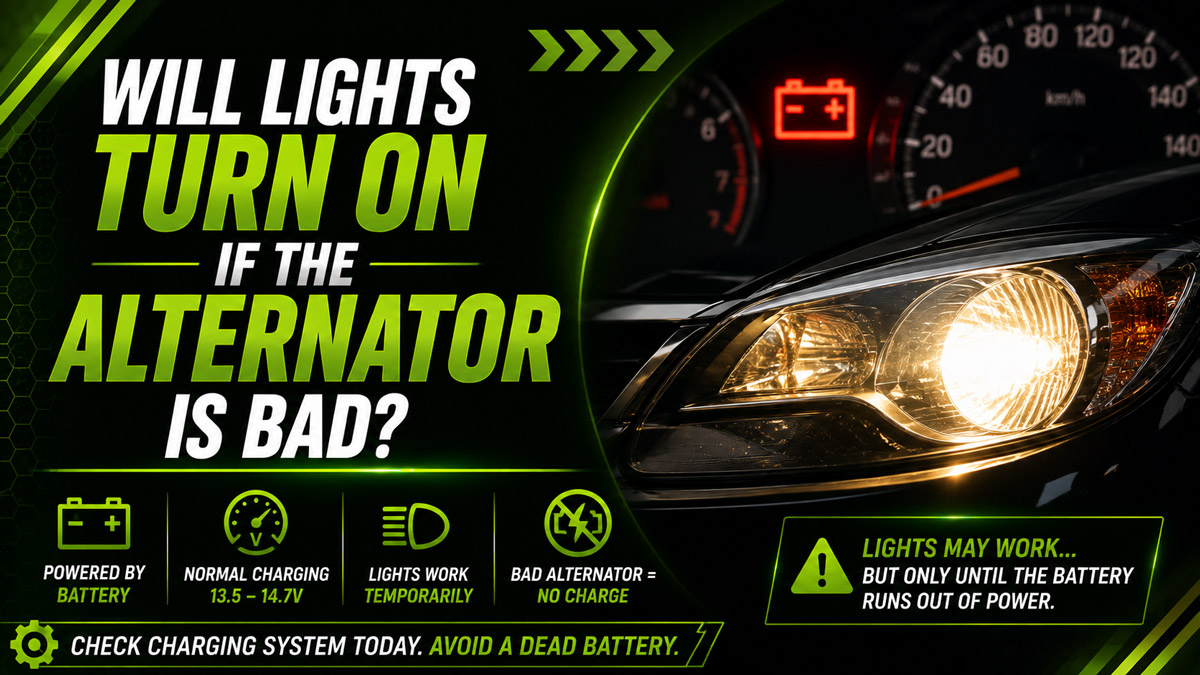
Yes, lights will usually turn on if the alternator is bad because the headlights, dashboard lights, and interior lights can draw electricity from the battery. However, once the battery’s stored energy is depleted, the lights will dim or shut off, and the engine may stall.
Key Facts at a Glance
- Vehicle lights can operate temporarily from battery power when the alternator fails.
- Bright headlights do not automatically prove that the alternator is working.
- A failing alternator commonly causes dimming, flickering, or brightness changes with engine speed.
- A healthy conventional charging system commonly produces approximately 13.5–14.7 volts with the engine running.
- A fully charged 12-volt battery commonly measures approximately 12.6 volts after resting with the engine off.
- Continued driving with no alternator output can eventually discharge the battery and stop the engine.
Why Do the Lights Still Work With a Bad Alternator?
The lights still work because the vehicle battery stores enough electrical energy to power them without immediate alternator assistance. Turning the ignition key or light switch connects the battery to the lighting circuit, so the headlights can illuminate even when the engine is off.
The alternator’s main role begins after the engine starts. The engine rotates the alternator through the serpentine belt, allowing it to produce electrical power and recharge the battery.
When the alternator fails, the battery becomes the vehicle’s temporary power source for:
- Headlights and taillights
- Dashboard displays
- Fuel injectors
- Ignition coils
- Engine-control modules
- Electric power steering
- Cooling fans
- Audio and climate-control systems
The lights may therefore appear normal immediately after an alternator failure. Their operation only proves that electrical power is available somewhere in the system, not that the alternator is generating it.
What Happens After the Alternator Stops Charging?
After the alternator stops charging, the vehicle enters a discharge cycle in which every operating electrical component drains the battery. The exact failure sequence depends on battery condition, electrical load, vehicle design, and whether the alternator has completely or partially failed.
A typical sequence is:
- The battery starts the engine.
The starter consumes a large burst of current. - The alternator fails to take over.
Charging voltage remains near battery voltage instead of rising normally. - The battery supplies the vehicle.
Lights, modules, ignition components, pumps, and fans consume stored energy. - Voltage gradually falls.
Headlights may dim, gauges may flicker, and warning lights may appear. - Electronic systems begin shutting down.
Low-priority accessories may stop before essential engine systems. - The engine stalls.
Fuel injectors, ignition coils, computers, or electric fuel pumps can no longer operate reliably.
The engine may continue running for a short period or considerably longer depending on the battery’s charge and the vehicle’s electrical demand.
Will the Headlights Be Bright With a Bad Alternator?
Headlights can initially remain bright with a bad alternator, especially when the battery is fully charged. Brightness usually decreases as battery voltage falls or when additional electrical loads are switched on.
Common lighting symptoms include:
- Headlights dimming at idle
- Lights brightening when the engine is revved
- Pulsing or flickering illumination
- Interior lights changing intensity
- Dashboard displays becoming unstable
- One or more warning lights appearing
- Lights shutting off shortly before the engine stalls
A completely failed alternator usually causes steadily weakening lights. A failing voltage regulator or defective alternator diode may instead cause fluctuating brightness, intermittent charging, or electrical noise.
Can the Lights Work When the Car Will Not Start?
Yes, the lights can work even when the engine will not start. Headlights require much less current than the starter motor, so a weak battery may illuminate the lights while lacking enough power to crank the engine.
This creates several possible situations:
| Lights and Starting Behavior | Likely Explanation |
| Lights are bright, but the engine does not crank | Starter, relay, ignition switch, neutral-safety switch, or cable issue |
| Lights dim heavily during cranking | Weak battery, poor connection, excessive starter draw, or discharged battery |
| Lights work after a jump-start, but the engine later dies | Alternator may not be charging |
| Lights and dashboard are completely dead | Severely discharged battery, loose terminal, blown main fuse, or cable problem |
| Lights flicker while driving | Alternator, regulator, ground, belt, or connection fault |
Working lights alone cannot separate a battery problem from an alternator problem. Voltage testing and charging-system inspection are required.
How Long Will Lights Work With a Bad Alternator?
There is no reliable fixed operating time because battery capacity and vehicle load vary substantially. A fully charged, healthy battery will generally power essential systems longer than an old, partially discharged, or damaged battery.
Operating time becomes shorter when the vehicle is using:
- Headlights
- Heated seats
- Rear-window defroster
- Air-conditioning blower
- Electric cooling fans
- Windshield wipers
- Powerful audio equipment
- Auxiliary lighting
- Electric power steering
A modern vehicle may also consume substantial power through computers, sensors, pumps, and safety systems even when visible accessories are switched off.
Night driving is therefore especially risky with a failed alternator. The headlights increase battery drain while decreasing visibility as voltage falls.
Does the Battery Warning Light Mean the Alternator Is Bad?
The battery-shaped warning light usually indicates a charging-system problem, not necessarily a defective battery. It may illuminate when system voltage is too low, too high, or inconsistent with the vehicle’s expected charging output.
Possible causes include:
- Failed alternator
- Defective voltage regulator
- Loose or broken serpentine belt
- Weak belt tensioner
- Damaged alternator wiring
- Blown charging-system fuse or fusible link
- Corroded battery terminals
- Poor engine or chassis ground
- Faulty battery-current sensor
- Control-module or communication fault
The warning light may come on continuously or intermittently. A light that appears only at idle, during rain, or when large electrical loads are activated may indicate belt slippage, weak alternator output, or a connection problem.
What Voltage Should a Good Alternator Produce?
A conventional charging system commonly measures approximately 13.5–14.7 volts at the battery terminals while the engine is running. However, vehicle-specific charging strategies can produce readings outside that range temporarily.
| Test Condition | Typical Reading | General Interpretation |
| Engine off after battery rests | About 12.6 volts | Battery is near full charge |
| Engine off at 12.4 volts | Approximately 75% charged | Battery is partly discharged |
| Engine off at 12.2 volts | Approximately 50% charged | Significant discharge |
| Engine running on conventional system | About 13.5–14.7 volts | Charging normally |
| Engine running near 12.6 volts | Little or no charging | Alternator or circuit problem possible |
| Above approximately 15 volts | Possible overcharging | Regulator or control problem possible |
Some modern vehicles use computer-controlled or smart charging. Their voltage may move between the low 12-volt range and the upper 14-volt range depending on battery temperature, load, deceleration, and state of charge.
For that reason, one reading should not be treated as definitive without checking the manufacturer’s specifications.
How Do You Test Whether the Alternator Is Bad?
Test the charging system with a digital multimeter, then inspect the belt and electrical connections before replacing the alternator.
1. Inspect the Battery and Cables
Switch off the engine and inspect both battery terminals. Tighten loose connections and look for corrosion, damaged cables, broken ground straps, or overheated wiring.
A poor connection can reduce charging current and imitate alternator failure.
2. Check the Serpentine Belt
Confirm that the serpentine belt is present, correctly routed, and properly tensioned. Look for cracking, glazing, contamination, looseness, or a failed tensioner.
A good alternator cannot charge correctly if the belt is slipping or not rotating it.
3. Measure Engine-Off Battery Voltage
Set the multimeter to DC volts and connect the red lead to the positive battery terminal and the black lead to the negative terminal.
A charged battery commonly reads about 12.6 volts after resting. A substantially lower reading means the battery may need charging before alternator testing can be conclusive.
4. Start the Engine and Retest
Start the engine and measure voltage at the battery again. A conventional system should normally rise above resting battery voltage.
A reading that remains around 12.6 volts or steadily decreases suggests that the battery is supplying the vehicle without adequate alternator output.
5. Add an Electrical Load
Turn on the headlights, cabin blower, and rear defroster. Observe whether voltage remains stable or drops continuously.
A weak alternator may appear functional without load but fail when demand increases.
6. Compare Battery and Alternator Voltage
When safely accessible, compare voltage at the alternator output terminal with voltage at the battery. A meaningful difference may indicate resistance in the positive charging cable, fuse, fusible link, or connection.
Ground-side voltage-drop testing may also reveal a corroded engine ground or battery ground cable.
7. Obtain a Charging-System Test
Use a professional charging-system analyzer when readings are inconsistent. Many repair shops and parts retailers can test battery condition, alternator output, diode ripple, and starter draw.
A complete test is more reliable than replacing parts based only on symptoms.
Can You Test an Alternator by Disconnecting the Battery?
No. Disconnecting the battery while the engine is running is an outdated and unsafe alternator test, especially on modern vehicles.
Removing a battery cable can create voltage spikes that damage:
- Engine-control modules
- Infotainment systems
- Airbag modules
- Sensors
- Alternator diodes
- Electronic transmission controls
The battery also acts as a voltage stabilizer. Removing it can cause unstable system voltage even when the alternator is functional.
Use a multimeter or charging-system analyzer instead.
Could the Battery Cause the Same Symptoms?
Yes, a weak battery can cause slow cranking, dim lights, clicking, warning lights, and unstable electronics. The difference is that a healthy alternator may restore normal voltage after the engine starts, while a failed alternator allows system voltage to continue falling.
Battery and alternator faults can also occur together. A failed alternator may repeatedly discharge and damage the battery. Conversely, a shorted battery cell can overload the alternator and contribute to premature failure.
A complete diagnosis should evaluate:
- Battery state of charge
- Battery capacity
- Alternator output
- Starter current draw
- Cable resistance
- Parasitic drain
Replacing only the battery may provide temporary improvement if the alternator remains defective.
Can a Bad Alternator Work Intermittently?
Yes, alternators can fail intermittently because of worn brushes, damaged diodes, loose internal connections, heat-sensitive components, or a failing voltage regulator. The vehicle may charge normally when cold and stop charging after the alternator heats up.
Intermittent symptoms include:
- Battery light appearing and disappearing
- Headlights pulsing
- Charging voltage changing abruptly
- Engine stalling after extended driving
- Radio interference or whining
- Burning-rubber or electrical odors
- Normal operation after the vehicle cools
Testing during the actual failure produces the most useful result. An alternator that passes a brief cold test may still fail under heat and load.
What Other Problems Mimic a Bad Alternator?
Several faults can prevent the battery from charging even when the alternator itself is usable.
| Possible Fault | How It Mimics Alternator Failure |
| Loose serpentine belt | Alternator spins too slowly or slips |
| Failed belt tensioner | Charging becomes weak or intermittent |
| Corroded battery cable | Charging current cannot reach the battery |
| Broken ground strap | Electrical return path develops excessive resistance |
| Blown fusible link | Alternator output is disconnected from the battery |
| Damaged alternator connector | Regulator or field circuit loses control |
| Weak battery | System voltage drops despite some charging output |
| Excessive parasitic drain | Battery repeatedly goes dead while parked |
| Failed crankshaft pulley | Belt appears present but accessories are not driven correctly |
Alternator replacement should follow diagnosis, not precede it.
Is It Safe to Drive With a Bad Alternator?
Driving with a confirmed alternator failure is not considered safe because the engine can stall without warning once battery voltage becomes too low. Steering assistance, lighting, engine controls, and safety systems may become limited or unavailable.
A short trip may still end in:
- Loss of headlights
- Engine shutdown at an intersection
- Reduced power steering assistance
- Transmission malfunction
- Disabled cooling fans
- Battery damage
- Need for towing
When the battery warning light appears while driving, reduce unnecessary electrical load and move to a safe stopping location. Avoid continuing simply to see how long the vehicle will run.
How Much Does Alternator Replacement Cost?
Alternator replacement commonly costs several hundred dollars, although the final price depends on the vehicle, alternator capacity, part quality, labor access, and local rates.
| Replacement Type | Typical Part Range | Best Use |
| Remanufactured | $100–$250 | Older vehicles or budget repairs |
| New aftermarket | $150–$400 | Cost-conscious daily drivers |
| OEM | $400–$800 or more | Vehicles requiring precise fit and output |
| High-output unit | $300–$1,000 or more | Modified vehicles with heavy electrical demand |
Total installed cost may range from approximately $300 to more than $1,100. Some vehicles require only straightforward belt and fastener removal, while others require removing intake components, cooling fans, engine mounts, or underbody panels.
Typical labor time is roughly 1.5–3 hours, but difficult engine-bay access can extend the job.
Which Replacement Alternator Should You Choose?
Choose an alternator that matches the vehicle’s required amperage, mounting points, pulley design, connector, rotation direction, and charging-control system.
OEM Alternator
An OEM alternator is generally the safest choice for newer vehicles, fleet vehicles, and models with sensitive computer-controlled charging. It usually offers precise fit and predictable regulation but has the highest price.
New Aftermarket Alternator
A reputable new aftermarket alternator can balance cost and reliability. Quality varies by manufacturer, so warranty length and supplier reputation matter more than the lowest price.
Remanufactured Alternator
A remanufactured alternator is suitable for budget repairs when it comes from a trusted rebuilder with a meaningful warranty. Reliability can vary because the reused housing and internal-core condition differ between units.
High-Output Alternator
A high-output alternator is appropriate when a vehicle has powerful audio equipment, winches, auxiliary lighting, refrigeration equipment, or other heavy electrical accessories. It is unnecessary for an otherwise stock vehicle unless the original charging system is undersized for the added load.
Common Alternator Diagnostic Mistakes
Replacing the Battery Without Testing Charging Output
A new battery can temporarily restore normal operation even when the alternator is defective. Test engine-running voltage before concluding that the old battery was the only problem.
Assuming Working Lights Mean the Alternator Is Good
The battery can power the lights independently. Light operation is not proof of alternator output.
Ignoring the Belt and Tensioner
A loose, contaminated, or slipping belt can produce low charging voltage, squealing, and intermittent warning lights.
Testing Only at Idle With No Load
A weak alternator may pass an unloaded idle test. Add headlights, blower, and rear defroster while monitoring voltage.
Disconnecting the Battery While Running
This test can damage electronics and should not be used on modern vehicles.
Ignoring Cable Voltage Drop
An alternator can produce proper voltage at its output terminal while corroded wiring prevents that voltage from reaching the battery.
Frequently Asked Questions
Will a car keep running if the alternator is bad?
A car may keep running temporarily with a bad alternator by drawing stored energy from the battery. Once battery voltage falls below the level required by the engine computer, ignition system, injectors, or fuel pump, the engine will stall and usually will not restart without charging or replacing the battery.
Will a jump-start fix a bad alternator?
A jump-start can provide enough energy to start the engine, but it does not repair the alternator. The engine may shut off again after the jumper cables are removed or after the temporary battery charge is consumed. Charging-system voltage should be tested immediately after the jump-start.
Can an alternator fail without a warning light?
Yes. A damaged warning-light circuit, intermittent alternator fault, slipping belt, failed diode, or communication problem may occur without a constant battery warning light. Dimming lights, repeated dead batteries, electrical odors, whining sounds, and unstable voltage can still indicate a charging-system fault.
Can a bad alternator drain a battery while parked?
A defective alternator diode can allow current to flow backward after the engine is switched off, creating a parasitic drain. However, many other components can also drain a parked vehicle. An amperage-draw test is needed to determine whether the alternator or another circuit is responsible.
Does revving the engine help a weak alternator?
Increasing engine speed may temporarily improve output if the alternator is weak at idle or the belt is slipping. However, normal charging only at higher revolutions indicates an unresolved problem involving the alternator, belt, pulley, tensioner, wiring, or idle speed.
Can a bad alternator damage a new battery?
Yes. Undercharging repeatedly leaves the battery discharged, which promotes sulfation and capacity loss. Overcharging can cause overheating, electrolyte loss, swelling, and internal damage. The charging system should be tested before or immediately after installing a replacement battery.
The Bottom Line
Lights will turn on if the alternator is bad as long as the battery still contains enough stored electricity. The lights may initially look normal, but they can dim, flicker, or shut off as the battery discharges.
Do not diagnose the alternator from light operation alone. Measure battery voltage with the engine off and running, test the system under electrical load, inspect the belt and connections, and confirm the fault before replacing parts.