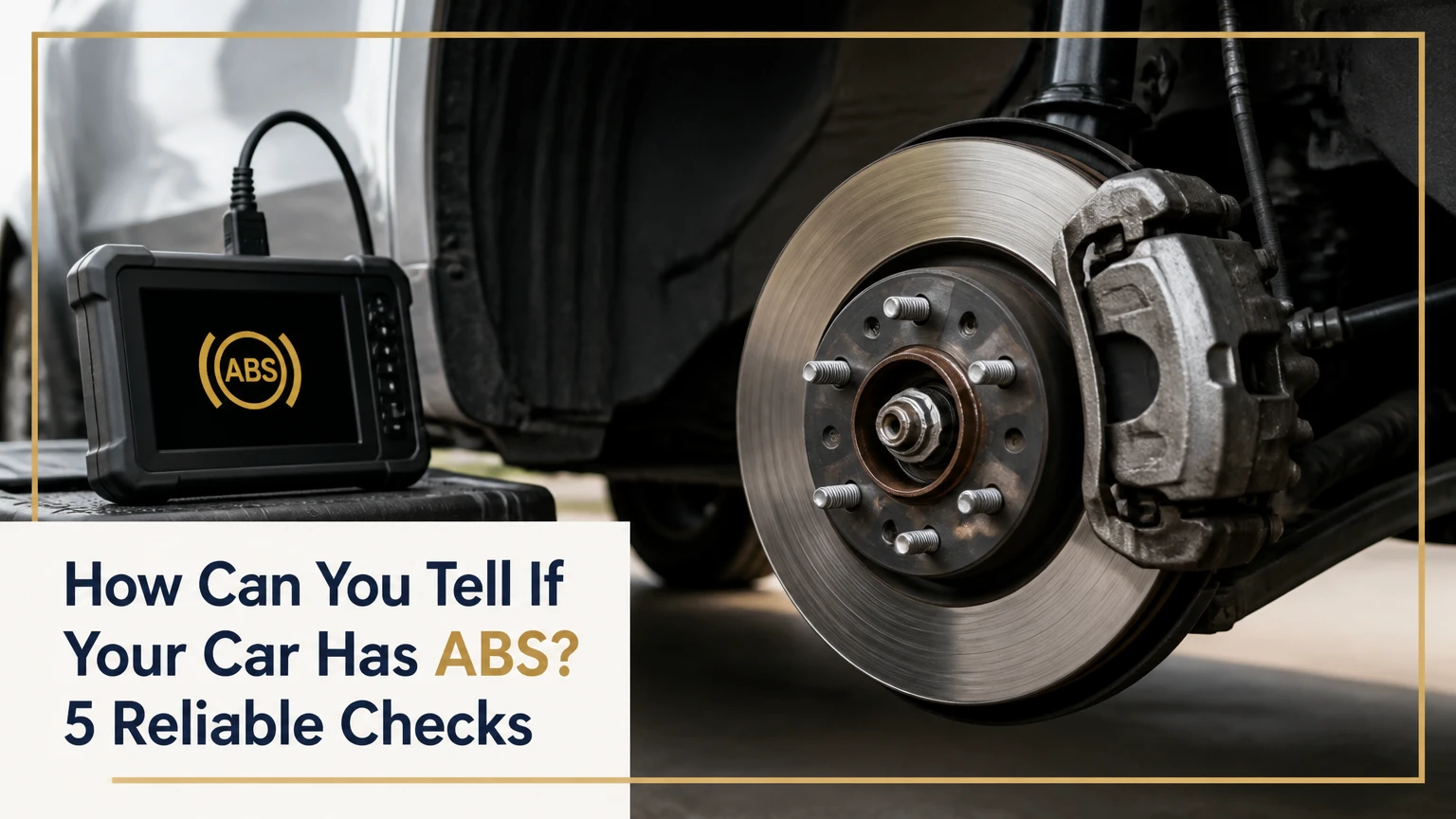
You can tell whether your car has an Anti-lock Braking System (ABS) by checking the instrument cluster during ignition self-test, confirming the equipment in the owner’s manual or VIN record, and inspecting the ABS hydraulic module or wheel-speed sensors. The dashboard check is fastest, but a VIN or manufacturer build sheet is more reliable when the warning light is faulty or missing.
Key Facts at a Glance
- A car with ABS normally illuminates an amber ABS light for several seconds when the ignition is switched on.
- A warning light that remains on after the engine starts indicates an ABS fault or disabled anti-lock function.
- ABS sensors sit near the wheel hubs and monitor wheel rotation during braking.
- ABS helps preserve steering control during hard braking, but it does not guarantee a shorter stop on every surface.
- A basic engine-only OBD2 reader may not retrieve ABS trouble codes.
- A 2012 vehicle is not automatically equipped with ABS solely because of its model year or sale location.
How Can You Tell If Your Car Has ABS?
The fastest confirmation takes less than one minute: switch the ignition to the ON position without starting the engine and watch for an amber ABS symbol. The light should appear during the instrument-cluster self-test and then go out after the engine starts if the system detects no fault.
Use several checks when certainty matters. Look for “ABS” or “Anti-lock Braking” in the owner’s manual, request the vehicle’s factory build sheet, or use a manufacturer-specific VIN equipment record. Physical inspection can provide supporting evidence, but parts may be difficult to see without removing a wheel.
| Check | Typical time | Reliability | What confirms ABS |
|---|---|---|---|
| Ignition self-test | 30 seconds | Medium | Amber ABS lamp appears, then turns off |
| Owner’s manual | 2-5 minutes | High | ABS section or warning-light description |
| Factory build sheet | 5-15 minutes | Very high | Listed anti-lock brake option or standard equipment |
| Wheel or under-hood inspection | 15-45 minutes | High | Hydraulic modulator and wheel-speed sensor wiring |
A missing dashboard lamp does not prove that a vehicle lacks ABS. Instrument clusters can be replaced, bulbs can fail, and some warning symbols are displayed only briefly. Conversely, an ABS-looking symbol can be part of a shared traction-control or stability-control warning system.
What Does ABS Do?
ABS prevents a braked wheel from remaining locked during severe braking, allowing the driver to retain more steering control while slowing. The system does not make tires grip beyond the available road friction, and it cannot compensate for bald tires, excessive speed, contaminated brake components, or an unsafe following distance.
The National Highway Traffic Safety Administration describes ABS as designed to help drivers “maintain steering control during hard braking.” That distinction matters. Conventional brakes can stop a vehicle effectively, but a locked front tire cannot provide normal directional control because it slides instead of rolling.
ABS does not automatically avoid a collision. It also does not replace stability control, which can selectively brake wheels to help manage yaw during a turn. Many modern cars combine ABS, traction control, and electronic stability control through shared wheel-speed sensors and a central control module.
How does ABS work?
ABS wheel-speed sensors measure rotational speed, while an electronic control unit compares the signals and controls hydraulic valves. When the controller detects that a wheel is approaching lockup, it reduces and reapplies brake pressure many times per second.
The cycle has four functional stages:
- Measure wheel speed: Sensors at the hubs or axles send rotational data to the ABS control unit.
- Detect impending lockup: The controller identifies an unusually rapid decrease in wheel speed.
- Modulate pressure: Hydraulic valves reduce pressure at the affected brake circuit.
- Restore pressure: A pump and valves reapply pressure as the wheel resumes rotation.
The driver may feel rapid pedal pulsation and hear buzzing, clicking, or grinding during activation. Those sensations are usually normal. The correct response is to hold firm pressure and steer toward the intended escape path rather than pump the pedal.
Where Is ABS Located on a Car?
The main ABS assembly is usually a hydraulic control unit installed near the brake master cylinder, although exact placement varies by vehicle. It commonly consists of a metal valve block, an electric pump, brake pipes, and an electronic module with a wiring connector.
A typical four-wheel ABS unit has multiple brake lines entering or leaving the modulator. The appearance is not universal: some systems integrate the pump and computer into one compact unit, while older systems separate the electronic controller from the hydraulic block.
Do not loosen brake lines to identify the unit. Opening the hydraulic system introduces air, releases brake fluid, and may require pressure bleeding with a scan tool. A visual check from above the engine compartment is appropriate, but a technician should handle uncertain identification.
Can you confirm ABS behind the wheels?
A wheel-speed sensor and its wiring provide strong physical evidence that the car has ABS. The sensor is mounted close to a toothed reluctor ring, encoder ring, or magnetic tone ring at the hub, axle, or sometimes inside the wheel bearing.
Look for a small cable routed from the suspension or hub into the vehicle body. Do not confuse that cable with a brake pad wear sensor, which may serve only one wheel and has a different connector or routing pattern.
Safe inspection rules are important:
- Do not crawl under a vehicle supported only by a jack.
- Use axle stands on a level surface if a wheel must be removed.
- Keep hands away from moving parts during any ignition or wheel-speed test.
- Do not scrape a magnetic sensor with a screwdriver.
- Do not assume an intact sensor proves that the complete ABS system works.
A missing sensor, broken harness, cracked tone ring, or failed control module can disable ABS even when the vehicle was originally equipped with it.
Can a VIN Confirm That a Car Has ABS?
A VIN can often confirm factory equipment, but a generic VIN decoder may not display every option. The most dependable sources are the manufacturer’s build sheet, a dealer parts or service database, the original window sticker, and a market-specific equipment list.
The 17-character VIN identifies the vehicle, but VIN decoding formats differ by manufacturer and country. A public decoder may identify the model and engine while omitting whether ABS was standard, optional, or part of a package.
Use this process:
- Copy the VIN from the dashboard plate or driver-door label.
- Check a government or manufacturer-supported decoder for the vehicle’s market.
- Ask a franchised dealer for the original build data.
- Compare the result with the owner’s manual and physical equipment.
- Treat conflicting records as a reason for professional inspection.
VIN equipment cannot prove that the current car still has a functioning ABS system. A used vehicle may have a replacement cluster, a swapped body, non-original axles, or a disabled module. The VIN establishes original specification, not present condition.
Does Vehicle Age Prove It Has ABS?
Vehicle age alone cannot prove ABS equipment. Many manufacturers offered anti-lock braking as standard or optional equipment before it became widespread, while some older commercial vehicles, base trims, and vehicles sold in different markets used conventional brakes.
The claim that ABS became mandatory on every new passenger car in the United States and European Union in 2012 is too broad. The year 2012 is associated with important electronic stability-control requirements in the United States, not a universal rule that makes every 2012 passenger car an ABS-equipped vehicle. Regulations also differ by vehicle category, country, and approval date.
| Vehicle clue | What it suggests | What it cannot prove |
|---|---|---|
| 1990s compact car | ABS may be optional | Base trim may use conventional brakes |
| 2000s family sedan | ABS is common | A warning lamp may be faulty |
| 2012 US passenger car | ABS is likely | Model year alone is not documentation |
| Older pickup or van | One-channel or three-channel ABS is possible | Front wheels may lack independent control |
| Imported vehicle | Local equipment rules may differ | US-market VIN data may be incomplete |
For a used-car purchase, combine the model-year equipment list with the ignition self-test and a scan of the ABS module. That three-part approach is more dependable than relying on age or a seller’s description.
What Types of ABS Systems Do Cars Have?
ABS configurations differ by the number of wheel-speed sensors and independently controlled hydraulic channels. Modern passenger cars commonly use four-channel, four-sensor systems, while older rear-wheel-drive trucks may use a shared rear axle sensor.
| Configuration | Sensors | Hydraulic control | Typical application |
|---|---|---|---|
| One-channel, one-sensor | 1 rear axle sensor | 1 rear circuit | Older rear-wheel-drive trucks |
| Three-channel, three-sensor | 2 front, 1 rear | Front circuits independent, rear shared | Older pickups and vans |
| Four-channel, three-sensor | 2 front, 1 rear axle signal | Vehicle-specific | Some older light trucks |
| Four-channel, four-sensor | 4 wheel sensors | Each wheel controlled independently | Most modern cars and SUVs |
A one-channel system can prevent rear-wheel lockup but cannot provide independent anti-lock control at each front wheel. A four-channel system generally offers better control because the controller can respond to differences in grip between individual wheels.
ABS design is also connected to traction control and stability control. The same sensor network may detect wheelspin during acceleration or help the stability controller correct a skid, although those functions use different control logic.
ABS Compared With Conventional Brakes
ABS is preferable for most road vehicles because it helps preserve directional control during panic braking, but conventional brakes can stop a vehicle effectively when the driver modulates pressure correctly. The practical advantage of ABS is greatest when a driver must brake hard and steer at the same time.
| Situation | ABS-equipped vehicle | Conventional-brake vehicle |
|---|---|---|
| Dry asphalt, panic stop | Maintains wheel rotation | Front-wheel lockup can remove steering |
| Wet pavement | Limits lockup from reduced grip | Driver must release pressure manually |
| Loose gravel | May increase stopping distance | Locked tires can build a material wedge |
| Deep snow | Calibration may reduce effectiveness | Manual modulation can sometimes stop sooner |
| Evasive steering | Brake and steer together | Locked tires respond poorly to steering |
ABS does not always shorten stopping distance. On loose gravel, sand, or deep snow, a locked tire can push material ahead of the contact patch and stop sooner, although the driver loses steering control. Some vehicles provide an off-road mode that changes ABS behavior, but disabling road safety systems on public pavement is not appropriate.
Tire condition remains decisive. Four-wheel ABS cannot create traction when tread is worn below the legal limit, pressures are badly mismatched, or one axle uses substantially different tire compounds.
What If the ABS Light Stays On?
A continuously illuminated amber ABS light means the anti-lock function has detected a fault or has been switched off. The ordinary hydraulic brakes may still work, but the vehicle should be driven cautiously only far enough for diagnosis, especially if the red brake warning light, low pedal, fluid leak, or unusual braking behavior also appears.
The most common causes include a damaged wheel-speed sensor, corroded connector, broken wiring, cracked tone ring, low system voltage, low brake fluid, or an ABS module fault. A recent wheel bearing, suspension, brake, or axle repair can disturb sensor wiring or change the sensor-to-ring gap.
How do you diagnose an ABS warning?
Diagnosis starts with warning-light interpretation, fluid inspection, and an ABS-capable scan. A basic engine OBD2 reader often cannot communicate with the anti-lock module, so a code reader must specifically support ABS or chassis systems.
| Symptom | Likely area | First diagnostic action | Typical repair range |
|---|---|---|---|
| ABS light after wheel bearing work | Sensor gap or encoder ring | Inspect hub and harness | $150-$500 |
| ABS and traction lights together | Wheel-speed signal | Read live wheel-speed data | $150-$400 |
| ABS light with low fluid | Hydraulic or fluid-level issue | Check for leaks before topping up | $100-$1,000+ |
| Pump runs continuously | Hydraulic unit or relay | Stop driving if pressure is abnormal | $600-$1,500 |
| Red brake light and low pedal | Hydraulic brake fault | Tow the vehicle | $150-$2,000+ |
Typical US independent-shop prices vary by vehicle and region. A single wheel-speed sensor may cost $150-$400 installed, an ABS hydraulic pump may cost $600-$1,500, and an electronic control module can exceed $1,000 when programming is required.
Do not replace a sensor solely because a code names a wheel. The code may identify a signal problem caused by a damaged tone ring, excessive bearing play, wiring resistance, or incompatible aftermarket parts.
How Should You Brake If Your Car Has ABS?
With ABS, press the brake pedal firmly and continuously during an emergency stop, then steer around the hazard if the path is clear. Do not pump the pedal, because the system already performs pressure release and reapplication faster than a driver can do manually.
Expect vibration, pedal kickback, and mechanical noise when ABS activates. Maintain firm pressure until the vehicle slows or stops, and avoid abruptly releasing the pedal because the road surface changes from one wheel to another.
With conventional brakes, threshold braking requires careful pressure control to prevent lockup. Drivers should not test whether ABS works by deliberately braking hard in traffic, near pedestrians, or on public roads.
Is pedal pulsation always ABS activation?
Pedal pulsation during a normal, gentle stop is not automatically normal ABS operation. ABS usually activates during hard braking or when one or more tires approach lockup, while pulsation at low pedal pressure can indicate a warped brake rotor, uneven hub, loose wheel bearing, or another mechanical issue.
A technician should inspect recurring pulsation that changes with vehicle speed. ABS activation usually includes the amber warning system remaining normal, a characteristic rapid vibration, and a braking event involving low traction or high pedal force.
What Are the Main ABS Edge Cases?
ABS identification becomes less reliable when a vehicle has aftermarket parts, an instrument-cluster fault, a modified brake system, or a nonstandard import history. A car may retain ABS hardware but have no active anti-lock function, or a warning lamp may fail to reveal a disabled system.
Important edge cases include:
- Motorcycles: Motorcycle ABS often uses a separate indicator and compact wheel sensors; car inspection methods do not transfer perfectly.
- Hybrid and electric cars: Regenerative braking works alongside friction brakes, but ABS still controls hydraulic wheel braking when necessary.
- Imported vehicles: Equipment packages can differ from the same model sold domestically.
- Cluster replacement: A missing self-test lamp can hide a fault or alter the apparent equipment.
- Aftermarket conversions: ABS retrofits require compatible sensors, hydraulic control, wiring, calibration, and software.
- Low battery voltage: A weak battery or charging fault can trigger several chassis warning lights simultaneously.
- Brake modifications: Larger calipers or different wheels do not prove that ABS is present or correctly calibrated.
The safest conclusion comes from matching factory records, dashboard behavior, and an ABS-module scan. One clue alone can mislead.
The Bottom Line
You can tell if your car has ABS by watching for the amber ABS self-test light, checking the owner’s manual, confirming the factory build sheet or VIN equipment record, and identifying the hydraulic modulator and wheel-speed sensors. The dashboard check is fastest, but documentation and an ABS-capable scan provide stronger confirmation.
Do not treat a constant ABS light as proof that the vehicle has no brakes. Treat it as evidence that anti-lock protection may be unavailable, then distinguish that condition from a red brake warning, low fluid, a soft pedal, or a hydraulic leak. If the red brake light appears with poor braking, stop driving and arrange a tow.
Frequently Asked Questions
Can a car have ABS without an ABS dashboard light?
Yes. A failed bulb, replaced instrument cluster, damaged circuit, or unusual warning-light design can hide the self-test. Confirm equipment through the owner’s manual, factory build sheet, hydraulic modulator, and an ABS-module scan rather than relying only on the dashboard.
Does ABS work every time I press the brake pedal?
No. ABS activates only when the control unit detects that one or more wheels are approaching lockup. Gentle braking on dry pavement usually produces no pedal pulsation because the tires continue rolling without hydraulic pressure modulation.
Can I install ABS on a car that does not have it?
A professional retrofit may be technically possible, but it is rarely simple or economical. The conversion can require hubs, sensors, tone rings, brake lines, a hydraulic modulator, wiring, programming, and calibration. Replacing the vehicle with an ABS-equipped model is usually safer and less expensive.
Why do the ABS and traction-control lights appear together?
Traction control and stability control often share ABS wheel-speed sensors and the ABS control module. A single failed sensor, damaged harness, or module communication fault can therefore disable several related systems and illuminate multiple warning lamps.
Is ABS useful on snow and ice?
ABS usually helps maintain steering control on snow and ice, but stopping distance depends on tires, temperature, snow depth, and calibration. Specialized winter tires provide more benefit than relying on ABS alone, and drivers should increase following distance substantially.
Can an ABS light turn off by itself?
A temporary sensor or voltage fault may clear after several normal ignition cycles, but the underlying problem can remain stored in the module. If the light returns, scan the ABS system and inspect the cause instead of assuming the system has repaired itself.