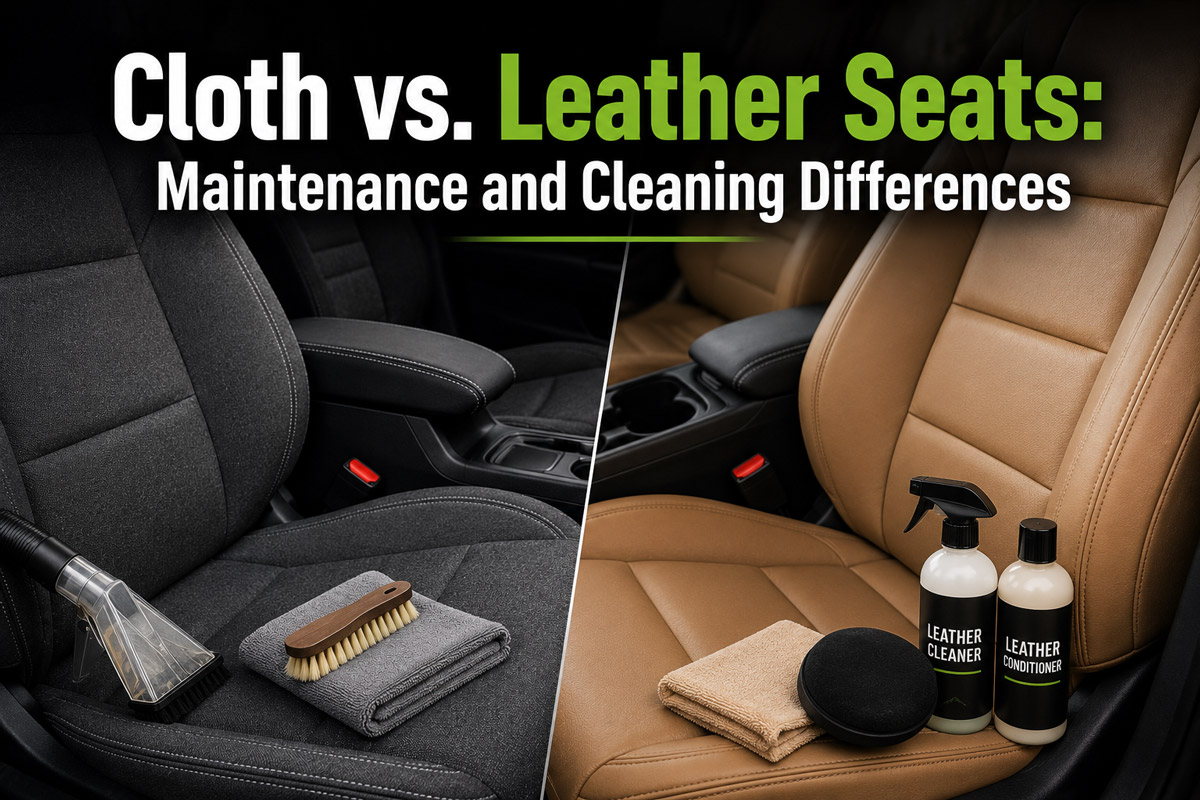
The primary maintenance and cleaning difference between cloth and leather seats lies in their porosity and chemical requirements. Cloth upholstery operates as a highly porous matrix that absorbs liquids through capillary action, requiring wet-extraction cleaning to pull embedded dirt out of the underlying foam. Leather upholstery establishes a semi-impermeable topical barrier that repels immediate spills but requires active chemical conditioning every 3 to 6 months to replenish lipids and prevent structural cracking.
Key Facts / At a Glance
- Routine Maintenance: Cloth requires high-suction vacuuming every 2–4 weeks; leather requires vacuuming and a damp topical wipe-down on the same schedule.
- Deep Cleaning Frequency: Cloth requires wet extraction once a year to remove biological odors; leather demands deep pore cleaning and lipid conditioning 2–4 times annually.
- DIY Cost: Cloth maintenance averages $15–$30 annually (shampoo and fluoropolymer protectant); leather averages $30–$60 (pH-neutral cleaner and premium conditioner).
- Dye Transfer: Light-colored leather is highly susceptible to indigo dye transfer from blue jeans, requiring immediate polymer-eraser removal.
- Longevity: Properly hydrated leather lasts 15+ years; cloth typically shows thinning and pilling after 7–10 years of heavy use.
Quick Verdict by Driver Persona
- For Families and Pet Owners: Choose pigmented leather or synthetic leatherette. The non-porous surface allows immediate wipe-up of bio-fluids (vomit, urine, spilled milk) before they cause permanent cabin odors.
- For Extreme Climate Drivers: Choose cloth. Without active seat ventilation, leather can reach 150°F (65°C) in summer and become uncomfortably rigid in winter. Cloth maintains thermal stability year-round.
- For Low-Maintenance Budget Owners: Choose synthetic leatherette (PU/PVC). It mimics the spill resistance of real leather but eliminates the need for expensive lipid-replenishing conditioners.
Master Maintenance Comparison
How Do the Cleaning Workflows Compare?
Cloth and leather require fundamentally opposite cleaning philosophies. Cloth upholstery cleaning is a volumetric extraction process. Because synthetic polymers like nylon or polyester are woven, liquid and dirt bypass the surface and settle into the polyurethane seat foam. Cleaning cloth requires forcing a cleaning solution into the matrix to suspend the dirt, and then vacuuming that liquid back out.
Leather cleaning is strictly a topical decontamination process. Modern automotive leather is “pigmented” or “finished,” meaning the natural hide is sealed beneath a polyurethane clear coat. You are technically cleaning this clear coat, not the raw leather. The workflow relies on chemical emulsification to lift body oils and surface dirt without abrading the protective seal.
How to Deep Clean Cloth Seats: Step-by-Step
Deep cleaning cloth upholstery requires mechanical agitation and moisture extraction. Attempting to clean cloth by simply spraying and wiping will only push the dirt deeper into the cushion.
Before You Start:
- Time: 60 minutes active, 4+ hours drying.
- Cost: $20–$40 for chemicals; $100+ if purchasing an extractor.
- Tools: High-lift vacuum, pH-neutral fabric cleaner, medium-stiffness drill brush or hand brush, hot-water carpet extractor (or microfiber towels).
Step 1: Dry Extraction
Vacuum the fabric using a crevice tool and a high-lift brush attachment. Extracting loose, dry debris before introducing water prevents dirt from turning into deep-seated mud.
Step 2: Chemical Pre-Treatment
Mist a pH-neutral fabric or upholstery cleaner evenly over the surface. Do not flood the seat. Applying too much liquid pushes contaminants past the reach of your extractor and risks short-circuiting electronic seat heating elements.
Step 3: Mechanical Agitation
Scrub the fibers using a medium-stiffness upholstery brush in cross-hatch strokes (up and down, then left and right). This mechanical friction dislodges bound contaminants and bodily oils from the woven polymer threads.
Step 4: Moisture Extraction
Use a hot-water extractor to pull the suspended dirt out of the fabric. Press the extractor nozzle firmly into the seat and pull slowly in straight lines. You’ll know this step is complete when the water passing through the extractor’s clear window changes from brown to clear. If you lack an extractor, firmly blot (do not rub) the area with dry microfiber towels until no more moisture transfers.
Step 5: Curing and Protection
Allow the seats to dry completely in a well-ventilated area for at least four hours. Once bone-dry, apply a high-grade fluoropolymer fabric protector to re-establish a hydrophobic barrier against future spills.
How to Deep Clean Leather Seats: Step-by-Step
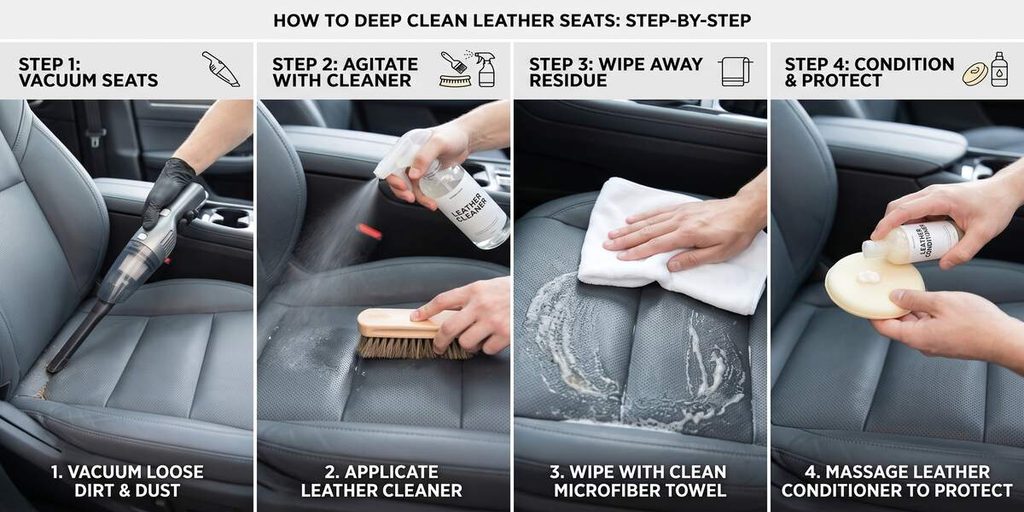
Leather decontamination requires precise pH control and gentle agitation. Aggressive scrubbing will permanently strip the clear coat, leaving the raw hide vulnerable to rapid deterioration.
Before You Start:
- Time: 45 minutes active, 30 minutes curing.
- Cost: $30–$60.
- Tools: Soft horsehair brush, pH-optimized leather cleaner, water-in-oil emulsion conditioner, microfiber towels.
Step 1: Surface Decontamination
Vacuum the seats using a soft horsehair brush attachment. Hard plastic vacuum nozzles will scratch the leather’s polyurethane clear coat, creating micro-abrasions that harbor dirt.
Step 2: Targeted Cleansing
Work a pH-optimized, alkaline-free leather cleaner into the material using a soft detailing brush. Work in small sections, moving in tight circular motions until a light foam lifts the embedded body oils and dirt.
Step 3: Neutralization and Wiping
Wipe away the suspended dirt and cleaning residue immediately with a clean, slightly damp microfiber cloth. Leaving high-pH cleaners on the surface will chemically burn the clear coat and rapidly dehydrate the underlying hide.
Step 4: Lipid Replenishment
Massage a premium leather conditioner into the surface using an applicator pad. Natural automotive leather gradually loses its internal moisture and lipids through UV exposure and heat. Allow the conditioner to penetrate the pores for 15–30 minutes to restore suppleness.
Step 5: Final Buffing and Sealing
Wipe away any unabsorbed conditioner with a dry towel. For maximum longevity, apply a cross-linking polymer or ceramic leather sealant. This creates a sacrificial layer that prevents dye transfer from denim clothing.
How Do You Fix Common Cleaning Mistakes?
Even diligent owners make errors during automotive upholstery maintenance. Identifying the failure mode quickly dictates whether the damage is reversible.
The Over-Saturation Mistake (Cloth)
Flooding cloth seats with liquid forces water deep into the polyurethane seat foam, past the reach of standard vacuum extractors. This trapped moisture breeds mold and chronic musty odors.
- The Fix: Immediately park the vehicle in direct sunlight with the windows cracked. Place a heavy-duty dehumidifier inside the cabin for 24–48 hours. If mold has set, inject an enzymatic odor neutralizer into the foam cushion using a specialized syringe, then extract.
Blue Jean Dye Transfer (Leather)
Light-colored leather easily absorbs indigo dyes from denim through friction and body heat.
- The Fix: Clean the area immediately with a mild polymer eraser sponge (like a melamine sponge, but explicitly formulated for leather) and a dedicated leather cleaner. Use extremely light pressure; aggressive scrubbing will burn directly through the protective topcoat.
Stiff, Hardening Leather
Leather becomes rigid and cardboard-like when its internal lipids are completely depleted by heat and neglect.
- The Fix: Apply a deep-penetrating leather rejuvenator oil. Wrap the treated seats in clean plastic trash bags and park the vehicle in direct sunlight for 4 to 6 hours. The greenhouse heat will open the leather’s pores, forcing the material to absorb the conditioning oils.
Clogged Perforated Leather
Applying liquid cleaners or thick cream conditioners directly onto ventilated leather seats will clog the perforation holes, trapping white residue that blocks airflow.
- The Fix: Never apply product directly to perforated seats. Spray or dab the cleaner onto your brush or microfiber towel first, then gently agitate the surface. To clear already clogged holes, use a wooden toothpick or a blast of compressed air at a 45-degree angle.
Which Upholstery Material Should You Choose?
Choosing between cloth and leather dictates your vehicle’s maintenance schedule for the next decade. Base your decision on who rides in the car and your geographic climate.
Choose Cloth If…
- You live in extreme climates without ventilated seats. Cloth remains thermally stable. It will not burn bare skin in 100-degree summers, nor will it feel like a block of ice during zero-degree winters.
- You are an outdoor or off-road enthusiast. Cloth provides high physical traction, keeping passengers planted during aggressive cornering or off-roading.
- You refuse to perform ongoing maintenance. Aside from vacuuming, cloth can largely be ignored if you don’t spill anything on it.
Choose Leather If…
- You transport infants, toddlers, or pets. Leather’s topical barrier is non-negotiable for bio-fluids. Vomit or spilled milk on a cloth seat will penetrate the foam and smell for years; on leather, it takes 30 seconds to sanitize with a damp wipe.
- You prioritize resale value. A well-maintained leather interior holds its aesthetic appeal significantly better than cloth, which inevitably thins and pills after 50,000 miles of entry and exit friction.
- You suffer from severe allergies. Leather does not trap pet dander, pollen, or dust mites within a fibrous matrix, making the cabin air significantly easier to keep clean.
Frequently Asked Questions
Can I use household carpet cleaner on my car’s cloth seats?
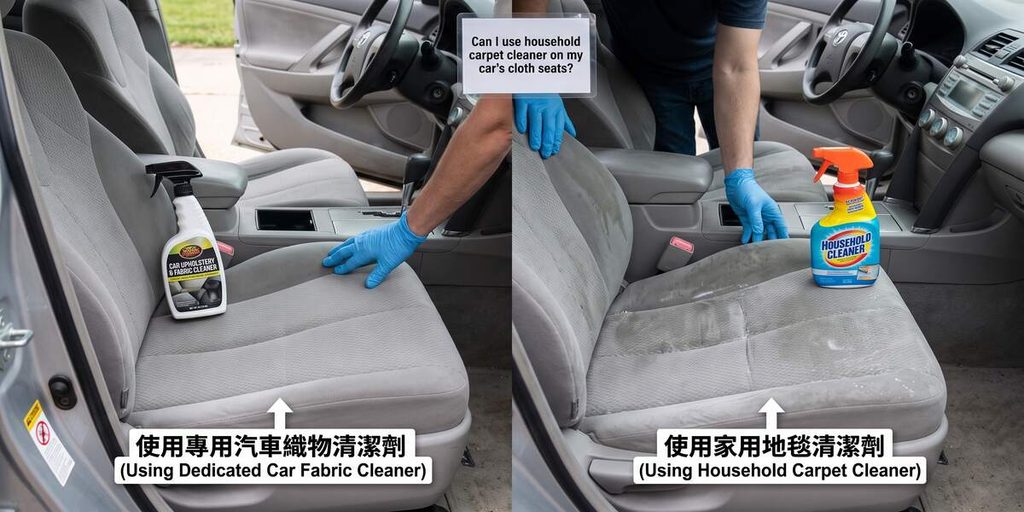
No. Household carpet cleaners often contain harsh, high-foaming detergents that are impossible to fully rinse out of automotive seat foam. This leftover soap residue turns the seat into a dirt magnet, causing it to look dirtier than before within weeks. Always use a low-foaming, dedicated automotive upholstery surfactant.
Is Alcantara cleaned the same way as leather or cloth?
Neither. Alcantara (or microsuede) is a synthetic microfiber that mimics suede. It cannot be heavily wet-extracted like cloth, nor can it be conditioned like leather. It requires dry-brushing with a specialized suede brush and spot-cleaning with a dedicated Alcantara foam to prevent the microfibers from matting down permanently.
Does synthetic leather (leatherette, SofTex, MB-Tex) need conditioning?
No. Synthetic leathers are derived from polyurethane (PU) or polyvinyl chloride (PVC) plastics. Because they contain no natural animal hides, they do not have pores and cannot absorb lipid-based conditioners. Conditioners will simply sit on the surface and create a greasy mess. Clean them with a mild all-purpose cleaner and protect them with a standard UV-blocking interior detailer.
Why did my leather seats become shiny over time?
Clean, factory-fresh automotive leather has a matte finish. When leather becomes shiny, you are looking at a layer of accumulated body oils, sweat, and dirt that has been polished smooth by the friction of your clothing. A thorough deep cleaning with a boars-hair brush and a pH-neutral cleaner will strip away this grime and restore the original matte appearance.