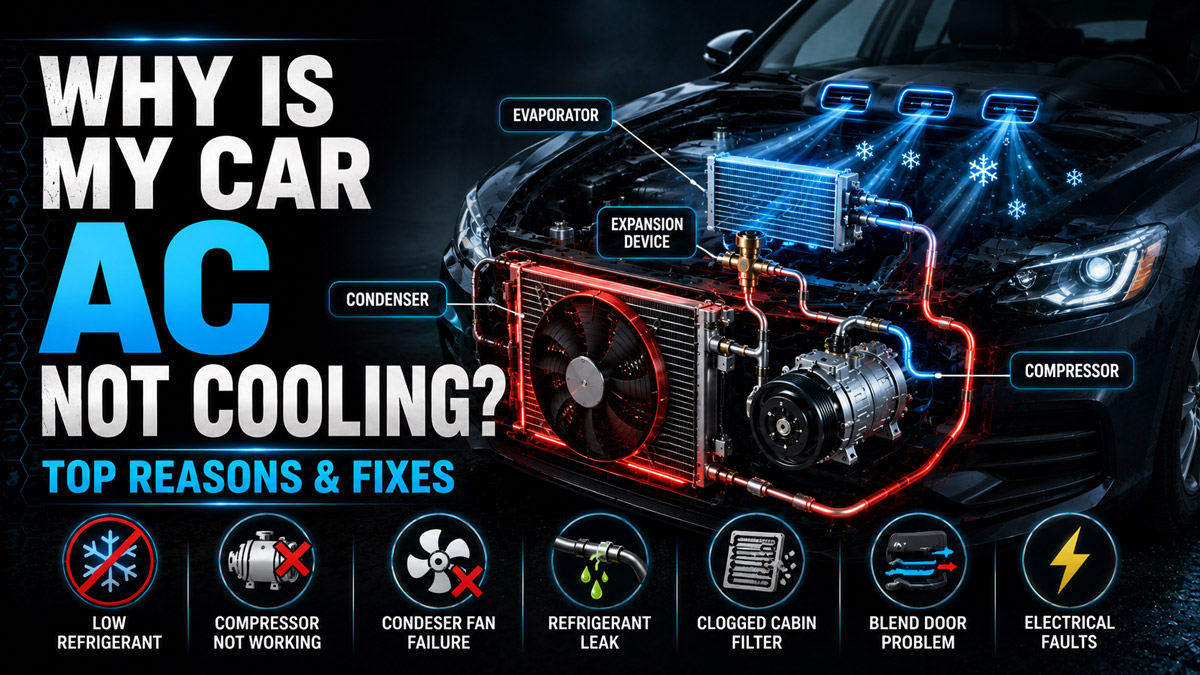
A car AC usually stops cooling because refrigerant has escaped through a leak, the compressor is not operating, or insufficient airflow is passing through the condenser or evaporator. Electrical faults, incorrect refrigerant charge, blocked components and damaged climate-control doors can also make the vents blow warm air even when the AC system appears to be running.
At a Glance
- Low refrigerant caused by a leak is one of the most common reasons a car AC stops cooling.
- Strong airflow with warm air usually indicates a refrigeration or temperature-control problem.
- Weak airflow usually points to a clogged cabin filter, frozen evaporator or blower-system fault.
- An AC system that cools while driving but warms at idle often has a condenser-fan or airflow problem.
- Adding refrigerant without measuring the factory-specified charge can make cooling worse.
- A system that has been opened or completely emptied must be leak-tested, evacuated and recharged by weight.
What Are the Most Common Causes of a Car AC Blowing Warm Air?
The most common causes are low refrigerant, a refrigerant leak, compressor failure, electrical faults, condenser airflow problems and malfunctioning blend doors. The symptom pattern usually reveals which category should be tested first.
Common causes include:
- Low refrigerant: A leaking O-ring, hose, condenser, evaporator or compressor seal allows refrigerant to escape.
- Compressor not operating: The clutch, control valve, relay, fuse or compressor itself may have failed.
- Cooling-fan failure: The condenser cannot release heat effectively when the vehicle is stationary.
- Restricted condenser: Dirt, bugs or bent fins reduce heat transfer.
- Expansion-device blockage: A blocked expansion valve or orifice tube restricts refrigerant flow.
- Blend-door failure: Heated air may be mixed with properly cooled air inside the dashboard.
- Incorrect refrigerant charge: Both undercharging and overcharging reduce performance.
- Evaporator icing: Ice blocks airflow after several minutes of operation.
- Climate-control sensor fault: Incorrect temperature or pressure information can disable the compressor.
A professional diagnosis separates airflow, electrical and refrigerant problems before any parts or refrigerant are added.
How Does a Car Air-Conditioning System Produce Cold Air?
A car AC cools the cabin by absorbing heat at the evaporator and releasing that heat through the condenser. The refrigerant continuously changes pressure and temperature as it circulates through the compressor, condenser, expansion device and evaporator.
The cycle works in four stages:
- Compression: The compressor raises the pressure and temperature of refrigerant vapor.
- Condensation: Outside air removes heat from the refrigerant as it passes through the condenser at the front of the vehicle.
- Expansion: The expansion valve or orifice tube sharply lowers refrigerant pressure.
- Evaporation: The cold refrigerant absorbs heat from cabin air flowing across the evaporator.
The blower motor then pushes the cooled, dehumidified air through the dashboard vents. Water removed from the cabin air normally drains beneath the vehicle.
A failure anywhere in this heat-transfer loop can reduce cooling. For example, low refrigerant prevents the evaporator from being used fully, while poor condenser airflow keeps the high-pressure refrigerant too hot to cool effectively.
What Readings Should a Healthy Car AC Produce?
A healthy car AC commonly produces center-vent temperatures around 38°F to 48°F, or approximately 3°C to 9°C, under favorable test conditions. Actual temperatures and pressure readings vary with ambient temperature, humidity, engine speed, refrigerant type and vehicle design.
For many R-134a systems operating in warm weather, approximate readings may be:
These figures are diagnostic references, not universal recharge targets. A pressure that appears normal at 75°F may be abnormal at 100°F.
Professionals compare pressure with ambient temperature and examine how both gauges respond when engine speed changes. The refrigerant label under the hood remains the correct source for refrigerant type and charge weight. Modern systems are normally charged by mass, often within a tolerance of only a few grams.
How Can I Identify the Type of AC Problem?
Separate the problem into airflow, refrigeration and electrical categories before replacing parts. The fastest first check is to compare vent airflow, air temperature, compressor operation and cooling behavior while driving versus idling.
Use this symptom guide:
Start by confirming that the engine reaches normal operating voltage and that the radiator or condenser fans run when commanded. Then inspect the cabin filter and visible condenser surface.
Refrigerant pressures should be checked only with equipment compatible with the vehicle’s refrigerant. A single low-side gauge cannot reveal many restrictions, overcharge conditions or compressor problems.
Why Does My AC Cool Only While the Car Is Moving?
A car AC that cools while driving but becomes warm at idle usually has inadequate airflow through the condenser. Road speed forces air through the condenser, but a stationary vehicle depends on electric cooling fans.
Likely causes include:
- A failed radiator or condenser fan
- A blown fan fuse or relay
- A defective fan-control module
- Damaged wiring or connectors
- A condenser blocked by bugs, leaves or dirt
- Excessive system pressure caused by overcharging
- Engine overheating that causes the computer to reduce AC operation
Turn on the AC with the engine running and observe the cooling fans from a safe position. At least one fan normally operates or cycles when system pressure rises, although exact behavior varies by model.
Do not place hands, clothing or tools near an electric fan. Electric cooling fans can start unexpectedly even when they were stationary moments earlier.
If cooling improves immediately when road speed increases, test fan operation and condenser cleanliness before assuming the compressor is defective.
Why Does the AC Start Cold and Turn Warm Later?
An AC system that starts cold but turns warm after 15–20 minutes may have an evaporator that is freezing, an overheating compressor clutch, excessive system pressure or an electrical component that fails when hot. The airflow pattern helps separate these causes.
If air volume gradually becomes weaker, ice is probably forming on the evaporator. Possible causes include:
- A faulty evaporator temperature sensor
- Incorrect refrigerant pressure
- A clogged cabin filter
- Restricted airflow across the evaporator
- A malfunctioning expansion valve
- A compressor that does not reduce output correctly
- A climate-control module fault
If airflow remains strong but the temperature suddenly becomes warm, inspect compressor operation. A clutch coil, relay or control valve may stop working as temperature rises.
Switching the AC off while leaving the blower running may temporarily melt evaporator ice. Cooling may return after 10–20 minutes, but that result confirms a symptom rather than repairing the cause.
Why Is the Air Cold but the Vent Airflow Weak?
Cold air with weak airflow usually indicates an airflow restriction rather than a refrigerant problem. The most common causes are a clogged cabin air filter, evaporator icing, blower-motor failure or a door inside the HVAC housing that is not opening fully.
Begin with the cabin filter because it is accessible on many vehicles and may become packed with dust, leaves or pollen. A severely clogged filter can reduce airflow at every fan speed.
Other possibilities include:
- A blower motor that runs slowly
- A failing blower resistor or electronic speed controller
- Debris inside the blower wheel
- A recirculation door stuck between positions
- A clogged evaporator surface
- Ice covering the evaporator
- A collapsed or disconnected air duct
A useful rule is that refrigerant problems primarily change air temperature, while blower and filter problems primarily change air volume. Evaporator icing can affect both because the system initially produces cold air before the ice obstructs airflow.
Why Does the AC Compressor Not Turn On?
The compressor may remain off because the system detects unsafe refrigerant pressure, an electrical component has failed, or the vehicle’s control module is intentionally preventing operation. Low refrigerant is common, but it is not the only explanation.
Possible causes include:
- A blown AC fuse
- A failed compressor relay
- Low refrigerant pressure
- Excessive high-side pressure
- A faulty pressure sensor
- A damaged compressor clutch
- A failed variable-displacement control valve
- Broken wiring or poor ground
- Low battery or charging voltage
- Engine-overheating protection
- A climate-control or engine-control module fault
Many newer vehicles use clutchless or variable-displacement compressors. The pulley may appear to spin constantly even when little or no cooling is being commanded. Compressor diagnosis on those vehicles requires scan-tool data and pressure measurements rather than a simple visual clutch test.
Never assume that a stationary clutch confirms low refrigerant. Check the fuse, relay command, pressure data and power supply before replacing the compressor.
Can Too Much Refrigerant Stop the AC From Cooling?
Yes. Too much refrigerant can reduce cooling, raise high-side pressure and cause the compressor to be disabled by the pressure-protection system. Overcharging is particularly common after refrigerant is added using a DIY can without recovering and weighing the existing charge.
An overcharged system may cause:
- Warm or inconsistent vent temperatures
- Very high high-side pressure
- Compressor cycling or shutdown
- Excessive condenser heat
- Engine-cooling fans running at high speed
- Compressor noise or liquid refrigerant damage
Air trapped inside the system can produce symptoms similar to an overcharge. Non-condensable air raises pressure and reduces the condenser’s ability to reject heat.
The correct repair is not to vent refrigerant. Refrigerant must be recovered with approved equipment, the system must be vacuum-tested when appropriate, and the specified mass must be installed. The under-hood label may specify a charge such as 500 ± 15 grams, illustrating how narrow the correct range can be.
Why Is One Side Cold and the Other Side Warm?
One-sided cooling is usually caused by a faulty blend-door actuator, but low refrigerant can also cool the evaporator unevenly. Dual-zone vehicles have separate air doors that regulate temperature for the driver and passenger sides.
A blend-door actuator may have stripped plastic gears, a failed motor or lost calibration. Common signs include:
- Clicking or tapping behind the dashboard
- Temperature that does not change on one side
- One zone responding while the other does not
- A temperature problem that remains identical at idle and highway speed
Low refrigerant can create a different pattern. Because only part of the evaporator receives enough refrigerant, air passing over one section may feel colder than air passing over another.
Technicians compare left and right vent temperatures, scan actuator position data and test refrigerant performance. Replacing a blend-door actuator will not solve an unevenly fed evaporator, while adding refrigerant will not repair a broken air door.
Can a Broken Blend Door Make the AC Blow Hot Air?
Yes. A broken blend door can route air across the heater core or mix heated air with cold evaporator air, causing warm vent temperatures even when the refrigeration system is functioning correctly.
The blend door sits inside the HVAC housing and determines how much air passes through or around the heater core. The actuator moves the door according to the selected cabin temperature.
Signs of a blend-door fault include:
- Temperature changes that do not match the control setting
- Repetitive clicking inside the dashboard
- One side staying hot in a dual-zone vehicle
- Correct AC pressure readings but warm vent air
- Cooling that changes after hitting a bump or restarting the vehicle
Some actuators are accessible behind the glove box or lower dashboard. Others require substantial dashboard disassembly. Before replacing the actuator, verify that the door itself is not cracked and that the climate-control module has not lost calibration.
A refrigerant recharge cannot correct a mechanical temperature-door problem.
Should I Use a DIY Refrigerant Recharge Can?
A DIY recharge can is appropriate only when the correct refrigerant is confirmed, the system still contains pressure, no major fault is present and the charge can be measured accurately. In most cases, a pressure-only aerosol gauge cannot determine whether the system is leaking, restricted, contaminated or already overcharged.
Avoid DIY charging when:
- The system is completely empty
- The vehicle uses R-1234yf and the equipment is not compatible
- Refrigerant type is unknown
- The compressor is noisy
- The system has been opened for repair
- High-side pressure cannot be monitored
- The vehicle uses a variable-displacement compressor
- Stop-leak products are included
- The vehicle is a hybrid or electric model requiring special compressor oil
A system that has lost refrigerant has a leak. Adding gas may restore temporary cooling, but it does not repair the leak.
Professional service normally includes refrigerant identification, recovery, leak testing, evacuation and recharging by the factory-specified weight. That process prevents overcharging and helps protect expensive equipment from contaminated refrigerant.
Is It Safe to Bypass the AC Pressure Switch?
No. An AC pressure switch should not be bypassed as a repair or left bypassed during operation. The switch protects the compressor from dangerously low or high refrigerant pressure.
Forcing the compressor to run with low pressure can reduce oil circulation and damage internal components. Forcing operation during excessive pressure can overload hoses, seals and the compressor.
A technician may briefly perform a controlled electrical test according to the manufacturer’s diagnostic procedure, but that is different from inserting a jumper wire and operating the system normally. Many modern pressure sensors produce a variable voltage signal and cannot be safely tested by shorting terminals.
A better diagnostic sequence is:
- Read pressure-sensor data with a compatible scan tool.
- Compare the electronic reading with mechanical gauge pressure.
- Check sensor reference voltage, signal and ground.
- Confirm whether the control module is commanding the compressor.
- Repair the pressure or circuit fault instead of defeating the protection.
Bypassing safety controls can convert a minor leak or sensor fault into a compressor replacement.
How Much Does It Cost to Repair a Car AC?
Car AC repair may cost approximately $50 for a simple fuse or relay, $150–$400 for leak diagnosis and recharge, or $1,000–$2,500 or more for major compressor or evaporator work. Labor rates, refrigerant type and vehicle design create large price differences.
Typical broad ranges include:
Evaporator and blend-door repairs can be expensive because the dashboard may need to be removed. R-1234yf service also tends to cost more than traditional R-134a service because the refrigerant and equipment are more expensive.
Request a diagnosis before authorizing a recharge. Paying for refrigerant repeatedly without repairing the leak usually costs more over time.
Can I Keep Driving When the Car AC Is Not Cooling?
You can usually drive with a non-cooling AC if the engine temperature remains normal and the compressor is not making noise. However, stop using the AC if the engine overheats, the belt squeals, the compressor grinds or smoke appears under the hood.
A failed AC system can sometimes affect more than cabin comfort. The compressor may share a serpentine belt with the alternator, water pump or power-steering pump. A seized compressor pulley can damage or throw that belt.
Turn the AC off and arrange prompt inspection when:
- The engine temperature rises with the AC on
- A burning smell appears
- The compressor rattles or grinds
- The drive belt slips or smokes
- Refrigerant oil is visibly spraying
- The cooling fans do not run
- Defrost performance is poor in humid or cold weather
Loss of AC cooling alone is not normally an emergency. Mechanical noise, overheating or belt problems make continued operation risky.
When Should I Call a Professional AC Technician?
Call a qualified automotive AC technician when the system is empty, the compressor is noisy, the refrigerant type is uncertain, pressures are abnormal or the repair requires opening the sealed refrigerant circuit. These situations require recovery equipment, leak testing and precise charging.
Professional diagnosis is especially important when:
- Refrigerant has already been added but cooling remains poor
- The system repeatedly loses cooling
- The vehicle uses R-1234yf
- The car is hybrid or electric
- The compressor does not engage
- High-side pressure rises excessively
- Metal debris is found in the system
- The evaporator or dashboard components require removal
- The system has been open to the atmosphere
- A previous product contained stop-leak sealant
A practical inspection sequence is to verify airflow, scan for fault codes, test cooling-fan operation, inspect visible leaks and measure both high- and low-side pressures. Refrigerant should then be recovered and weighed if the charge level remains uncertain.
The professional rule is simple: diagnose first, charge second. Refrigerant quantity should never be used as a substitute for identifying the fault.
The Bottom Line
A car AC that is not cooling usually has low refrigerant, compressor-control trouble, inadequate condenser airflow or an internal HVAC door problem. The specific symptom—warm air, weak airflow, one-sided cooling or failure only at idle—determines which system should be tested first. Avoid blindly adding refrigerant because an overcharged, contaminated or mechanically damaged system can become more expensive to repair. Accurate diagnosis requires checking airflow, electrical commands, refrigerant pressure and the factory-specified charge.