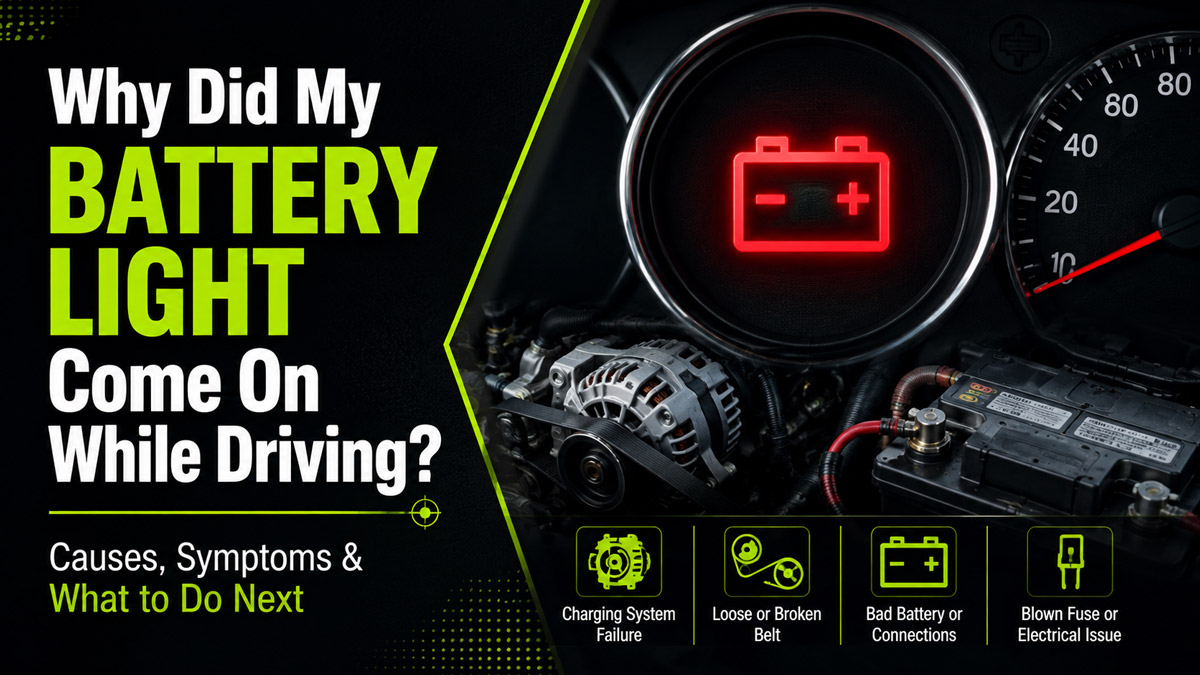
The battery light came on while driving because the vehicle detected a charging-system problem. In most cases, the alternator is no longer producing enough electrical power to operate the vehicle and recharge the battery, so the car begins running on the battery’s limited stored energy.
At a Glance
- A battery light usually signals a charging-system fault, not simply a weak battery.
- A running vehicle commonly charges at approximately 13.5 to 14.8 volts.
- A failed alternator, slipping belt, damaged cable, or blown fuse can trigger the warning.
- The engine may stall when remaining battery voltage becomes too low.
- Turn off unnecessary electrical equipment and drive to a safe location immediately.
- Continuing to drive can leave the vehicle stranded and may cause loss of power-assisted systems.
What Does the Battery Warning Light Mean?
The battery warning light means the vehicle’s charging system is not operating within its expected range. The warning does not automatically mean the battery itself has failed.
When the engine is off, the battery supplies approximately 12.4 to 12.7 volts in a healthy, fully charged condition. After the engine starts, the alternator normally raises system voltage to roughly 13.5 to 14.8 volts, depending on temperature, electrical demand and the vehicle’s charging strategy.
The warning appears when the powertrain control module, body control module or voltage regulator detects an abnormal difference between battery voltage and alternator output. The vehicle may then rely partly or entirely on stored battery power.
A common beginner mistake is replacing the battery before testing the charging system. A new battery may temporarily make the vehicle start normally, but it will discharge again if the alternator, wiring or belt problem remains.
What Are the Most Common Causes of a Battery Light?
The most common causes are a failing alternator, a loose or broken drive belt, damaged charging cables, corroded connections and a weak battery that cannot accept or maintain a charge.
| Possible cause | Typical clue |
|---|---|
| Failing alternator | Dimming lights, low voltage or repeated stalling |
| Slipping serpentine belt | Squealing noise or warning during rain |
| Broken belt | Battery light plus overheating or heavy steering |
| Corroded terminals | Intermittent warning or difficult starting |
| Loose alternator cable | Light flickers over bumps |
| Blown alternator fuse | Alternator tests well but battery receives no charge |
| Weak battery | Slow cranking and unstable voltage |
| Bad ground strap | Voltage drops under heavy electrical load |
The alternator is often blamed first, but professionals test the entire circuit before replacing it. A perfectly functional alternator cannot charge the battery through a loose cable, damaged fusible link or high-resistance ground connection.
Can a Bad Alternator Cause the Battery Light?
Yes. A failing alternator is one of the most common reasons the battery light comes on while driving.
The alternator converts engine rotation into electricity. Internal carbon brushes, diodes, bearings and the voltage regulator can wear or fail. When output falls below the vehicle’s electrical demand, the battery begins supplying the difference.
Alternator failure may produce several symptoms:
- Headlights become dimmer at idle.
- Dashboard lights flicker.
- The blower motor slows down.
- Electrical accessories stop working.
- A whining or grinding sound develops.
- The engine eventually stalls.
- The vehicle will not restart after being switched off.
A basic voltage reading can identify obvious failure. For example, a vehicle showing 12.2 volts with the engine running is generally not charging normally. However, a steady reading near 14 volts does not eliminate every alternator fault. A failed diode can create excessive AC ripple even when average DC voltage appears acceptable.
Can a Broken or Slipping Serpentine Belt Trigger It?
Yes. A broken, loose or contaminated serpentine belt can stop the alternator from turning fast enough to generate electricity.
The serpentine belt often drives several components, including the alternator, water pump, air-conditioning compressor and power-steering pump. Belt routing differs by vehicle, so a broken belt may cause additional warnings or symptoms.
Stop the engine quickly if the battery light appears together with:
- A rapidly rising coolant-temperature gauge.
- Heavy steering.
- A loud belt slap or snapping sound.
- Multiple warning lights.
- A burning-rubber smell.
On vehicles where the serpentine belt drives the water pump, continuing to drive can overheat the engine within minutes. The potential engine damage is far more serious than the charging problem.
A slipping belt may trigger the warning only during rain, at idle or when electrical demand is high. Water, oil or coolant contamination reduces belt grip, while a weak tensioner allows the belt to slip around the alternator pulley.
Can a Weak Battery or Corroded Terminals Cause It?
Yes, although the battery light more commonly indicates a charging fault. A shorted battery cell, severely discharged battery or high-resistance terminal connection can disrupt system voltage enough to illuminate the warning.
Battery-terminal corrosion acts like resistance in an electrical circuit. The alternator may generate sufficient voltage, but the charging current cannot move efficiently into the battery or vehicle network.
Common clues include:
- White, blue or green corrosion around the terminals.
- Loose terminal clamps that can rotate by hand.
- Slow cranking before the engine starts.
- Electrical power cutting out over bumps.
- A battery light that flickers rather than staying continuously illuminated.
- Voltage measured at the alternator that is higher than voltage measured at the battery.
A voltage-drop test is more useful than visual inspection alone. Under load, excessive resistance between the alternator and battery may produce a measurable drop even when the cable looks normal externally.
What Should You Do When the Battery Light Appears?
Reduce electrical demand, identify a safe stopping location and arrange charging-system inspection as soon as possible.
- Do not switch off the engine immediately.
The vehicle may not restart if battery reserve is already low. - Turn off unnecessary electrical equipment.
Disable the air conditioner, heated seats, rear defroster, audio system and phone chargers. - Keep safety equipment operating.
Do not switch off headlights, wipers or hazard lights when conditions require them. - Watch the temperature gauge.
A broken belt may also stop the water pump and cause overheating. - Notice changes in steering or engine performance.
Heavy steering, flickering lights or rough running suggests the problem is becoming urgent. - Drive only to the nearest safe location.
Choose a repair facility, parking area or roadside stopping point rather than continuing the planned journey. - Request towing when other warnings appear.
Stop immediately if the engine overheats, steering becomes unsafe or the belt is visibly broken.
The safest professional rule is to treat an illuminated battery light as a limited-time warning, not a reminder to repair the vehicle next week.
Is It Safe to Continue Driving?
It is only safe to drive a short distance when the vehicle remains stable, the temperature is normal and no belt-related symptoms are present. Continued driving is not considered risk-free.
The vehicle can stall without much warning once battery voltage falls too low to operate the fuel pump, engine-control module, ignition system and electronic throttle. Steering effort may increase after the engine stops, and brake assistance may become limited after one or more pedal applications.
Pull over and arrange towing when:
- The coolant-temperature gauge rises.
- Steering suddenly becomes heavy.
- The headlights become extremely dim.
- The engine begins misfiring or losing power.
- A burning smell or smoke appears.
- The instrument cluster starts switching off.
- The serpentine belt is missing or damaged.
Driving several miles to a nearby repair shop may be reasonable under stable conditions. Driving home for an hour because the vehicle “still feels normal” is a common mistake that ends with a roadside stall.
How Long Can a Car Drive With the Battery Light On?
A car may continue running for approximately 15 to 60 minutes, but no dependable driving-time guarantee exists.
Remaining time depends on:
- Battery capacity and state of charge.
- Battery age and condition.
- Headlight, blower and wiper use.
- Engine-management power demand.
- Outside temperature.
- Whether the alternator has stopped completely or is producing reduced output.
A fully charged, healthy battery may keep a simple vehicle running longer than a partially discharged battery in a modern luxury vehicle with numerous control modules. Night driving in rain can shorten the available time because headlights, wipers, demisters and blowers create significant electrical demand.
The frequently quoted 20-to-45-minute estimate should be treated as an emergency planning range, not a promise. A damaged battery may support the engine for only a few minutes, while a partially functioning alternator may allow longer operation.
Will the Car Suddenly Stall While Driving?
Yes. The engine can stall when battery voltage drops below the level required by the vehicle’s electronic systems.
There is no universal shutdown voltage, but serious problems often begin as system voltage approaches roughly 10 to 11 volts. Fuel injectors, ignition coils, control modules and electric fuel pumps may stop operating consistently.
The failure often develops in stages:
- The battery light appears.
- Headlights and dashboard lights dim.
- Warning messages multiply.
- The transmission or stability-control system enters fault mode.
- The engine begins misfiring or losing throttle response.
- The instrument panel shuts down.
- The engine stalls.
Some vehicles may stop with little warning, especially when the battery has a failed cell. After stalling, the vehicle usually will not restart without charging or jump-starting, and it may stall again soon afterward if the underlying charging fault remains.
Why Does the Light Come On Only at Idle?
A battery light that appears at idle but disappears when the engine is revved usually indicates low alternator speed, belt slippage, an alternator beginning to fail or an unusual pulley setup.
Alternator output generally increases with rotational speed. A worn alternator may produce marginal voltage at 650 to 800 rpm but recover when engine speed rises. A weak belt tensioner can create a similar pattern because the belt slips more under certain loads.
Other possibilities include:
- An oversized aftermarket underdrive pulley.
- A worn alternator decoupler pulley.
- Excessive electrical demand at idle.
- A poor engine-to-chassis ground.
- Low idle speed caused by another engine fault.
- A failing voltage regulator.
A technician should measure voltage at idle and again near 2,000 rpm with headlights and blower operating. A large improvement only after revving the engine points toward an alternator-speed, belt or low-output problem rather than a simple dashboard-sensor error.
Why Does the Battery Light Flicker During Deceleration?
A battery light that flickers when the accelerator is released may result from a slipping alternator decoupler pulley, unstable belt tension, loose wiring or rapid changes in a smart-charging system.
Many modern alternators use an overrunning or decoupler pulley to reduce belt vibration when engine speed changes. A worn pulley may slip, lock or oscillate during deceleration, temporarily reducing alternator speed.
The warning may also flicker when engine movement pulls on a loose cable or damaged connector. This is especially possible if the light appears during braking, turning or driving over bumps.
Smart-charging vehicles complicate diagnosis because alternator voltage intentionally changes according to battery condition, engine load and deceleration strategy. Variable voltage alone is not proof of failure. Diagnosis should include fault-code scanning, live charging data, pulley inspection and voltage-drop testing rather than relying on one multimeter reading.
Why Does the Battery Light Come On When It Rains?
The battery light may appear in rain because water causes a loose or worn serpentine belt to slip around the alternator pulley.
A slipping belt often produces a squeal immediately after driving through standing water or during heavy rain. The warning may disappear after the belt dries and regains traction.
Rain-related warnings can also result from:
- Water entering a damaged alternator connector.
- Splashing onto exposed wiring.
- Moisture affecting a cracked fuse box.
- A missing engine splash shield.
- Water contamination inside an aging alternator.
- Corroded grounds becoming more resistive when wet.
A light that appears only in wet weather should not be dismissed simply because it later turns off. Belt slippage can worsen, and moisture-related electrical faults may eventually become permanent. Inspect the belt for glazing, cracks, contamination and insufficient tension, and check whether the lower engine splash shields are intact.
Can a Blown Fuse Cause the Battery Warning?
Yes. A blown alternator fuse or fusible link can illuminate the battery light even when the alternator itself is capable of producing normal voltage.
Many vehicles protect the main charging cable with a high-amperage fuse, commonly rated from approximately 80 to more than 200 amps. If that connection opens, alternator output may not reach the battery.
This creates a misleading situation: voltage measured directly at the alternator output terminal may look normal, while voltage at the battery continues falling.
A blown charging fuse may be caused by:
- Incorrect jump-start cable connection.
- A shorted alternator.
- Damaged charging wiring.
- A tool contacting the positive terminal and ground.
- Installing a battery with reversed polarity.
- A fuse weakened by heat or poor terminal contact.
Replacing the fuse without finding the cause can lead to another immediate failure. High-current charging circuits can generate severe heat, so diagnosis should include cable inspection and resistance testing.
Can Loose Wiring or a Bad Ground Trigger the Light?
Yes. Loose charging cables, damaged connectors and corroded ground straps can trigger the battery light even when both the battery and alternator pass basic tests.
The charging circuit must complete a low-resistance path from the alternator to the battery and back through the engine and chassis grounds. Small amounts of resistance become important when the alternator is carrying 50, 100 or more amps.
A poor ground may remain unnoticed during a no-load voltage check but fail when the headlights, air conditioner and rear defroster are operating simultaneously. This is why professionals perform voltage-drop testing under load.
Typical maximum voltage drops vary by manufacturer, but readings above approximately 0.2 to 0.5 volts on either side of the charging circuit deserve investigation. Always follow the vehicle’s service specifications.
A warning that flickers over bumps strongly suggests movement-sensitive wiring. Inspect the battery clamps, alternator plug, main output cable, engine ground strap and chassis connection points.
Why Is the Light Still On After Alternator Replacement?
The battery light may remain on because the replacement alternator is defective, incorrectly specified, poorly connected or unable to communicate with the vehicle’s computer-controlled charging system.
Common post-replacement causes include:
- A loose alternator electrical connector.
- A main charging cable left disconnected.
- A blown fuse or fusible link.
- Incorrect belt installation.
- A defective remanufactured alternator.
- The wrong alternator amperage or regulator type.
- An unregistered replacement battery.
- Stored diagnostic trouble codes.
- A damaged battery-current sensor.
Some European and late-model vehicles require battery registration or charging-system adaptation after battery replacement. This procedure tells the energy-management module the battery type, capacity and age. Alternator replacement itself does not always require programming, but computer-controlled alternators must be compatible with the vehicle’s communication protocol.
Do not assume a new component is functional. Measure charging performance, scan for generator-control codes and verify the part number before replacing additional parts.
What Symptoms Help Identify the Exact Cause?
The most useful clues are when the warning appears, which other systems change and whether the vehicle produces noise, heat or odor.
| Symptom | More likely cause |
|---|---|
| Light plus belt squeal | Slipping belt or weak tensioner |
| Light plus overheating | Broken belt or water-pump issue |
| Light plus heavy steering | Broken belt on hydraulic-steering vehicle |
| Light flickers over bumps | Loose cable or connector |
| Light only at idle | Weak alternator or belt problem |
| Light after jump-starting | Blown fuse or damaged alternator |
| Burning-rubber smell | Belt slipping or seized pulley |
| Rotten-egg smell | Overcharging or damaged battery |
| Whining sound | Alternator bearing or diode fault |
| Repeated dead battery | Charging fault or parasitic drain |
The symptom pattern narrows the search but does not replace testing. For example, dim headlights suggest low voltage, but low voltage can result from the alternator, battery, belt, fuse, cable or ground.
How Can You Test the Charging System Safely?
Test battery voltage, running voltage, loaded output and cable voltage drop while avoiding moving belts and electrical short circuits.
- Inspect the belt with the engine off.
Look for cracks, glazing, looseness, missing ribs or contamination. - Check battery terminals.
Confirm that both clamps are tight and free of heavy corrosion. - Measure resting battery voltage.
A fully charged battery commonly reads about 12.6 volts after resting. - Start the engine and measure again.
Many conventional systems show approximately 13.5 to 14.8 volts. - Apply an electrical load.
Turn on headlights and the blower, then watch for excessive voltage decline. - Test voltage drop.
Compare alternator output with battery-terminal voltage under load. - Scan charging-system codes.
Modern vehicles may store generator, battery-sensor or communication faults. - Test AC ripple if possible.
Excessive ripple can reveal failed alternator diodes.
Never disconnect a battery cable while the engine is running. That outdated test can create damaging voltage spikes in modern electronic systems.
How Much Does It Cost to Fix a Battery Light?
Battery-light repair commonly costs from about $20 for cleaning a connection to more than $1,500 for complex alternator or wiring repairs.
Approximate ranges include:
| Repair | Typical cost range |
|---|---|
| Battery-terminal cleaning | $20–$100 |
| Serpentine belt replacement | $100–$300 |
| Belt tensioner replacement | $200–$500 |
| Battery replacement | $150–$450 |
| Alternator replacement | $400–$1,200 |
| Fuse or fusible-link repair | $100–$400 |
| Charging-cable repair | $150–$600 |
| Electrical diagnosis | $100–$250 |
Luxury vehicles, difficult alternator locations and computer-controlled charging systems may cost more. Some alternators require removal of other components, while certain vehicles use liquid-cooled or high-output units.
The least expensive diagnosis is not automatically the one that replaces the fewest parts. Proper testing prevents the more expensive mistake of installing an alternator when the real problem is a $30 connection or damaged ground strap.
The Bottom Line
The battery light came on while driving because the vehicle detected inadequate or abnormal charging-system performance. A failing alternator is common, but a slipping belt, damaged fuse, weak battery, loose cable or corroded ground can produce the same warning. Reduce electrical demand and reach a safe stopping point before the battery discharges. Stop immediately when the warning is accompanied by overheating, heavy steering, smoke or a broken belt.