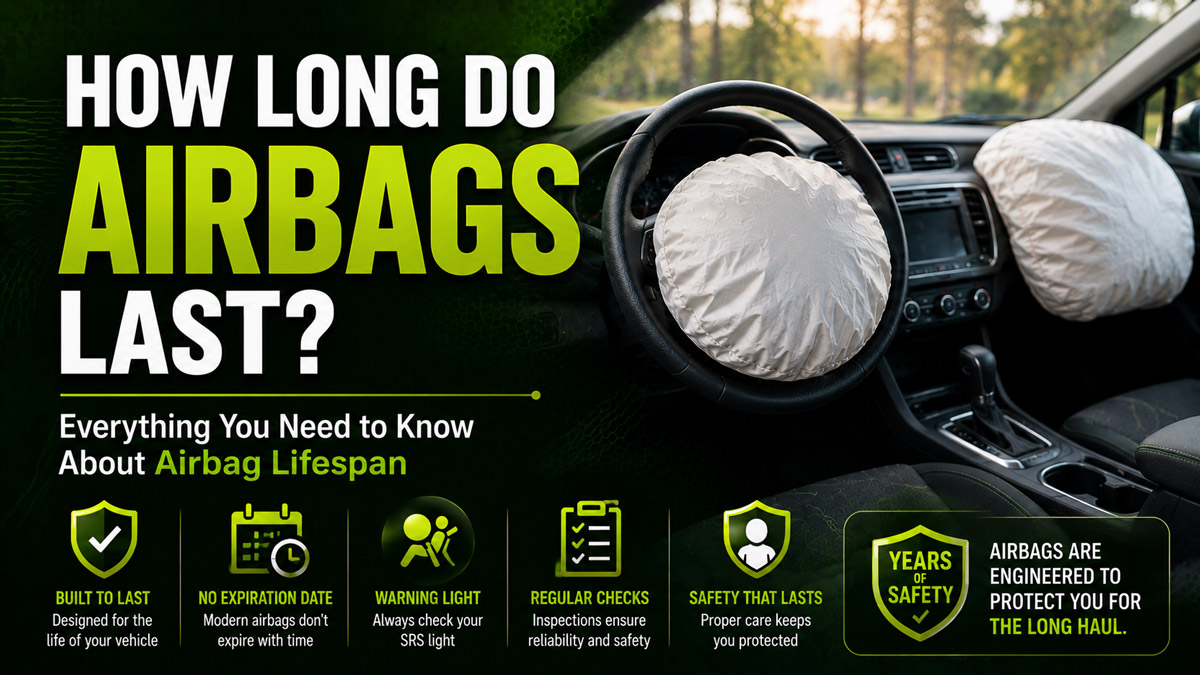
Modern airbags generally last for the lifetime of the vehicle and do not have a fixed expiration date. However, an airbag may require inspection or replacement after deployment, water damage, electrical faults, physical damage, improper repairs, or a manufacturer safety recall.
Key Facts at a Glance
- Most airbags installed in modern vehicles are designed as lifetime components.
- A deployed airbag cannot be reused, repacked, or safely reinstalled.
- An illuminated SRS warning light means the restraint system has detected a fault.
- Airbag age alone usually does not justify replacement in a modern vehicle.
- Flooding, corrosion, collision damage, and recalled inflators can make an airbag unsafe.
- The vehicle identification number should be checked regularly for open safety recalls.
Do Airbags Expire?
Most modern airbags do not expire according to a fixed calendar date. Vehicle manufacturers generally design the airbag module, inflator, crash sensors, wiring, and control unit to remain functional throughout the vehicle’s normal service life.
An airbag is different from a consumable maintenance item such as engine oil, brake pads, or a timing belt. It remains sealed and inactive unless the control system determines that a qualifying crash has occurred.
Some older vehicles included recommendations to inspect or replace airbags after approximately 10 to 15 years. These recommendations were more common when airbag technology was relatively new and manufacturers had less long-term reliability data.
Owners should follow the instructions in the vehicle’s original manual rather than relying only on a general age rule.
How Long Do Modern Airbags Last?
Airbags in most vehicles built from the mid-1990s onward are expected to last as long as the vehicle remains in service. A properly manufactured and undamaged airbag can remain operational for 20, 25, or even 30 years.
The phrase “lifetime component” does not guarantee that every airbag will function forever. It means the airbag normally has no scheduled replacement interval when the system remains undamaged, passes its electronic self-check, and is not affected by a recall.
Airbag reliability depends on more than the fabric cushion. The complete Supplemental Restraint System includes:
- Airbag modules
- Inflators
- Impact sensors
- Seat-belt pretensioners
- Occupant detection sensors
- Steering-wheel clock spring
- Wiring connectors
- Airbag control module
- Backup power supply
A fault in any important component may disable part or all of the system even when the airbag itself is still physically intact.
Do Older Airbags Have a Shorter Lifespan?
Some airbags installed in vehicles from the 1980s and early 1990s were originally assigned inspection or replacement intervals of approximately 10 to 15 years. Early manufacturers were cautious because the long-term performance of inflator seals, propellants, connectors, and diagnostic systems had not yet been established.
Many manufacturers later revised or removed those replacement recommendations after gaining additional durability data. However, instructions vary by manufacturer and model year.
| Vehicle category | Typical guidance | Recommended action |
| Modern vehicle | Usually treated as a lifetime system | Check warning lights and recalls |
| Early airbag-equipped vehicle | May have a 10–15-year inspection recommendation | Review the original manual |
| Classic or collector vehicle | Parts and diagnostic support may be limited | Consult a brand specialist |
| Flood-damaged vehicle | System reliability may be compromised | Obtain a full SRS inspection |
| Previously crashed vehicle | Components may be missing or improperly repaired | Verify the entire restraint system |
Owners of vehicles built before the mid-1990s should contact the manufacturer or an experienced dealership if the original maintenance schedule is unclear.
Why Can an Airbag Last for Decades?
An undeployed airbag remains folded inside a sealed module until it is needed. The inflator is engineered to protect its internal propellant from normal environmental exposure, while the SRS control unit continuously monitors electrical resistance and communication across the system.
When a qualifying crash occurs, impact sensors send information to the airbag control unit. The controller evaluates the crash severity and, when deployment criteria are met, sends an electrical current to the inflator igniter.
Gas rapidly fills the fabric cushion, which emerges from the steering wheel, dashboard, seat, door, or roof rail. The cushion then vents immediately as the occupant contacts it.
This process happens in milliseconds. Once an airbag deploys, the inflator is spent and the module must be replaced.
Can an Airbag Stop Working Without Deploying?
Yes. An airbag system can become inoperative even when none of the airbags has deployed. Electrical faults are among the most common reasons the SRS warning light appears.
Possible faults include:
- Broken steering-wheel clock spring
- Loose connector beneath a front seat
- Damaged crash sensor
- Failed occupant classification sensor
- Low system voltage
- Corroded wiring
- Faulty seat-belt pretensioner
- Internal control-module fault
- Previous collision data stored in the module
- Missing or incorrectly installed components
The vehicle may still start and drive normally while the restraint system is disabled. Normal drivability therefore does not prove that the airbags are operational.
What Does the Airbag Warning Light Mean?
An airbag or SRS warning light that stays illuminated, flashes, or reappears after startup means the control system has detected a fault. Depending on the vehicle, one airbag, several airbags, or the entire Supplemental Restraint System may be unavailable.
During a normal startup sequence, the warning light should illuminate briefly while the system performs a self-check. It should then turn off.
Three startup patterns deserve attention:
- The light stays on: The SRS module has stored an active or historical fault.
- The light flashes: The flashing pattern may represent a manufacturer-specific diagnostic code.
- The light never comes on: The bulb, instrument cluster, or circuit may have been altered to conceal a problem.
A basic engine-code reader may not access airbag faults. Diagnosis usually requires a scan tool that supports the vehicle’s SRS module.
What Can Shorten an Airbag’s Lifespan?
Airbag age is rarely the greatest concern. Damage, contamination, previous repairs, and manufacturing defects are more important.
Water and Flood Damage
Floodwater can corrode sensors, connectors, wiring harnesses, seat components, and the control module. Saltwater exposure is especially destructive because conductive residue can remain after the interior appears dry.
A flood-damaged airbag system should not be judged by the warning light alone. Corrosion can progress gradually and create intermittent faults.
Excessive Moisture and Humidity
High humidity can contribute to inflator degradation when an inflator has a design or sealing defect. This issue became especially important in certain recalled airbag inflators used in hot and humid regions.
Normal humidity does not mean every airbag will fail. The greater concern is whether the vehicle contains a recalled inflator that is vulnerable to moisture-related deterioration.
Collision Damage
A crash can damage sensors, brackets, wiring, seat-belt pretensioners, or the control module without deploying every airbag. Vehicles repaired after moderate or severe collisions require a complete SRS evaluation.
Poor-Quality Repairs
Some vehicles are repaired using resistors that imitate an airbag’s electrical resistance and turn off the dashboard warning light. Others may contain salvage, counterfeit, previously deployed, or incompatible modules.
A warning light that turns off does not prove that the correct components are installed.
Interior Modifications
Seat covers, dashboard mats, phone mounts, wiring modifications, and replacement seats can interfere with deployment areas or occupant sensors. Any component marked “SRS Airbag” should remain unobstructed.
Do Airbags Need Routine Maintenance?
Airbags do not normally require periodic servicing, lubrication, inflation, or chemical replacement. Routine ownership checks focus on the warning light, recalls, interior condition, and evidence of previous collision damage.
Owners should:
- Confirm that the SRS light turns on briefly at startup and then turns off.
- Check the vehicle identification number for open recalls.
- Keep deployment panels free of accessories and thick covers.
- Investigate water leaks near seats, pillars, dashboards, and control modules.
- Have warning lights diagnosed promptly.
- Review the manual for age-related instructions on older vehicles.
Owners should not probe airbag connectors with a standard test light or multimeter unless the manufacturer’s service procedure specifically permits it. Incorrect testing can damage components or trigger deployment.
Should Airbags Be Replaced Because of Age Alone?
Modern airbags should not normally be replaced solely because the vehicle has reached a particular age. Replacement is justified when the manufacturer specifies an interval, the module is recalled, a diagnostic fault confirms failure, or the system has been damaged.
Unnecessary replacement introduces its own risks. Airbag work requires correct components, torque specifications, wiring procedures, battery-disconnection steps, static-electricity precautions, and manufacturer scan-tool functions.
For an older vehicle with no warning light and no open recall, a professional inspection is usually more appropriate than automatically replacing every airbag.
When Must an Airbag Be Replaced?
An airbag or related component should be replaced when:
- The airbag has deployed.
- The module or cover is physically damaged.
- The vehicle manufacturer requires replacement.
- A recall calls for inflator or module replacement.
- Water or fire has contaminated the unit.
- Diagnostic testing identifies an internal failure.
- The wrong airbag was installed during a previous repair.
- Wiring or connectors cannot be restored to manufacturer standards.
A deployed airbag cannot be folded back into the dashboard or steering wheel. Its inflator has already completed its one-time chemical reaction, and the cushion, seams, cover, and housing may have experienced extreme heat and force.
How Much Does Airbag Replacement Cost?
Replacing one airbag commonly costs several hundred to several thousand dollars after parts, labor, diagnostics, programming, and related trim repairs are included. Complete restoration after a serious crash can cost approximately $1,500 to more than $6,000.
Typical cost categories include:
| Repair | Typical range |
| Individual airbag module | $200–$1,500+ |
| Professional labor | $100–$500+ |
| Steering-wheel clock spring | $200–$600 |
| Crash sensor | $150–$500 |
| Seat-belt pretensioner | $150–$500 each |
| Dashboard replacement | $1,000–$3,000+ |
| Complete post-crash SRS restoration | $1,500–$6,000+ |
Vehicle brand, airbag position, parts availability, dashboard construction, programming requirements, and the number of deployed restraints can change the final cost substantially.
A manufacturer recall repair is normally completed at no cost to the vehicle owner.
How Can You Check Whether an Airbag Was Recalled?
Use the vehicle’s 17-character vehicle identification number to check the manufacturer’s recall portal or the official government recall database in the country where the vehicle is registered.
A model-level search is not always enough. Two visually identical vehicles may contain different inflators because of production dates, assembly plants, previous recall repairs, or replacement-part histories.
An open recall should be completed promptly. Recall repairs may involve replacing only the inflator rather than the entire visible airbag assembly.
How Should Used-Car Buyers Inspect the Airbags?
A used-car buyer should verify the SRS startup sequence, recall status, collision history, seat-belt condition, dashboard panels, steering wheel, seats, and interior trim.
During inspection:
- Turn the ignition on without immediately starting the engine.
- Confirm that the SRS light illuminates.
- Start the vehicle and verify that the light turns off.
- Look for uneven dashboard seams or mismatched trim.
- Check whether steering-wheel and seat airbag covers appear original.
- Inspect seat belts for locked, frayed, or replaced components.
- Check the VIN for incomplete recalls.
- Request an SRS scan before purchasing a previously crashed vehicle.
A clean history report does not guarantee that the vehicle has never been damaged. Independent physical inspection remains important.
Is It Safe to Drive With the Airbag Light On?
Driving with the airbag light on is not considered safe because the system may not protect occupants as designed during a crash. The vehicle may remain mechanically drivable, but that is different from having a fully functional restraint system.
The warning should be diagnosed as soon as practical. Seat belts must still be worn because airbags are supplemental restraints, not replacements for seat belts.
Disconnecting the battery or erasing the code does not repair the underlying fault. The light will usually return when the module detects the same problem again.
Expert Insights About Airbag Lifespan
System Condition Matters More Than Calendar Age
A 20-year-old vehicle with an intact, recall-free SRS may be safer than a five-year-old vehicle with flood damage or poor collision repairs. Vehicle history and diagnostic condition are stronger indicators than age alone.
A Dark Warning Light Can Be Suspicious
Buyers often focus on a light that stays on, but a light that never illuminates may indicate tampering. The startup bulb check is one of the fastest ways to identify a potentially concealed problem.
“No Codes” Does Not Always Mean “Original Airbags”
Electrical resistors can imitate the expected resistance of an airbag circuit. A professional inspection may need to combine scan data with physical verification of modules, connectors, part numbers, and previous repair work.
The Bottom Line
How long do airbags last? Most modern airbags are designed to last for the entire service life of the vehicle and do not require scheduled replacement based on age alone.
Replacement becomes necessary after deployment, confirmed component failure, water or fire damage, physical damage, improper repair, or a safety recall. Owners should monitor the SRS warning light, keep deployment areas unobstructed, check recalls by VIN, and arrange professional diagnosis whenever the system reports a fault.
Frequently Asked Questions
Can a 20-year-old airbag still work?
Yes. A 20-year-old airbag may remain functional when the vehicle has no open recall, water damage, warning light, collision damage, or improper previous repairs. Modern airbags are generally designed as lifetime components, but the complete SRS should be evaluated if warning signs appear.
Can an airbag be tested without deploying it?
An airbag module cannot be functionally deployed as a test and then reused. Technicians evaluate the system through fault codes, circuit measurements permitted by the manufacturer, connector inspections, module communication, recall status, and physical condition.
Do airbags need to be replaced after a minor accident?
Not automatically. Airbags that did not deploy may remain usable, but sensors, wiring, seat-belt pretensioners, and the control module should be inspected when the collision was strong enough to damage the vehicle’s structure or restraint components.
Does disconnecting the battery reset the airbag light?
Disconnecting the battery may temporarily remove some warning conditions, but it does not repair an active SRS fault. Many airbag codes remain stored in nonvolatile memory and require an SRS-capable diagnostic scanner after the underlying problem has been corrected.
Can airbags be replaced with used parts?
Used airbag parts may have an unknown storage, crash, moisture, recall, or handling history. Regulations vary by location, but new manufacturer-approved components are generally the safest choice. Counterfeit or incorrectly matched airbags can fail to deploy or rupture dangerously.
Will airbags still work if the battery is damaged in a crash?
Airbag control systems commonly include stored backup electrical energy so the system can deploy during the first moments of a crash even if normal battery power is interrupted. Backup capacity is limited and does not guarantee deployment when the SRS already has an active fault.