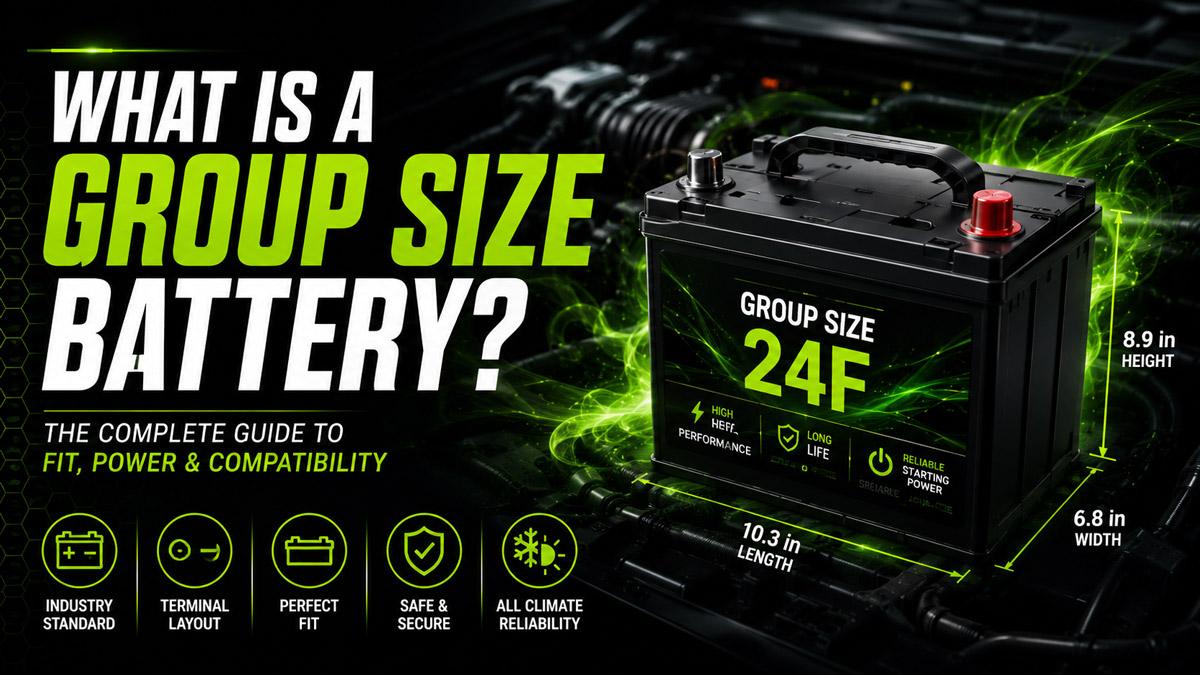
A group size battery is a battery classified by an industry-standard code describing its physical dimensions, terminal position, and mounting configuration. The group number helps ensure the battery fits the vehicle tray, remains securely clamped, clears surrounding components, and connects to the positive and negative cables without stretching or crossing them.
At a Glance
- Battery group size primarily describes physical fit, terminal layout, and mounting design.
- Group size does not directly specify cold-cranking amps or reserve capacity.
- Batteries with similar dimensions may still differ in polarity, base flanges, venting, and post height.
- A higher CCA rating is usually acceptable, but the required battery chemistry must still match.
- Start-stop vehicles commonly require an AGM or EFB battery rather than a standard flooded battery.
- Some modern vehicles require battery registration after replacement.
What Does a Battery Group Size Tell You?
A battery group size identifies the battery’s approximate length, width, height, terminal arrangement, and hold-down configuration. Battery Council International, commonly called BCI, publishes the group-number system widely used for automotive batteries in North America.
The designation answers several fitment questions:
- Will the battery sit inside the factory tray?
- Will the battery clear the hood, seat, trunk panel, or nearby electronics?
- Are the positive and negative posts located where the cables can safely reach?
- Does the case include the correct bottom flange or top-bar mounting points?
- Are the terminals the correct height and type?
For example, Group 35 and Group 24F batteries are both common in Japanese vehicles, but a Group 24F is approximately one inch longer. A vehicle may have enough tray space for both, yet the factory hold-down may secure only one correctly.
Professionals therefore treat group size as a fitment specification, not merely a rough measurement. A battery that sits in the tray but cannot be firmly clamped is not a correct fit.
Does Group Size Determine Battery Power?
No. Battery group size does not directly determine cold-cranking amps, reserve capacity, or amp-hour capacity. Group size describes the battery’s case and connection layout, while performance ratings describe what the battery can deliver.
The main performance specifications are:
- CCA: Cold-cranking amps measure starting output at 0°F, or approximately −18°C.
- CA: Cranking amps measure output at 32°F, or 0°C.
- Reserve capacity: The number of minutes a battery can provide a specified electrical load before voltage falls below a defined level.
- Amp-hours: A capacity measurement more commonly emphasized for deep-cycle and auxiliary batteries.
Larger battery cases often have room for more lead plates, so a physically larger group may offer higher CCA or reserve capacity. That relationship is common but not guaranteed.
For example, one Group 48 AGM battery may provide 760 CCA, while another Group 48 battery provides 850 CCA. Both share the same basic fitment designation but have different internal construction and performance.
Always verify group size and electrical ratings separately.
What Do F and R Mean in Battery Sizes?
The letters F and R usually distinguish case or terminal arrangements within a battery family. An R commonly means the positive and negative terminals are reversed relative to the standard version.
A Group 51 and Group 51R may have nearly identical dimensions, but the positive post is positioned on the opposite side. The same warning applies to batteries such as Group 34 and 34R.
Group 24 and 24F also have different terminal layouts, although suffix conventions are not perfectly uniform across every battery family. The safest method is to compare the positive-post location while viewing the battery from the same orientation specified by the manufacturer.
Installing the wrong polarity layout can create three problems:
- The factory cables may not reach.
- A stretched cable may rub against metal and eventually short.
- Reversing the actual electrical connections can damage control modules, alternator diodes, fuses, and wiring.
Never rotate a battery merely to make the terminals line up unless the tray, venting, hold-down, and cable routing were designed for that orientation.
What Are the Most Common Battery Group Sizes?
Common automotive battery group sizes include 24F, 35, 51R, 48/H6, 94R/H7, and 65. The correct application varies by model year, engine, trim, climate package, and factory equipment.
| Group size | Approximate dimensions | Common uses | Important detail |
|---|---|---|---|
| 24F | 10.3 × 6.8 × 8.9 in. | Toyota, Honda, Acura, Lexus | Common Japanese fitment with specific terminal orientation |
| 35 | 9.1 × 6.9 × 8.9 in. | Subaru, Nissan, Mazda, Toyota | Shorter than Group 24F |
| 51R | 9.4 × 5.1 × 8.8 in. | Honda Civic, CR-V, Mazda | Narrow case with reversed terminals |
| 48 / H6 | 10.9 × 6.9 × 7.5 in. | BMW, Volkswagen, Ford, Chevrolet | European-style low-profile case |
| 94R / H7 | 12.4 × 6.9 × 7.5 in. | European cars, SUVs, light trucks | Longer than H6 |
| 49 / H8 | 13.9 × 6.9 × 7.5 in. | Large European luxury vehicles | Higher capacity and greater weight |
| 65 | 12.1 × 7.5 × 7.6 in. | Ford trucks, SUVs, some Jeeps | Wide, low-profile top-post design |
These measurements are approximate. Manufacturers may make cases slightly smaller than the maximum group envelope, and features such as handles, vent caps, and terminal covers can affect clearance.
Are Group 48 and H6 Batteries the Same?
Yes. Group 48 and H6 usually refer to the same basic battery size and are commonly treated as equivalent fitments. Group 48 is the BCI designation, while H6 is a European DIN-style size name.
Other common equivalents include:
| BCI designation | European designation |
|---|---|
| Group 48 | H6 or L3 |
| Group 94R | H7 or L4 |
| Group 49 | H8 or L5 |
Physical equivalence does not guarantee that every battery is interchangeable. Check the following before replacing a Group 48 with an H6:
- AGM, EFB, or flooded chemistry
- Cold-cranking-amp requirement
- Vent-port location
- Bottom hold-down flange
- Terminal type and polarity
- Battery-management-system coding requirements
A BMW designed for an H6 AGM battery should not receive a flooded Group 48 merely because the case dimensions match. The flooded battery may fit physically but perform poorly under the vehicle’s charging strategy.
How Do You Find the Correct Battery Group Size?
Find the correct group size by checking the owner’s manual, the existing battery label, and a vehicle-specific fitment guide. Confirm the result using the vehicle’s year, make, model, engine, trim, and start-stop equipment.
Use this process:
- Read the owner’s manual. Look under battery replacement, specifications, or maintenance.
- Inspect the existing battery label. Group codes may appear as 35, 51R, 48, H6, H7, or another designation.
- Use a fitment database. Enter the complete vehicle information, including engine size.
- Check the terminal orientation. Confirm which side contains the positive terminal.
- Inspect the hold-down. Determine whether the battery uses a top bar, side clamp, or bottom flange.
- Confirm the chemistry. Match flooded, enhanced flooded, or AGM technology.
- Verify electrical ratings. Meet or exceed the manufacturer’s minimum CCA and reserve-capacity requirements.
The existing battery is not always reliable evidence. A previous owner may have installed an undersized or incorrect replacement. The vehicle specification should take priority over the battery currently in the tray.
Can Two Batteries Have the Same Dimensions but Not Fit?
Yes. Two batteries can have nearly identical dimensions and still be incompatible because of terminal placement, bottom flanges, vent connections, post height, or hold-down design.
European vehicles frequently secure batteries using molded rails near the bottom of the case. A replacement battery may fit inside the tray but lack the correct base ledge for the retaining clamp. Without that flange, the battery can move during braking or cornering.
Other hidden fitment differences include:
- A vent port on the wrong side
- Standard posts instead of recessed posts
- Positive and negative terminals reversed
- A case lip that interferes with the factory bracket
- Terminals tall enough to contact a metal cover
- Missing threads for a vehicle-specific mounting system
The expert rule is simple: a battery is not correctly fitted until it can be securely fastened using the original hold-down hardware.
Measure dimensions when necessary, but verify the complete case configuration rather than shopping by length, width, and height alone.
What Happens If You Install the Wrong Group Size?
Installing the wrong battery group size can cause loose mounting, cable strain, electrical shorts, damaged terminals, hood contact, vibration damage, or unreliable starting. The severity depends on how the replacement differs from the specified battery.
A battery that is too tall may allow the positive terminal to touch the hood or a metal brace. That contact can produce a direct short circuit capable of melting wiring, damaging electronics, or starting a fire.
A battery that is too small may move inside the tray. Repeated vibration can damage internal plates, crack the case, loosen terminals, and shorten battery life. A loose battery is also more likely to leak during a collision.
Wrong terminal placement can force cables across the case or leave them under tension. Battery cables should reach naturally without pulling, twisting, or rubbing against sharp metal.
The safest response to a poor fit is to stop installation and obtain the specified group. Do not compensate with improvised wood blocks, foam, zip ties, or an unsecured spacer.
Can You Put a Bigger Battery in Your Car?
Yes, a larger battery can sometimes be installed if the tray, hold-down, cable routing, terminal clearance, charging system, and manufacturer specifications support it. Extra physical space alone does not make the upgrade safe.
A larger battery may provide:
- More reserve capacity
- Higher available CCA
- Better support for accessories
- Greater tolerance for short trips or cold starts
However, the larger case may be too tall for the hood, too long for the tray, or too heavy for the original bracket. The positive terminal must remain protected from nearby metal.
A common example is upgrading from Group 35 to Group 24F in a vehicle with an extended tray and compatible hold-down. The upgrade may add reserve capacity, but only when the cable positions and bracket adjustment match.
The alternator does not normally struggle merely because a battery has higher capacity. The more important questions are whether the battery chemistry matches the charging system and whether the battery can be mounted securely.
Can You Use a Smaller Battery Temporarily?
A smaller battery should be used only as a short-term emergency measure when it can be firmly secured, has the correct polarity, meets the minimum starting requirement, and does not interfere with cable routing. An unsecured undersized battery should not be driven.
A smaller case may have lower CCA and reserve capacity. The engine may start normally in warm weather but fail after a cold night or after several short trips. Vehicles with heated seats, electric steering, large audio systems, or start-stop operation are especially sensitive to reduced capacity.
Temporary installation does not excuse an incorrect hold-down. The battery must remain immobile under acceleration, braking, and cornering.
A Group 34 battery, for example, is shorter than some similarly sized alternatives and may require a manufacturer-supplied height adapter. Removing that spacer can leave a top-mounted bracket loose.
Replace the temporary battery with the specified group as soon as practical. A battery that starts the engine once is not necessarily suitable for daily service.
Can You Use a Battery With Higher CCA?
Yes. A replacement battery can generally have a higher CCA rating than the vehicle’s minimum specification. The starter draws only the current it needs; the battery does not force excessive amperage into the starter.
For example, replacing a 600-CCA battery with an 760-CCA battery of the correct group size and chemistry is normally acceptable. The higher rating can improve cold-weather starting and provide more margin as the battery ages.
Avoid going below the manufacturer’s minimum CCA. An undersized battery may crank slowly, produce voltage drops that trigger electronic faults, and fail during cold weather.
Higher CCA should not be used to justify the wrong battery type. A high-CCA flooded battery is not necessarily an appropriate replacement for an AGM battery in a start-stop vehicle.
The practical priority is:
- Correct group size and terminal arrangement
- Correct battery chemistry
- Required venting and mounting
- Minimum CCA and reserve capacity
- Higher CCA as an optional upgrade
More CCA is beneficial only after the essential fitment and technology requirements are satisfied.
Does a Start-Stop Vehicle Need an AGM Battery?
A start-stop vehicle must use the battery technology specified by the manufacturer, commonly AGM or EFB. A standard flooded battery may physically fit but can fail prematurely because it is not designed for frequent engine restarts and deep cycling.
Start-stop systems may restart the engine dozens of times during one urban trip. They also power lighting, climate controls, infotainment, pumps, and control modules while the engine is off.
An AGM battery generally offers stronger cycle resistance, low internal resistance, and good charge acceptance. An EFB battery is an enhanced flooded design used in some less demanding start-stop systems.
Do not downgrade an AGM application to EFB or conventional flooded technology unless the vehicle manufacturer explicitly permits it. An EFB-to-AGM upgrade may be acceptable in some applications, but charging-system compatibility and battery registration should be confirmed.
A conventional battery installed in an AGM application may appear normal initially yet lose capacity within months. The mistake is common because the group number matches even though the internal technology does not.
Does a New Battery Need to Be Registered?
Some modern vehicles require battery registration or adaptation after installation. Registration tells the battery-management system that a new battery has been fitted and may also record its capacity and chemistry.
Battery registration is common on various BMW, Audi, Volkswagen, Mercedes-Benz, Ford, Jaguar, Land Rover, and other electronically managed vehicles. Requirements differ by model and year.
Without registration, the vehicle may continue using a charging strategy calculated for the old, aged battery. Possible consequences include:
- Chronic overcharging or undercharging
- Reduced battery lifespan
- Incorrect start-stop operation
- Battery warning messages
- Energy-management faults
Replacing a battery with the same capacity and chemistry may require only a reset. Changing from flooded to AGM or changing amp-hour capacity may require additional coding.
Registration normally requires a compatible scan tool or professional diagnostic system. Check the service information before disconnecting the old battery, because some vehicles also need backup power or relearning procedures for windows, steering, or other systems.
Do Electric Vehicles Use Group Size Batteries?
Electric vehicles may use a conventional BCI or DIN group size for the low-voltage auxiliary battery, but the high-voltage traction battery is not classified by ordinary automotive group size.
The 12-volt auxiliary battery powers computers, relays, locks, lights, safety systems, and the electronics needed to activate the high-voltage system. Depending on the vehicle, the auxiliary battery may be lead-acid, AGM, or lithium-ion.
The traction battery is a large manufacturer-specific pack measured in kilowatt-hours, such as 60 kWh or 80 kWh. It is not replaced by selecting a Group 35, H6, or 51R battery.
Hybrid vehicles follow a similar distinction. A hybrid may have a high-voltage propulsion battery plus a smaller 12-volt battery with a recognizable automotive size.
Owners should use a vehicle-specific fitment source because electric-vehicle auxiliary batteries may have unusual venting, terminal, software, or chemistry requirements even when the physical case resembles a familiar group.
How Much Does Group Size Affect Price and Lifespan?
Battery group size can affect price by approximately $20 to more than $100, but chemistry, brand, warranty, CCA, and reserve capacity usually have a greater influence. Larger batteries contain more material and are generally heavier, which can increase cost.
A conventional flooded automotive battery may cost roughly $100 to $220, while a comparable AGM battery may cost about $180 to $400 or more. Vehicle-specific European and luxury-car batteries can exceed those ranges.
Group size alone does not determine lifespan. Typical service life is often:
- Flooded lead-acid: approximately 3–5 years
- AGM: approximately 4–7 years under suitable conditions
- EFB: commonly between standard flooded and AGM performance
Heat, undercharging, vibration, deep discharge, short-trip driving, and parasitic drains can shorten those ranges substantially.
A physically larger battery may offer greater reserve capacity, but it will not necessarily last longer if it is mismatched to the charging system. Correct chemistry and proper charging have more influence on longevity than simply choosing the largest case that fits.
Should You Match Size, CCA, or Chemistry First?
Match the complete physical fit and required battery chemistry first, then meet or exceed the manufacturer’s CCA and capacity specifications. No single specification should be considered in isolation.
Use this replacement hierarchy:
- Application approval: Confirm the battery is listed for the exact vehicle.
- Physical group: Match dimensions, terminals, hold-down, and venting.
- Chemistry: Use the specified flooded, EFB, AGM, or lithium design.
- Electrical output: Meet the minimum CCA and reserve capacity.
- Software requirements: Register or code the battery when required.
- Optional upgrade: Choose higher CCA or capacity within approved limits.
The mistake professionals see most often is buying solely by CCA. A powerful battery with reversed terminals or the wrong mounting flange is still the wrong battery.
The second common mistake is buying solely by group number. A flooded Group 48 and an AGM H6 may occupy the same space but behave differently in a start-stop charging system.
The Bottom Line
A battery group size is an industry designation for a battery’s dimensions, terminal layout, and mounting configuration. The correct group helps the battery fit securely and connect safely, but it does not by itself guarantee the correct CCA, capacity, chemistry, or vehicle compatibility. Always verify terminal polarity, hold-down design, battery technology, and manufacturer specifications. Modern vehicles may also require vent connections and electronic battery registration after replacement.