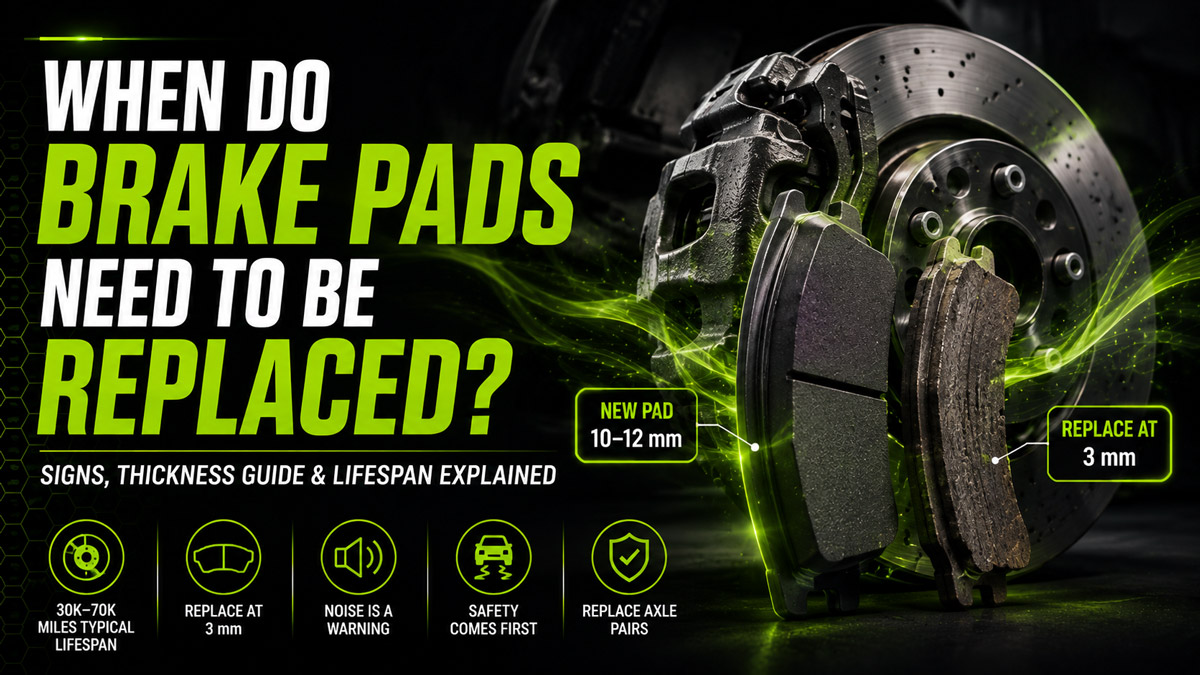
Brake pads need to be replaced when their friction material reaches approximately 3 millimeters, when a wear indicator activates, or when braking symptoms show that safe stopping performance is deteriorating. Most brake pads last 30,000 to 70,000 miles, but thickness and condition are more reliable replacement measures than mileage alone.
Key Facts at a Glance
- New passenger-vehicle brake pads commonly measure about 10 to 12 mm thick.
- Brake-pad replacement should usually be scheduled when material reaches 3 to 4 mm.
- Pads at approximately 2 mm or less require immediate replacement.
- Grinding often means the friction material is gone and the backing plate is contacting the rotor.
- Brake pads are normally replaced in axle pairs, not one wheel at a time.
- Driving style, vehicle weight, terrain, pad material, and caliper condition determine actual service life.
At What Thickness Should Brake Pads Be Replaced?
Brake pads should generally be replaced at 3 mm of remaining friction material. At 4 mm, replacement is not always immediately necessary, but the pads should be monitored and service should be planned.
A practical thickness guide is:
| Remaining Material | Condition | Recommended Action |
| 8–12 mm | Good or nearly new | Continue normal inspections |
| 5–7 mm | Serviceable | Recheck during routine maintenance |
| 4 mm | Wearing low | Plan replacement soon |
| 3 mm | Replacement threshold | Schedule service promptly |
| 2 mm or less | Critically worn | Replace immediately |
| No material visible | Metal-on-metal | Stop driving and repair the brake system |
These figures apply to the friction material, not the total thickness of the pad and steel backing plate.
Some manufacturers specify a different minimum thickness. The vehicle service manual or manufacturer specification takes priority over a general rule.
How Long Do Brake Pads Normally Last?
Brake pads commonly last 30,000 to 70,000 miles, although some wear out in less than 25,000 miles and others remain usable beyond 80,000 miles. The broad range exists because brake-pad wear depends more on operating conditions than calendar age.
For a driver covering 10,000 to 14,000 miles annually, a typical set may last approximately three to seven years. Mileage should never override a physical inspection.
What Shortens Brake-Pad Life?
Brake pads wear faster under conditions that generate frequent friction and heat:
- Stop-and-go city traffic
- Aggressive or late braking
- Mountain or downhill driving
- Towing trailers or carrying heavy loads
- Oversized wheels and tires
- Performance driving
- Sticking calipers or seized slide pins
- Poor-quality friction material
- Driving with one foot resting on the brake pedal
A delivery vehicle operating in dense traffic may consume pads far sooner than a commuter vehicle driven mostly on open highways.
Can Brake Pads Last More Than 70,000 Miles?
Yes. Brake pads can exceed 70,000 miles when the vehicle is driven gently on highways or uses regenerative braking.
Hybrid and electric vehicles often use their electric motors to slow the vehicle before the friction brakes engage. This can greatly extend pad life. However, low usage can create rust, stuck hardware, or uneven pad contact, so the brakes still require regular inspection.
What Are the Signs That Brake Pads Need Replacement?
The most reliable signs are low measured thickness, a dashboard warning, a wear-indicator noise, or evidence that the pad material has worn away. Changes in noise or braking behavior should be inspected promptly because several brake-system faults can produce similar symptoms.
1. Squealing or Screeching
A persistent high-pitched squeal may come from a mechanical wear indicator touching the rotor when the pad becomes thin.
Not every squeal proves that the pads are worn. Moisture, surface rust, glazing, dust, poor hardware, or certain pad compounds can also create noise. Thickness must be checked before making a replacement decision.
2. Grinding During Braking
Grinding is an urgent warning. It often means the friction material has worn away and the steel backing plate is cutting into the rotor.
Continued driving can:
- Deeply score the rotor
- Overheat the caliper
- Extend the caliper piston too far
- Increase stopping distance
- Turn a pad replacement into a larger brake repair
A vehicle producing a harsh metal-on-metal grinding noise should be driven as little as possible and inspected immediately.
3. A Brake-Pad Warning Light
Some vehicles use electronic wear sensors embedded in one or more pads. When the material wears to the sensor, the dashboard displays a brake-pad warning.
The sensor usually needs replacement along with the pads. A warning may remain active after service if the sensor, wiring, or service-reset procedure is overlooked.
4. Longer Stopping Distance
Worn, overheated, glazed, or contaminated pads may require more distance to stop the vehicle. The pedal may feel normal even though braking friction has declined.
Longer stopping distance can also result from tire problems, brake-fluid degradation, rotor damage, hydraulic faults, or brake fade. It should not be diagnosed from pad thickness alone.
5. Vibration or Pulsation
Brake-pedal or steering-wheel vibration usually points more strongly toward rotor thickness variation, uneven pad deposits, loose suspension parts, or wheel problems than simple pad wear.
The pads should still be inspected because damaged rotors can wear them unevenly. Installing new pads on a severely grooved or distorted rotor may cause the symptoms to return quickly.
6. The Vehicle Pulls While Braking
A vehicle that pulls to one side may have uneven pad wear, a sticking caliper, restricted brake hose, contaminated friction material, or tire and alignment problems.
Replacing the pads without correcting the underlying cause allows the new set to wear unevenly again.
7. Visible Thin Pads
Many wheel designs allow part of the outer pad to be seen through the spokes. If the friction material appears to be around 3 mm thick, a complete inspection should be scheduled.
The visible outer pad does not reveal the entire condition. The inner pad may wear faster when the caliper piston, slide pins, or mounting hardware are not operating correctly.
Do Front Brake Pads Wear Faster Than Rear Pads?
Front brake pads usually wear faster because weight transfers toward the front of the vehicle during braking. The front brakes may handle roughly 60% to 80% of the braking load, depending on vehicle design and driving conditions.
However, rear pads can wear first on vehicles that use:
- Rear-biased electronic stability control
- Automatic emergency braking
- Adaptive cruise control
- Electronic parking brakes
- Aggressive traction-control intervention
- Small rear pads
- Sticking rear calipers
Never assume the front pads need replacement solely because they are older. Measure all four corners.
Should All Four Brake Pads Be Replaced Together?
Brake pads should normally be replaced as a complete set on the same axle. This means replacing both front wheels or both rear wheels together.
Replacing only one wheel can create differences in friction, bedding, wear rate, and braking force. It may cause pulling or unstable braking.
The front and rear axles do not always need service at the same time. For example, replacing the front pads while leaving serviceable rear pads installed is normal.
How Often Should Brake Pads Be Inspected?
Brake pads should be inspected at least once a year or approximately every 10,000 to 12,000 miles. Inspection during tire rotations is convenient because wheel removal allows the inner and outer pads to be examined properly.
Drivers should use shorter inspection intervals when the vehicle:
- Operates in heavy urban traffic
- Tows or carries heavy loads
- Travels through mountainous areas
- Has previously experienced uneven wear
- Uses performance brakes
- Sits unused for long periods
- Produces new braking noises or pedal changes
An inspection should include pad thickness, rotor condition, caliper movement, slide pins, brake hoses, fluid condition, dust boots, hardware, and signs of leakage.
How Is Brake-Pad Thickness Measured?
Brake-pad thickness can be checked with a dedicated brake gauge, ruler, vernier caliper, or visual inspection. The most accurate inspection usually requires wheel removal.
Measure only the usable friction material. Do not include the steel backing plate.
A proper inspection compares:
- Inner pad with outer pad
- Left wheel with right wheel
- Front axle with rear axle
- Top of the pad with bottom of the pad
Large differences suggest a mechanical problem. For example, a thin inner pad and thick outer pad may indicate a caliper piston or slide-pin issue.
Can You Rely on the Wear Indicator Alone?
No. A wear indicator is a useful warning device, but it should not replace scheduled inspection.
Mechanical indicators may be fitted to only one pad or wheel. Electronic sensors can fail, break, become disconnected, or activate only after the pad reaches a predetermined limit.
Uneven wear can also destroy an unmonitored pad while the sensor-equipped pad still appears serviceable.
Do Brake Pads Expire With Age?
Brake pads do not have a universal expiration date once installed, but age and storage conditions can affect the braking system.
Pads may remain thick yet become unsuitable because of:
- Friction-material separation
- Oil or brake-fluid contamination
- Severe glazing
- Cracking
- Corroded backing plates
- Uneven contact caused by rust
- Seized caliper hardware
Vehicles that sit for long periods may experience more corrosion than friction wear. Condition matters as much as thickness.
Which Type of Brake Pad Lasts Longest?
Ceramic brake pads commonly provide long, quiet service in normal passenger vehicles, but no material is best for every application.
| Pad Type | Typical Strengths | Main Drawbacks | Best Application |
| Ceramic | Quiet, low dust, stable daily performance | Higher price; not ideal for every heavy-duty use | Commuters and passenger cars |
| Semi-metallic | Strong bite and heat control | More noise and dust; can wear rotors faster | Trucks, towing, performance use |
| Organic or NAO | Quiet and inexpensive | Faster wear and lower heat capacity | Light vehicles and budget repairs |
| Low-metallic NAO | Good braking and heat transfer | More dust and noise than ceramic | Mixed city and highway driving |
The correct replacement should meet the vehicle manufacturer’s friction rating, dimensions, and intended operating conditions. Choosing the longest-lasting material without considering braking balance, heat range, and rotor compatibility can reduce performance.
Do Rotors Need to Be Replaced With Brake Pads?
Rotors do not automatically need replacement every time the pads are changed. They must be measured and inspected.
A rotor may need replacement when it is:
- Below the manufacturer’s minimum thickness
- Deeply scored
- Cracked or heat-spotted
- Severely rusted
- Producing unacceptable thickness variation
- Damaged by metal-on-metal contact
- Unable to be resurfaced within specification
New pads need a suitable rotor surface to bed correctly. Reusing a damaged rotor can cause noise, pulsation, poor contact, and premature pad wear.
Some modern rotors are manufactured with less spare material, making replacement more practical than resurfacing.
How Much Does Brake-Pad Replacement Cost?
Professional brake-pad replacement commonly costs $150 to $350 per axle for standard passenger vehicles. Pads and rotors together often cost approximately $300 to $700 per axle, depending on the vehicle, parts, labor rate, and rotor design.
Typical price factors include:
- Vehicle make and model
- Front or rear axle
- Pad material and brand
- Rotor size and construction
- Electronic parking-brake procedures
- Brake sensor replacement
- Caliper or hardware damage
- Local labor rates
- Luxury or performance components
A four-wheel pad-and-rotor service can range from roughly $600 to more than $1,500. Large trucks, European luxury vehicles, carbon-ceramic systems, and performance brakes can cost substantially more.
Is It Safe to Drive With Worn Brake Pads?
Driving should be limited when pads are near 3 mm, and a vehicle with grinding brakes, weakened stopping performance, fluid leakage, severe pulling, or an unsafe pedal should not continue in normal operation.
A few local miles on low but functional pads is different from continuing to drive after metal-on-metal contact begins. There is no dependable mileage allowance once the pads reach the service limit because remaining life changes with traffic, load, speed, and braking frequency.
Arrange immediate inspection when braking safety is uncertain.
How Quickly Can 3 mm Brake Pads Wear Out?
Brake pads with 3 mm remaining may last anywhere from a few hundred to several thousand miles. There is no accurate universal estimate.
A highway driver may consume the remaining material slowly, while a heavy vehicle in stop-and-go traffic can reach the backing plate much sooner. Uneven wear or a sticking caliper can reduce the remaining life to days.
The correct response at 3 mm is to schedule replacement, not calculate the maximum possible driving distance.
What Happens If Brake Pads Are Not Replaced?
Neglected brake pads eventually lose their friction material, allowing the backing plate to contact the rotor. Braking becomes noisier, less predictable, and more expensive to repair.
Possible consequences include:
- Deep rotor damage
- Increased stopping distance
- Excessive brake heat
- Caliper piston damage
- Brake-fluid overheating
- Uneven braking or pulling
- Loss of reliable stopping performance
Replacing pads before metal-on-metal contact protects both safety and the more expensive brake components.
What Does Uneven Brake-Pad Wear Mean?
Uneven wear usually indicates that part of the brake assembly is not moving or releasing properly.
Common patterns include:
- Inner pad thinner than outer pad: piston, slide, or release issue
- Outer pad thinner than inner pad: caliper slide or mounting problem
- One wheel worn faster: sticking caliper, hose restriction, or contamination
- Tapered wear: damaged hardware, misalignment, or caliper movement problem
- One axle wearing unusually fast: vehicle-control strategy, loading, or component sizing
New pads should not be installed until the cause is corrected. Otherwise, the replacement set may fail prematurely.
Can You Replace Brake Pads Yourself?
Brake-pad replacement is possible for an experienced DIYer with the correct tools, lifting equipment, torque specifications, and service information. Brakes are safety-critical, so uncertainty about any step is a reason to use a qualified technician.
A typical service involves:
- Securing the vehicle on rated jack stands
- Removing the wheel
- Inspecting hoses, calipers, pads, and rotors
- Removing and supporting the caliper
- Servicing the bracket and slide pins
- Retracting the piston correctly
- Installing pads and new hardware
- Tightening fasteners to specification
- Pumping the pedal before moving the vehicle
- Checking fluid level and leaks
- Bedding the pads according to manufacturer instructions
Rear electronic parking-brake systems may require a scan tool or manufacturer-specific service mode. Forcing an electronic caliper backward can damage its motor or internal mechanism.
Common Brake-Pad Replacement Mistakes
Replacing Pads Without Inspecting Rotors
New pads cannot correct a rotor that is under specification, deeply grooved, cracked, or badly distorted.
Ignoring Seized Slide Pins
A seized slide pin can keep one pad in contact with the rotor, producing heat and rapid uneven wear.
Applying Grease to Friction Surfaces
Brake lubricant belongs only on approved contact points. Grease on the pad face or rotor can reduce braking friction and ruin the components.
Allowing the Caliper to Hang by Its Hose
The caliper should be supported with a hook or wire. Its weight can damage the flexible brake hose.
Forgetting to Pump the Brake Pedal
The caliper piston remains retracted after installation. The pedal must be pumped until firm before the vehicle moves.
Skipping the Bedding Procedure
Controlled bedding transfers a stable layer of pad material to the rotor. Improper bedding can contribute to noise, poor initial braking, or uneven deposits.
When Do Brake Pads Need to Be Replaced Immediately?
Brake pads need immediate replacement when the material reaches approximately 2 mm, grinding begins, the backing plate contacts the rotor, or braking performance becomes unsafe.
Urgent inspection is also required when:
- The brake pedal sinks or feels unusually soft
- The vehicle pulls severely while braking
- A wheel becomes excessively hot
- Brake fluid leaks
- Smoke or a burning smell comes from a wheel
- The brake warning light appears with pedal changes
- The vehicle takes noticeably longer to stop
These symptoms may involve more than worn pads and should not be treated as a routine maintenance delay.
Frequently Asked Questions
Can Brake Pads Be Replaced at 4 mm?
Yes, brake pads can be replaced at 4 mm, especially before a long trip, towing season, winter driving, or an extended maintenance interval. Four millimeters usually means the pads are approaching the end of their practical life, although immediate replacement may not be necessary when wear is even and braking remains normal.
Is 5 mm a Good Brake-Pad Thickness?
Five millimeters is generally serviceable but partly worn. The pads should be monitored at future inspections. Remaining life depends on the original thickness and recent wear rate, so a technician may compare current measurements with earlier service records to produce a more useful estimate.
Why Do New Brake Pads Sometimes Squeak?
New pads may squeak because they are not fully bedded, the rotor surface is unsuitable, hardware is incorrectly installed, or the pad compound naturally produces more noise. Persistent squeaking should be inspected, especially when accompanied by vibration, pulling, heat, or reduced braking performance.
Can One Brake Pad Wear Faster Than the Others?
Yes. One pad can wear faster because of a sticking caliper piston, seized slide pin, damaged hardware, restricted hose, misalignment, or corrosion. Replacing the pads without repairing the mechanical cause usually results in the same uneven pattern appearing on the new set.
Does the Brake Warning Light Mean the Pads Are Worn?
Not always. A dedicated pad-wear light may indicate worn pads, but a general red brake warning light can also indicate low brake fluid, an engaged parking brake, a hydraulic fault, or another serious condition. Check the owner’s manual and inspect the system rather than assuming the pads are the only cause.
Should Brake Fluid Be Changed With the Pads?
Brake fluid does not have to be replaced every time the pads are changed. It should be serviced according to the manufacturer’s interval or when testing shows excessive moisture or contamination. Opening the hydraulic system, replacing a caliper, or correcting a fluid-related fault may also require bleeding or fluid replacement.
The Bottom Line
Brake pads should be replaced when they reach approximately 3 mm, produce a wear warning, develop unsafe symptoms, or show damage that compromises braking. Although most pads last 30,000 to 70,000 miles, measured thickness, wear pattern, rotor condition, and braking behavior provide a more dependable answer than mileage alone.
Inspect the pads at least annually or around every 10,000 to 12,000 miles, replace them in axle pairs, and correct any caliper or rotor problem that caused abnormal wear. Early replacement protects stopping performance and prevents a relatively simple pad service from becoming a costly rotor or caliper repair.