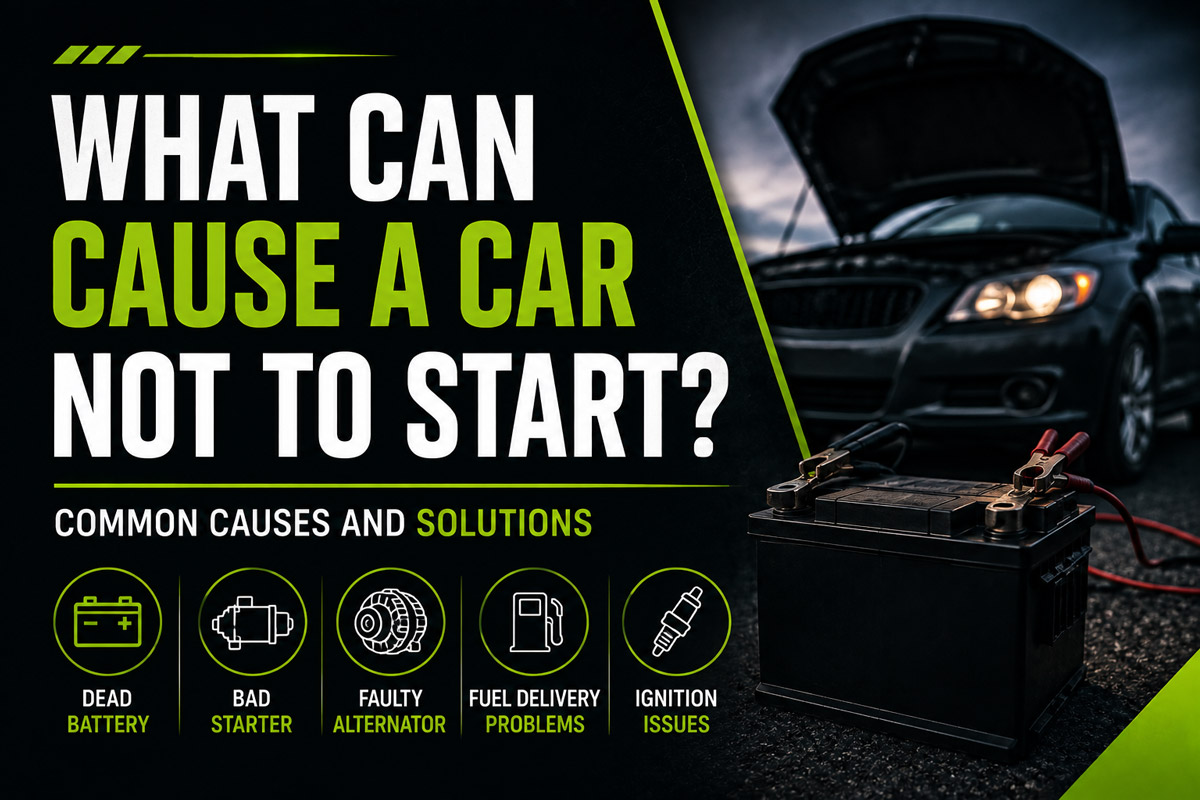
A car failing to start is most commonly caused by electrical issues like a dead 12-volt battery, a failing starter motor, or a bad alternator. If the engine cranks but will not fire, the cause shifts to fuel delivery failures, ignition system faults, or damaged sensors preventing the combustion cycle.
Key Facts / At a Glance
- Most common culprit: Dead or weak 12-volt batteries account for more than 50% of all “no-start” service calls.
- The sound test: A rapid clicking sound points to low battery voltage, while a single loud click indicates a jammed starter motor.
- Crank vs. No-Crank: If the engine physically turns over (cranks) but won’t run, the battery and starter are functional; the vehicle lacks fuel, spark, or compression.
- Average diagnostic cost: Professional diagnosis for a no-start condition typically costs between $120 and $180, which is usually rolled into the final repair bill.
- Safety warning: Continuously cranking an engine for more than 15 seconds will overheat and permanently damage the starter motor.
The 5 Core Systems Required to Start an Engine
For an internal combustion engine to start and run, five distinct mechanical and electronic systems must synchronize perfectly. A failure in any single system breaks the chain.
- Electrical (The Push): The 12-volt battery powers the starter motor, which physically rotates the engine’s flywheel to begin the cycle.
- Ignition (The Spark): The ignition coils and spark plugs generate high-voltage electricity to ignite the fuel-air mixture (gasoline engines only).
- Fuel (The Feed): The fuel pump pressurizes gasoline or diesel from the tank and pushes it through filters to the fuel injectors.
- Compression (The Squeeze): The engine’s pistons move upward in sealed cylinders to compress the fuel-air mixture, maximizing the explosive force.
- Timing (The Rhythm): The timing belt or chain ensures the engine’s valves open and close in exact synchronization with the pistons’ movements.
Diagnostic Sound Test: What Is Your Car Telling You?
Before opening the hood, the sound a vehicle makes when turning the ignition key or pressing the start button is the single best diagnostic indicator of the underlying failure.
| Sound Heard | Likely Culprit | Mechanical Meaning |
| Rapid Clicking | Weak Battery | The starter solenoid is rapidly engaging and disengaging because the battery voltage is too low to hold it open against its return spring. |
| One Loud Click | Starter Motor | The electrical signal reaches the starter solenoid, but the internal motor is seized or the contacts are burned out. |
| Complete Silence | Battery / Switches | Total power loss, a blown main fuse, or a failed ignition/neutral safety switch blocking the electrical signal. |
| High-Pitched Whirring | Starter / Timing | The starter pinion gear is spinning but failing to engage the flywheel, or the timing belt has snapped, resulting in zero engine compression. |
| Cranking (R-r-r-r) | Fuel / Spark | The starter and battery are perfectly fine. The engine lacks the fuel pressure or ignition spark required to achieve combustion. |
1. Electrical Failures (The Most Common Causes)
Electrical failures prevent the starter motor from turning the engine. These issues account for the vast majority of morning no-start scenarios.
Dead or Weak 12-Volt Battery
A dead battery is the leading cause of a car not starting. Batteries naturally degrade over 3 to 5 years, losing their Cold Cranking Amps (CCA) capacity. Extreme cold slows the chemical reaction inside the battery, while extreme heat degrades the internal lead plates. A parasitic draw—a computer module or light staying on while the car is parked—can drain a healthy battery overnight.
- Symptoms: Rapid clicking, dim dashboard lights, sluggish locks.
- Fix & Cost: Jump-start (temporary). Replacement costs $120–$350.
- Timeframe: 30–60 minutes for replacement.
Faulty Starter Motor
A starter motor is a high-torque electric motor that requires massive amperage to physically spin the heavy engine block. Over thousands of start cycles, the internal carbon brushes wear down, or the gear (Bendix drive) becomes jammed with debris.
- Symptoms: A single, distinct loud click from the engine bay. Dashboard lights remain bright when attempting to start.
- Fix & Cost: Replace the starter assembly. Costs range from $250–$650 depending on engine access.
- Timeframe: 2–4 hours (often requires working under the vehicle).
Failing Alternator
An alternator generates electricity to run the vehicle’s systems and recharge the battery while the engine is running. When an alternator fails, the car runs entirely on battery power until the battery is completely depleted, resulting in a stalled vehicle that will not restart.
- Symptoms: The vehicle dies while driving. A red battery-shaped warning light appears on the dashboard before failure.
- Fix & Cost: Replace the alternator. Costs range from $300–$750.
- Timeframe: 2–4 hours.
Blown Fuses and Bad Relays
Fuses and relays protect electrical circuits from voltage spikes. A burned-out starter relay or fuel pump relay will completely disable the starting sequence, mimicking a catastrophic part failure.
- Symptoms: Complete silence when turning the key, or the engine cranks but the fuel pump makes no humming noise.
- Fix & Cost: Swap the suspected relay with an identical non-essential relay (like the horn relay) in the fuse box. Replacement relays cost $10–$30.
2. Fuel and Air Issues (Engine Cranks But Won’t Start)
When the battery and starter are working normally (the engine goes “R-r-r-r”), the vehicle is missing the combustible materials required to run.
Fuel Pump Failure
The fuel pump is submerged in the gas tank and pushes fuel forward to the engine. These electric motors burn out over time, especially if the vehicle is frequently driven with less than a quarter tank of gas (the fuel acts as a coolant for the pump).
- Symptoms: The engine cranks endlessly. No faint “humming” sound from the rear of the car when the key is turned to the “ON” position.
- Fix & Cost: Replace the fuel pump assembly. Costs range from $1,100–$1,300, as it often requires removing the entire fuel tank.
Clogged Fuel Filter
A fuel filter traps dirt and rust before it reaches the engine. If neglected for over 60,000 miles, the filter becomes so restricted that the fuel injectors cannot deliver enough pressure to atomize the gasoline.
- Symptoms: Hard starting, hesitation during acceleration prior to the no-start event.
- Fix & Cost: Replace the in-line fuel filter. Costs range from $100–$150.
3. Ignition and Sensor Failures
Modern vehicles rely on a network of sensors to time the ignition spark perfectly. When sensors fail, the main computer disables the spark to prevent engine damage.
Bad Crankshaft or Camshaft Position Sensors
The crankshaft position sensor monitors the exact rotational angle of the engine. If this sensor fails, the Engine Control Unit (ECU) has no idea when to fire the spark plugs or pulse the fuel injectors.
- Symptoms: The engine cranks but will not start. Usually triggers a Check Engine Light (e.g., OBD2 Code P0335).
- Fix & Cost: Replace the sensor. Costs range from $150–$250.
Immobilizer and Security System Lockouts
Anti-theft systems use an RFID chip inside the key fob. If the key fob’s internal battery dies, or the vehicle’s receiver module fails, the immobilizer cuts off the fuel system because it assumes the car is being hot-wired.
- Symptoms: A red flashing “Key” or “Padlock” icon on the dashboard while attempting to crank.
- Fix & Cost: Try a spare key. For push-to-start vehicles, press the start button physically with the key fob, which utilizes a backup passive NFC chip.
4. Severe Mechanical Causes
Mechanical failures are less common but represent the most expensive repair scenarios.
Broken Timing Belt or Chain
The timing belt connects the bottom of the engine (crankshaft) to the top (camshaft). If it snaps while trying to start or drive, the valves stop moving while the pistons continue to pump, often smashing into each other.
- Symptoms: The engine cranks unusually fast and sounds completely different (a high-pitched whirring) because the engine has lost all compression.
- Fix & Cost: $3,000 to $6,000+. This usually requires a complete engine rebuild or replacement.
Step-by-Step Troubleshooting Without Tools
Before calling a tow truck, perform these immediate “parking lot” checks to rule out safety lockouts and user errors.
- Check the Gear Selector: Automatic transmissions will only start in Park or Neutral. If the Neutral Safety Switch is failing, shifting from Park to Neutral and turning the key will bypass the worn contact point and start the car.
- Unlock the Steering Wheel: If the ignition key refuses to physically turn, the steering column lock is jammed against the ignition cylinder. Pull the steering wheel firmly to the left, then to the right, while gently turning the key.
- Initiate “Clear Flood” Mode: If you smell raw gasoline, the engine may be flooded with fuel. Push the gas pedal all the way to the floorboard and hold it there while turning the key. In modern fuel-injected cars, wide-open throttle during cranking tells the computer to cut fuel delivery entirely, clearing the cylinders of excess gas.
- Perform the “Hammer Tap” (Tool required): If you hear a single loud click, the starter solenoid is stuck. Locate the cylindrical starter motor on the lower side of the engine and strike it firmly with a tire iron or hammer while a second person turns the key. The shockwave can temporarily realign internal brushes, allowing for one last start.
How to Tell Similar Failures Apart
Misdiagnosing starting issues leads to wasted money on unneeded parts. Use these comparative rules of thumb.
Bad Battery vs. Bad Alternator
- The Battery Test: If the car fails to start after sitting overnight, but jump-starting it allows it to run perfectly for your entire commute, the battery is dead and needs replacing.
- The Alternator Test: If the car stalls while driving, or if you jump-start the car and it immediately dies the second you remove the jumper cables, the alternator has failed and cannot supply running voltage.
Bad Starter vs. Seized Engine
- The Starter Test: You turn the key and hear a sharp “click,” or a spinning sound, but the engine block does not shake or move.
- The Seized Engine Test: You turn the key and hear a heavy “thunk,” and the interior lights dim dramatically. The starter is trying its hardest to turn the engine block, but the internal pistons are physically welded to the cylinder walls due to catastrophic oil starvation.
Frequently Asked Questions (FAQ)
Can low engine oil cause a car not to start?
Modern vehicles have an oil pressure switch that can disable the fuel pump to protect the engine if it detects critically low oil. However, in older vehicles, low oil will not prevent starting until the lack of lubrication physically seizes the internal metal components.
Will a car start with a bad mass airflow (MAF) sensor?
Yes, a car will typically start with a bad MAF sensor, but it will immediately run rough, sputter, and stall within a few seconds. The computer will revert to a “limp mode” default fuel map to keep the engine barely running.
Why does my car only struggle to start when it is cold?
Cold temperatures thicken engine oil, increasing the mechanical resistance against the starter motor. Simultaneously, freezing temperatures slow the chemical reactions inside lead-acid batteries, cutting their electrical output (Cold Cranking Amps) by up to 50%.
Do electric vehicles (EVs) experience “no-start” conditions?
Yes. While EVs do not have starter motors or alternators, they still rely on a traditional 12-volt lead-acid battery to power the computers and contactors that connect the high-voltage battery. If an EV’s 12-volt battery dies, the car will completely refuse to “turn on” or shift into gear.