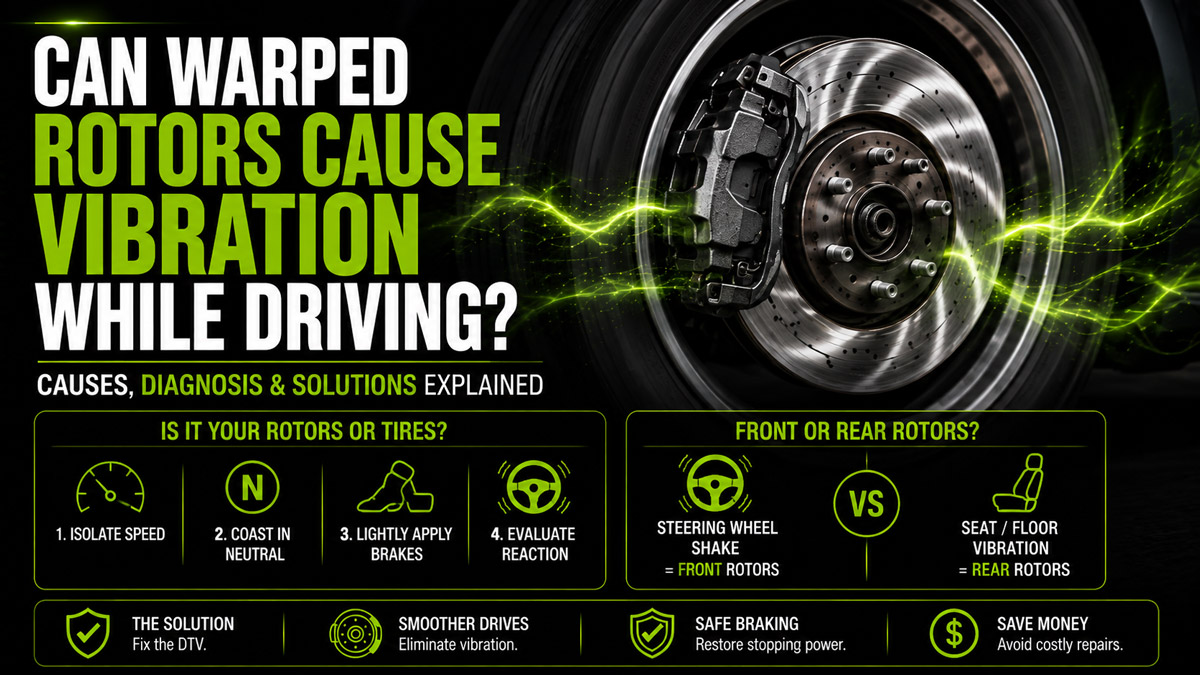
Yes, warped brake rotors can cause continuous vibration while driving, even when you are not actively pressing the brake pedal. Severe rotor unevenness—known as Disc Thickness Variation (DTV)—creates high spots that continuously graze the brake pads at highway speeds. This constant, high-speed friction transfers kinetic pulses through the steering rack, resulting in a persistent steering wheel shake or body shimmy.
Key Facts / At a Glance
- Vibration Source: The shake comes from the brake pads physically riding over microscopic waves on the rotor surface, vibrating the caliper and suspension.
- DTV Threshold: Thickness variations as small as 0.0005 inches (0.012 mm) are enough to trigger noticeable cabin or steering vibration.
- Runout Limits: Maximum allowable lateral runout for most standard passenger vehicles is 0.002 inches (0.05 mm).
- Temperature Extremes: Standard iron brake rotors begin to structurally degrade and experience uneven material transfer when operating temperatures exceed 1,200°F (649°C).
- Installation Criticality: Wheel lug nuts must be torqued within ± 5 ft-lbs of factory specifications using a calibrated torque wrench to prevent rotor hat distortion.
How Do Warped Rotors Cause Vibration When Not Braking?
Warped rotors cause vibration without braking because the brake pads always sit in microscopic proximity to the rotor surface. Modern disc brake systems do not have active return springs to pull the pads completely away from the rotor; they rely on a tiny amount of seal deflection to retract the piston.
When a rotor suffers from severe Disc Thickness Variation (DTV), the highest spots on the spinning disc will lightly impact the brake pads on every single revolution. At highway speeds of 65 mph, a standard tire rotates roughly 800 times per minute. The high spots on the rotor strike the pads 800 times per minute, creating a mechanical resonance. This micro-intermittent braking transfers directly into the knuckle, up through the tie rods, and into the steering rack, manifesting as a continuous vibration that mimics an out-of-balance tire.
What is the Difference Between True Warping and Disc Thickness Variation (DTV)?
The term “warped rotor” is a mechanical misnomer; standard cast iron brake rotors rarely physically bend like a potato chip unless subjected to catastrophic mechanical trauma. What drivers experience as warping is actually Disc Thickness Variation (DTV).
Cast iron is highly brittle. If you apply enough lateral force to bend it, it will crack and shatter long before it permanently deforms. DTV occurs when the friction surface of the rotor wears unevenly, resulting in a disc that is thicker in some spots and thinner in others.
The Step-by-Step Mechanism of Rotor Degradation
- Extreme Thermal Stress: Hard braking, heavy towing, or mountain descents push rotor temperatures past 1,200°F (649°C).
- Improper Cooling Bind: Stopping completely while the brakes are at peak temperature (e.g., at a red light after a highway off-ramp) traps immense heat directly under the brake pad.
- Material Deposition: The binding resins in the superheated brake pad liquefy and transfer a localized, uneven layer of friction material onto the hot rotor face.
- Cementite Transformation: As the rotor continues to heat and cool unevenly around these deposits, the localized hot spots structurally alter the cast iron into an ultra-hard crystal structure called cementite.
- Accelerated Uneven Wear: As you drive, the softer cast iron wears away naturally, but the hard cementite high-spots do not. Over thousands of miles, the rotor develops significant thickness variances across its rotational plane.
How Can You Tell if the Vibration is Caused by Rotors or Tires?
You can determine if the vibration is caused by the rotors rather than the tires by isolating the vehicle’s speed and applying light brake pressure. A rotor-induced vibration will aggressively intensify the moment brake pressure is applied, whereas a tire imbalance will remain constant regardless of braking.
Step-by-Step Diagnostic Road Test
- Isolate the Speed: Bring the vehicle up to the speed where the vibration is most noticeable (usually between 50 and 70 mph).
- Coast in Neutral: Safely shift the transmission into Neutral and coast. If the vibration immediately stops, the issue is likely drivetrain-related (axles, driveshaft, or transmission). If the vibration continues unchanged, proceed to step 3.
- Lightly Apply Brakes: Apply very light, steady pressure to the brake pedal—just enough to engage the pads without significantly slowing the vehicle.
- Evaluate the Reaction: If the steering wheel violently shakes or you feel a rapid pulsation pushing back against your foot on the brake pedal, you have severe DTV (warped rotors). If the vibration remains completely unchanged, the root cause is highly likely a wheel imbalance, a bent rim, or a worn suspension component.
Does Steering Wheel Shake Mean Front or Rear Rotors?
Steering wheel shake indicates that the front brake rotors are warped, while a vibration felt primarily in the driver’s seat or floorboard points to the rear rotors.
Because the front wheels are directly connected to the steering rack via tie rods, any kinetic energy generated by front rotor DTV transmits immediately into the driver’s hands. Rear wheels are fixed in a trailing arm or solid axle geometry; therefore, lateral vibrations from rear rotors travel through the chassis and manifest in the seat rails and floor pan. Furthermore, due to forward weight transfer during deceleration, front brakes handle 60% to 80% of the vehicle’s stopping power, making them significantly more prone to heat-induced DTV than rear brakes.
What Are the Solutions for Warped Rotors?
The only permanent solutions for warped brake rotors are either machining the existing rotors flat (resurfacing) or completely replacing them. Attempting to “bed in” the brakes to scrub off material only works in the first few days of minor pad transfer; it cannot fix established cementite.
Comparing Repair Solutions
| Solution | Pros | Cons | Typical Cost |
| Full Replacement | Restores factory thickness and thermal mass; guarantees zero runout; maximizes pad life. | Highest upfront component cost; requires breaking factory hardware torque. | $250 – $500 (Full axle shop job) |
| On-Car Machining | Corrects hub-matching runout directly on the vehicle; saves money on premium components. | Thins the rotor; less thermal mass means the rotor will warp faster the next time it overheats. | $150 – $250 (Labor + Lathe time) |
| Bench Resurfacing | Extremely cheap; smooths minor grooves and glazing. | Cannot account for hub rust or bent flanges; often pushes rotor below safe minimum thickness. | $20 – $40 (Per rotor, off-car) |
Expert Note: Never machine a rotor below its Minimum Machining Thickness limit, which is physically stamped into the metal hat of every legal brake rotor. A rotor machined too thin cannot absorb thermal energy safely and will rapidly suffer structural failure.
How Much Does It Cost to Fix Warped Rotors?
Fixing warped rotors costs between $250 and $500 per axle if you hire a professional shop to replace both the rotors and the brake pads. Because old brake pads conform to the shape of the warped rotor, reusing old pads on new rotors will immediately score the fresh metal and ruin the repair.
For the DIY mechanic, standard replacement blank rotors run $35 to $90 per wheel, and a set of premium ceramic brake pads costs roughly $40 to $70 per axle. A standard axle replacement takes approximately 1 to 2 hours in a professional shop, with labor rates varying from $100 to $180 per hour depending on your region. Ignoring the issue is much more expensive: prolonged driving with severe rotor vibration will prematurely destroy wheel bearings, outer tie rod ends, and ball joints, adding hundreds of dollars in secondary suspension repairs.
Which Brake Rotors Should You Choose to Prevent Warping?
You should choose premium, carbon-enhanced blank rotors for the best defense against warping in daily driving scenarios. Upgrading to slotted or drilled rotors is only necessary for specialized heavy-duty or track applications.
1. Blank / Smooth Rotors — Best for Daily Commuting
Standard blank rotors offer the maximum surface area for pad-to-metal contact, providing reliable, quiet stopping power. Premium versions are cast with higher carbon content, which dampens vibrations and resists thermal distortion better than cheap economy iron.
- Choose this if: You drive a standard passenger car, SUV, or minivan in regular stop-and-go traffic.
- Skip this if: You regularly tow a 5,000+ lb trailer through mountainous terrain.
2. Slotted Rotors — Best for Towing and Hauling
Slotted rotors feature shallow channels machined into the friction face. These slots act as a wiper blade, constantly shaving a micro-layer of the brake pad away to prevent glazing, while evacuating water, brake dust, and high-temperature outgassing.
- Choose this if: You haul heavy loads, tow boats/trailers, or drive heavy pickup trucks.
- Skip this if: You want whisper-quiet braking, as the slots create a slight humming noise under hard pedal pressure.
3. Cross-Drilled Rotors — Best for High-Performance Use Only
Cross-drilled rotors have holes drilled entirely through the metal to the internal cooling vanes. This provides maximum cooling and weight reduction for high-performance driving. However, drilling cast iron compromises its structural integrity, creating stress concentration points that are highly prone to micro-fracturing under daily driving heat cycles.
- Choose this if: You are driving a lightweight sports car on a closed track where heat shedding outweighs component longevity.
- Skip this if: You are driving a heavy SUV; the holes will crack under the thermal stress of stopping heavy vehicle mass.
What Common Installation Mistakes Cause Immediate Rotor Warpage?
The most frequent cause of new rotors warping within the first 2,000 miles is human error during installation, specifically uneven lug nut torque and improper hub surface preparation.
- Uneven Lug Nut Torquing: Using an air impact gun to blast lug nuts onto the wheel stretches the steel wheel studs unevenly. This uneven clamp load mechanically distorts the thin metal “hat” of the rotor against the wheel hub. Always use a calibrated manual torque wrench to tighten lugs in a star pattern.
- Skipping Hub Cleaning: The vehicle’s wheel hub must be meticulously cleaned of all rust scale with a wire wheel before a new rotor is mounted. A single flake of rust 0.002 inches thick trapped behind the new rotor will cause it to spin with lateral runout. Over a few weeks, the pads will shave down the high spots of this wobble, inducing severe DTV.
- Neglecting Caliper Slide Pins: Brake calipers float on greased metal slide pins. If these pins dry out or seize from rust, the caliper cannot release pressure when you let off the pedal. The inboard pad will continuously drag against the rotor, superheating the metal and causing rapid material transfer.
Frequently Asked Questions
Is it safe to drive with warped rotors?
It is safe for short distances, but prolonged driving with warped rotors is dangerous. The continuous vibration severely degrades steering components, accelerates wheel bearing failure, and drastically increases your emergency stopping distance by preventing consistent pad-to-rotor contact.
Will warped rotors cause the check engine light to come on?
No, mechanical brake rotor issues do not trigger a check engine light. However, severe vibrations can sometimes trigger a flashing ABS (Anti-lock Braking System) or Traction Control light if the wheel speed sensors detect erratic rotational data caused by the heavy shaking.
Can hitting a puddle while braking warp rotors?
Yes, rapid thermal shock can damage rotors. If your brake rotors are glowing hot (over 1,200°F) from a long mountain descent and you immediately plunge them into a deep puddle of freezing water, the rapid, uneven quenching can cause the cast iron to fracture, crack, or permanently distort.
Do ceramic brake pads cause rotors to warp faster?
Ceramic brake pads do not cause true warping, but they generate and retain more heat than softer semi-metallic pads. If paired with cheap, thin economy rotors that lack the thermal mass to absorb that heat, ceramic pads can accelerate the uneven material transfer (DTV) that causes vibration.