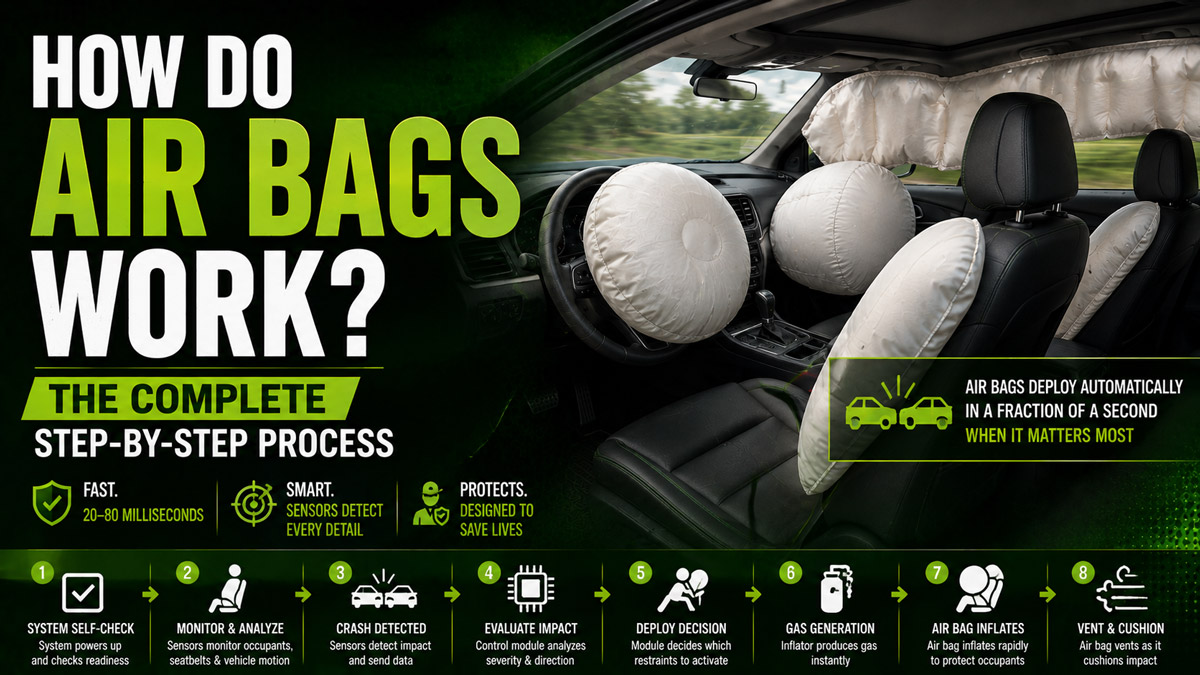
Air bags work through an eight-step process: the system checks itself, monitors occupants and vehicle motion, detects a crash, evaluates its severity, activates selected restraints, generates gas, inflates the cushions, and vents them during occupant contact. The sequence takes roughly 20–80 milliseconds, is fully automatic, and depends most on an accurately measured crash pulse.
Important: Airbag modules contain pyrotechnic inflators and stored electrical energy. Never open, repair, modify, measure, or apply power to an airbag circuit unless you are trained and following the vehicle manufacturer’s service procedure.
Before You Start
This is an explanation of system operation, not a do-it-yourself airbag repair procedure.
- Operating time during a crash: Approximately 20–80 milliseconds
- System self-check: Usually several seconds after startup
- Difficulty to understand: Intermediate
- DIY repair difficulty: Professional-only
- Cost to observe operation: None
- Typical diagnostic cost: About $100–$250
- Possible repair cost: Roughly $150 for a minor wiring repair to several thousand dollars after deployment
Tools and materials
No tools are needed to understand normal airbag operation.
Professional diagnosis may require:
- An SRS-capable diagnostic scan tool
- Manufacturer wiring diagrams
- Approved airbag circuit simulators or load tools
- Insulated hand tools
- A digital multimeter used only where the service manual permits
- Appropriate personal protective equipment
- Vehicle-specific disabling and handling instructions
Prerequisites
You should understand that an airbag is a supplemental restraint. It is designed to work with a properly worn seat belt, not replace one.
Sit upright, wear the lap-and-shoulder belt correctly, and keep at least about 10 inches between your breastbone and the steering-wheel airbag whenever possible.
Step 1: Run the Airbag System Self-Test
Turn the ignition on and allow the supplemental restraint system to complete its automatic readiness check.
The airbag control module checks electrical circuits connected to crash sensors, inflators, seat-belt pretensioners, warning indicators, occupant sensors, and internal backup power. The dashboard airbag or SRS light normally illuminates briefly and then switches off after several seconds.
The module also checks resistance and continuity within approved ranges. It stores a diagnostic trouble code when it detects an open circuit, short circuit, low voltage, internal module fault, or implausible sensor signal.
You’ll know it worked when the airbag warning light illuminates during startup and then turns off.
Common mistake: Assuming a warning light is merely a maintenance reminder. A light that remains on, flashes, or fails to illuminate may indicate that part or all of the restraint system is unavailable.
Step 2: Monitor Occupants and Vehicle Conditions
Use sensor data to determine which restraints may be needed if a collision occurs.
While the vehicle is operating, the restraint controller may monitor:
- Seat occupancy
- Passenger weight classification
- Seat position
- Seat-belt buckle status
- Vehicle acceleration and rotation
- Wheel speed
- Side-impact pressure
- Rollover movement
- Front and side crash-sensor signals
The passenger occupant-classification system may suppress or modify passenger-airbag deployment when the seat is empty, holds a small child, or contains weight below the programmed threshold. Exact thresholds vary by vehicle.
Modern systems can also coordinate airbags with pyrotechnic seat-belt pretensioners and load limiters. Pretensioners remove belt slack, while load limiters allow controlled belt movement to reduce chest loading.
You’ll know it worked when the passenger-airbag status indicator matches the seating condition described in the owner’s manual and no SRS warning appears.
Common mistake: Placing heavy bags, electronics, seat covers, cushions, or wet objects on the passenger seat. These can interfere with weight-sensing and occupancy-classification systems.
Step 3: Detect the Crash Pulse
Measure the vehicle’s rapid change in speed and direction during the impact.
Accelerometers inside the airbag control module continuously measure vehicle motion. Additional satellite sensors may be mounted near the front structure, doors, pillars, rocker panels, or rear body.
During a collision, these sensors detect the crash pulse—the pattern of deceleration over time. The first useful data may arrive within approximately 1–2 milliseconds.
Side-impact systems often rely on door-pressure sensors or body-mounted accelerometers because there is less crush space between the occupant and the striking object. Rollover systems use rotation and lateral-acceleration data.
Airbags do not deploy based on speed alone. A vehicle traveling 60 mph may not deploy its airbags during gradual braking, while a much lower-speed impact can deploy them if deceleration is sufficiently abrupt and directed toward a protected crash zone.
You’ll know it worked when the sensors send consistent impact data to the restraint controller without triggering a fault.
Common mistake: Believing every 10–14 mph collision must deploy an airbag. That figure is only a rough comparison sometimes used for a frontal impact against a rigid barrier. Impact angle, object stiffness, crush distance, braking, and vehicle design all affect deployment.
Step 4: Evaluate Crash Severity and Direction
Compare the sensor signals with programmed crash criteria before firing any restraint device.
The airbag control module analyzes:
- Deceleration magnitude
- Crash-pulse duration
- Impact direction
- Agreement between sensors
- Occupant and seat-belt status
- Rollover probability
- Vehicle-specific calibration
This decision commonly occurs within the first 5–15 milliseconds of a serious crash. The controller must distinguish a genuine collision from potholes, curb strikes, hard braking, door slams, minor bumper impacts, or rough-road vibration.
Some systems require confirmation from more than one sensor. Others rely on a central sensor supported by satellite data. Manufacturers calibrate the logic for the vehicle’s weight, structure, seating position, and available crush zones.
You’ll know it worked when only the restraints appropriate for the crash direction and severity are commanded.
Common mistake: Modifying bumpers, structural rails, seats, suspension height, sensor brackets, or restraint wiring without engineering approval. These changes can alter sensor timing, crash energy management, or deployment geometry.
Step 5: Select and Trigger the Required Restraints
Send a precisely controlled current to only the inflators and pretensioners needed for that event.
Once the controller confirms a qualifying crash, it activates selected firing circuits. Depending on the collision, this may include:
- Driver frontal airbag
- Passenger frontal airbag
- Seat-mounted torso airbag
- Roof-rail curtain airbag
- Knee airbag
- Far-side or center airbag
- Seat-belt pretensioners
- Deployable rollover restraints
The electrical firing pulse heats a bridge wire or initiator inside the inflator. This begins the gas-generating process.
Some frontal airbags use dual-stage inflators. The module can fire one stage, both stages together, or both stages with a calibrated delay. The selection can depend on crash severity, seat-belt use, occupant position, and vehicle design.
The controller usually contains reserve energy so it can activate restraints even if the crash disconnects or destroys the 12-volt battery.
You’ll know it worked when the required restraints activate without firing unrelated modules.
Warning: Never probe an airbag connector with a test light, jumper wire, battery source, or ordinary resistance test unless the manufacturer explicitly authorizes the procedure. A small unintended current can create a deployment risk.
Step 6: Generate Inflation Gas
Ignite the sealed inflator charge to create a controlled volume of hot gas.
The initiator starts a rapid combustion or gas-generation reaction inside the inflator housing. Filters and cooling components regulate the gas before it enters the cushion.
Older inflators sometimes used sodium-azide-based chemistry. A simplified reaction is:
[
2NaN_3 \rightarrow 2Na + 3N_2
]
However, complete older inflator systems included additional compounds that reacted with the sodium by-products. Modern inflators commonly use non-azide propellants such as guanidine-nitrate-based formulations or stored-gas hybrid designs.
The chemical and mechanical components are factory sealed. Propellant quantity, pressure, burn rate, venting, and filtration are matched to the specific airbag module. They are not adjustable service settings.
Gas generation may begin within a few milliseconds and continue through part of the bag’s inflation period.
You’ll know it worked when the inflator generates enough gas at the correct rate to fill the intended cushion.
Common mistake: Treating an undeployed airbag module as an ordinary automotive part. Never cut, drill, heat, crush, open, or dispose of one through normal household waste.
Step 7: Inflate and Position the Airbag
Fill the folded fabric cushion and break it through its designed deployment seam.
The inflator forces gas into a folded nylon or similar high-strength fabric bag. Rising pressure opens a scored cover seam in the steering wheel, dashboard, seat, headliner, door area, or center console.
Deployment timing varies by bag type:
- Frontal airbags may substantially inflate in roughly 20–40 milliseconds.
- Side torso airbags generally deploy faster because the occupant has less protective space.
- Curtain airbags may remain inflated longer to provide protection during rollovers or repeated impacts.
The bag expands toward the occupant’s expected movement path. It does not simply form a stationary pillow in front of the person. The seat belt should restrain and position the occupant before contact with the cushion.
You’ll know it worked when the cushion reaches the occupant’s path before the head or torso strikes a hard interior surface.
Common mistake: Attaching phone mounts, decorations, seat covers, dashboard mats, or other accessories over an airbag seam. Never place feet on the dashboard; deployment can drive the legs backward with severe force.
Step 8: Cushion the Occupant and Vent the Bag
Allow the occupant to compress the cushion while calibrated vents release gas.
As the belted occupant moves forward or sideways, the body contacts the inflated cushion. Gas exits through vent openings, allowing the bag to collapse progressively rather than rebound like a ball.
The airbag spreads force over a larger body area and lengthens the time over which the occupant slows. Even a few extra milliseconds can substantially reduce peak force on the head, chest, and neck.
Most frontal airbags begin venting almost immediately during contact. Curtains designed for rollover protection may remain inflated for several seconds.
Deployment can release dust, combustion residue, fabric lubricant, and hot gas. The cloud may resemble smoke, but do not automatically assume it is harmless. Residue can irritate the eyes, skin, throat, or lungs, and an actual post-crash fire is still possible.
You’ll know it worked when the cushion absorbs occupant movement, vents as designed, and prevents or reduces contact with hard vehicle structures.
Common mistake: Remaining inside a damaged vehicle because the visible cloud appears normal. Exit when safe, move away from traffic or fire hazards, and seek emergency help.
What Happens Immediately After Deployment?
Airbags and pyrotechnic pretensioners are single-use components. Once fired, they do not reset or refill.
After a deployment:
- Turn off the engine if it is safe to do so.
- Check occupants for injuries.
- Call emergency services when anyone may be hurt.
- Leave the vehicle if there is smoke, leaking fuel, fire risk, or traffic danger.
- Avoid touching hot inflator housings.
- Do not drive the vehicle merely because it still starts.
- Have the complete SRS and crash structure inspected professionally.
Repairs may require replacement of deployed airbags, pretensioners, damaged seats, steering-wheel parts, dashboard components, sensors, wiring, and the restraint control module. Manufacturer procedures may also require programming or calibration.
Common Mistakes and How to Fix Them
Ignoring an illuminated airbag light
Problem: The system has detected a fault and may disable one or more restraints.
Fix: Have the SRS scanned with a vehicle-compatible diagnostic tool. Record the codes, repair the underlying fault, and complete the manufacturer’s verification procedure before clearing them.
Clearing codes without repairing the fault
Problem: The warning light returns because the module still detects the same electrical or sensor problem.
Fix: Diagnose the circuit before erasing codes. Inspect connectors, wiring, battery voltage, seat components, clocksprings, sensors, and module communication as directed by the service manual.
Working under a seat with the battery connected
Problem: Disconnecting seat wiring while powered can create fault codes or expose a pretensioner or side-airbag circuit.
Fix: Follow the manufacturer’s shutdown procedure, including the specified waiting period after battery disconnection. Reserve energy may remain for several minutes.
Installing incompatible seats or steering wheels
Problem: Resistance, mounting position, occupant sensors, and deployment geometry may no longer match the vehicle calibration.
Fix: Use compatible, approved components with matching part numbers and transfer or calibrate sensors only as specified by the manufacturer.
Assuming deployment means the car is totaled
Problem: Airbag deployment does not automatically determine total-loss status.
Fix: Compare the complete structural and restraint-system repair estimate with the vehicle’s actual cash value and the insurer’s total-loss formula.
Handling deployment residue with bare hands
Problem: Dust and combustion residue may irritate skin, eyes, or lungs.
Fix: Move to fresh air, avoid rubbing the eyes, wash exposed skin with soap and water, and seek medical attention for breathing difficulty, persistent pain, burns, or eye irritation.
How Airbag Operation Varies by System Type
Frontal airbags
Frontal airbags respond mainly to moderate-to-severe frontal or near-frontal crashes. Advanced systems may vary inflation force through multi-stage inflators and use seat position, belt status, and occupant classification to determine deployment.
Side and curtain airbags
Side airbags must respond quickly because doors and body structures provide limited crush distance. Seat-mounted bags protect the torso, while roof-rail curtains protect the head and may reduce partial ejection during rollover events.
Rollover and center airbags
Rollover curtains use rotation and lateral-motion data and may stay inflated for several seconds. Center airbags deploy between front occupants to reduce occupant-to-occupant contact during side impacts.
How Long Does Airbag Deployment Take?
A typical restraint decision and deployment sequence occurs faster than a blink:
- Initial crash sensing: about 1–2 milliseconds
- Crash evaluation: commonly within 5–15 milliseconds
- Inflator initiation: within a few additional milliseconds
- Substantial frontal-bag inflation: roughly 20–40 milliseconds
- Occupant contact and venting: often within 30–80 milliseconds
- Extended curtain inflation: potentially several seconds
There is no single universal 60–80 millisecond timeline for every airbag. Bag type, crash direction, occupant position, sensor configuration, and vehicle calibration change the sequence.
What Does Airbag Diagnosis and Repair Cost?
Understanding how airbags work costs nothing, but diagnosis and repair ranges vary widely:
- SRS diagnostic scan: approximately $100–$250
- Minor connector or wiring repair: about $150–$500
- Clockspring replacement: roughly $250–$800
- Seat-belt pretensioner replacement: about $200–$700 each
- Individual airbag module: approximately $500–$2,000 or more
- Multi-airbag collision repair: often $2,000–$10,000 or higher
Luxury vehicles, curtain systems, damaged dashboards, seat replacement, structural damage, calibration, and limited parts availability increase the total.
Frequently Asked Questions
Do airbags deploy whenever a car crashes?
No. The control module deploys airbags only when the crash pulse, direction, and severity match programmed criteria. Low-speed bumper impacts, gradual deceleration, minor side scrapes, and some rear impacts may not require an airbag. Seat belts and vehicle structures remain the primary restraints in many collisions.
Can an airbag deploy after the battery is disconnected?
Potentially, for a limited period. Airbag control modules usually contain capacitors or reserve-energy systems that can retain deployment power after battery disconnection. Follow the manufacturer’s specified waiting time before working near airbags, pretensioners, sensors, or SRS wiring.
Why did only one airbag deploy?
The module selects restraints according to crash direction, severity, seat occupancy, belt use, and vehicle programming. A driver airbag may deploy while an unoccupied passenger airbag remains off, or side curtains may deploy without frontal airbags during a severe side impact or rollover.
Can airbags injure occupants?
Yes. Deployment can cause abrasions, burns, bruising, hearing symptoms, fractures, or more serious injuries, particularly when an occupant is unbelted, too close, out of position, or resting against a deployment area. The system is designed because the expected crash injury would usually be worse without it.
Is the powder after deployment toxic?
Deployment residue is not always simply talcum powder or cornstarch. It may contain fabric lubricant, combustion particles, alkaline residue, and other irritants. Avoid inhaling the cloud, rinse affected eyes or skin, and seek medical care for breathing problems, burns, or persistent irritation.
Can a deployed airbag be reused?
No. A deployed airbag module and fired pretensioner are single-use devices. They must be replaced with compatible components. The vehicle may also require wiring repairs, module replacement or programming, sensor inspection, structural repair, and diagnostic verification.
Conclusion
Understanding how do air bags work comes down to one rapid coordinated sequence: the system verifies itself, monitors the vehicle and occupants, recognizes a qualifying crash, chooses the appropriate restraints, ignites sealed inflators, positions the cushions, and vents them as the occupants make contact.
The system completes these decisions in milliseconds, but it depends on correct seating, properly worn seat belts, unobstructed deployment zones, intact sensors, and a fault-free SRS. Treat every warning light or deployed module as a safety issue requiring vehicle-specific professional diagnosis.