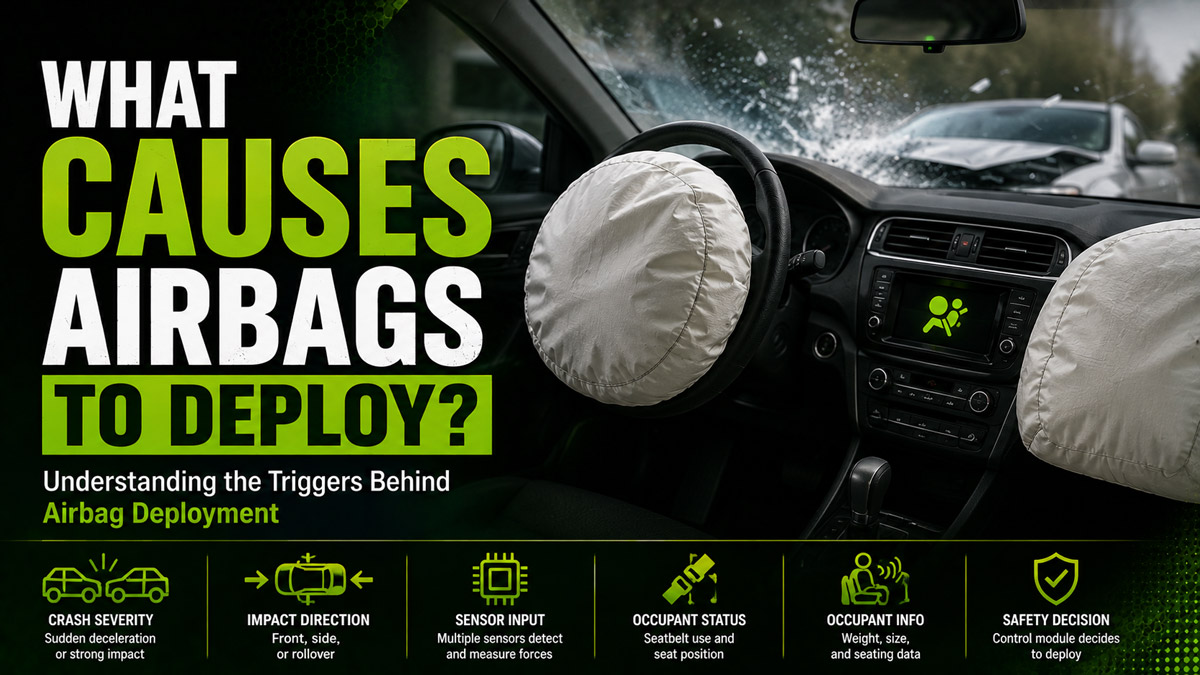
Airbags deploy when a vehicle’s restraint control system detects a crash severe enough to threaten an occupant. The decision is based mainly on rapid deceleration, impact direction, sensor readings, seatbelt status, and occupant information—not simply how fast the vehicle was traveling before the collision.
Key Facts at a Glance
- Airbags respond primarily to rapid changes in speed and direction.
- The airbag control module evaluates several sensor signals within milliseconds.
- Frontal, side, curtain, knee, and center airbags have different activation criteria.
- A vehicle can be traveling quickly without triggering airbags if it slows gradually.
- A relatively low-speed crash can deploy airbags if the stop is sudden and forceful.
- An illuminated SRS warning light may indicate that part of the restraint system is unavailable.
How Does an Airbag System Decide to Deploy?
An airbag system deploys when the airbag control module determines that the measured crash forces match a programmed deployment condition. The module evaluates information from accelerometers, impact sensors, pressure sensors, rollover sensors, seatbelt switches, seat-position sensors, and occupant-classification systems.
The exact logic varies by manufacturer and vehicle model. Modern vehicles may use several sensors positioned around the passenger compartment, front structure, doors, pillars, and center tunnel.
During a crash, the control module asks several questions:
- How quickly is the vehicle slowing down?
- From which direction is the force coming?
- How long does the force continue?
- Is the impact severe enough to threaten an occupant?
- Which seats are occupied?
- Are the occupants wearing seatbelts?
- Which airbags would provide useful protection?
Only the airbags appropriate for the detected crash should deploy. For example, a severe side impact may activate a torso airbag and side-curtain airbag without deploying the frontal airbags.
Does Speed Cause Airbags to Deploy?
Speed alone does not cause airbags to deploy. The critical factor is how quickly the vehicle’s speed changes during the impact.
A car traveling at 60 mph that brakes normally to a stop will not deploy its airbags. However, a vehicle traveling at a much lower speed may experience enough sudden deceleration to trigger deployment if it strikes a rigid object.
Frontal airbag thresholds are sometimes described as being comparable to striking a rigid barrier at approximately 10–16 mph. That comparison is only a general illustration, not a universal deployment rule. Actual activation depends on the vehicle’s structure, crash angle, sensor calibration, occupant status, seatbelt use, and the type of object struck.
A collision with a concrete wall can create a sharper deceleration pulse than a collision with a flexible barrier, brush, snowbank, or another object that absorbs energy.
What Happens During Airbag Deployment?
Airbag deployment occurs through a sequence completed in a fraction of a second.
1. Sensors Detect the Crash
Accelerometers and crash sensors measure sudden changes in movement. Side-impact systems may also use pressure sensors inside the doors to detect rapid deformation.
2. The Control Module Evaluates the Data
The airbag control module compares the sensor readings with programmed crash patterns. It distinguishes a genuine collision from events such as hard braking, driving over a pothole, striking a curb, or slamming a door.
3. The Module Selects the Required Restraints
The system determines whether to activate frontal airbags, side airbags, curtain airbags, knee airbags, seatbelt pretensioners, or a combination of components.
4. The Inflator Is Activated
An electrical signal activates an igniter inside the airbag inflator. The inflator produces gas that rapidly fills the folded airbag.
5. The Airbag Cushions the Occupant
The inflated bag helps reduce contact with the steering wheel, dashboard, door, pillar, or window. Small vents release gas as the occupant contacts the airbag, allowing it to absorb energy rather than remain rigid.
The complete process can occur within roughly 20–50 milliseconds, depending on the system and crash type.
Which Crash Forces Trigger Airbags?
Airbags are triggered by crash forces that match the direction and severity each unit is designed to address.
| Airbag Type | Typical Location | Main Trigger | Primary Protection |
| Frontal airbag | Steering wheel or dashboard | Moderate-to-severe frontal or near-frontal impact | Head and chest |
| Side torso airbag | Seat or door area | Moderate-to-severe side impact | Chest, ribs, and abdomen |
| Curtain airbag | Roof rail | Side impact or rollover risk | Head and ejection reduction |
| Knee airbag | Lower dashboard | Frontal collision | Knees, legs, and occupant positioning |
| Center airbag | Between front seats | Certain side impacts | Reduces contact between occupants |
| Inflatable seatbelt | Seatbelt webbing | Certain frontal or side crashes | Distributes force across the torso |
The deployment of one airbag does not automatically mean every airbag in the vehicle will activate.
What Causes Frontal Airbags to Deploy?
Frontal airbags deploy during moderate-to-severe frontal or near-frontal collisions when the control module predicts that seatbelts alone may not provide sufficient protection.
Common scenarios include:
- Striking a rigid wall or barrier
- A head-on collision with another vehicle
- A severe offset-frontal crash
- Hitting a large fixed object
- Certain underride or overlap crashes that produce a qualifying sensor signal
Frontal airbags may deploy at different output levels. Advanced systems can adjust inflation force based on crash severity, seat position, occupant size, and seatbelt use.
Dual-stage airbags may fire one inflator stage during a less severe qualifying crash and both stages during a more severe event. The exact strategy differs among manufacturers.
What Causes Side and Curtain Airbags to Deploy?
Side airbags deploy when sensors detect rapid intrusion or acceleration from the side of the vehicle. Side crashes provide less space between the occupant and the striking object, so these systems must respond extremely quickly.
Curtain airbags may deploy during:
- A direct side impact
- A severe angled impact
- A detected rollover
- An imminent rollover
- Certain multi-directional crashes
Some curtain airbags remain inflated longer than frontal airbags to help reduce the risk of an occupant’s head striking the window area or being partially ejected during a rollover.
A side impact on the passenger side may activate only the passenger-side airbags. However, system design varies, and some vehicles deploy curtains on both sides during a rollover.
Can Hitting a Pothole Deploy an Airbag?
A normal pothole impact should not deploy an airbag because the control module is designed to distinguish road shocks from crash pulses. The force, direction, duration, and combination of sensor readings normally do not match a qualifying collision.
Deployment may become more likely if the vehicle:
- Strikes a deep pothole or obstruction with structural damage
- Hits a curb and then another object
- Experiences severe underbody impact
- Has damaged or improperly installed crash sensors
- Has previous collision repairs that altered sensor mounting
- Has an electrical or control-module fault
Unexpected deployment after an ordinary road impact is unusual and should be investigated by a qualified repair facility.
Why Do Airbags Sometimes Fail to Deploy?
Airbags may remain inactive because the crash did not meet the programmed threshold, the force came from a direction the airbag was not designed to address, or the restraint system had a fault.
Common explanations include:
The Collision Was Not Severe Enough
A vehicle can sustain visible bumper, hood, or body damage without producing a crash pulse severe enough to require airbags.
The Vehicle Slowed Gradually
Collisions with flexible barriers, vegetation, snowbanks, or objects that move may spread deceleration over a longer period.
The Impact Direction Did Not Match the Airbag
Frontal airbags may not deploy in a rear-end collision, minor side impact, or rollover unless the vehicle is designed to activate them under those conditions.
The Crash Missed Important Sensor Zones
Narrow-overlap, underride, or unusual angled impacts can create complicated force patterns. Modern systems use multiple sensors to improve detection, but no restraint system can respond identically to every crash configuration.
The Occupant Was Not Detected
The passenger airbag may be suppressed if the occupant-classification system identifies an empty seat, a small occupant, or certain child-seat conditions.
The SRS Had an Existing Fault
Damaged wiring, low voltage, faulty sensors, connector problems, water intrusion, or an unresolved previous crash can disable part of the system.
Non-deployment does not automatically prove that the system malfunctioned. Investigators must examine crash data, sensor records, vehicle damage, diagnostic codes, and manufacturer specifications.
Does the Seatbelt Affect Airbag Deployment?
Seatbelt status can influence airbag timing and inflation strategy in many modern vehicles. The system may deploy an airbag differently for a belted occupant than for an unbelted occupant because the expected body movement is different.
Seatbelts remain the primary restraint. Airbags are supplemental restraints designed to work with them.
A seatbelt can:
- Hold the occupant in a safer seating position
- Reduce forward movement
- Distribute forces across stronger areas of the body
- Allow the airbag to provide more controlled cushioning
- Reduce the likelihood of striking the airbag while too close to it
An airbag is not a replacement for wearing a seatbelt.
Can Passenger Weight Affect Airbag Deployment?
Passenger weight and seating position can affect whether the passenger airbag is enabled, suppressed, or deployed at a reduced level. Occupant-classification sensors estimate whether the seat is empty, occupied by an adult, occupied by a small person, or carrying an object.
Heavy bags, electronic equipment, groceries, or pressure placed on the seat can sometimes confuse the system. A passenger-airbag indicator may show whether the frontal passenger airbag is active or disabled.
Rear-facing child seats should not be placed in front of an active passenger airbag. Children are generally safest in the rear seat using an age- and size-appropriate restraint.
Does an Airbag Warning Light Stop Deployment?
An illuminated airbag or SRS warning light means the control module has detected a fault. Depending on the fault, one component, several components, or the entire supplemental restraint system may be unavailable.
Possible causes include:
- Damaged seat wiring
- Loose under-seat connectors
- A faulty clock spring
- Seatbelt pretensioner faults
- Low battery voltage
- Occupant-sensor problems
- Water intrusion
- Previous crash data stored in the module
- Damaged impact sensors
The warning light should be diagnosed with a scan tool capable of reading SRS codes. Disconnecting the battery or clearing the light without repairing the cause does not restore reliable operation.
Can Airbags Deploy When the Car Is Parked?
Airbags generally do not deploy merely because a parked vehicle is struck lightly. However, a sufficiently severe impact can activate the restraint system even when the engine is off if the system remains powered and the collision meets the deployment criteria.
Vehicle designs differ in how long the restraint system retains backup power after the ignition is turned off. Capacitors inside the control system may preserve enough energy for a limited period.
Airbags can also deploy during service work if technicians fail to follow proper disabling procedures. Airbag components should never be probed with an ordinary test light, struck, exposed to improper voltage, or handled without manufacturer-specific precautions.
What Happens After Airbags Deploy?
After deployment, the vehicle should not be considered fully repaired until the complete restraint system has been inspected and restored.
Required work may include replacement or inspection of:
- Deployed airbags
- Seatbelt pretensioners
- Seatbelt assemblies
- Crash sensors
- The airbag control module
- Steering-wheel components
- Dashboard panels
- Wiring and connectors
- Seat sensors
- Interior trim
- The vehicle battery and charging system
Some control modules can be reset under approved procedures, while others require replacement. Repair decisions should follow the vehicle manufacturer’s service information.
Used, counterfeit, recalled, or incompatible airbag components can create serious safety risks. Airbag replacement is not an appropriate area for improvised repairs.
How Can Drivers Reduce Airbag-Related Injuries?
Drivers and passengers can reduce injury risk by combining correct seating position with proper seatbelt use.
Use these precautions:
- Wear the lap and shoulder belt correctly.
- Sit upright with your back against the seat.
- Keep approximately 10 inches between the breastbone and steering-wheel airbag when practical.
- Hold the steering wheel near the 9-and-3 positions.
- Avoid resting arms or objects over an airbag cover.
- Do not allow passengers to place their feet on the dashboard.
- Keep children in the correct rear-seat restraint.
- Investigate any illuminated SRS warning light promptly.
- Never place a rear-facing child seat in front of an active airbag.
Shorter drivers should adjust the seat, steering wheel, and pedals to maintain control without sitting unnecessarily close to the airbag.
Frequently Asked Questions
Can hard braking make airbags deploy?
Hard braking alone should not deploy airbags. The control module recognizes the difference between controlled braking and the abrupt crash pulse associated with a collision. Deployment would require sensor readings that meet the programmed severity and direction criteria.
Do airbags deploy in rear-end collisions?
Frontal airbags usually do not deploy when a vehicle is struck from behind because occupants initially move toward the seatbacks rather than the dashboard. Other restraints, including active head restraints and seatbelts, provide the main protection. Deployment remains possible in a secondary frontal impact.
Do airbags deploy during a rollover?
Curtain airbags may deploy when a rollover sensor detects that the vehicle is rolling or is likely to roll. Frontal airbags do not necessarily deploy unless the rollover also includes a qualifying frontal impact.
Can a dead battery prevent airbag deployment?
A completely unpowered system cannot operate normally, but many vehicles include reserve energy that may allow deployment for a limited period after primary power is interrupted. Battery problems can also create SRS diagnostic faults that require professional inspection.
Why did only one airbag deploy?
Only one airbag may deploy because the control module activates the restraints appropriate for the crash direction, severity, seat occupancy, and occupant position. Selective deployment is a normal feature of modern restraint systems.
How fast does an airbag inflate?
An airbag typically inflates within approximately 20–50 milliseconds. The rapid inflation is necessary because the bag must be positioned before the occupant moves deeply into the impact zone.
The Bottom Line
What causes airbags to deploy is not vehicle speed by itself, but a specific combination of rapid deceleration, impact direction, crash duration, sensor input, occupant status, and control-module programming. Modern vehicles select only the restraints needed for the detected collision.
Airbags work best as part of a complete safety system that includes seatbelts, proper seating position, functional sensors, and an SRS system free of warning lights. Any unexplained deployment, non-deployment, or airbag warning should be inspected using the manufacturer’s diagnostic and repair procedures.