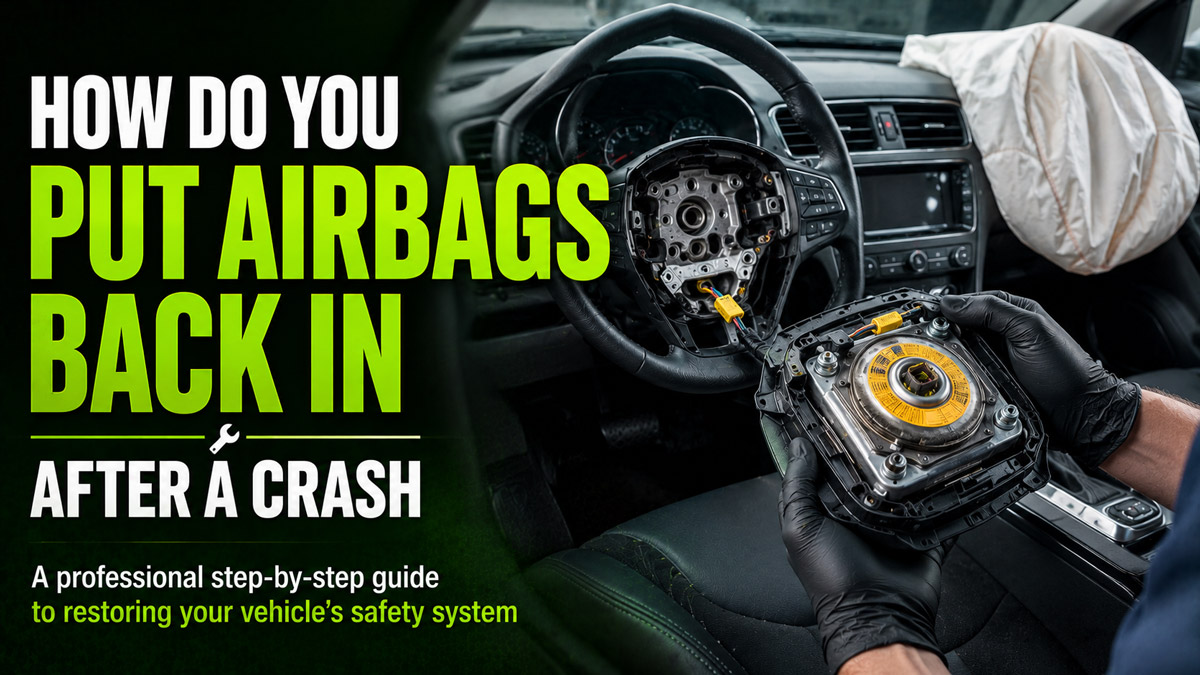
You do not fold, refill or put a deployed airbag back into its original module. A deployed airbag is a single-use safety device that must be replaced with the correct undeployed assembly. A complete repair may also require new seat-belt pretensioners, sensors, trim, wiring and an SRS control module, depending on the manufacturer’s instructions.
Safety warning: Airbag replacement is not an ordinary interior repair. Accidental deployment, incorrect handling or counterfeit components can cause severe or fatal injuries. The following explains the professional repair process rather than providing instructions for dismantling or energizing an airbag system.
At a Glance
- A deployed airbag cannot be repacked or reused.
- Every deployed airbag module must be replaced with the correct compatible unit.
- Airbag deployment may also trigger seat-belt pretensioners and record crash data in the SRS module.
- The manufacturer’s model-specific repair procedure determines which sensors, modules and fasteners require replacement.
- Disconnecting the battery does not instantly make every SRS component safe.
- The repair is incomplete until the warning light, diagnostic codes and system configuration have been verified.
Can deployed airbags be put back in?
No. A deployed airbag cannot be pushed, folded or installed back into its housing. The entire deployed module is replaced because the inflator has fired and the cushion, cover and internal components are no longer suitable for a second deployment.
A driver airbag usually comes as a complete steering-wheel module containing the cushion, inflator, housing and decorative cover. Passenger, knee, seat-mounted and curtain airbags are also replaced as assemblies or according to the vehicle manufacturer’s specified parts package.
The practical rule is simple: deployed means replace, not repair. NHTSA recommends replacing airbags after every deployment and warns that a missing airbag is one reason a used vehicle may fail to protect its occupants in a later crash.
Replacing only the visible fabric is not an acceptable repair. The airbag’s electrical resistance might appear normal after somebody installs a resistor or altered connector, yet no protective device would deploy in a collision. Counterfeit modules have reportedly used resistors specifically to prevent the warning light from revealing that a functional airbag is missing.
Why can’t a deployed airbag be reused?
A deployed airbag cannot be reused because its inflator has completed its one-time activation and the module has undergone extreme heat, pressure and mechanical force. The folded cushion, housing, seams, cover and electrical initiator are engineered for one controlled deployment.
During a crash, the SRS control unit sends an electrical signal to the inflator. The resulting gas generation expands the cushion within milliseconds. The cover opens along predetermined seams, and the cushion then vents to absorb occupant movement.
After that event, several irreversible changes may exist:
- The inflator’s charge has been consumed.
- The module cover has broken open.
- The cushion may be heat-marked, contaminated or torn.
- Mounting points may have been distorted.
- Connectors or wiring may have heat or impact damage.
- The vehicle may have stored a deployment event or hard fault.
The surprising mistake beginners make is assuming an airbag resembles a reusable balloon. An automotive airbag is closer to a sealed pyrotechnic safety assembly: once activated, the complete deployed component has reached the end of its service life.
What must be replaced after airbags deploy?
Every deployed airbag must be replaced, but the complete parts list depends on which restraint devices activated and what the manufacturer requires for that vehicle. Airbag replacement is therefore a system repair, not simply a steering-wheel repair.
Possible replacement items include:
- Driver, passenger, knee, seat or curtain airbag modules
- Seat-belt retractors or pretensioners
- Buckle pretensioners
- Front or side impact sensors
- The SRS control or diagnostic module
- Steering-wheel clockspring
- Dashboard, instrument panel or airbag cover
- Headliner, pillar trim or seat upholstery
- Damaged SRS wiring and connectors
- One-time bolts, clips and mounting fasteners
Manufacturer requirements vary significantly. For example, Nissan repair information may require replacement of the airbag diagnosis sensor unit after an SRS component deploys, along with all activated pretensioner assemblies. Some side-airbag repairs require replacing the affected seatback assembly rather than inserting an airbag into the old upholstery.
Professionals determine the parts list by checking the vehicle identification number, deployment record, diagnostic codes and OEM collision-repair instructions.
How are deployed airbags professionally replaced?
Professional airbag restoration follows a model-specific inspection, replacement, programming and verification process. It is not safe to use one universal five-step procedure because power-down times, required parts, torque specifications and control-module rules differ by vehicle.
A qualified repair normally follows this sequence:
- Document the collision and deployment.
The technician identifies every deployed airbag, activated pretensioner, damaged trim panel and visible impact area. - Perform a complete SRS diagnostic scan.
A capable scan tool retrieves deployment-related codes, sensor faults, communication errors and configuration information. - Consult the manufacturer’s repair instructions.
The OEM procedure identifies mandatory replacements, one-time fasteners, power-isolation requirements and calibration procedures. - Safely disable the restraint system.
The exact procedure and waiting period come from the service information—not from a generic internet rule. - Replace deployed and damaged components.
Correct modules, pretensioners, sensors, trim, wiring and mounting hardware are installed. - Address the SRS control module.
The module is replaced, programmed or handled exactly as the manufacturer permits. - Reassemble and configure the system.
Occupant-classification or passenger-detection systems may require initialization or calibration. - Complete post-repair verification.
The technician clears repairable faults, checks the warning-light sequence and confirms that no SRS codes return.
Can you replace airbags yourself?
Airbag replacement should generally be performed by a trained technician with OEM service information and SRS-capable diagnostic equipment. A mechanically experienced owner may be able to remove interior panels, but handling a live inflator and deciding which restraint components must be replaced introduces risks that ordinary repair experience does not address.
An accidental deployment can propel the airbag module, tools or trim pieces toward the person working on the vehicle. Incorrect electrical testing is another danger: technicians do not treat airbag initiator circuits like ordinary lights, switches or speakers.
DIY replacement also creates less obvious risks:
- Installing a visually similar but incompatible module
- Reusing one-time mounting bolts
- Pinching or misrouting SRS wiring
- Failing to replace an activated pretensioner
- Damaging the clockspring during steering-wheel work
- Skipping passenger-seat calibration
- Masking a fault without restoring crash protection
The professional rule is that an illuminated SRS lamp is not the only measure of safety. A resistor or unsuitable component can sometimes imitate the expected electrical load while leaving the occupant unprotected.
Does disconnecting the battery make an airbag safe?
No. Disconnecting the 12-volt battery is only one part of disabling an SRS system and does not make every airbag component instantly safe. Restraint control systems can contain reserve energy, while hybrid and electric vehicles add high-voltage isolation requirements.
The widely repeated instruction to “disconnect the negative cable and wait three minutes” is not universal. Different vehicles specify different shutdown sequences and waiting periods. Some vehicles also maintain electrical power briefly after the ignition is switched off.
Even after the prescribed waiting period, an undeployed airbag remains a pyrotechnic device. Safe handling still requires the correct carrying position, storage orientation, connector protection and static-electricity precautions specified by the manufacturer.
A generic battery-disconnection procedure can also create unrelated problems, including lost settings, diagnostic faults or damage caused by interrupting modules before they have completed their shutdown. The correct procedure must therefore be taken from the service information for the exact year, make and model.
Must the SRS control module be replaced or reset?
It depends on the vehicle manufacturer and the type of crash data stored. Some SRS modules must be replaced after deployment, while others may remain serviceable after prescribed diagnostics; an independent “crash-data reset” is not automatically an OEM-approved repair.
The terms clearing codes and resetting crash data are often incorrectly used as though they mean the same thing. They do not:
- A repairable diagnostic trouble code may clear after the fault is fixed.
- A deployment record may remain locked in the control unit.
- A replacement module may require programming or configuration.
- Some manufacturers require a new module whenever specified restraints deploy.
For example, certain Nissan procedures require replacement of the airbag diagnosis sensor unit after any SRS component deploys. Other vehicle procedures condition module replacement on specific deployment codes or internal faults.
A technician should never decide to mail out a module for resetting solely because a website advertises the service. The OEM procedure and applicable repair standards determine whether resetting is permitted.
Do crash sensors need replacement after deployment?
Crash sensors are replaced when the manufacturer requires it or when inspection reveals physical, electrical or mounting damage. Deployment does not create one universal rule for every sensor on every vehicle.
Some manufacturers require specific front-impact sensors to be replaced whenever frontal airbags or pretensioners activate. Other procedures allow certain sensors to be inspected and retained when they pass the prescribed checks.
Sensor replacement is commonly required when:
- The sensor is located in the damaged impact zone.
- Its bracket is bent, cracked or misaligned.
- The connector or wiring is damaged.
- Diagnostic testing identifies an internal fault.
- The manufacturer mandates replacement after deployment.
A sensor should not be judged by appearance alone. Its mounting angle and attachment to the vehicle structure help determine how it interprets deceleration. Installing a good sensor on a distorted bracket can therefore compromise system performance.
For a 2016 Nissan 370Z, for example, the OEM-derived repair information calls for replacing the crash-zone sensor and bracket when front airbags or seat-belt pretensioners activate.
Must seat belts be replaced after airbags deploy?
Activated seat-belt pretensioners must be replaced, and other belt assemblies must be inspected or replaced according to the manufacturer’s collision-repair procedure. A belt can retract normally yet still contain a fired pretensioner or crash-damaged internal mechanism.
Pretensioners tighten the belt at the beginning of a qualifying collision. Depending on the vehicle, the device may be integrated into the retractor, buckle, anchor or another belt component.
Signs of an activated or damaged belt system include:
- A belt that will not extend or retract
- A shortened buckle stalk
- A pretensioner-related SRS code
- Heat marks or deployed-device residue
- Frayed webbing
- Damaged anchors or mounting points
- A belt that was heavily loaded during the crash
Some manufacturers require replacement of all activated pretensioner assemblies. Certain General Motors procedures also require replacement of seat-belt systems that were in use during a collision severe enough to deploy an automatic restraint device.
Replacing the airbags while leaving fired pretensioners in place is one of the most common incomplete repairs.
What happens when a passenger or curtain airbag deploys?
Passenger and curtain-airbag deployment frequently damages expensive interior components in addition to the airbag module. The repair may require a dashboard, instrument panel, headliner, pillar trim, roof hardware or seat components.
A passenger airbag may deploy through a dedicated cover or a tear seam built into the instrument panel. If the panel is designed as one integrated assembly, replacing only the airbag underneath it will not restore the original deployment path.
Curtain airbags usually extend along the roof rail. Deployment can damage:
- The headliner
- A-, B- or C-pillar trim
- Retaining clips
- Grab handles
- Roof wiring
- Weather seals or interior mouldings
Replacement trim must be installed correctly because unsuitable clips, screws or adhesive can obstruct the cushion when it deploys. Side airbags mounted inside seats present a similar issue: the seat cover and seam construction may be part of the deployment system.
The expert rule is that decorative trim around an airbag is often a functional safety component, not merely upholstery.
How much does airbag replacement cost?
A post-deployment SRS repair can cost roughly $1,000 for a limited single-module repair to well over $5,000 when multiple airbags, pretensioners, electronics and interior panels are involved. Luxury vehicles and extensive curtain- or passenger-airbag damage can cost substantially more.
The total depends on:
| Cost factor | Why it changes the price |
|---|---|
| Number of deployed airbags | Each module is a separate replacement assembly |
| Airbag location | Dash and curtain systems require more trim work |
| Seat-belt pretensioners | Multiple occupied seating positions may be affected |
| SRS control module | Replacement may require programming |
| Sensors and wiring | Impact damage may extend beyond the cabin |
| Dashboard or headliner | Large interior assemblies add parts and labor |
| Vehicle age and brand | Parts availability and pricing vary |
| Calibration requirements | Passenger-detection systems may need setup |
There is no authoritative universal “per-airbag” price. A proper estimate requires the VIN, a diagnostic scan, the OEM replacement list and an inspection of the collision damage.
How long does airbag replacement take?
A straightforward driver-airbag repair may require several labor hours, while a multi-airbag collision repair can take days once diagnostic, interior and programming work is included. Parts availability often controls the calendar time more than installation labor.
Typical variables include:
- Whether only one module deployed
- Whether the dashboard must be removed
- Whether curtain airbags damaged the headliner
- How many pretensioners activated
- Whether the control module requires replacement and programming
- Whether structural repairs must be completed first
- Whether passenger-seat calibration is required
A steering-wheel airbag should not be treated as a stand-alone quick replacement when the crash also affected the belt pretensioners, clockspring or steering-column components.
The repair sequence matters as well. SRS components should be installed only after relevant structural mounting areas have been restored to specification. A technician cannot reliably position sensors or restraint modules on bent, unrepaired vehicle structure.
Can used or aftermarket airbags be installed safely?
A verified new OEM airbag is generally the lowest-risk replacement because its identity, compatibility and storage history can be established. Salvage, counterfeit and substandard imported parts create uncertainty about previous damage, moisture exposure, recalls and internal construction.
NHTSA has repeatedly warned about dangerous replacement inflators found in previously crashed used vehicles. In January 2026, the agency reported additional deaths connected with substandard replacement inflators and urged inspection of vehicles repaired after earlier deployments.
A used airbag may look undamaged but still have:
- An unknown vehicle history
- Incorrect part-number compatibility
- Water or humidity exposure
- Damaged connectors
- Recall eligibility issues
- Improper shipping or storage
- A counterfeit label or inflator
A low price is not evidence of a safe component. The replacement part should be checked against the VIN, manufacturer catalogue and applicable recalls rather than matched only by appearance.
Can a normal OBD2 scanner clear the airbag light?
Most basic OBD2 scanners cannot diagnose or clear manufacturer-specific SRS faults because they are designed mainly for emissions-related powertrain codes. An SRS-capable scanner with coverage for the exact vehicle is normally required.
Even a capable scanner cannot legitimately switch off the warning light when an active fault remains. The light will return if the system still detects an open circuit, incorrect resistance, fired pretensioner, damaged sensor, incompatible module or configuration problem.
A scan tool also cannot:
- Restore a missing airbag
- Rebuild an activated pretensioner
- Repair damaged wiring
- Make an incompatible module safe
- Override a manufacturer’s replacement requirement
Clearing codes is the final diagnostic step after the physical repair, not a substitute for it. A vehicle that displays no warning light only because somebody installed a resistor remains dangerously incomplete.
Can you drive after the airbags deploy?
A vehicle with deployed airbags should not be driven on public roads until its roadworthiness and restraint system have been professionally evaluated. Towing is the safer choice because the vehicle may have hidden steering, braking, structural, electrical or seat-belt damage.
The immediate concern is not that a deployed airbag will deploy again. The concern is that it cannot protect the occupant in another collision.
Driving may also be unsafe when:
- The seat-belt pretensioners have locked.
- The steering-wheel cover or column is damaged.
- The dashboard obstructs controls or visibility.
- Curtain material blocks a window.
- Crash damage affects wheels, suspension or cooling systems.
- Warning lamps indicate other safety faults.
- Sharp trim or inflator debris remains inside the cabin.
Road-use and inspection requirements vary by jurisdiction. Even where driving is not expressly prohibited by a specific airbag law, operating a crash-damaged vehicle can violate broader roadworthiness rules or insurance conditions.
Does airbag deployment automatically total a car?
No. Airbag deployment does not automatically make a vehicle a total loss. An insurer usually totals the car when the projected repair cost, salvage value and applicable state formula make repair economically unreasonable.
A late-model high-value vehicle may justify replacing several airbags and interior components. An older vehicle may be declared a total loss after one passenger airbag damages the dashboard and activates multiple pretensioners.
The decision commonly considers:
- Pre-crash actual cash value
- Structural and body repair costs
- SRS parts and labor
- Supplement risk after disassembly
- Salvage value
- Local total-loss thresholds or formulas
- Parts availability
A frequently quoted “70% rule” is not universal. Some jurisdictions use a fixed percentage, others use a total-loss formula, and insurers may apply their own economic thresholds within local law.
The repairability question is technical; the total-loss decision is financial. A vehicle can be technically repairable yet economically totaled.
How do you verify that the repaired SRS works?
A repaired SRS is verified through parts documentation, diagnostic scanning, warning-lamp checks, configuration procedures and manufacturer-required calibrations. No non-destructive shop test can intentionally deploy the airbags to prove future crash performance.
A proper post-repair verification includes:
- Confirming that every installed restraint component matches the VIN and specified location.
- Verifying that all connectors, locks, wiring retainers and grounds are secure.
- Confirming that required one-time fasteners were replaced and tightened to specification.
- Scanning every relevant restraint-system module.
- Correcting active, pending or history faults as permitted.
- Performing occupant-classification initialization or calibration when required.
- Checking the SRS warning-light prove-out when the ignition is switched on.
- Documenting part numbers, programming and final scan results.
The SRS warning light should illuminate briefly during its self-check and then go out according to the vehicle’s normal sequence. A light that never illuminates can be just as suspicious as one that remains on because the bulb, display or circuit may have been altered.
The Bottom Line
A deployed airbag cannot be put back into its module; the correct repair is replacement of the single-use assembly. The repair must also address activated seat-belt pretensioners, required sensors, damaged trim, wiring and the SRS control module according to manufacturer instructions. Battery disconnection and code clearing alone do not restore crash protection. For the safest result, use verified compatible parts and require a documented pre-repair and post-repair SRS scan.