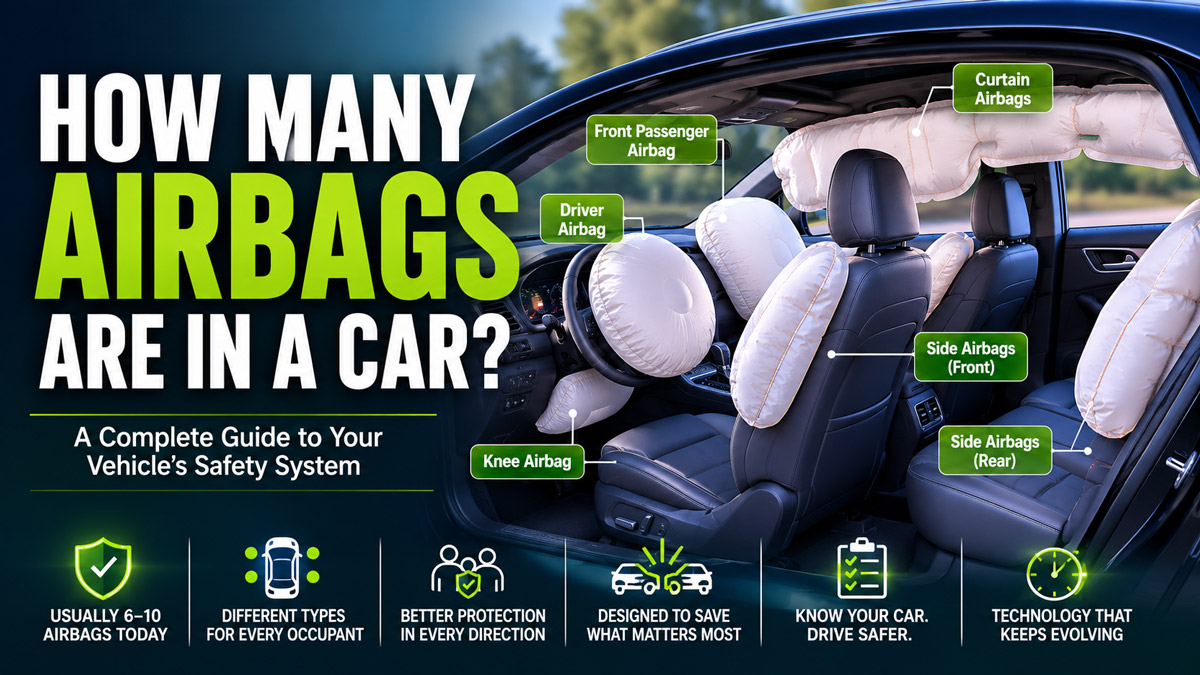
Most modern cars contain six to ten airbags, although the exact number varies by model, body style, trim level, market, and model year. Basic vehicles may have only two to six airbags, while some luxury vehicles and highly equipped family models use ten, twelve, or even sixteen separate airbag units.
Key Facts at a Glance
- Most current passenger vehicles have six to ten airbags.
- Two frontal airbags are the minimum common configuration in modern cars.
- Side-curtain airbags may protect both seating rows but can be counted as only two assemblies.
- Premium vehicles may include knee, center, rear-seat, or seat-cushion airbags.
- Airbag quantity does not by itself determine a vehicle’s crashworthiness.
- Airbags supplement seatbelts; they do not replace them.
How Many Airbags Does a Typical Car Have?
A typical modern car has six airbags: two frontal airbags, two front-seat side airbags, and two side-curtain airbags. Vehicles with additional knee, rear-seat, center, or seat-cushion airbags commonly have eight to twelve.
Older economy vehicles may have only driver and front-passenger airbags. Newer crossovers, sedans, SUVs, and minivans increasingly include side-impact protection across both rows.
The advertised number can be confusing because manufacturers do not always count systems in the same way. A curtain extending from the front pillar to the rear pillar may protect several occupants but still be described as one airbag on each side.
Where Are the Airbags Located?
Airbags are installed around the passenger compartment so they can protect different parts of the body during different collision types.
| Airbag type | Common location | Typical quantity | Main protection |
| Driver frontal | Steering wheel | 1 | Head and chest |
| Passenger frontal | Dashboard | 1 | Head and chest |
| Front side-torso | Outer front seatbacks | 2 | Chest, ribs and pelvis |
| Side-curtain | Roof rails above side windows | 2 | Head and upper body |
| Knee | Lower dashboard or steering column | 1–2 | Knees, legs and seating position |
| Front-center | Between front seats | 1 | Far-side impact and occupant contact |
| Rear side-torso | Rear seatbacks or side trim | 2 | Rear occupants’ torso and pelvis |
| Seat-cushion | Beneath seat cushion | 1–2 | Reduces sliding beneath the seatbelt |
| Rear frontal | Front-seat backs or rear console area | 1–2 | Rear-passenger head and chest |
Not every vehicle contains every type. Equipment may also differ between trim levels or countries, even when the model name appears identical.
What Are the Main Types of Car Airbags?
Frontal Airbags
Frontal airbags deploy from the steering wheel and passenger-side dashboard during qualifying frontal or near-frontal crashes. Most cars have two.
Modern systems may use multiple deployment stages. The airbag control module can adjust deployment according to crash severity, seat position, seatbelt use, and passenger classification.
Side-Torso Airbags
Side-torso airbags usually deploy from the outside edge of a seatback. They protect the chest, ribs, abdomen, and pelvis when another vehicle or object strikes the side of the car.
Seat-mounted designs remain aligned with the occupant when the seat moves forward, backward, or reclines.
Side-Curtain Airbags
Side-curtain airbags deploy downward from the roof rails above the windows. They reduce the chance of an occupant’s head striking the glass, door frame, intruding vehicle, or roadside object.
Many curtain systems remain inflated longer during a rollover to help contain occupants inside the vehicle.
Knee Airbags
Knee airbags deploy from the lower dashboard or steering-column area. Their purpose is not simply to cushion the knees; they also help control lower-body movement so the occupant remains properly positioned for the seatbelt and frontal airbag.
Some vehicles have a driver knee airbag only, while others provide knee airbags for both front occupants.
Front-Center Airbags
A front-center airbag deploys between the driver and front passenger. It helps reduce head contact between occupants and can protect the driver during a far-side collision, where the impact occurs on the opposite side of the vehicle.
This design is increasingly used in vehicles engineered for improved side-impact performance.
Rear-Seat Airbags
Some premium and family vehicles include rear side-torso airbags or specialized frontal airbags for rear passengers. These systems require careful design because rear occupants vary widely in size and may include children in restraint systems.
Why Do Some Cars Have More Airbags Than Others?
Cars have different airbag counts because manufacturers design restraint systems around the vehicle’s structure, seating arrangement, crash targets, available space, price, and intended market.
A compact two-seat sports car does not require the same layout as a three-row SUV. A large family vehicle may need extended curtain airbags, rear side airbags, additional sensors, and protection for several seating positions.
The most important factors include:
- Number of seating rows: Three-row vehicles require a longer protective area.
- Crash-test objectives: Additional airbags may improve protection in side, far-side, rollover, or small-overlap crashes.
- Vehicle structure: Stronger structures may manage impact energy differently.
- Trim level: Advanced safety packages may be standard on premium trims but optional on base models.
- Regional regulations: Required equipment can vary by country and production year.
- Occupant-detection technology: More sensors allow more selective deployment strategies.
Does a Higher Airbag Count Mean a Safer Car?
A higher airbag count does not automatically mean a safer car. Airbag placement, sensor calibration, seatbelt design, body structure, crash compatibility, and occupant positioning matter more than the advertised number alone.
For example, a well-engineered six-airbag vehicle can outperform a poorly engineered ten-airbag vehicle. The six-airbag model may have a stronger passenger cell, better crumple zones, more effective seatbelt pretensioners, and more accurate deployment algorithms.
When comparing vehicles, consider:
- Independent crash-test results
- Side-impact and rollover protection
- Seatbelt pretensioners and load limiters
- Automatic emergency braking
- Child-seat compatibility
- Structural integrity
- Airbag coverage for every occupied row
The best system is an integrated restraint system, not simply the vehicle with the largest number in its brochure.
How Do Airbags Work During a Crash?
An airbag system detects a qualifying collision, evaluates its direction and severity, ignites the appropriate inflator, fills the selected cushion, and vents the gas as the occupant contacts it. The complete sequence occurs within milliseconds.
1. Sensors Detect the Impact
Accelerometers, pressure sensors, and other crash sensors measure rapid deceleration, side intrusion, or structural movement. The system distinguishes ordinary bumps and hard braking from an impact likely to injure an occupant.
2. The Control Module Evaluates the Crash
The airbag control module analyzes the sensor signals, impact direction, occupant status, seatbelt use, and other available data. It decides which restraint devices should activate.
3. Selected Restraints Activate
The module sends an electrical signal to the required airbag inflators and seatbelt pretensioners. A frontal crash may trigger the frontal airbags without deploying the side curtains, while a side impact may trigger only the affected side.
4. The Airbags Inflate
The inflator rapidly generates gas and fills the folded fabric cushion. The bag breaks through a designed seam in the steering wheel, dashboard, seat, roof trim, or other interior panel.
5. The Bags Vent
Small vents release gas as the occupant contacts the cushion. Controlled deflation absorbs energy and prevents the airbag from behaving like a rigid surface.
Do All Airbags Deploy in Every Accident?
No. Airbags deploy selectively according to the crash direction, severity, sensor information, seating status, and system design.
A low-speed bumper impact may not require any airbags. A severe side collision may deploy the side-torso and curtain airbags on the struck side but leave both frontal airbags intact.
Possible deployment patterns include:
- Frontal crash: Driver and passenger frontal airbags, knee airbags and pretensioners
- Side impact: Side-torso and curtain airbags on the affected side
- Rollover: Curtain airbags and pretensioners
- Far-side impact: Center airbag plus selected side restraints
- Unoccupied passenger seat: Passenger frontal airbag may be suppressed
- Minor collision: No airbags if deployment would provide little benefit
An airbag that did not deploy is not necessarily defective. The system may have determined that deployment was unnecessary or could increase injury risk.
How Can You Find Your Car’s Exact Airbag Count?
The most reliable way to identify the exact number of airbags is to consult the owner’s manual or manufacturer specifications for the vehicle’s model year, trim, body style, and sales market.
Use these methods:
- Read the Supplemental Restraint System section of the owner’s manual.
- Look for “SRS AIRBAG” labels on seats, pillars, dashboard panels, and roof trim.
- Enter the vehicle identification number into the manufacturer’s owner portal.
- Review the original window sticker or build sheet.
- Ask a dealership parts department to check the factory equipment by VIN.
- Consult official crash-test documentation for the exact model year.
Do not rely only on visible labels. Curtain airbags and seat-cushion airbags may be concealed behind trim with minimal markings.
How Many Airbags Do Older Cars Have?
Many cars from the 1990s and early 2000s have only two frontal airbags. Side-torso and curtain airbags became more common over time, first as optional equipment and later as standard equipment on many models.
A simplified pattern is:
| Vehicle generation | Common configuration |
| Early airbag-equipped cars | Driver airbag only |
| Later 1990s vehicles | Two frontal airbags |
| Early-to-mid 2000s vehicles | Two to six airbags |
| Many 2010s vehicles | Six to eight airbags |
| Many current vehicles | Six to ten airbags |
| Advanced premium models | Ten to sixteen airbags |
These ranges are general rather than universal. A premium older vehicle may have more airbags than a newer entry-level car.
What Happens After an Airbag Deploys?
A deployed airbag cannot be folded back into its compartment and reused. The deployed module must be replaced according to the vehicle manufacturer’s repair procedures.
A complete post-crash repair may involve:
- Deployed airbag modules
- Seatbelt pretensioners
- Damaged seatbelts
- Crash sensors
- Airbag control module inspection or replacement
- Steering-wheel trim
- Dashboard panels
- Seat upholstery or seatbacks
- Roof-liner and pillar trim
- Electrical connectors and wiring
Several deployed airbags can make repair expensive because the visible cushions are only part of the restraint system. Labor, diagnostic programming, trim replacement, and manufacturer-required components can substantially increase the total.
How Much Does Airbag Replacement Cost?
Replacing one deployed airbag commonly costs about $1,000 to $2,500, but the total depends heavily on the vehicle and damaged components. A multi-airbag restoration can cost several thousand dollars.
Passenger dashboard airbags are often expensive because deployment can split or deform a large dashboard panel. Seat-mounted and curtain airbags may require upholstery, seatback, headliner, or pillar-trim replacement.
Cost factors include:
- Number and type of airbags deployed
- New OEM, remanufactured, or salvage components
- Dashboard and interior damage
- Seatbelt pretensioner replacement
- Module programming
- Sensor replacement
- Labor rates
- Manufacturer repair requirements
Because the Supplemental Restraint System is safety-critical, repairs should follow factory procedures and applicable local regulations.
What Does the Airbag Warning Light Mean?
An illuminated airbag or SRS warning light means the system has detected a fault. Depending on the vehicle and fault, one component, one seating position, or a larger part of the restraint system may be unavailable.
Common causes include:
- Damaged steering-wheel clockspring
- Loose or corroded seat wiring
- Passenger-occupancy sensor fault
- Low system voltage
- Water-damaged control module
- Previous deployment data
- Faulty impact sensor
- Seatbelt buckle or pretensioner fault
A standard engine-code reader may not access airbag faults. Diagnosis normally requires a scan tool capable of communicating with the vehicle’s SRS module.
Never probe airbag circuits with ordinary test equipment unless the manufacturer’s procedure specifically permits it. An incorrect test method can damage the system or create a deployment hazard.
What Airbag Safety Rules Should Occupants Follow?
Airbags are most effective when occupants wear seatbelts, sit upright, and remain outside the deployment path.
Follow these core rules:
- Maintain approximately 10 inches between the driver’s chest and steering-wheel airbag where practical.
- Wear the lap belt low across the hips and the shoulder belt across the chest.
- Never place a rear-facing child seat in front of an active passenger airbag.
- Keep children under 13 in an appropriate rear seating position.
- Do not rest feet on the dashboard.
- Avoid attaching hard decorations or equipment over airbag covers.
- Do not use seat covers that block seat-mounted airbag seams unless specifically approved.
- Investigate an illuminated SRS warning light promptly.
Airbags deploy with significant speed and force. Correct seating allows the cushion to protect the occupant after the seatbelt has begun controlling body movement.
Common Misunderstandings About Airbag Counts
“A Curtain Airbag Counts as Several Airbags”
A curtain may protect multiple seating positions, but manufacturers often count the complete left-side curtain as one airbag and the right-side curtain as another. Marketing descriptions may use different counting methods.
“Every SRS Label Marks a Separate Airbag”
An SRS label identifies an airbag area but does not always reveal the total number of inflators or chambers. One visible curtain may contain a complex multi-chamber design.
“More Airbags Eliminate the Need for Seatbelts”
Airbags are supplemental restraints. Without a seatbelt, an occupant may move too close to the deploying cushion, slide beneath it, or be ejected during a rollover.
“No Deployment Means the System Failed”
Deployment is based on measured crash conditions, not visible body damage alone. A vehicle can suffer expensive exterior damage without reaching an airbag deployment threshold.
The Bottom Line
The answer to how many airbags are in a car is usually six to ten in a modern vehicle, with two frontal, two side-torso, and two curtain airbags forming the most common six-airbag configuration. More advanced vehicles may add knee, center, rear-seat, and seat-cushion airbags, bringing the total to ten, twelve, or sixteen.
Airbag count is only one safety metric. Crash-test performance, body structure, seatbelts, sensor calibration, seating position, and the coverage provided to each row determine how effectively the complete restraint system protects occupants.
Frequently Asked Questions
Can a car have only one airbag?
Yes. Some early airbag-equipped vehicles were built with only a driver-side frontal airbag. Such systems are now outdated compared with modern configurations that protect both front occupants and provide side-impact coverage.
How many airbags does an SUV have?
Most modern SUVs have six to ten airbags. Three-row and premium SUVs may include longer curtain airbags, rear side airbags, knee airbags, or a front-center airbag, raising the total to ten or more.
How many airbags does a luxury car have?
A luxury car commonly has eight to twelve airbags, while some advanced models have as many as sixteen. Additional units may protect the knees, rear occupants, center space between the front seats, or occupants during far-side impacts.
Are side-curtain airbags important?
Yes. Side-curtain airbags protect the head during side impacts and may help contain occupants during rollovers. Their coverage is especially valuable because a vehicle door and window provide less crush space than the front of a car.
Do airbags expire?
Modern airbag systems are generally designed to last for the service life of the vehicle, but electrical faults, corrosion, water intrusion, damaged wiring, recalls, or previous crash repairs can make the system unreliable. Follow manufacturer inspections and complete all open recalls.
Can you drive with the airbag light on?
The vehicle may still move normally, but part of the restraint system may not operate correctly in a crash. The warning should be diagnosed with an SRS-capable scan tool rather than cleared without repairing the underlying fault.