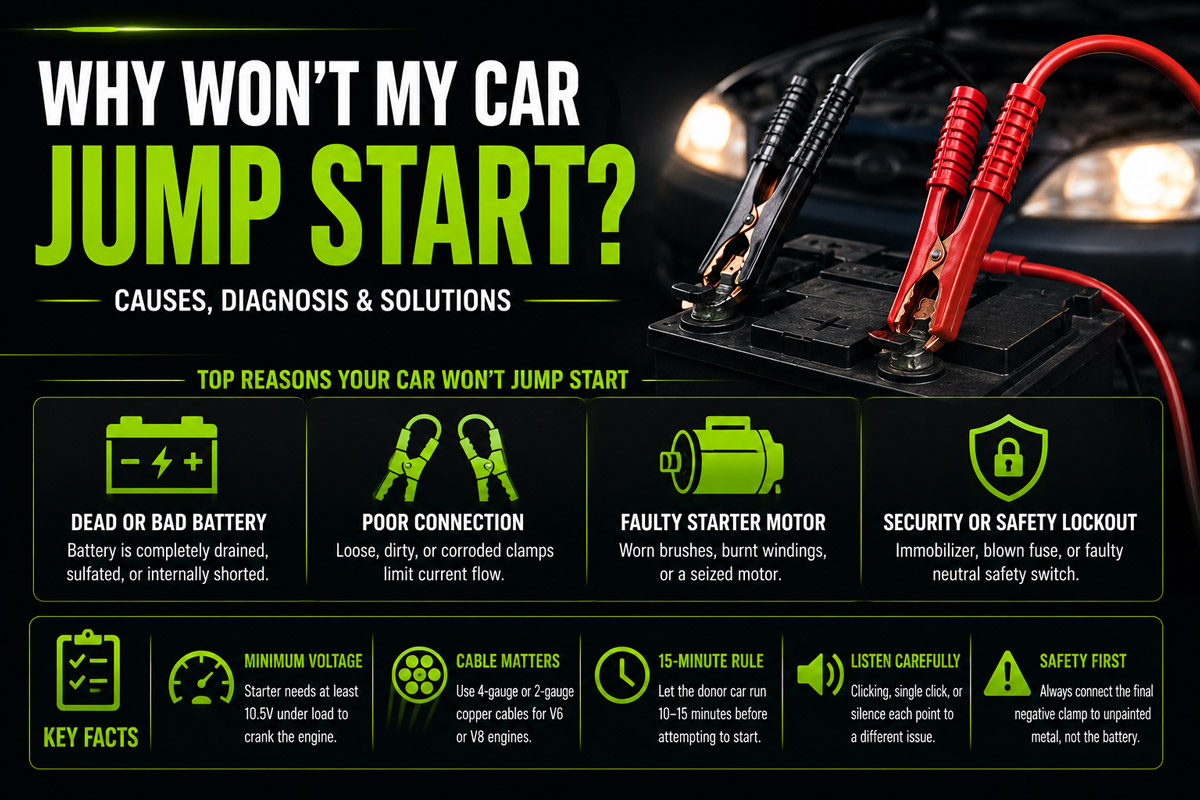
If you find yourself asking, “why won’t my car jump start,” the engine is failing to receive the 150 to 600 Cold Cranking Amps (CCA) required for ignition. This failure stems from excessive circuit resistance, a defective starter motor, a completely shorted battery absorbing the current, or an active security immobilizer. While a jump start bypasses a depleted power source, it cannot overcome physical breaks in your vehicle’s electrical circuit.
Key Facts at a Glance
- Minimum Voltage Required: A starter motor requires a minimum of 10.5 volts under load to spin the engine; anything lower results in rapid clicking.
- Cable Gauge Matters: Standard 10-gauge emergency cables often introduce too much resistance for V6 or V8 engines; 4-gauge or 2-gauge copper cables are required for reliable current transfer.
- The 15-Minute Rule: A completely dead battery must equalize by drawing charge from the donor vehicle for 10 to 15 continuous minutes before cranking.
- Audio Diagnostics: Rapid clicking indicates low voltage, a single loud click indicates a seized starter, and complete silence points to an electrical disconnect or blown main fuse.
- Safety Protocol: Connecting the final negative jumper cable to the dead battery’s negative terminal creates a spark hazard near highly flammable hydrogen gas; always ground to bare engine metal.
What Does the Ignition Audio Tell You?
Diagnosing a failed jump start begins by analyzing the specific sound the vehicle makes when you turn the key. The ignition audio reveals exactly where the electrical current is failing to reach.
Why does my car make rapid clicking noises?
Rapid clicking indicates the starter solenoid is receiving low voltage—usually between 8V and 10V—rather than the required 12.6V. The solenoid has enough power to physically push the pinion gear forward, but the moment the starter motor draws heavy current to spin the engine, the voltage drops completely. The solenoid loses power, retracts, regains power, and pushes forward again, repeating this cycle multiple times per second. To fix this, twist the jumper cable clamps aggressively on the terminals to bite through invisible oxidation, and allow the donor car to charge the dead battery for an additional 10 minutes.
Why do I hear a single loud click when turning the key?
A single, harsh metallic click signifies that full electrical current is reaching the starter solenoid, but the starter motor itself cannot rotate. The solenoid successfully engages the flywheel, but internal armature windings are burned out, or the carbon brushes inside the motor are completely worn. You can temporarily bypass dead spots on the commutator by firmly tapping the cylindrical body of the starter motor with a metal wrench or solid stick while an assistant simultaneously turns the ignition key.
Why is there complete silence when I try to jump start?
Complete silence means absolutely zero amperage is flowing through the primary ignition circuit. This points to a total physical disconnect: heavily corroded battery terminals preventing surface contact, a blown main ignition fuse (often 100A or higher), a broken neutral safety switch, or an active anti-theft immobilizer. First, verify the transmission is firmly locked into the “Park” position. Next, verify that dashboard lights illuminate; if the dash is completely dark despite being hooked to a running donor car, your jumper cable connections are failing at the clamps.
What Are the 4 Major Jump Start Failure Modes?
When external power is present but the engine will not turn over, the root cause falls into one of four mechanical or electrical categories.
| Failure Category | Root Cause Mechanism | Primary Diagnostic Symptom | Immediate Resolution |
| Circuit Delivery Failure | High electrical resistance from thin-gauge cables, loose clamps, or lead sulfate buildup on terminals. | Rapid clicking or rapid dashboard light flickering during crank attempt. | Clean terminals with a wire brush; upgrade to thick 4-gauge copper jumper cables. |
| Starter Motor Failure | Internal electrical short within the starter motor, worn carbon brushes, or a seized pinion gear. | A single loud click from the engine bay; dashboard lights remain bright during crank. | Strike the starter motor casing with a tool during ignition; replace starter assembly. |
| Total Battery Collapse | Internal lead plates touch (short circuit) or are heavily sulfated, turning the battery into a heat sink. | Cables get extremely hot; car refuses to crank even after 15 minutes of equalization. | Disconnect the dead battery completely and replace it. |
| System Interlock Lockout | Broken neutral safety switch or tripped anti-theft system preventing relay activation. | Complete silence during crank, but radio, headlights, and HVAC fan operate normally. | Cycle the gear shifter firmly; lock and unlock driver door with the physical metal key. |
How Does Cable Quality Affect a Jump Start?
The physical diameter and material composition of your jumper cables dictate how many amps can flow from the donor vehicle to the dead starter motor.
Why are thin jumper cables preventing my car from starting?
Thin jumper cables act like a heavily clogged pipe, choking off electrical flow and converting necessary starter energy into waste heat. Standard gas stations often sell cheap 8-gauge or 10-gauge copper-clad aluminum cables. When tasked with moving 300 amps to start a V6 engine, these thin wires suffer massive voltage drop. The donor car pushes 14.4V, but the dead car’s starter receives only 9V. If your jumper cables feel hot to the touch while connected, they are introducing critical resistance and failing to carry the load.
How do lithium-ion jump packs compare to traditional cables?
Lithium-ion jump packs (ranging from 1000A to 4000A peak output) bypass the resistance issues of long cables by delivering a massive, instantaneous current directly to the battery posts via thick, 8-inch leads. A 1000A pack easily starts a 2.0L commuter car, while diesel engines demand 2000A+ units.
Expert Insight: Lithium jump packs have one fatal flaw—they fail in extreme cold. Lithium battery chemistry drastically loses discharge capability below 32°F (0°C). If you keep a jump pack in your frozen trunk, bring it inside your jacket to warm against your body heat for 15 minutes before attempting a jump start.
What If the Battery Is Completely Dead?
Not all dead batteries are equal; a deeply discharged battery acts differently than an internally destroyed battery.
Can a dead cell prevent a jump start entirely?
Yes, a battery with an internal short circuit can completely block a jump start. A standard 12V automotive battery contains six 2.1V lead-acid cells. If the physical plates warp and touch inside one of these cells, the battery becomes a parasitic load. Instead of allowing the donor current to pass through to the starter motor, the shorted battery absorbs all incoming amperage, rapidly converting it into heat and hydrogen gas. If 15 minutes of charging yields zero change in cranking speed, the battery must be removed from the circuit entirely.
How long should you let the donor vehicle charge the dead battery?
You should allow the donor vehicle to run for 10 to 15 continuous minutes while connected before attempting ignition. A completely flat battery acts as a massive electrical wall. Equalization charging allows the dead battery to rebuild a base surface charge, which lowers its internal resistance and allows the subsequent surge of starter current to pass through the circuit smoothly.
Expert Insight: Modern donor vehicles feature “smart alternators” that drop voltage to 12.5V at idle to save fuel. To force the donor car’s alternator to output the necessary 14.4V for jump starting, turn on the donor car’s headlights and AC blower fan. This triggers the ECU to command maximum alternator output.
Is a Mechanical Failure Blocking the Engine?
Electrical power is useless if the mechanical components responsible for turning the engine are physically broken or jammed.
How can you tell if the starter motor is dead?
A dead starter motor is diagnosed by verifying that the component is receiving 12V, but failing to convert that voltage into kinetic energy. Turn on the vehicle’s interior dome light and attempt to crank the engine. If you hear a single click and the dome light stays bright, the starter is receiving power but refusing to spin (internal motor failure). If the dome light instantly dims to black, the starter is trying to spin but is starved for amperage (battery/cable failure).
Could a seized engine block prevent cranking?
A mechanically seized engine block will absolutely prevent a jump start, simulating a starter motor failure. If an engine has run completely out of oil, overheated severely, or suffered hydrostatic lock (water in the cylinders), the internal pistons weld themselves to the cylinder walls. The starter motor engages, but it cannot overcome the thousands of pounds of mechanical resistance. A mechanic will verify this by attempting to turn the engine’s crankshaft manually with a long breaker bar.
How Do Modern Security Systems Interfere?
Modern vehicles prioritize theft prevention over convenience, utilizing complex computer interlocks that routinely misinterpret a dead battery as an unauthorized intrusion attempt.
Why does the anti-theft immobilizer lock out a jump start?
When a vehicle’s battery voltage drops below 9V, the Body Control Module (BCM) often loses its memory of the key fob’s transponder synchronization. When power is suddenly reintroduced via jumper cables, the vehicle wakes up in “theft mode,” disabling the fuel pump and starter relay. You will see a blinking red padlock icon or security light on the dashboard. To resolve this, exit the vehicle, close all doors, and lock/unlock the driver’s door using the physical metal key blade inserted into the exterior door cylinder. This mechanical action manually resets the immobilizer logic in most modern vehicles.
What Are the Most Common Jump Starting Mistakes?
Executing a jump start incorrectly damages expensive electronic control units (ECUs) and poses severe physical danger.
- Incorrect Grounding: Connecting the final black (negative) clamp directly to the dead battery’s negative terminal is highly dangerous. Lead-acid batteries off-gas flammable hydrogen when rapidly charged. A spark at the terminal can ignite this gas, exploding the plastic battery casing. Always attach the final black clamp to unpainted bare metal on the engine block.
- Touching Live Clamps: Allowing the red and black clamps to touch while connected to the donor car creates a dead short. This 300+ amp arc will instantly melt the cables, blow the donor car’s alternator diodes, and potentially fry both vehicles’ engine computers.
- Reversing Polarity: Connecting red-to-black and black-to-red instantly blows the vehicle’s main fusible link. In modern cars, reverse polarity destroys the infotainment system, the BCM, and the alternator voltage regulator within milliseconds.
How Much Does It Cost to Fix a Car That Won’t Jump Start?
If a jump start fails and external diagnostics point to hardware replacement, expect the following estimated repair costs and timeframes.
| Component to Replace | Estimated Parts Cost | Estimated Labor Cost | Average Service Time |
| Standard Flooded Battery | $120 – $220 | $50 – $100 | 15 – 30 Minutes |
| AGM / Stop-Start Battery | $250 – $400 | $70 – $150 (Requires OBD2 Registration) | 30 – 45 Minutes |
| Starter Motor Assembly | $150 – $350 | $150 – $600 (Varies by engine access) | 1.0 – 2.5 Hours |
| Alternator Assembly | $300 – $750 | $180 – $270 | 1.5 – 3.0 Hours |
| Main Fusible Link | $20 – $50 | $100 – $200 | 1.0 Hour |
The Bottom Line
Understanding why won’t my car jump start requires tracing the electrical path from the external power source to the engine’s mechanical limits. If you hear rapid clicking, aggressively clean your terminals and use thicker cables to overcome resistance. If you hear a single click, tap the starter motor casing to bypass worn contacts. If you experience total silence, reset your anti-theft system and verify the main ignition fuses remain intact. Always prioritize heavy-duty 4-gauge copper cables or high-output lithium jump packs to ensure your equipment is not the bottleneck.
Frequently Asked Questions
Can a bad alternator prevent a jump start?
No, a failed alternator will not prevent an initial jump start. The alternator’s job is to generate electricity after the engine is running. However, if the alternator is completely dead, the car will immediately stall and die the moment you disconnect the jumper cables, as the spark plugs have no ongoing electrical supply.
Is it safe to jump start an AGM battery?
Yes, Absorbent Glass Mat (AGM) batteries can be jump-started exactly like traditional flooded lead-acid batteries. However, AGM batteries are highly sensitive to overcharging. Once the vehicle is started, ensure the alternator is outputting between 13.8V and 14.8V; anything higher will boil the acid suspended in the glass mats, destroying the battery.
Why do jump cables get extremely hot?
Jumper cables become hot because their wire gauge is too thin for the amperage passing through them. The physical resistance inside a thin 10-gauge wire forces the electrical current to convert into thermal energy. If cables begin to smoke or melt their rubber insulation, disconnect them immediately to prevent an electrical fire.
Can a hybrid vehicle jump start a standard gas car?
You should generally avoid using a hybrid vehicle to jump start a standard gas car. Most hybrids utilize a tiny 12V auxiliary battery solely to boot up internal computers, not to crank a massive mechanical starter motor. Drawing 300 amps from a hybrid’s 12V system can blow its internal DC-DC converter, resulting in thousands of dollars in damage.
Will a jump start fix a blown fuse?
No, a jump start cannot bypass a blown fuse. Fuses are physical gates designed to permanently break when overloaded. If the main ignition fuse (often 100A to 140A) is blown, the circuit is physically severed. No amount of external power will reach the starter motor until the physical fuse is replaced.