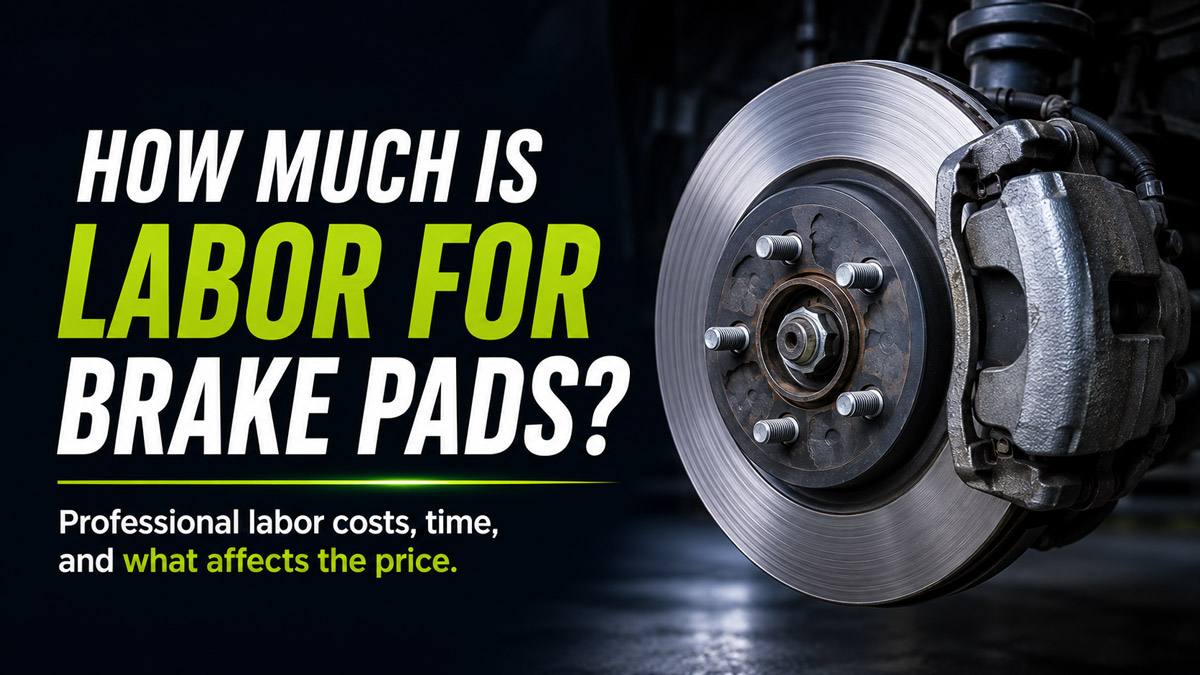
Professional labor costs for replacing brake pads average $80 to $200 per axle, depending on the vehicle type and repair facility. Certified mechanics generally bill between 1.0 and 1.5 flat-rate hours for a standard pad swap, with modern shop rates ranging from $120 to $220 per hour.
Key Facts / At a Glance
- Labor accounts for the majority of a standard $150 to $350 pads-only invoice.
- Adding brake rotor replacement extends the billed labor time to 1.5 to 2.0 hours per axle.
- Dealerships charge a 20% to 50% premium on labor and parts compared to independent repair shops.
- Electronic Parking Brakes (EPB) require digital scan tool retraction, frequently adding a 0.5-hour diagnostic fee.
- Do-it-yourself (DIY) pad replacement saves $90 to $200 in labor per axle but voids professional installation warranties.
How Are Professional Brake Labor Costs Calculated?
Repair shops calculate brake labor by multiplying their posted hourly rate by an industry-standard “flat-rate” time manual, not by the actual minutes spent working on the vehicle. If the commercial guide dictates 1.5 hours to replace front brake pads on a specific sedan, the customer pays for 1.5 hours even if a fast technician finishes the job in 45 minutes.
In 2026, standard independent shop labor rates hover between $120 and $150 per hour, while dealerships and specialized European shops often charge $180 to $220 per hour. The flat-rate system protects consumers from paying extra if a technician struggles with a rusty bolt, but it heavily incentivizes mechanics to work as fast as possible.
Which Repair Provider Offers the Best Labor Value?
Independent mechanics offer the best overall labor value, balancing certified expertise with lower hourly rates and more flexible part-sourcing options. When choosing where to spend your labor budget, the provider type drastically alters the final invoice.
| Provider Type | Est. Labor Cost (Per Axle) | Total Job Price (Pads + Labor) | Best For |
| Independent Shop | $80 – $150 | $150 – $350 | Commuters seeking transparency and fair pricing. |
| National Chain | $90 – $160 | $170 – $350 | Drivers needing weekend hours and nationwide warranties. |
| Mobile Mechanic | $100 – $140 | $180 – $300 | Busy professionals wanting driveway service convenience. |
| Car Dealership | $150 – $250 | $250 – $400+ | Vehicles under factory warranty or complex European cars. |
| Do-It-Yourself (DIY) | $0 | $35 – $150 | Budget-conscious drivers with mechanical experience. |
The Limitations of Bringing Your Own Parts (BYOP)
Many budget-conscious drivers attempt to purchase cheap brake pads online and pay a shop strictly for the labor. While this bypasses the standard 50% to 100% parts markup, the major drawback is warranty forfeiture. If a customer-supplied brake pad squeaks or fails prematurely, the shop will charge full labor rates again to swap them out. Most reputable shops refuse BYOP jobs entirely to avoid liability disputes.
What Are the Key Steps in the Professional Brake Replacement Process?
A proper brake pad replacement takes roughly 45 to 60 minutes per axle and involves a strict protocol to ensure safety, noise reduction, and system longevity.
- Safety Lift and Wheel Removal: The technician lifts the vehicle securely on a hydraulic hoist and removes the wheels to expose the caliper and rotor assemblies.
- Caliper Disassembly: The mechanic unbolts the slider pins and removes the caliper housing. The caliper is suspended with a hook to prevent damaging the flexible rubber hydraulic brake lines.
- Component Inspection: The technician measures the brake rotor thickness using a micrometer. If the rotor is grooved or below the minimum safe thickness, the shop will require a rotor replacement, pushing the total per-axle cost to $400–$900.
- Piston Retraction: Using a manual compression tool, the mechanic pushes the hydraulic piston back into the caliper to make room for the new, thicker friction material. Note: Modern vehicles with Electronic Parking Brakes (EPB) require a bi-directional scan tool to electronically command the piston to retract.
- Hardware Refurbishment and Lubrication: The old anti-rattle clips are discarded. The technician cleans the caliper slide pins with a wire brush and applies specialized high-temperature silicone ceramic grease. Skipping this step causes the caliper to seize.
- Pad and Caliper Installation: New pads are seated into the brackets, the caliper is re-mounted, and bolts are torqued exactly to manufacturer specifications.
- System Bleed and Bedding: The technician pumps the brake pedal to re-seat the hydraulic pistons, checks the master cylinder fluid level, and performs a brief road test to bed (burnish) the new pads onto the rotor.
How Do Brake Pad Material Types Affect the Total Quote?
The friction material you choose directly impacts the parts cost, which makes up roughly 30% to 40% of your total brake replacement invoice.
- Ceramic Pads: The premium standard for modern commuter cars. They cost more ($60–$120 per set) but generate minimal dust, operate silently, and offer the longest lifespan.
- Semi-Metallic Pads: Composed of 30% to 65% steel, iron, and copper. They deliver aggressive stopping power ideal for towing and heavy trucks but create heavy black dust and wear down rotors faster.
- Organic (NAO) Pads: Formulated from rubber, glass, and resins. They provide a soft pedal feel and are the cheapest option ($30–$50 per set), but they wear out rapidly and fade under high heat.
- Carbon-Ceramic Pads: Ultra-premium composites designed strictly for track use and supercars. They suffer zero thermal fade but require high operating temperatures and cost thousands of dollars.
What Are the Most Common Brake Labor Billing Mistakes?
Consumers frequently overpay for brake jobs due to billing technicalities and deferred maintenance. Avoid these three common pitfalls when reviewing a repair quote.
Paying Double Labor for Rotors
If a shop quotes 1.5 hours of labor for brake pads, and an additional 1.5 hours of labor for brake rotors, you are being double-charged. To replace a rotor, the technician must remove the brake pads anyway. Rotor replacement should only add 0.2 to 0.4 hours of labor per axle to a pad replacement job.
Declining Slide Pin Service
Some discount chains advertise a “pad slap” for extremely low labor rates. This means they are simply dropping new pads into a dirty caliper. Failing to pay the extra 15 minutes of labor to clean and lubricate the slide pins guarantees the new pads will bind, wear unevenly, and squeal within weeks.
Ignoring the “Procrastination Tax”
Waiting to replace worn pads until you hear metal-on-metal grinding destroys the brake rotors. This negligence flips the financial equation: rotors are significantly more expensive than pads, and destroying them roughly doubles the quote for work that was entirely avoidable.
How Do You Know When Brake Pads Require Immediate Replacement?
Identifying failing brakes early keeps your labor and parts costs strictly to pad replacement, preventing expensive collateral damage to the rotors and calipers.
- High-Pitched Squealing: Modern brake pads feature built-in metal wear indicators. When the friction material drops below 2mm to 3mm, this metal tab rubs against the rotor to alert the driver.
- Deep Grinding Noises: A heavy scraping or grinding sound means the friction material is entirely depleted, and the steel backing plate is carving into the rotor. Both pads and rotors must be replaced immediately.
- Steering Wheel Vibration: If the steering wheel shakes aggressively when applying the brakes at highway speeds, the rotors have warped or developed severe thickness variations.
- Spongy Brake Pedal: If the brake pedal sinks to the floor, air has entered the hydraulic lines or the brake fluid has degraded. This requires a system bleed and fluid flush, which typically adds $80 to $150 in labor.
Frequently Asked Questions
How much does it cost to replace all 4 brake pads?
Replacing all four brake pads (front and rear axles) generally costs between $300 and $700, including both parts and labor. The front brakes handle 70% of the vehicle’s stopping power, so they usually require replacement more frequently than the rears.
Can I replace brake pads without replacing rotors?
Yes, if the rotors meet the manufacturer’s minimum thickness specifications and exhibit no deep grooving or warping, you can replace just the brake pads. However, many modern lightweight rotors are designed to wear out alongside the pads and often cannot be machined or saved.
How long does it take a mechanic to change brake pads?
A certified mechanic can physically change brake pads on a single axle in 45 to 60 minutes. However, the shop will bill based on flat-rate manual times, which usually dictate 1.0 to 1.5 hours of labor per axle regardless of actual completion speed.
Does a brake pad replacement include a brake fluid flush?
No, a standard brake pad replacement does not include a brake fluid flush. A fluid flush is a separate maintenance item that involves purging old hydraulic fluid from the master cylinder and lines, typically costing an additional $100 to $150.
Are rear brake pads cheaper to replace than front ones?
The parts cost for rear brake pads is often slightly cheaper because the pads are smaller. However, the labor cost is usually identical to the front axle, as the teardown and reassembly process requires the exact same steps and time commitment.