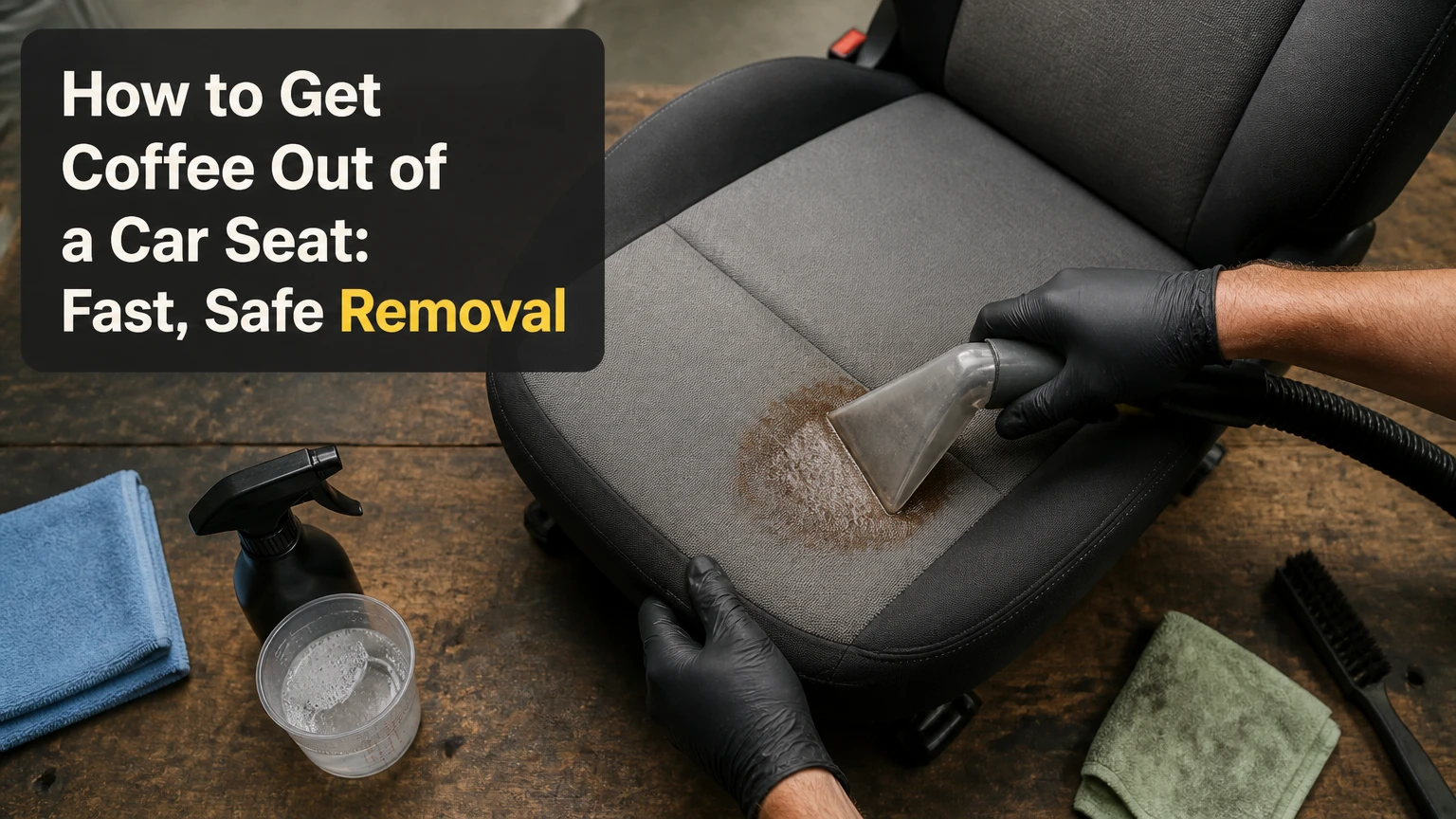
To get coffee out of a car seat, blot the spill, dilute the residue with a small amount of cool water, apply a material-safe cleaner, blot out the solution, and dry the seat completely. Fresh spills usually take 10-20 minutes to treat, while deep or dried stains may need an extractor or professional detailing.
Key facts at a glance
A fresh coffee spill is easiest to remove before it dries into the seat fabric or foam.
Use a small amount of cool or lukewarm water, because flooding the cushion can drive coffee into the foam.
Mild upholstery cleaner is generally safer for fabric than an untested vinegar mixture.
Leather needs a damp cloth and leather cleaner, not a wet scrub or baking-soda paste.
Milk, cream, and flavored syrups increase the risk of greasy residue and sour odor.
A stain that reappears after drying usually indicates wicking from contaminated foam.
What You Need Before Cleaning a Coffee-Stained Car Seat
A basic fabric-seat cleanup needs two microfiber towels, cool water, a mild upholstery cleaner, and a soft brush. Add a wet-dry vacuum or portable extractor when the spill was large, reached the seat seams, or contained milk and sugar.
Before You Start
| Item | Typical requirement | Why it matters |
|---|---|---|
| Active cleaning time | 10-20 minutes | Covers blotting, spot cleaning, and extraction |
| Surface drying time | 2-6 hours | Varies with humidity, ventilation, and saturation |
| Microfiber towels | 3-5 towels | Separates dirty, damp, and final-dry cloths |
| Cool water | 120-250 milliliters | Dilutes residue without flooding foam |
| Upholstery cleaner | 5-15 milliliters | Removes coffee pigment and dairy residue |
| Soft detailing brush | 1 brush, 2-4 centimeter head | Loosens residue without fraying fabric |
| Typical DIY cost | $5-$20 | Assumes household towels and cleaner |
| Difficulty | Low for fresh spills | Medium to high for dried or deep stains |
Park in shade or indirect daylight if possible. Direct sun can dry the surface before the padding has released moisture, which increases the chance of a visible ring.
Check the vehicle manual before using liquid near seat-mounted side airbags, seat occupancy sensors, electrical connectors, or heated-seat controls. Do not remove seat upholstery or unplug yellow electrical connectors unless the vehicle manufacturer specifically provides that procedure.
Identify the Seat Material First
Seat appearance alone can be misleading. Synthetic leather, coated leather, vinyl, microfiber suede, and cloth each tolerate different levels of moisture and agitation.
| Seat surface | Safer first cleaner | Avoid initially | Drying rule |
|---|---|---|---|
| Woven cloth or polyester | Diluted upholstery cleaner | Bleach, peroxide, stiff brush | Ventilate for 2-6 hours |
| Vinyl | Damp microfiber with mild soap foam | Alcohol, abrasive paste | Dry seams and piping |
| Coated leather | Dedicated leather cleaner | Vinegar, baking soda, household degreaser | Condition after cleaning |
| Perforated leather | Small amount of leather cleaner | Spraying directly into holes | Wipe across, never flood perforations |
| Alcantara or microfiber suede | Manufacturer-approved cleaner | Water rings, aggressive brushing | Follow nap direction while drying |
Test the cleaner on a hidden lower edge for 10-15 minutes. Check the towel for transferred dye and the surface for lightening, stickiness, roughness, or a changed sheen.
How to Get Coffee Out of a Car Seat in Five Steps
The safest general process is controlled absorption, limited dilution, gentle cleaning, residue removal, and complete drying. Work from the outside toward the center, use several light applications instead of one heavy spray, and stop adding liquid when the towel begins lifting color.
Step 1: Blot the Coffee Without Rubbing
Press a clean, dry microfiber towel onto the spill for 10-20 seconds, lift it, rotate to a dry section, and repeat until the towel picks up little additional liquid. For a larger spill, place a folded towel over the area and apply firm hand pressure without twisting the seat.
You will know this step worked when the surface looks damp rather than glossy and the towel shows progressively less brown transfer. Do not rub in circles at this stage, because friction spreads coffee across the weave and can push liquid below the surface.
The common mistake is reaching for a wet cloth immediately. Extra water adds volume before the loose coffee has been removed, making foam contamination more likely.
Step 2: Dilute the Remaining Coffee With Cool Water
Dampen a clean cloth with 30-60 milliliters of cool or lukewarm water and press it onto the stain in short passes. Blot each pass with a dry towel before applying more water, stopping after two or three cycles.
Cool water is useful because it loosens water-soluble coffee compounds without rapidly softening adhesives, setting dairy residue through heat, or stressing leather finishes. The commonly repeated claim that hot water “cooks” coffee tannins is imprecise; heat does not literally cook tannins, but it can make milk proteins harder to remove and can damage dyes, coatings, or seat adhesives.
You will know the dilution is sufficient when the brown edge becomes lighter and the dry towel receives a pale beige transfer. The common mistake is pouring water directly onto the cushion.
Step 3: Apply a Material-Safe Cleaner
For fabric, apply 5-10 milliliters of upholstery cleaner to a cloth or soft brush rather than soaking the seat. Allow the cleaner to dwell for 3-5 minutes, keeping the area damp but not saturated.
A practical homemade option is 250 milliliters of water with 2-3 drops of mild dish soap. White vinegar can be added at 5-10 milliliters, but vinegar is not a universal chemical neutralizer for coffee tannins; its main practical role is mild acidity and odor reduction. A dedicated upholstery product is usually more predictable because its surfactants are formulated for textile soil.
Use a commercial enzyme cleaner only when milk, cream, syrup, or another food residue remains. Enzymes can digest selected proteins and sugars, but they do not replace mechanical extraction and are not automatically better for black coffee pigment.
You will know the cleaner is working when the stain softens without a halo forming around it. The common mistake is combining vinegar, baking soda, bleach, peroxide, and commercial cleaners, which can create residue or unpredictable discoloration.
Step 4: Agitate the Fibers Gently
Use a soft nylon detailing brush and make short strokes from the stain’s outside edge toward its center. Limit brushing to 20-30 seconds per application, then blot the loosened soil with a dry towel.
Gentle agitation separates coffee residue from fibers; aggressive scrubbing damages the textile surface and can create a permanently lighter, fuzzy patch. On patterned fabric, match the existing weave direction instead of forcing circular motion.
You will know agitation was controlled when the fabric remains flat, the dye stays consistent, and the towel shows brown transfer. The common mistake is using a toothbrush with hard bristles, especially on thin seat cloth or synthetic suede.
Step 5: Rinse, Extract, and Dry the Seat
Press a cloth dampened with 30-60 milliliters of clean water over the treated area, then immediately extract moisture with a dry towel or wet-dry vacuum. Repeat once if the surface feels slick, because leftover cleaner can attract dust and create a new ring.
Open the doors or windows and run ventilation for at least 2 hours. A seat is dry when the surface and seams feel the same temperature and texture as the surrounding upholstery, no dark patch appears after 30 minutes, and the towel remains dry after firm pressure.
The common mistake is closing the vehicle while the padding is still damp. Hidden moisture can produce a sour smell, encourage microbial growth, and cause the stain to wick back toward the surface.
Which Cleaner Works Best for Coffee on Upholstery?
A dedicated upholstery cleaner is the best first choice for fabric seats, while diluted mild soap is a useful low-cost alternative. Vinegar may help with odor, baking soda helps absorb surface odor after drying, and an extractor is the strongest option when coffee has reached the foam.
| Cleaning option | Best use | Typical amount | Main limitation |
|---|---|---|---|
| Upholstery spot cleaner | Fresh or dried cloth stains | 5-15 milliliters | Requires residue removal |
| Mild dish soap solution | Small fresh spill | 2-3 drops per 250 milliliters | Can leave a sticky film |
| Water and vinegar mix | Light odor or mineral ring | 5-10 milliliters vinegar per 250 milliliters water | May alter dye or smell acidic |
| Enzyme cleaner | Milk, cream, syrup residue | Label-directed dose | Does not remove all pigment |
| Portable extractor | Deep foam contamination | 2-5 slow passes | Prolongs drying time |
| Professional detailer | Large, old, or recurring stain | Service-specific | Typical cost of $75-$200 |
Dish soap is a surfactant, so it can lift dairy fats, but household formulas vary in fragrance, alkalinity, and rinsability. Use only a few drops and rinse with a separate damp cloth.
Baking soda should not be rubbed aggressively into damp automotive upholstery. If odor remains after the fabric has dried, sprinkle a thin layer, leave it for 30-60 minutes, and vacuum it thoroughly.
How Do You Remove Dried Coffee From a Cloth Car Seat?
Dried coffee requires rehydration before cleaning, but the seat should be dampened gradually rather than soaked. Place a cloth moistened with 30-60 milliliters of lukewarm water over the mark for 2-3 minutes, then use the five-step process and allow extra extraction time.
First vacuum loose particles from the seat. Dried sugar crystals and grit can scratch vinyl or become abrasive during brushing.
Apply upholstery cleaner to the cloth, let it dwell for 5 minutes, and make two light cleaning passes. Old discoloration may be permanent if the coffee altered the textile dye, so a pale shadow after cleaning does not always indicate remaining soil.
A stain ring often forms when the original spill spread into surrounding fibers. Clean a slightly wider area, feathering the cleaner outward, then extract evenly across the entire damp zone. Do not clean only the darkest center if a visible edge already exists.
How Should You Clean Coffee From Leather or Vinyl Seats?
Clean leather or vinyl coffee spills with a barely damp microfiber cloth and a pH-appropriate leather or vinyl cleaner. Keep liquid away from perforations, stitching, seat controls, and seams, then apply leather conditioner only after the surface is clean and fully dry.
For a fresh spill, blot first. Use leather cleaner on the cloth, not directly on the seat, and wipe a section no larger than 15 by 15 centimeters at a time.
For coated leather, one or two light passes normally remove a surface coffee mark. A soft horsehair brush can clean textured grain, but do not brush perforated panels because liquid and residue can enter the holes.
Vinyl does not contain leather oils, so leather conditioner can leave an unwanted film on vinyl. Identify the surface before conditioning.
Leather-Specific Risks
| Surface condition | Correct response | Stop condition |
|---|---|---|
| Smooth coated leather | Leather cleaner on microfiber | Finish becomes tacky |
| Perforated leather | Wipe across holes with minimal product | Cleaner appears below panel |
| Aniline or uncoated leather | Follow manufacturer instructions | Color transfers immediately |
| Vinyl seat | Mild vinyl cleaner or diluted soap foam | Gloss changes after test |
| Heated leather seat | Use minimal moisture | Seat remains damp near controls |
Never use vinegar, alcohol, nail-polish remover, abrasive melamine foam, or baking soda paste as a first treatment on leather. These products can remove finish, change sheen, dry the surface, or expose a different color beneath the coating.
Does Coffee With Milk, Cream, or Sugar Need Different Treatment?
Coffee containing milk, cream, or syrup needs both stain removal and residue control. Surfactant cleaner removes fats, cool water dilutes sugars, and an enzyme product can help with persistent protein odor after the visible spill has been extracted.
Milk residue can smell sour even when the brown mark has disappeared. That odor usually indicates residue below the surface, not a need for stronger perfume.
Treat the area with a small amount of upholstery cleaner, dwell for 3-5 minutes, and extract repeatedly with clean water. If a label-approved enzyme cleaner is used, follow its dilution and dwell instructions and never mix it with vinegar, bleach, or another chemical.
Coffee with sugar can leave a tacky patch that attracts dust. After cleaning, test the seat with a clean fingertip through a dry cloth; any stickiness indicates that another light rinse is needed.
How Long Does a Car Seat Take to Dry?
A lightly treated cloth seat typically dries in 2-4 hours, while an extracted cushion may need 4-8 hours in humid conditions. Leather and vinyl usually dry within 30-90 minutes, but seams and perforations can retain moisture longer than the visible surface.
| Treatment level | Typical moisture load | Typical drying time | Recommended ventilation |
|---|---|---|---|
| Blotting only | Under 30 milliliters | 30-60 minutes | Doors open for 15 minutes |
| Light spot cleaning | 30-100 milliliters | 2-4 hours | Windows open or fan |
| Multiple rinse passes | 100-250 milliliters | 3-6 hours | Fan aimed across seat |
| Portable extraction | 250-750 milliliters | 4-8 hours | Continuous airflow |
| Professional deep cleaning | Service-dependent | 6-12 hours | Follow detailer instructions |
Do not use a high-heat hair dryer on leather, vinyl, or a synthetic seat. A room-temperature fan is safer and moves moisture away without concentrating heat on one panel.
Avoid driving with a damp seat when possible. Pressure from the occupant can force liquid deeper into foam and recreate the stain later.
Why Does the Coffee Stain Come Back After Cleaning?
A returning coffee stain is usually caused by wicking, where dissolved coffee in the cushion foam moves upward as the surface dries. Re-moisten the surrounding area lightly, place an absorbent towel over it, apply even pressure, and replace the towel when it becomes damp.
Use 60-120 milliliters of clean water across the affected zone, not directly into one point. Cover the area with a white cotton towel, press firmly for 30 seconds, and leave a dry towel weighted with a flat object for 2-4 hours.
Check the towel. Brown transfer confirms that the foam still contains coffee. Repeat once, then dry with airflow.
A recurring stain after two extraction cycles usually needs professional hot-water extraction or cushion disassembly. Home cleaning cannot reliably reach foam beneath glued upholstery without increasing the risk of mold, sensor damage, or a permanent water ring.
What Are the Most Common Cleaning Mistakes?
The most damaging mistakes are rubbing, over-wetting, using an incompatible chemical, and closing the vehicle before the foam dries. Each mistake has a specific recovery method, but rapid correction reduces permanent discoloration.
| Mistake | What happens | Recovery |
|---|---|---|
| Rubbing a fresh spill | Pigment spreads and fibers fuzz | Stop friction, blot from the perimeter |
| Pouring water on the seat | Coffee enters foam and seams | Extract immediately, then ventilate |
| Using bleach or peroxide | Dye may lighten permanently | Flush lightly, stop if color changes |
| Applying too much soap | Sticky residue attracts dust | Rinse with a barely damp cloth |
| Scrubbing leather | Protective finish becomes dull | Stop, wipe gently, use approved cleaner |
| Closing a damp vehicle | Sour odor and wicking develop | Open doors, use airflow, extract again |
Do not assume a darker wet patch is a failed cleaning result. Wet upholstery often looks darker temporarily; judge the final color only after complete drying.
Do not use a steam cleaner simply because steam is hot. Steam can loosen adhesives, force moisture into foam, and damage leather coatings. A low-moisture extractor is generally more controllable for cloth seats.
How Do You Remove Coffee From Other Car Interior Surfaces?
Coffee on a seat belt, carpet, door panel, or center console needs a surface-specific method. Blot fabric and carpet, wipe hard plastic with a damp cloth, and extend the belt fully before cleaning its webbing without soaking the retractor.
Seat Belt Webbing
Pull the belt out fully and secure it with a clip. Blot the coffee, wipe with diluted mild soap, rinse with a clean damp cloth, and leave it extended until dry.
Do not use bleach, solvent, fabric softener, or a washing machine. These products can weaken or alter belt webbing.
Carpet and Floor Mats
Remove the mat if possible, blot from both sides, apply upholstery or carpet cleaner, and extract until the underside is dry. A removable rubber mat can be washed separately, but it should be fully dry before returning to the vehicle.
Plastic, Vinyl, and Console Surfaces
Use a microfiber cloth dampened with water and a drop of mild soap. Keep liquid away from USB ports, switches, gear selectors, speaker grilles, and dashboard seams.
Can You Clean a Child Car Seat After a Coffee Spill?
Clean a child car seat only according to the seat manufacturer’s manual. Harness webbing, buckle components, cover fabric, and foam often have different cleaning limits, and bleach, solvents, ironing, or machine drying can compromise safety components.
Remove only parts the manual identifies as removable. Do not soak the harness or submerge the buckle unless the manufacturer expressly permits it.
If coffee reached the harness, buckle mechanism, shell seams, or impact-absorbing foam, contact the manufacturer for instructions. A child restraint is safety equipment, not ordinary upholstery.
DIY Cleaning or Professional Detailing: Which Is Better?
DIY cleaning is appropriate for a small, fresh surface spill that has not reached seams or foam. Professional detailing is preferable for a large spill, recurring wicking, persistent milk odor, expensive uncoated leather, or a stain covering more than one seat panel.
| Option | Typical cost | Active time | Drying time | Best scenario |
|---|---|---|---|---|
| Household spot clean | $0-$20 | 10-25 minutes | 2-6 hours | Small fresh spill |
| Commercial upholstery cleaner | $8-$30 | 15-30 minutes | 2-6 hours | Dried cloth mark |
| Portable extractor rental | $30-$60 per day | 30-60 minutes | 4-8 hours | Deep foam contamination |
| Professional interior detail | $75-$200 | 1-3 hours onsite | 6-12 hours | Multiple stains or odor |
| Leather specialist repair | $150-$500 | 1-4 hours | 12-24 hours | Finish damage or dye loss |
Typical US prices vary by city, vehicle size, and service scope. A professional cleaner can remove embedded residue more evenly, but detailing cannot always restore dye that coffee permanently altered.
The honest limitation is important: no cleaner can guarantee removal of a stain that has bleached, dyed, or chemically changed the upholstery. Cleaning removes soil; it does not recreate damaged pigment.
Variations for Difficult Situations
Different spill conditions change the safest sequence. Use less liquid for leather and electronics, more extraction for foam contamination, and manufacturer instructions for safety restraints.
If the Spill Happened Minutes Ago
Blot immediately, remove the cup or loose liquid, and use only one or two small water-dilution passes. Fresh coffee often clears without brushing when the towel removes most of the liquid before drying.
If the Spill Reached the Seat Seam
Blot both sides of the seam if accessible, then extract with a narrow nozzle. Avoid pushing a brush across the seam, because the action can move coffee into the gap.
If the Seat Smells Sour
Treat the hidden residue, not the odor alone. Use an upholstery cleaner or manufacturer-approved enzyme product, extract with clean water, and dry for 6-8 hours with airflow.
If a Light Halo Remains
Clean the entire affected panel lightly rather than repeatedly treating only the center. Uneven moisture and cleaner concentration often create the halo, while uniform extraction reduces the contrast.
FAQ
Will vinegar remove a coffee stain from a car seat?
Vinegar can help reduce light odor and may assist with some mineral residue, but it is not a guaranteed coffee-stain remover. For fabric, use 5-10 milliliters of white vinegar in 250 milliliters of water only after patch testing, and never use it as the first cleaner on leather or uncoated surfaces.
Can I use baking soda on a cloth car seat?
Baking soda can absorb surface odor after the upholstery has dried, but it is not the strongest treatment for a deep coffee stain. Apply a thin layer for 30-60 minutes, then vacuum thoroughly; do not make a wet paste or grind powder into the fabric.
Does club soda remove coffee from upholstery?
Club soda is mostly water with dissolved carbon dioxide and does not provide a special stain-removal advantage over clean water. It may dilute a fresh spill, but controlled blotting with plain water produces less residue and avoids adding minerals or flavoring.
Should I use a carpet cleaner on a car seat?
Use a carpet or upholstery cleaner only when its label allows automotive fabric and the product passes a hidden-area test. Apply small amounts and extract the residue, because automotive seat foam dries more slowly than a removable household carpet.
How do I remove coffee odor from a car after cleaning?
Remove the odor source by extracting milk, cream, and sugar residue from the foam, then dry the seat completely. Afterward, ventilate the vehicle and use baking soda temporarily on dry fabric; fragrance alone masks odor and does not remove the residue.
When should I replace the seat upholstery?
Consider upholstery repair when the coffee caused permanent dye loss, a burn-like mark, damaged leather finish, or contamination inside inaccessible foam. A professional can usually assess the panel before replacement, which may cost less than replacing the entire seat cover.
The Bottom Line
To get coffee out of a car seat, blot first, dilute sparingly, use a cleaner matched to the seat material, extract residue, and dry the cushion completely. Fabric tolerates controlled upholstery cleaning, while leather and vinyl require minimal moisture. If coffee with milk or sugar wicks back or smells sour after two treatments, use professional extraction rather than adding stronger household chemicals.