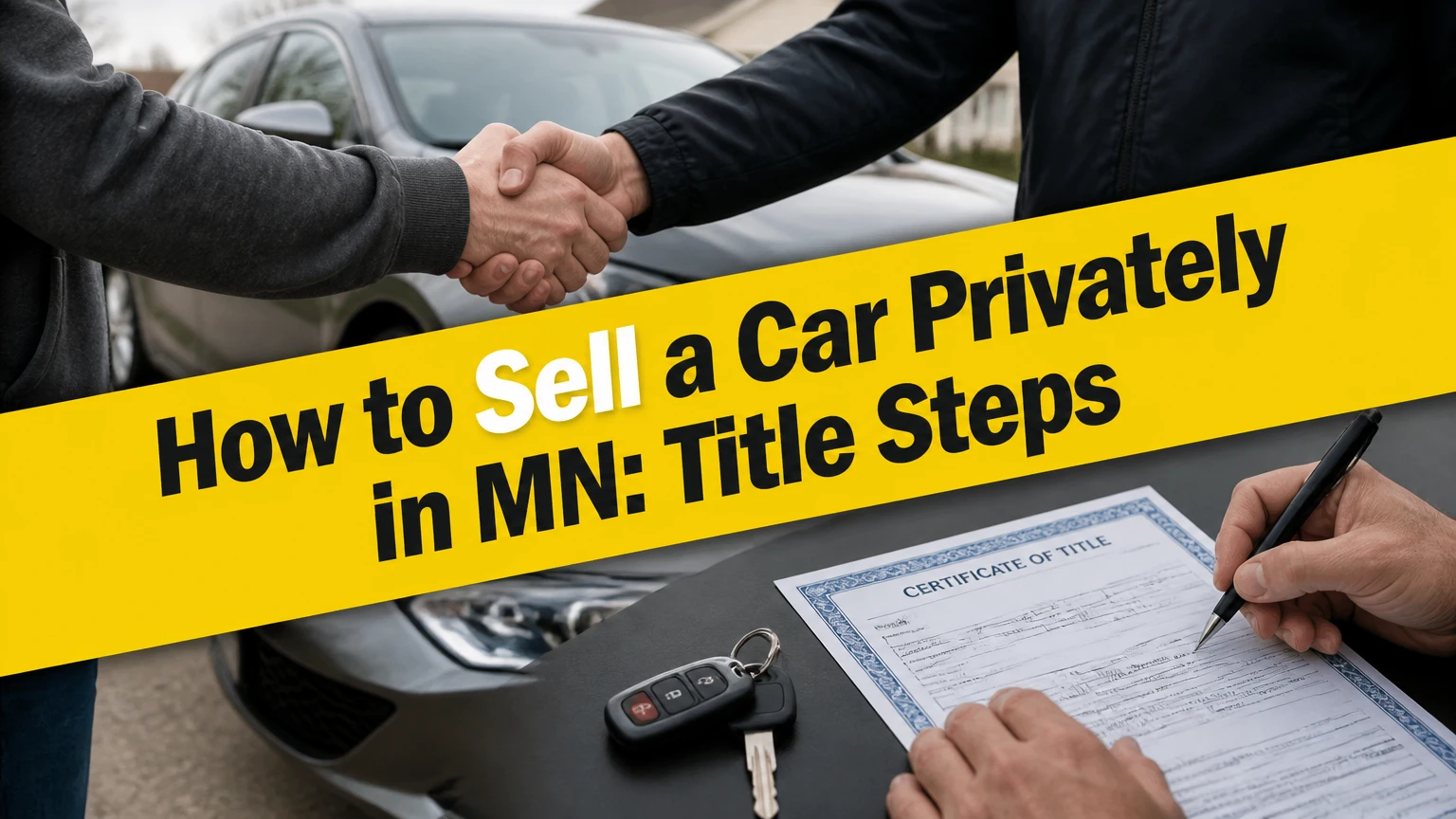
To sell a car privately in MN, prepare a transferable title, disclose required mileage and damage information, agree on a documented price, verify payment, complete the ownership assignment, and report the sale to Minnesota Driver and Vehicle Services (DVS). A typical transaction takes several days to three weeks, but title or lien problems can extend the timeline.
Key Facts at a Glance
Minnesota private-party vehicle sales generally require the buyer to pay motor vehicle sales tax when registering the vehicle.
Minnesota’s state motor vehicle sales tax rate is 6.875%; local taxes or fees can affect the buyer’s total.
The buyer must apply for title and registration promptly, generally within 10 days of purchase under Minnesota requirements.
The seller should file a DVS report or notice of sale as soon as the transaction is complete and retain confirmation.
A lender’s lien must be satisfied or properly handled before the buyer can receive transferable ownership.
Minnesota residents should verify current plate instructions with DVS because standard, personalized, special, and out-of-state transactions can differ.
What does a private car sale in Minnesota involve?
A Minnesota private car sale is a direct transfer from an individual owner to another buyer without a licensed dealer arranging the transaction. The seller supplies ownership documents and accurate disclosures, while the buyer pays the purchase price, obtains insurance, and completes title and registration work with DVS.
Minnesota DVS administers titles, registrations, liens, duplicate titles, and reports of vehicles sold or removed from the state. The Minnesota Department of Revenue administers the tax collected during registration. Those are separate responsibilities, so a seller should not represent that a signed bill of sale alone completes the transfer.
A private sale is usually financially attractive when the vehicle is clean, desirable, and fairly priced. The trade-off is that the seller handles advertising, buyer screening, inspection access, payment verification, title accuracy, and post-sale records.
Before you list the car, what should you prepare?
Prepare the title, lien information, maintenance records, vehicle identification number, disclosure details, and a realistic asking price before publishing an advertisement. A seller who discovers a missing title or unreleased lien after accepting a deposit has already created avoidable risk.
Document checklist
| Item | When it is needed | Seller action |
|---|---|---|
| Minnesota certificate of title | Every titled Minnesota vehicle | Confirm the VIN, owner names, lien status, and title condition |
| Lien release | Any vehicle with a paid or active loan | Obtain lender instructions, payoff amount, and electronic or physical release |
| Odometer disclosure | Most vehicles within the applicable federal and Minnesota age rules | Record the exact mileage in the title disclosure area |
| Damage disclosure | Vehicles within Minnesota’s applicable damage-disclosure age threshold | Complete the title’s damage section accurately |
| Maintenance records | Not generally required for title transfer | Organize invoices, recalls, tire records, and inspection receipts |
| Bill of sale | Strongly recommended for both parties | State price, date, VIN, mileage, condition, warranty status, and signatures |
| Identification | Closing and test drive | Compare buyer identity with payment and insurance information |
Inspect the title in bright light. Do not use correction fluid, erase entries, cross out mistakes, or sign in a box intended for another party. Minnesota county deputy registrar offices and DVS instructions can confirm how to correct a defective title, but a replacement process may delay closing.
If the physical title is lost, ask DVS about the current duplicate-title application before advertising the vehicle as ready for immediate sale. A duplicate title does not remove an unresolved lien.
Step 1: Confirm ownership, liens, and title eligibility
Confirm that the seller named on the title is the person selling the vehicle and that every required owner can sign. A title showing two owners joined by “and” commonly requires both signatures, while titles using “or” may permit either owner, but the exact title language controls.
How do you sell a financed vehicle?
A financed vehicle should be sold through a lender-assisted payoff process, preferably at the lender’s branch or another location where the lien can be verified. The buyer’s funds pay the lender, the lender documents satisfaction of the lien, and the seller transfers ownership only after the paperwork supports that sequence.
| Loan situation | Safest closing method | Main delay |
|---|---|---|
| Loan balance is lower than sale price | Buyer pays lender, seller receives remaining funds | Lien-release processing |
| Loan balance exceeds sale price | Seller brings the shortfall to closing | Funding the negative equity |
| Electronic lien | Lender releases lien electronically after payoff | DVS and lender processing time |
| Paper title held by lender | Bank releases title after cleared funds | Mailing or branch availability |
| Private lender or credit union | Close at the lender’s office | Appointment and payoff verification |
Never hand over an assigned title while promising that a lien release will arrive later unless the lender, buyer, and payment process are documented. A buyer cannot obtain clean ownership merely because the seller says the loan has been paid.
Step 2: Set a defensible price and create the listing
Set the price by comparing at least three current reference points: Kelley Blue Book private-party value, local listings for the same year and trim, and recent dealer or instant-offer estimates. Adjust for mileage, accident history, rust, tire age, service records, warning lights, and Minnesota winter exposure.
A typical private-sale preparation budget is $50-$300 for cleaning, photographs, fluids, minor supplies, and an independent inspection contribution. Major repairs rarely return dollar-for-dollar, so repair safety defects first and disclose cosmetic defects rather than hiding them.
What should a Minnesota vehicle listing include?
A useful listing includes the year, make, model, trim, mileage, VIN-related history, title status, lien status, maintenance evidence, known defects, asking price, and location. State whether the vehicle is sold as-is, but do not use “as-is” to conceal a known safety defect or inaccurate disclosure.
Use 15-25 clear photographs, including the odometer, tires, dashboard warning lights, exterior panels, interior, engine bay, title status with sensitive information covered, and any damage. Remove the license plate number from public photographs if desired, but do not alter the VIN in a document shown to a serious buyer.
Step 3: Screen buyers and control the test drive
Screen buyers by phone or an established messaging account before giving the exact home address. Ask whether the buyer has financing, whether a trade is involved, whether an inspection is expected, and when the buyer can complete payment.
Meet during daylight at a police-department safe-exchange area, bank, inspection station, or other monitored public location. A seller should inspect the buyer’s driver’s license, confirm that the buyer is legally licensed to drive, and establish who is covered during the test drive.
Test-drive controls
- Ride with the buyer unless a specific safety arrangement makes that impractical.
- Photograph or record the buyer’s license information according to applicable privacy practices.
- Keep the vehicle title and keys away from the vehicle until payment and paperwork are complete.
- Remove valuables and disable saved garage-door or navigation information.
- Let an independent mechanic inspect the car, but require the buyer to authorize and pay for the inspection unless you agree otherwise.
A buyer who refuses identity verification, insists on an unusual payment method, or pressures the seller to ship the vehicle is a fraud risk. Legitimate buyers may negotiate, request a pre-purchase inspection, or ask detailed questions; those behaviors alone are not warning signs.
Step 4: Agree on terms and sign the required documents
Write the agreed terms before signing the title. The agreement should identify the buyer and seller, vehicle identification number, sale price, date and time, mileage, payment method, known defects, included equipment, and whether any warranty exists.
Is a Minnesota bill of sale required?
A bill of sale is not generally the document that transfers Minnesota vehicle ownership, because the properly assigned certificate of title performs that function. A signed bill of sale is still valuable evidence of the transaction, especially when it records the exact delivery time, as-is condition, payment, and disclosures.
Use two signed copies. The seller keeps one with the payment proof and a photograph or scan of the completed title, while the buyer keeps the other with the title and registration documents.
Complete the title exactly as printed:
- Enter the sale date and purchase price where required.
- Record the exact odometer reading and select the correct mileage status.
- Complete the damage disclosure section when the title requires it.
- Print and sign every required owner name.
- Use the buyer’s legal name as supplied by the buyer.
- Do not leave blank assignment fields that a later person could complete.
A title mistake can cause rejection or require a corrected title. When uncertain, stop signing and contact a Minnesota DVS office or deputy registrar before altering anything.
Step 5: Resolve sales tax, plates, and insurance
The buyer normally pays Minnesota motor vehicle sales tax during title and registration. The 6.875% state rate applies to the taxable transaction value, while applicable local taxes, registration charges, filing fees, and other government charges may change the final amount.
For example, a taxable purchase price of $18,000 produces $1,237.50 in state motor vehicle sales tax at 6.875%, before registration and any applicable local charges. The buyer should confirm the final amount with DVS or the Minnesota Department of Revenue because exemptions, trade-in credits, gifts, inherited vehicles, and special transactions can change the calculation.
What happens to Minnesota license plates?
Plate treatment depends on the plate type and transaction. Minnesota sellers should check current DVS instructions rather than rely on a general rule copied from another state, especially when the plate is personalized, special-design, collector, or the buyer lives outside Minnesota.
| Transaction | Plate issue to verify | Practical seller action |
|---|---|---|
| Standard Minnesota plate, Minnesota buyer | Whether the plate remains assigned to the vehicle | Follow current DVS instructions and document the plate number |
| Personalized plate | Personal assignment may not transfer | Contact DVS before delivery and arrange retention or reassignment |
| Special or collector plate | Special eligibility can affect transfer | Confirm with DVS before signing |
| Minnesota vehicle sold out of state | Buyer’s state controls registration | Ask DVS and the destination state about removal and transit rules |
| Seller wants to reuse a plate | Plate transfer rules apply | Complete any required DVS transfer before using it elsewhere |
Do not cancel insurance while the vehicle remains in your possession. After delivery, notify the insurer of the sale, preserve the cancellation confirmation, and confirm that the buyer has arranged coverage before the buyer drives away.
Step 6: Verify payment before releasing the vehicle
Release the vehicle only after the payment is verified and the title assignment is complete. A bank employee can verify a cashier’s check at the issuing bank, but a screenshot, email, deposit receipt, or telephone number supplied by the buyer does not prove that funds are genuine.
Payment methods and risk
| Payment method | Typical verification | Seller risk |
|---|---|---|
| Cash | Count at a bank or use a bank counter | Counterfeit bills and robbery risk |
| Cashier’s check | Meet at issuing bank and verify directly | Forged or altered checks |
| Bank wire | Confirm cleared funds in seller’s account | Recalled or pending transfers |
| Instant payment app | Confirm account restrictions and cleared status | Limits, reversals, impersonation |
| Personal check | Wait for final clearance | Returned payment after delivery |
The safest practical arrangement is a bank closing: the buyer obtains verified funds, the lender receives payoff money if applicable, both parties sign documents, and the seller leaves with evidence of payment. Do not accept an overpayment and refund the difference. That pattern is a common fraud mechanism.
Step 7: Report the sale and preserve proof
Report the completed sale through the current Minnesota DVS process as soon as possible, and retain the confirmation, buyer information, signed bill of sale, title copy, payment proof, and delivery date. A report of sale helps establish when possession and control left the seller, but it does not itself transfer title to the buyer.
Minnesota DVS provides online services and instructions for reporting a vehicle sold, donated, or removed from the state. Requirements and online screens can change, so use the official DVS portal rather than a third-party form that claims to replace it.
The buyer remains responsible for applying for title and registration. Minnesota commonly requires the buyer to complete that work within 10 days, but the seller should not assume the buyer has done so. If the buyer delays, the seller’s retained report and transaction records provide a documented response to later notices involving parking, tolls, registration, or an accident.
Closing record checklist
- Completed and signed title copy
- Signed bill of sale
- Payment confirmation or bank receipt
- Buyer’s name and contact information
- Delivery date and approximate time
- DVS report-of-sale confirmation
- Insurance cancellation or vehicle-removal confirmation
- Photographs of the vehicle and odometer at delivery
What does selling a car privately in Minnesota cost and take?
A straightforward Minnesota private sale typically takes 7-21 days and costs the seller about $50-$500, excluding major repairs and loan payoff shortfalls. The largest variables are vehicle demand, title readiness, advertising fees, inspection arrangements, lender processing, and the time required to find a serious buyer.
| Sale component | Typical amount or time | Who usually pays |
|---|---|---|
| Cleaning and basic supplies | $25-$150 | Seller |
| Professional detail | $150-$400 | Seller, optional |
| Vehicle history report | $20-$45 | Seller, optional |
| Pre-sale mechanical inspection | $100-$250 | Seller or buyer by agreement |
| Listing fee | $0-$100 | Seller, platform-dependent |
| Buyer’s state motor vehicle tax | 6.875% state rate, plus applicable charges | Buyer |
| Basic sale cycle | 7-21 days | Both parties |
| Lien-release delay | 2-14 business days, typical | Depends on lender |
Private sales can return more than a dealer trade-in because the seller captures part of the retail spread. That advantage disappears when the vehicle has a defective title, an unrealistic price, major undisclosed repairs, or a buyer who cannot complete payment.
Which selling method fits your situation?
A private sale usually produces the highest gross price, while a trade-in minimizes effort and an instant cash offer provides speed with a predictable but often lower payout. The best option depends on the seller’s available time, vehicle condition, need for immediate funds, and tolerance for buyer contact.
| Method | Typical seller time | Price position | Paperwork burden | Best fit |
|---|---|---|---|---|
| Private-party sale | 5-20 hours over 7-21 days | Highest potential | High | Clean, desirable vehicle |
| Dealer trade-in | 1-3 hours | Usually below private price | Low | Seller buying another vehicle |
| Instant cash offer | 1-5 hours | Moderate | Low to moderate | Speed and convenience |
| Consignment sale | 2-5 hours | Moderate to high | Medium | Seller avoiding direct meetings |
| Donation or salvage sale | 1-5 hours | Lowest cash return | Low to medium | Nonrunning or low-value vehicle |
Who should choose a private sale?
Choose a private sale if the vehicle has a clean title, no unresolved lien, strong local demand, and a seller who can manage inspections and payment safely. A newer SUV with complete service records often justifies the additional effort.
Choose a dealer trade-in if the seller needs a same-day transaction, values sales-tax treatment connected to a replacement vehicle, or cannot safely host test drives. The lower offer may buy convenience and reduce administrative exposure.
Choose an instant offer if the seller needs a firm process and pickup window. The offer may change after an in-person inspection, so compare the final written amount with realistic private-party net proceeds.
Choose consignment if the seller wants professional handling but accepts a commission, longer contract terms, and less control over the final buyer relationship.
What problems can occur after the sale?
Most post-sale disputes arise from incomplete title assignments, payment that never cleared, undisclosed defects, or confusion about who controlled the vehicle at delivery. A seller’s strongest protection is a complete transaction file created before the keys leave the seller’s hand.
The buyer never transfers the title
Keep the DVS report confirmation and signed bill of sale, then respond to any government, toll, insurer, or law-enforcement inquiry with the sale date, buyer identity, and delivery evidence. Do not backdate documents or attempt to complete the buyer’s signature.
The title has an error
Contact DVS or a deputy registrar before making another mark. White-out, scratch-outs, overwritten mileage, and signatures in the wrong fields can invalidate the assignment or trigger a duplicate-title process.
The buyer claims a hidden defect
A detailed listing, inspection opportunity, written disclosures, and as-is language help establish the agreed condition. An as-is clause is not a license to lie about a known flood history, salvage brand, odometer issue, or safety defect.
The buyer wants to take the car before payment clears
Decline the request. A signed title and vehicle possession give the buyer leverage even when the payment later fails.
The buyer lives outside Minnesota
Complete the Minnesota ownership assignment correctly, retain a copy, and confirm the destination state’s title, temporary permit, plate, and tax requirements. The buyer may need an odometer statement, VIN inspection, or additional state form.
The vehicle belongs to an estate or has multiple owners
An estate representative may need probate or court authority, and multiple owners must sign according to the title’s conjunction. Resolve authority before advertising, not at the closing appointment.
When does private selling become dealer activity?
Minnesota residents should investigate dealer-licensing requirements before selling five or more vehicles in a 12-month period or repeatedly buying vehicles for resale. The exact legal classification depends on the facts, including ownership, intent, frequency, advertising, and whether the seller is acting as a business.
Minnesota Attorney General consumer guidance on “curbstoning” warns that unlicensed sellers may conceal vehicle history, title ownership, or the number of vehicles sold. Selling a personally owned vehicle is different from acquiring vehicles primarily to resell them for profit.
Keep purchase records and sale records for vehicles you own. If frequent sales are part of an income-producing operation, contact Minnesota DVS or a qualified attorney about dealer licensing, surety bonds, business records, sales practices, and tax obligations.
Expert rules that prevent expensive mistakes
Do not optimize for the highest advertised price. A vehicle priced 10% above comparable local listings can lose more money through an extra month of insurance, repeated showings, and price reductions than a correctly priced vehicle loses through negotiation.
Close at the buyer’s bank when payment is complex. Bank verification solves two problems at once: it reduces counterfeit-payment exposure and creates a neutral location for a lien payoff or wire transfer.
Photograph the odometer and signed documents at delivery. A dated record of mileage, title fields, keys, and vehicle condition gives the seller a consistent timeline if a later registration or condition dispute occurs.
An inspection is a sales tool, not an admission of defects. Offering a buyer access to an independent mechanic increases confidence, but the inspection should identify current condition rather than create an open-ended promise about future reliability.
FAQ
Can I sell a car in Minnesota without a title?
Usually, a seller should obtain a valid transferable title before completing a private sale. If the title is lost, damaged, or held by a lender, contact Minnesota DVS or the lienholder about a duplicate or release process. Do not substitute an informal receipt for ownership documentation.
Does the buyer or seller pay registration fees?
The buyer generally pays title, registration, plate, and motor vehicle sales tax charges when registering the vehicle. The seller may pay optional listing, detailing, inspection, repair, or duplicate-title costs. The exact government total depends on the vehicle and the buyer’s registration circumstances.
Can I sell a car that does not run?
Yes, a nonrunning vehicle can be sold privately, but the listing should state the mechanical condition, storage location, towing requirement, title status, and known defects. Do not permit an unsafe road test. Arrange towing only after payment and ownership documents are complete.
Should I let the buyer keep the license plates?
Do not apply a blanket rule from another state. Minnesota plate treatment varies by plate type and transaction, and an out-of-state buyer may follow different registration rules. Verify the current instruction with Minnesota DVS before delivery, especially for personalized, special, or collector plates.
Can I return a vehicle after selling it privately?
A private sale normally does not create a general cooling-off period. The signed agreement, title assignment, disclosures, and applicable consumer or fraud law control the dispute. A seller who misrepresented the vehicle can still face legal consequences despite using an as-is clause.
What if the buyer wants a payment plan?
Do not use an informal payment plan unless a qualified attorney prepares a secured transaction and lien arrangement. The safer private-sale practice is cleared payment in full before possession and title delivery, because repossession and ownership disputes are difficult for an individual seller to manage.
The Bottom Line
To sell a car privately in MN safely, clear the title and lien first, price the vehicle against local evidence, disclose condition accurately, screen the buyer, verify cleared funds at a bank, complete every title field without alteration, confirm current plate instructions, and file the Minnesota DVS report of sale immediately. Keep the complete transaction file after the buyer takes possession.