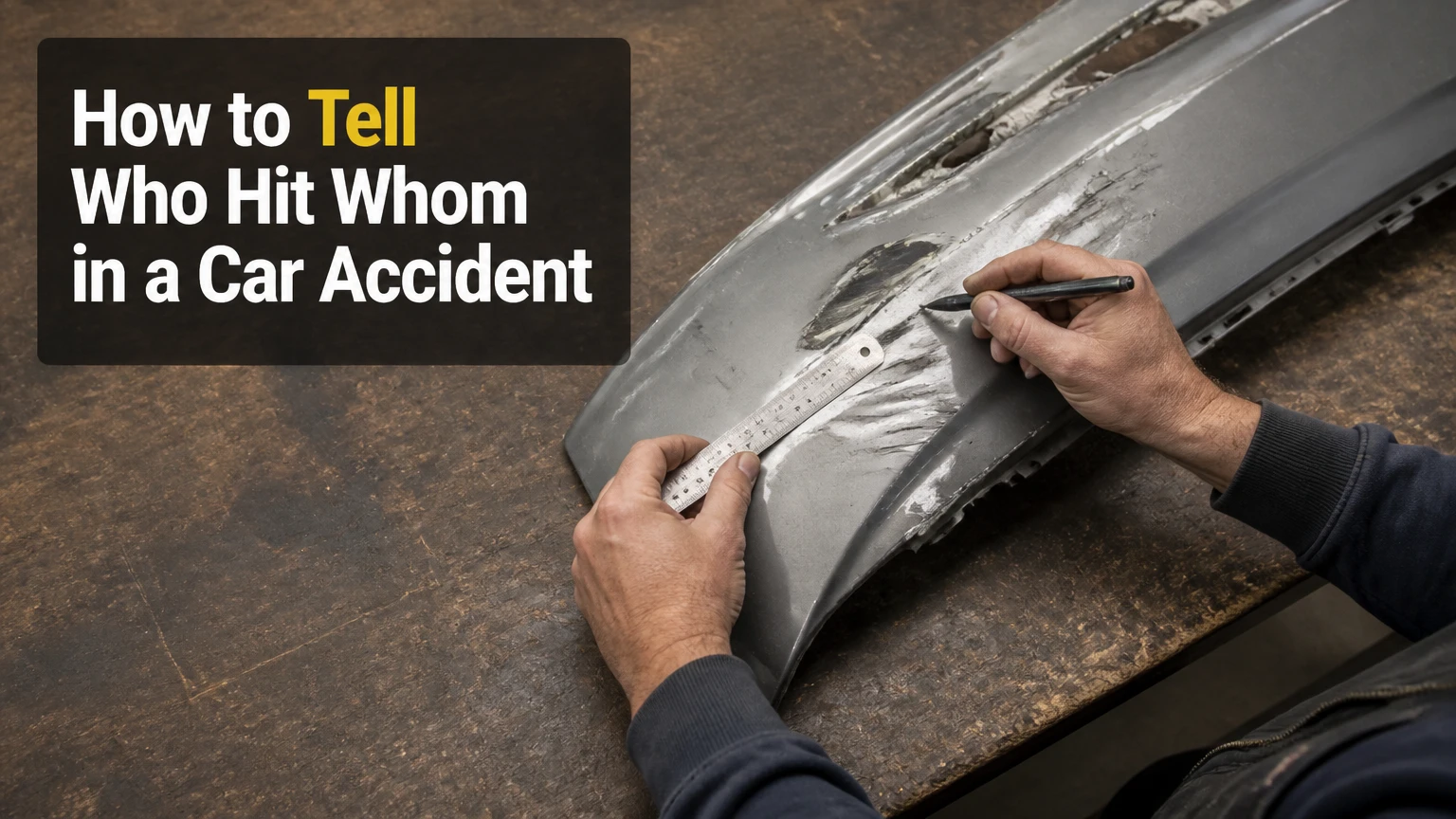
To tell who hit whom in a car accident, identify the vehicle that initiated contact, then compare damage patterns, vehicle positions, roadway marks, video, witness accounts, and available Event Data Recorder information. The striking vehicle is not automatically the legally responsible vehicle, because traffic signals, right-of-way, lane changes, and comparative fault can change liability.
Key Facts
The striking vehicle made the contact first; the striking vehicle is not automatically at fault.
Front-end damage alone cannot establish legal responsibility.
EDR data may record speed, braking, throttle, seat-belt use, and crash forces, but it does not determine negligence.
Independent video, fixed-object evidence, and contemporaneous photographs usually carry more weight than delayed driver recollections.
A reconstruction expert becomes more useful when injuries are severe, vehicles moved after impact, or several accounts conflict.
Preserve vehicles, photographs, dashcam files, phone data, and nearby-camera footage before repair, disposal, or automatic deletion.
What Does “Who Hit Whom” Actually Mean?
“Who hit whom” describes the physical sequence of impact, while fault describes which driver violated a legal duty. A vehicle can strike another vehicle after the other driver created the dangerous situation, such as when a car runs a red light and is hit broadside by a driver traveling through a green signal.
The investigation therefore answers two separate questions:
- Which vehicle contacted the other first?
- Which driver caused the collision under the applicable traffic and negligence rules?
A rear vehicle often strikes the vehicle ahead, but a sudden unsafe lane change can make the merging driver responsible even when the other car’s front bumper shows the most obvious damage. In a T-bone collision, the vehicle with front-end damage may have entered an intersection lawfully and hit a vehicle that crossed its path.
Police officers document evidence and may issue a citation. Insurance adjusters make claim decisions under policy and state law. A judge or jury makes the final legal determination when a lawsuit reaches trial.
How Do You Determine the Striking Vehicle?
Determining the striking vehicle requires matching contact locations, crush direction, vehicle rest positions, debris, roadway marks, and independent records to one physical sequence. No single photograph or damaged bumper should control the conclusion when the collision involved rotation, a sideswipe, multiple impacts, or post-crash vehicle movement.
Start with the contact points
Record each vehicle’s damage by location, height, direction, and material transfer. Useful observations include:
- A concentrated front crush pattern
- A side intrusion with matching bumper height
- Paint transfer from one vehicle to another
- Scrapes that widen or narrow in a particular direction
- Broken lamps, mirrors, trim, or grille pieces
- Tire marks leading toward or away from the contact area
- Debris concentrated near the first impact point
A collision technician or reconstructionist compares the damaged areas like matching parts of a three-dimensional puzzle. A deep, narrow crease may indicate a bumper edge or structural component, while broad shallow scraping may indicate a sideswipe rather than a direct hit.
Build a timeline from fixed evidence
Photograph the scene before cleanup whenever safety permits. Include lane lines, traffic lights, stop signs, road grade, skid marks, debris, vehicle rest positions, and nearby businesses with cameras.
Vehicle positions matter because they show where the cars stopped, not necessarily where they first collided. A car can rotate, roll forward after braking, or be pushed several feet by a heavier vehicle. Ask the investigating agency whether the official crash report includes measurements, diagrams, photographs, citations, and recorded statements.
Which Evidence Is Most Useful?
The most useful evidence is usually independent evidence that records timing or physical movement. Video and measured scene evidence often provide stronger sequencing than damage photographs alone, while EDR data can clarify speed and braking without independently proving who had the right of way.
| Evidence type | What it can establish | Typical availability | Main limitation |
|---|---|---|---|
| Dashcam video | Approach, signal phase, impact sequence | Same day to 30 days | Camera angle, overwritten files |
| Traffic or business video | Lane position, light status, movement | 24 hours to 90 days | Retention varies by owner |
| EDR report | Speed, braking, throttle, delta-V | 1-10 business days | Access and trigger limitations |
| Vehicle photographs | Contact height, crush, paint transfer | Immediately | Shows effects, not full timeline |
| Skid and yaw marks | Braking, steering, post-impact motion | Hours to several days | Weather and traffic erase marks |
| Independent witness | Observed movement or signal status | Immediately | Memory and viewing angle |
| Police report | Statements, diagram, citation, measurements | 3-30 days | Officer may not have witnessed crash |
| Reconstruction analysis | Integrated speed and impact sequence | 2-8 weeks | Cost and incomplete inputs |
How reliable are skid marks and debris?
Skid marks can show braking or tire slip, but they do not automatically identify the negligent driver. Modern vehicles with antilock braking systems may leave intermittent or faint marks, and a tire mark can result from emergency avoidance rather than impact.
Debris can help locate an initial impact, especially when pieces from lights, plastic, or glass remain near the collision area. Road crews, passing traffic, weather, and tow operations can move or remove that material within hours. Treat debris as scene evidence that needs photographs and measurements, not as a self-interpreting answer.
Does Front-End Damage Prove Who Was at Fault?
Front-end damage does not prove fault because the vehicle with the damaged front may have been traveling lawfully when another driver entered its path. Damage identifies forces and contact geometry; fault requires evidence of a traffic violation, unreasonable driving, or another legally recognized cause.
Consider four common examples:
| Collision scenario | Vehicle with likely front damage | Likely fault question |
|---|---|---|
| Rear-end impact | Following vehicle | Did the lead driver stop unlawfully or cut in? |
| Red-light T-bone | Lawful cross-traffic vehicle | Which driver had the signal? |
| Unsafe lane change | Vehicle in continuing lane | Did the changing driver enter occupied space? |
| Left-turn collision | Oncoming vehicle | Did the turning driver yield as required? |
Rear-end claims often favor the front vehicle because drivers must maintain following distance, but the presumption can be challenged. Evidence may show that the lead driver reversed, changed lanes into the rear vehicle, had nonfunctioning brake lights, or stopped unexpectedly where no reasonable driver could react.
A legal conclusion also depends on jurisdiction. Some states reduce recovery according to each person’s percentage of fault, while others restrict recovery after a claimant reaches a statutory threshold. An insurance adjuster’s percentage is not necessarily the percentage a court would assign.
What Should You Do at the Crash Scene?
At the crash scene, protect people first, document the vehicles and roadway second, and preserve digital evidence before leaving. The first 24 hours matter because vehicles may be towed, cameras may overwrite files, and witnesses may become difficult to identify.
Step 1: Get medical help and report the crash
Call emergency services for injuries, blocked lanes, suspected impairment, or significant vehicle damage. Follow the reporting threshold in your state, because many jurisdictions require a report when injury or property damage exceeds a specified amount.
Do not argue about fault at the scene. Exchange names, phone numbers, driver-license details, insurance information, license plates, and vehicle-owner information. Tell the officer what you observed in chronological terms rather than guessing speed, distance, or intent.
Success checkpoint: You have a report number, the other driver’s identifying information, and medical documentation for each reported injury.
Common mistake: Saying “I’m sorry” as an admission of fault. A polite safety statement is different from accepting legal responsibility, but keep the conversation factual.
Step 2: Photograph the scene and vehicles
Take wide photographs before cars are repaired or dismantled, if the scene remains safe. Capture each vehicle from all four corners, every damaged panel, tire position, deployed airbag, broken component, license plate, and visible paint transfer.
Photograph road geometry from the driver’s approach, including signal heads, lane arrows, signs, sight obstructions, lighting, and weather. Preserve the original files because metadata can show the capture time, although metadata alone does not prove when the collision occurred.
Success checkpoint: A person who was not present can identify lane positions, damage locations, and the intersection layout from your photographs.
Common mistake: Taking only close-ups. Close-ups show damage but cannot establish orientation or the relationship between the vehicles.
Step 3: Identify witnesses and video sources
Obtain witness names and phone numbers, then ask each witness what they personally saw without suggesting an answer. Note where the witness stood, whether anything blocked the view, and whether the witness observed the signal, approach, impact, or only the aftermath.
Ask nearby stores, homes, garages, transit agencies, and municipal departments whether cameras face the roadway. Send a written preservation request promptly when a dispute is likely. Many systems retain footage for approximately 24 hours to 30 days, although retention depends on the operator.
Success checkpoint: You have a dated list of possible witnesses and camera owners, with a request to preserve footage.
Common mistake: Waiting for the police or insurer to request video. A camera owner may delete footage before either party knows it exists.
Step 4: Preserve the vehicles and electronic records
Tell the insurer, repair shop, tow yard, and salvage facility that the vehicle must be preserved in its post-crash condition. Do not authorize structural repairs, disposal, or sale of a totaled vehicle before documenting damage and considering an EDR download.
An EDR may be located within an airbag control module or another vehicle system. Access typically requires compatible Bosch, OEM, or other crash-data-retrieval equipment, and an OBD-II connection is not a universal guarantee that a complete report can be obtained.
Success checkpoint: You know where each vehicle is stored, who controls it, and whether an expert has preserved or downloaded available data.
Common mistake: Assuming driving the vehicle after the crash automatically erases EDR data. Some records remain, but post-crash driving can add events or complicate interpretation, so avoid unnecessary use.
Step 5: Create a dated evidence file
Keep the police report, exchange form, photographs, medical records, repair estimates, towing bills, insurer messages, witness contacts, and video files in one chronological folder. Write your own account promptly, including direction of travel, lane, signal color as perceived, braking, impact, and vehicle movement afterward.
Do not edit dashcam footage. Save the native file and a backup copy, and record the device model, memory card, time-zone setting, and whether the camera clock was accurate.
Can a Car’s Black Box Show Who Hit Whom?
An Event Data Recorder can show what a vehicle was doing immediately before and during a qualifying event, but EDR data cannot by itself determine legal fault. The report may include speed, accelerator position, brake application, seat-belt status, engine speed, and delta-V, subject to the vehicle model and applicable data rules.
Federal Motor Vehicle Safety Standard 49 CFR Part 563 governs required EDR data elements for covered vehicles and describes EDRs as devices that record crash-related information for “a very brief period of time.” The National Highway Traffic Safety Administration explains that EDR records are technical crash data, not a complete narrative of driver behavior.
Typical limitations include:
- Some crashes do not trigger a recorded event.
- Older vehicles may have fewer data elements.
- A module can contain multiple events.
- Data may require the owner’s consent, a court order, or other lawful authority.
- The report may not capture a traffic signal, lane position, distraction, or a vehicle’s pre-event mechanical condition.
- Delta-V describes change in velocity, not necessarily the vehicle’s speed before impact.
EDR results become more persuasive when they agree with photographs, scene measurements, video, and damage geometry. A high recorded brake application in one vehicle may show an attempted avoidance maneuver, but it does not prove the other driver had the legal right of way.
When Is Accident Reconstruction Worth the Cost?
Accident reconstruction is usually worth considering when injuries are serious, the vehicles show complex damage, several impacts occurred, or liability will determine a substantial financial claim. Typical private reconstruction costs range from approximately $2,000 to more than $10,000, depending on travel, vehicle inspections, data retrieval, scene surveying, and testimony.
| Case condition | Reconstruction value | Typical cost range | Typical timing |
|---|---|---|---|
| Clear rear-end crash, no injury dispute | Low | $0-$1,500 | 1-7 days |
| Conflicting intersection accounts | Moderate to high | $2,000-$6,000 | 2-6 weeks |
| Serious injury with EDR and scene data | High | $4,000-$10,000+ | 3-10 weeks |
| Multi-vehicle chain collision | High | $6,000-$15,000+ | 4-12 weeks |
| Fatal crash or courtroom testimony | Very high | $10,000-$30,000+ | 2-6 months |
A reconstructionist may use crush measurements, vehicle weights, photographs, friction estimates, EDR reports, surveillance footage, and software such as PC-Crash or HVE. The expert should state assumptions and test alternative sequences rather than present a polished animation unsupported by measurements.
A reconstruction is not a substitute for missing evidence. If both vehicles were repaired, the scene was never measured, and no video or EDR data exists, an expert may offer only a limited opinion. Ask for the proposed methodology, required materials, qualifications, hourly rates, inspection fees, and testimony charges before retaining one.
How Do You Resolve Conflicting Driver Stories?
Resolve conflicting accounts by ranking independent physical and digital evidence above confident but unsupported recollections. Compare each story against signal timing, lane geometry, vehicle damage, rest positions, braking evidence, EDR records, video, and statements made immediately after the crash.
Use an evidence matrix:
| Fact to test | Driver A claim | Driver B claim | Best corroboration |
|---|---|---|---|
| Signal color | Green | Green | Traffic signal phase or witness |
| Lane position | Staying in lane | Changing lanes | Video, impact height, paint transfer |
| Braking | Stopped before impact | No braking | EDR, tire marks, brake lights |
| First contact | Rear corner | Front corner | Damage topology and debris |
| Vehicle movement | Stationary | Moving | EDR, scene marks, independent video |
Statements can be inaccurate without being intentionally dishonest. Stress, poor visibility, delayed questioning, and a driver’s focus on another vehicle can distort perception. Record what each person actually observed, then separate observation from interpretation.
An insurer may assign shared fault when evidence remains evenly balanced. Do not assume a police citation ends the analysis, because a citation addresses a specific alleged violation while a civil claim may involve different facts and legal standards.
What Are the Most Common Investigation Mistakes?
The most common mistakes are repairing vehicles too early, relying on bumper damage alone, failing to request video, and giving inconsistent statements after the crash. Each mistake reduces the amount of evidence available to test the competing timelines.
- Treating the front vehicle as automatically innocent: A lead vehicle that reverses or changes lanes can cause a rear impact.
- Treating the front bumper as proof of fault: A lawful driver can hit a vehicle that crossed into the travel path.
- Failing to preserve a totaled vehicle: Salvage disposal can eliminate crush measurements and paint-transfer evidence.
- Overstating speed: Estimate only when supported by measurements, EDR data, or video.
- Editing video files: Exporting, trimming, or converting footage can raise authenticity questions.
- Posting an admission online: Social-media statements and photographs can be used out of context.
- Ignoring minor symptoms: Neck, back, and concussion symptoms can appear hours later; obtain medical assessment when appropriate.
One practitioner rule is especially useful: preserve first, interpret second. A wrong early theory can be corrected when evidence remains intact, but missing evidence cannot be recreated reliably.
What Changes in Different Collision Types?
Collision type changes which evidence deserves priority, but the same sequence applies: identify first contact, test movement, then evaluate right-of-way and negligence. A sideswipe needs different analysis from a perpendicular intersection impact because contact surfaces and vehicle paths differ.
| Collision type | Highest-value evidence | Frequent false assumption |
|---|---|---|
| Rear-end | Brake lights, following distance, EDR braking | Rear vehicle is always liable |
| T-bone | Signal phase, entry path, impact height | Front damage proves fault |
| Sideswipe | Lane lines, scrape direction, camera footage | Longer scrape identifies the violator |
| Left-turn | Turn arrow, position, witness view | Turning driver is automatically liable |
| Chain reaction | Impact sequence, vehicle spacing, EDR events | Last vehicle caused every loss |
| Parking-lot impact | Right-of-way signs, aisle geometry, video | Private property means no traffic rules |
What if the other driver fled?
A hit-and-run requires immediate reporting, medical documentation, and preservation of every identifying detail. Record vehicle color, body style, partial plate, direction of travel, distinctive damage, debris, and nearby cameras, then notify your insurer about uninsured-motorist coverage deadlines.
Do not chase the vehicle. A witness, business camera, license-plate reader, or paint fragment may identify it later. The absence of the other vehicle makes physical comparison harder, but it does not eliminate the value of scene photographs and video.
What if three or more vehicles collided?
A multi-vehicle crash requires a separate analysis for each contact, because the first impact may have caused the chain reaction while a later driver may have added damage. Photograph all vehicles before repair, identify every sequence described by witnesses, and ask whether each EDR recorded multiple events.
A pileup cannot be assigned fairly by looking only at the final vehicle positions. The first collision, reaction time, road conditions, following distances, and subsequent contacts may produce different fault percentages for different drivers.
Who Pays for the Investigation?
The person or organization requesting an investigation commonly pays upfront, although legal fees, contingency arrangements, insurer costs, and cost-shifting rules vary by case and jurisdiction. Typical expenses include $0 for personal photographs, $200-$750 for some data-retrieval services, and several thousand dollars for expert reconstruction.
| Investigation action | Typical direct cost | Best user | Practical result |
|---|---|---|---|
| Personal scene photographs | $0-$50 | Every driver | Preserves visible conditions |
| Police-report copy | $5-$30 | Claimant or insurer | Obtains official diagram and statements |
| EDR download | $200-$750 | Disputed or serious claim | Produces vehicle event data |
| Vehicle inspection | $300-$1,500 | Damage dispute | Documents crush and component transfer |
| Reconstruction report | $2,000-$10,000+ | Severe or complex claim | Tests competing collision sequences |
Costs rise when an expert travels, scans the scene, inspects multiple vehicles, performs testing, or testifies. Obtain a written scope before authorizing work, and ask whether the expert needs the vehicles before repairs or only existing photographs and reports.
The Bottom Line
To determine how to tell who hit whom in a car accident, preserve the vehicles and digital evidence, document contact points and roadway geometry, obtain the police report, request video quickly, and compare every account against physical facts. The striking vehicle made first contact, but legal fault depends on right-of-way, traffic conduct, causation, and applicable comparative-fault law.
Start with inexpensive evidence before commissioning an expert. Escalate to EDR retrieval or reconstruction when the claim involves serious injury, a totaled vehicle, multiple impacts, or a meaningful dispute over the collision sequence.
Frequently Asked Questions
Can you prove fault without eyewitnesses?
Yes. Fault can be supported by vehicle damage, signal timing, roadway marks, photographs, EDR data, video, admissions, and the parties’ positions. Eyewitness testimony is helpful but not required. A consistent physical sequence can outweigh two conflicting memories, particularly when the scene and vehicles were documented before repairs.
How long do you have to report a car accident?
The deadline depends on the state, crash severity, and insurance policy. Some states require police reporting for injury or property damage above a statutory threshold, while policies may require prompt notice regardless of the legal reporting deadline. Report qualifying crashes promptly and check the policy’s notice language.
Can an insurance company decide who hit whom?
An insurance company can decide how to handle a claim under its policy and assign an internal fault percentage, but that decision is not a court judgment. The insurer must evaluate available evidence, policy terms, state negligence rules, and claims regulations. A disputed decision can be challenged through documentation, appraisal procedures, regulatory complaints, or litigation.
What if neither car has much visible damage?
Low visible damage does not prove that no contact occurred or that nobody was injured. Bumpers can absorb energy while hiding mounts, sensors, or reinforcement damage. Photograph both vehicles, obtain repair inspections, preserve event data, and document symptoms and medical evaluations separately from the property-damage assessment.
Should you give the other insurer a recorded statement?
Give required notice and basic facts, but consider legal advice before providing a recorded statement when injuries, disputed fault, or multiple vehicles are involved. Answer accurately, avoid speculation, and distinguish what you saw from what you inferred. Do not guess at speed, distance, signal timing, or the other driver’s intent.